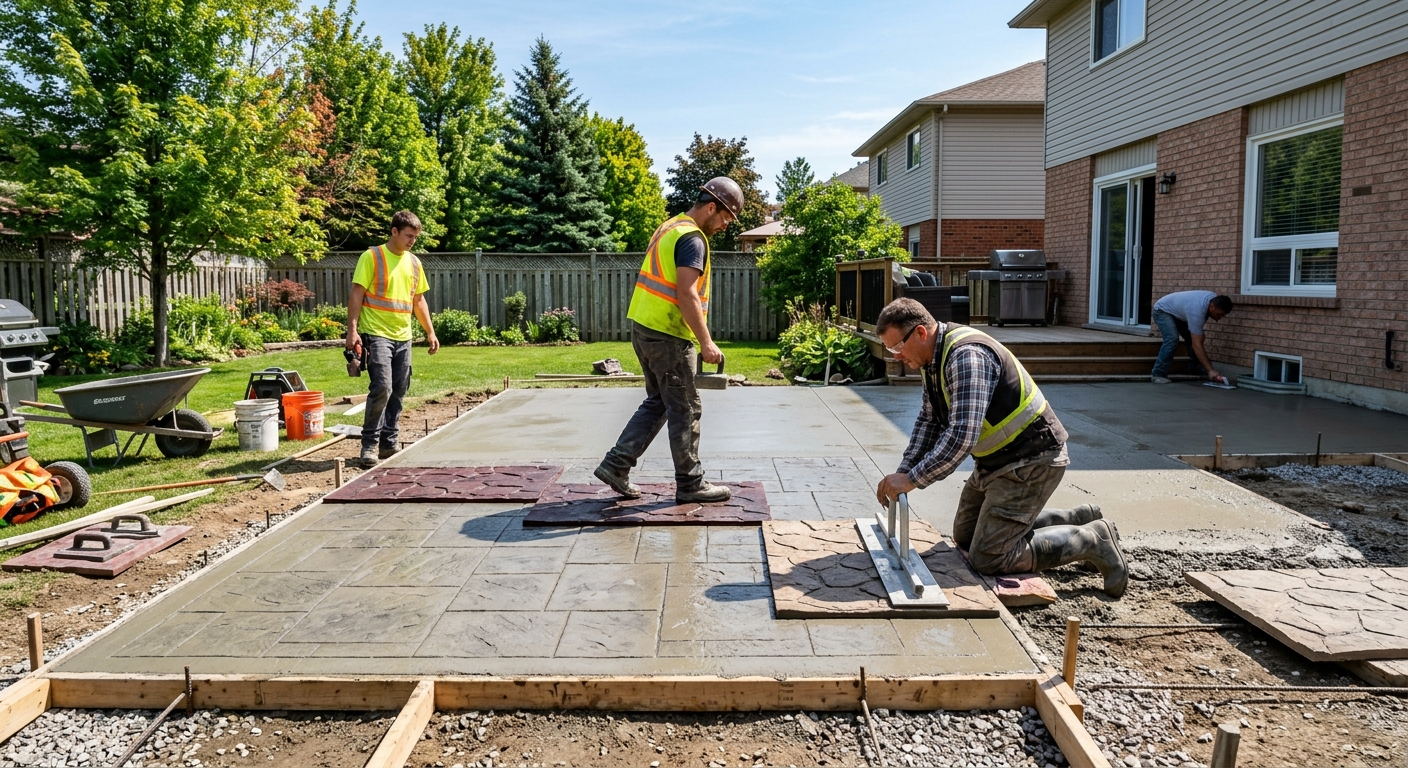
Concrete work options and costs in Gabriola
Concrete in Gabriola is a practical choice for driveways, patios, and foundations because the island climate reliably challenges slabs with wet weather and freeze–thaw movement. Gabriola is a smaller community (population 4,500, Statistics Canada, 2021 Census), and that scale affects contractor availability and scheduling—when the docks and ferry schedules are tight, crews often book out sooner for flatwork. You’ll also see lots of single-family housing patterns typical of suburban islands, which is why concrete driveway and patio work stays in steady demand, especially around residential pockets like the Russell Street / main village corridor where access is usually easier but drainage detailing still matters.
In the Lower Mainland–Southwest, mild winters and a shallow frost line around 450 mm / 18" still shape design and pricing. Footings and thickened edges must be placed below frost to reduce heave risk, and saturated soils plus coastal rainfall drive the cost of base preparation and drainage. Concrete mix selection and curing plans also influence labour: air-entrained mixes and longer cure windows (plus curing blankets or sealers when nights stay cool and humid) help protect surfaces from scaling and spalling. As a result, two driveways that look similar can land at meaningfully different totals—especially when you compare broom-finished work to exposed aggregate or stamped systems.
Below are realistic ranges for common projects in Gabriola. Use them as a starting point, then we can tighten the numbers once we confirm soil conditions, excavation depth, rebar needs, finish type, and whether truck access is straightforward.
| Application |
Typical Size |
Key Spec |
Finish Option |
Price Range |
| Concrete driveway (standard broom finish) |
12' x 24' (288 sq. ft.) |
Reinforced slab with compacted granular base, air-entrained exterior mix |
Broom finish, control joints |
$3,800–$6,400 |
| Exposed aggregate driveway |
12' x 24' (288 sq. ft.) |
Reinforced slab, higher-spec aggregate mix, controlled curing to expose stone |
Exposed aggregate (light/medium aggregate) |
$5,000–$8,200 |
| Stamped concrete driveway or patio |
12' x 24' (288 sq. ft.) |
Reinforced slab, release agent + integral or topical colour, proper joint pattern |
Stamped pattern + colour system |
$6,200–$10,800 |
| Plain concrete patio or walkway |
10' x 14' (140 sq. ft.) |
Compact granular base, air-entrained mix for exterior durability |
Light broom or smooth trowel (as specified), joints |
$2,200–$3,900 |
| Garage floor (interior slab) |
20' x 22' (440 sq. ft.) |
Vapour barrier, compacted base, typical reinforcement per site conditions |
Steel-trowel or broom finish |
$6,000–$10,500 |
| Foundation footings (structural, below frost) |
Per linear foot |
Excavation + form + rebar; poured below design frost depth; drainage detailing as needed |
Structural concrete |
$200–$350 |
Prices are estimates only and vary by project scope, site access and material selection.
What affects the price of concrete work in Gabriola
Even when two homeowners request “the same” concrete job in the Lower Mainland–Southwest, quotes can swing by 30–50% because each part of the build—excavation depth, base prep, reinforcement, mix design, finishing, and curing—responds to site conditions. In British Columbia, labour and material rates also shift with scheduling and seasonal demand across the Vancouver–Surrey–Abbotsford corridor, which can affect truck availability and crew lead times for projects on the island.
Climate is the main reason the spec changes. Frost protection is not optional: exterior elements must be detailed for the local design frost depth. In coastal BC, frost depth is typically roughly 0.5–1.2 m, and footings must extend below that depth to prevent freeze heave. Exterior slabs should use air-entrained concrete so the freeze–thaw cycles don’t break down the surface. When nights are cool and humidity is high, we also plan cold-weather curing precautions—curing blankets, longer cure times, and sometimes temporary insulation—so concrete reaches target strength before it’s exposed to stress. Finally, coastal rainfall and driveway traffic plus de-icing practices (common near walkways) increase the need for surface protection, because salt can accelerate spalling when the finish is not sealed and maintained.
In Gabriola, a driveway quote can rise quickly if soil is wet and requires deeper granular replacement and more under-slab drainage; conversely, it can be lower when truck access is easy and the subgrade is stable with minimal rebar adjustments. Finish selection drives another jump: upgrading from broom-finished concrete (often the $18–$28 per sq. ft. band for driveways) to stamped systems (often $22–$36 per sq. ft.) is usually a justified cost when you’re increasing thickness control, labour time, and colour/shade consistency. On foundations, the per-linear-foot band ($200–$350 for footings) is mostly about excavation effort, form height, and reinforcement complexity—more complexity, more cost.
| Price Factor |
Why It Matters |
Cost Impact |
| Frost line depth — determines footing depth and form height |
Footings must sit below design frost to prevent heave |
Higher excavation depth increases labour and disposal |
| Site preparation — excavation, grading, compacted granular base |
Loose or saturated soil leads to settlement and poor drainage |
Wet, soft subgrade can add granular replacement and time |
| Reinforcement — rebar or wire mesh requirement |
Controls cracking and supports slab performance under loads |
Extra steel weight and placement time raises costs |
| Mix design — air-entrainment and compressive strength spec |
Freeze–thaw durability depends on air-entrainment and strength |
Higher-spec mix can cost more per cubic metre |
| Finish type — broom vs. stamped vs. exposed aggregate |
Finish systems require additional steps, labour and materials |
Stamped/exposed typically adds more labour and consumables |
| Pour size and concrete truck access to site |
Smaller pours may need more mobilization; hard access increases pumping/handling |
Limited access can add equipment and time |
| Cold-weather curing precautions — heating and blankets |
Cool nights and humidity slow strength gain and increase surface risk |
Curing measures add materials and labour hours |
| Control joint pattern and sealing cost |
Joints guide cracking; sealing protects from moisture and salts |
More labour for sawing/jointing and added sealer product |
Permits & regulations in British Columbia
In British Columbia, structural concrete work such as footings, foundation walls, and grade beams typically requires a building permit, and municipalities often expect engineered drawings for structural details. The goal is to ensure your foundation system is sized and reinforced correctly for soil conditions, loads, and drainage. For concrete flatwork—driveways, patios, and walkways—a permit is often not required when the work stays within normal site limits. That said, you may need approval if the work affects lot grading, stormwater management, impervious surface coverage rules, or impacts municipal right-of-way features (like sidewalks, boulevards, or drainage areas). In all cases, confirm with the local authority before breaking ground, especially on sloped or high-rainfall lots.
To verify a contractor in Gabriola, don’t guess—check documentation before work starts:
- Look for their British Columbia business licensing or contractor registration details (often via provincial/online registry listings) and confirm the scope matches the work.
- Request a certificate of liability insurance. It should name you (or your property as the project site) if required by contract, and show valid dates and adequate limits.
- Ask for proof of coverage for WCB (workers’ compensation) or the appropriate provincial coverage for their workforce. If they’re self-managing with specific coverage structures, ask to see the certificate/clearance letter.
- Verify references on similar-size projects (driveways/patios and foundation work) and confirm they’ve handled island access realities—mobilization, scheduling, and weather protection.
Getting concrete right in Gabriola's freeze-thaw climate
Concrete failures in Gabriola usually trace back to one of five things: inadequate base preparation, the wrong mix for freeze–thaw exposure, weak curing, poorly planned control joints, or insufficient surface protection. In the Lower Mainland–Southwest, you still have freeze–thaw cycles and prolonged wet periods—so the “standard” approach for interior slabs doesn’t transfer to exterior driveways and walkways. To spec the job correctly, start with base preparation: build a properly graded and compacted granular sub-base to the right depth for local soil and to achieve the required frost protection. Then specify mix design: for exterior flatwork, ask for air-entrainment (typically 5–7% air content) and a minimum 32 MPa compressive strength. Air-entrainment is what reduces scaling and spalling when water in the concrete freezes and expands.
Next, control joints must be installed with a layout that limits random cracking. Finally, curing matters more than many homeowners expect. Plan for at least 7 days of curing under suitable conditions, and in cold snaps use curing blankets and/or temperature management so strength develops before the slab sees stress. For the finish, apply a penetrating sealer after cure—commonly around 28 days post-pour—to help repel de-icing salts and drive rain water away from the surface.
Here’s a practical dollar example: upgrading from broom-finished driveway concrete to stamped might increase your total from the typical driveway range near $18–$28 per sq. ft. up toward the stamped band near $22–$36 per sq. ft.. That price difference can be justified when it includes extra labour for consistent colour/texture and a tighter joint/finish plan—but don’t pay for premium aesthetics if the base, air-entrainment, and curing plan are cut back.
| Spec |
Why It Matters in Gabriola |
What to Ask For |
Impact if Skipped |
| Compacted granular base (depth?) |
Supports the slab and manages moisture under wet, coastal soils |
Granular base depth sized to site; confirm compaction method and subgrade condition |
Settlement, cracking, and drainage-related deterioration |
| Air-entrained concrete mix (target air %?) |
Protects against scaling/spalling from freeze–thaw cycles |
Air content target of about 5–7% for exterior flatwork |
Spalling and surface scaling within a few winters |
| Compressive strength (MPa rating) |
Strength development affects durability and load resistance |
Minimum 32 MPa (confirm test/quality standard in writing) |
Premature wear, raveling, and reduced service life |
| Control joints (spacing per ACI guidelines) |
Guides where cracking happens during drying and thermal movement |
Joint spacing and timing for saw-cut plan (confirm layout before pour) |
Random cracking and more expensive patching |
| Minimum 7-day curing period |
Cold nights and humidity can slow strength gain |
Confirm curing blankets/sealer plan when conditions are cool or wet |
Weaker surface, increased vulnerability to freeze–thaw |
| Penetrating sealer (when applied after cure) |
Helps resist moisture and de-icing chemical exposure |
Apply around 28 days after pour (or as product requires) |
Faster deterioration from salt and water intrusion |
How to choose a concrete work contractor in Gabriola
Choosing the right concrete contractor in Gabriola is mostly about proof, process, and clarity. Start with verification: request their British Columbia licensing/registration details for contracting work, and confirm the scope matches concrete flatwork or structural foundation work (as applicable). Next, ask for a certificate of liability insurance—it should be current and cover the period of the project. Finally, confirm WCB/WCB clearance (or the applicable provincial worker coverage documentation) so you know workers are insured. A legitimate crew should be comfortable providing these documents before you sign.
Then get 2–3 itemised written quotes that break labour and materials into clear line items, not one vague lump sum. For each quote, read the scope carefully: what’s excluded (removal/disposal, trucking, pumping, regrading, temporary drainage, saw-cut joints, sealing)? Is the permit pull included where required for structural work? Make sure the quote clearly states excavation, base prep, reinforcement (type and placement), concrete mix spec (air-entrainment and strength), finishing steps, and curing/sealing responsibilities.
Warranty should be in writing: workmanship warranty length and what it covers, plus the product/manufacturer warranties for sealers or admixtures. Ask whether the warranty is transferable if you sell the home. On payment, never pay more than 10–15% upfront; use a holdback until the job is complete and cleaned up. For scheduling, require a start date and completion estimate in writing, with weather contingency plans—rain and cool nights are real factors on the island.
- Bring your own checklist and ask for the mix spec (air content and compressive strength) in writing.
- Confirm footing depth details for frost protection if any structural work is included.
- Ask what they use for drainage under slabs (and how they handle saturated soils).
- Request a joint plan (layout and timing for saw-cutting).
- Ask who provides and places curing blankets or manages curing in cool/wet weather.
- Get proof of liability insurance and valid WCB/WCB documentation before the first day on site.
- Verify the quote includes disposal and hauling for removed materials (or states exclusions clearly).
- Confirm rebar size, spacing, and tie-down details (or mesh type where applicable).
- Ensure the scope lists finish method (broom vs stamped vs exposed aggregate) and colour options.
- Check whether sealing is included and when it will be applied after the pour.
- Use a written schedule that accounts for rain delays and curing time.
- Confirm the payment schedule: small deposit, staged payments, and a holdback for completion.
Concrete red flags in Gabriola include: quotes that don’t mention air-entrained mix for exterior work, missing details on granular base depth/compaction, “we’ll do it later” answers about curing blankets or joint cutting, paying a large deposit before any materials are staged, and vague scopes that exclude drainage, disposal, or reinforcement specifics.
Frequently asked questions — concrete work in Gabriola
How much does concrete work cost in Gabriola?
In Gabriola, pricing depends on the finish and the site conditions, especially drainage and freeze–thaw exposure. For common exterior flatwork, homeowners often see driveway work in the roughly $18–$28 per sq. ft. band for broom-finished concrete, while stamped systems typically land in the $22–$36 per sq. ft. range once labour for forms, pattern work, and colour consistency are included. A plain patio or walkway usually prices a bit lower than a driveway because the load requirements and thickness specs can differ, but base prep and air-entrained durability still apply. Foundation footings are usually quoted on a linear-foot basis and commonly fall around the $200–$350 range depending on excavation, reinforcement, and form height. If you’re comparing quotes, ensure each one includes the same granular base scope, reinforcement approach, mix spec, and curing plan—those are the items that drive real cost differences in British Columbia.
How deep must footings be for Gabriola's frost line?
Footings must be placed below the design frost depth used for the building location. In coastal BC (including the Lower Mainland–Southwest), frost is typically shallower than in interior or northern regions, and practice often assumes about 450 mm / 18" as a planning reference. However, the safe approach for any foundation is to follow the design frost depth required by the applicable building requirements and engineering for your site. That means excavations, form height, and reinforcement placement all change with soil conditions and where your slab/foundation meets the ground. In Gabriola, wet or poorly drained soils can make excavation and base replacement more involved, even when frost depth is less than farther inland. Your contractor should be able to explain the footing depth in plain language and show how it aligns with the engineered or code-required frost protection depth.
Why does concrete crack in Gabriola and how is it prevented?
Concrete cracks are common, especially in exterior flatwork, because concrete naturally shrinks as it cures and it also moves with temperature changes and moisture. In Gabriola and the wider British Columbia coastal climate, freeze–thaw cycles add extra stress: water can get into micro-spaces, freeze, and expand, which worsens cracking and can lead to scaling. The prevention strategy is practical and technical: use the correct air-entrained exterior mix, build a well-compacted granular base with good drainage, and install control joints at the right spacing and timing so cracking happens where you planned. Proper curing for at least 7 days under suitable conditions helps the slab gain strength before it faces stress. If you’re seeing random cracking early, it often points to skipped joint planning, inadequate base prep, or an exterior mix without the right air-entrainment.
Stamped vs broom-finish concrete — cost difference?
Stamped concrete costs more because it involves additional materials and labour—pattern mats or stamps, release agents, consistent colouring, and more careful finishing to maintain crisp edges and uniform tone. In Gabriola, that cost difference generally shows up within the driveway price bands: standard broom-finished driveways often fall in the $18–$28 per sq. ft. range, while stamped driveway or patio systems commonly fall into the $22–$36 per sq. ft. range. The key point for homeowners is not just the aesthetic premium; it’s that stamped work also demands the same structural basics—compacted base, correct reinforcement, air-entrained exterior mix, and proper jointing. A “cheap” stamped job that compromises curing or mix spec can cost more later through early spalling or uneven wear. So compare quotes line by line, not just the total.
When is the best time to pour concrete in Gabriola?
The best time to pour concrete in Gabriola is when you can control curing conditions: avoid extended heavy rain windows and aim for periods with milder temperatures and stable drying. The Lower Mainland–Southwest climate can be wet and humid, and cool nights can slow strength gain, so contractors often schedule to minimize the time concrete spends in the vulnerable early-age stage. If you must pour in cooler weather, a reputable contractor will plan for curing blankets or temperature management and extend curing time to reach design strength before additional exposure. Practically, many homeowners aim for spring to early fall when access and curing are easier, but the correct decision depends on the crew’s readiness and the specific weather forecast. Ask your contractor what contingency they use for rain and how they protect the slab during the first 7 days.
How long does concrete take to cure?
Concrete curing happens in phases. Most commonly, contractors plan for at least 7 days of curing under proper conditions for exterior flatwork, especially where cool, wet weather is expected in British Columbia. Early-age strength develops during this first week, and curing protection (blankets/sealers when conditions warrant) helps ensure the slab reaches the strength needed to handle typical construction stresses. Full durability and optimal sealer performance require more time: penetrating sealers are typically applied around 28 days after the pour, once the concrete has cured sufficiently and moisture conditions are appropriate. If you apply coatings too early, you can trap moisture and reduce performance. When you’re budgeting, remember that “cure time” affects scheduling—follow-on work and proper protection are part of the warranty-quality job.