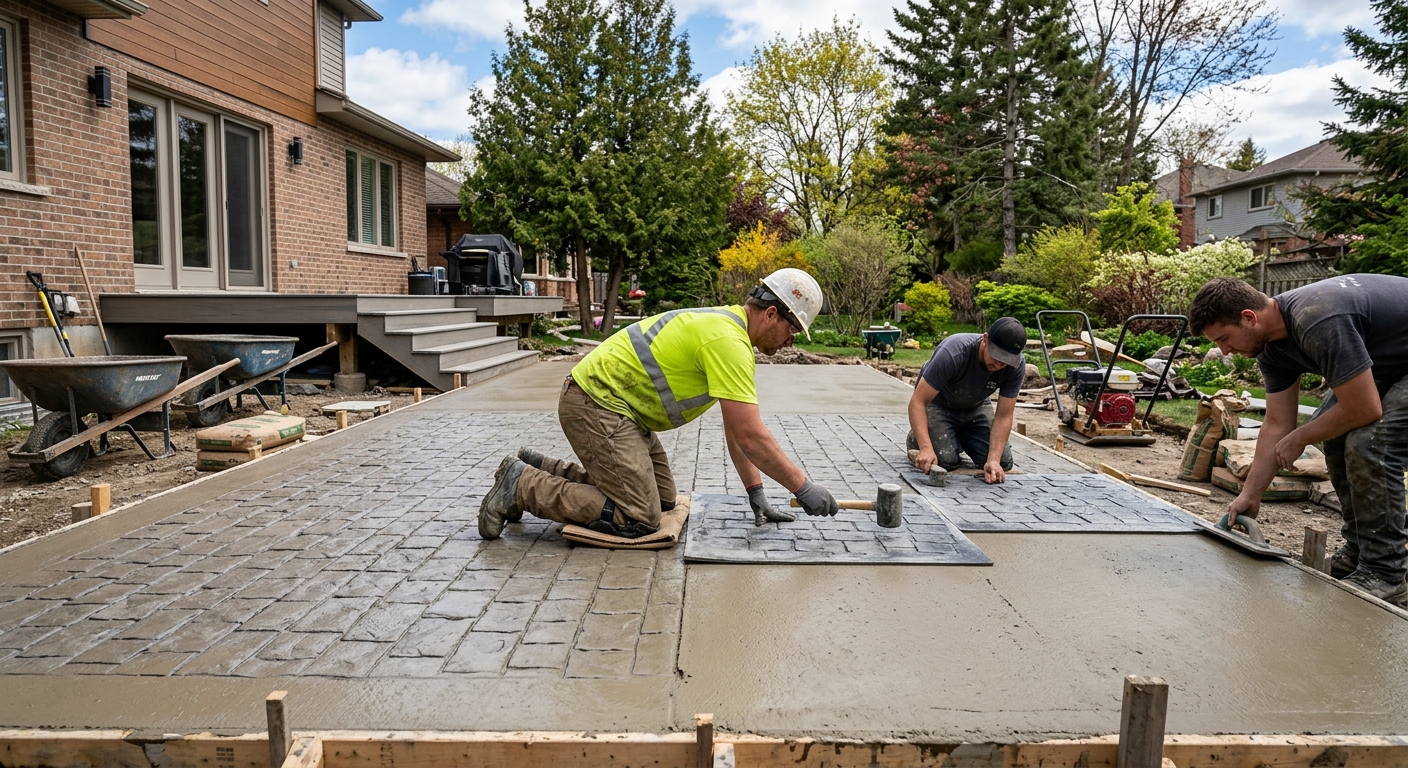
Concrete work options and costs in Ironwood
Concrete work in Ironwood, British Columbia is priced around the same core ingredients—excavation, forming, rebar, concrete mix design, finishing, and proper curing—but the final number is shaped a lot by our Lower Mainland–Southwest climate and the realities of local foundations. With a population of 6,236 (Statistics Canada, 2021 Census), Ironwood is a smaller market where good crews can be booked quickly when rain windows open. Most flatwork demand comes from single-detached homeowners, the type of property where driveways, patios, and walkways are a big part of day-to-day living, and they’re exposed to coastal-wet weather and freeze–thaw cycles.
In this region, even with mild winters, we still design for a frost depth around 450 mm / 18". That means footings and thickened edges are placed below the frost line to reduce frost heave risk, and exterior slabs typically use air-entrained mixes. Costs can also swing because rain and cool nights affect curing logistics (curing blankets, sealers later in the timeline, and longer wait times to protect surfaces). If your site has saturated soils or drainage issues, base prep and granular compaction get more attention—often raising labour and material usage.
In Ironwood, trades are especially busy around the established residential pockets where driveways and front-entry walkways are commonly upgraded—clients often want durable surfaces that can handle de-icing salts and wet freeze–thaw. To help you compare options, use the ranges below as a practical starting point for your budget, then we can tighten the estimate once we see your site conditions and finishes.
| Application |
Typical Size |
Key Spec |
Finish Option |
Price Range |
| Concrete driveway (standard broom finish) |
400–600 sq. ft. |
Compacted granular base, air-entrained exterior mix, control joints |
Broom finish |
$18,000–$28,000 |
| Exposed aggregate driveway |
400–600 sq. ft. |
Compacted base, air-entrained mix, surface retarder and proper curing |
Exposed aggregate |
$22,000–$34,000 |
| Stamped concrete driveway or patio |
300–500 sq. ft. |
Air-entrained exterior mix, integral color, release agent, saw-cut joints |
Stamped & colored |
$22,000–$36,000 |
| Plain concrete patio or walkway |
200–400 sq. ft. |
Compacted base, air-entrained mix, edging and joints |
Float and broom or light broom |
$16,000–$26,000 |
| Garage floor (interior slab) |
300–500 sq. ft. |
Vapour barrier (if required), insulation where applicable, flatness prep |
Basic broom or steel trowel float |
$14,000–$24,000 |
| Foundation footings (structural, below frost) |
Varies by foundation layout |
Excavation and formwork, reinforcement, concrete placed below frost depth |
Structural concrete / smooth formed |
$200–$350 |
Prices are estimates only and vary by project scope, site access and material selection.
What affects the price of concrete work in Ironwood
It’s common to see quotes for the same concrete scope vary by 30–50% across the Lower Mainland–Southwest and other parts of British Columbia because the “hidden” work isn’t hidden to your final cost. In concrete flatwork, excavation and base build-up, mix design (especially air-entrainment), reinforcement detailing, and the curing plan are what protect you from cracks, spalling, and scaling later. Labour availability also plays a role: during busy weeks, crews price in schedule pressure and the cost of protecting surfaces in wet conditions.
Here’s the big driver: frost and freeze–thaw cycles dictate the specs. Footings must extend below the design frost depth (in coastal BC, often roughly 0.5–1.2 m depending on the engineered requirements and local soil), and exterior slabs need air-entrained concrete so freeze–thaw doesn’t rapidly damage the surface. Cold snaps in coastal BC are less frequent than in the interior, but they still create a shorter practical pour window—meaning more planning for curing blankets and temperature control if nights drop. De-icing salts further accelerate surface wear if the mix and sealing aren’t right, so many homeowners eventually choose the protective route that keeps surfaces looking better longer.
In Ironwood, pricing often rises when the site is saturated: extra granular, sub-drain improvements, and longer downtime for soils to stabilize can add thousands. It can also decrease when access is straightforward and your driveway formwork is simple; in those cases, standard broom-finish driveway work can align closer to the lower end of the $18,000–$28,000 band, while upgrades like stamped concrete land nearer the $22,000–$36,000 range because of additional labour for stamping, color, and careful joint execution.
Age of housing and drainage changes matter too. Older lots often have uneven grades or damaged downspout discharge, which means more grading and base corrections before any concrete goes down—sometimes the difference is a few days of extra prep that shows up in the quote.
| Price Factor |
Why It Matters |
Cost Impact |
| Frost line depth — determines footing depth and form height |
Footings placed below design frost reduce frost heave risk |
Higher depth increases excavation, forming and rebar quantities |
| Site preparation — excavation, grading, compacted granular base |
Saturated or weak subgrade needs rebuilding for stable support |
More granular, compaction time, and drainage detailing |
| Reinforcement — rebar or wire mesh requirement |
Controls cracking and improves slab performance when engineered |
Material and labour cost increases with thicker slabs or heavy use |
| Mix design — air-entrainment and compressive strength spec |
Air-entrainment protects against freeze–thaw scaling and spalling |
Specialty concrete and stricter batching/quality control |
| Finish type — broom vs. stamped vs. exposed aggregate |
Finish methods change labour, material handling, and timing |
Stamped and exposed finishes typically add cost for labour and sequence |
| Pour size and concrete truck access to site |
Access dictates how efficiently concrete can be delivered and placed |
Pump, multiple pours, or long carries increase labour and equipment |
| Cold-weather curing precautions — heating and blankets |
Protects early-age concrete from temperature-related strength loss |
Blankets/heating add materials and crew time during cold nights |
| Control joint pattern and sealing cost |
Proper joints reduce random cracking and sealing reduces salt-related wear |
More saw-cuts and sealant application later in the schedule |
Permits & regulations in British Columbia
In British Columbia, structural concrete work generally needs a building permit, especially when it contributes to the load-bearing system. That includes footings, foundation walls, grade beams, and other structural elements supporting a foundation. Municipal requirements can also trigger engineered drawings review before concrete is placed, depending on your soil conditions and foundation design. Flatwork like patios, walkways, and driveways usually does not require a permit on its own—unless your project affects lot grading, impervious surface coverage limits, drainage patterns, or the municipal right-of-way (for example, driveway approaches and changes near curb/sidewalk areas). Always confirm with the local authority before breaking ground.
For contractor qualification in Ironwood and across BC, don’t rely on word-of-mouth—verify documentation yourself. Step one: confirm the contractor’s licence status using the BC business registry or the relevant licensing channel they provide (ask them for their licence or contractor number and check it). Step two: request a certificate of insurance showing general liability coverage; ask for the policy effective date. Step three: verify WSIB/WCB coverage (or the current equivalent coverage they’re required to carry for workers), and ensure the certificate matches the scope and is current. Step four: ask for references from similar-size concrete pours in BC—driveways, patios, or structural foundation work—so you can judge workmanship and curing practices, not just finish photos.
Getting concrete right in Ironwood's freeze-thaw climate
In Ironwood, concrete failures almost always come back to one theme: water movement plus freeze–thaw. When rain soaks into a slab, then temperatures swing, freeze–thaw stresses the surface and can lead to scaling and spalling—especially if the mix doesn’t have the right air-entrainment. To spec the job correctly in the Lower Mainland–Southwest climate, we build from the bottom up.
(1) Base preparation: the slab needs compacted granular to the right depth for your soils and to support the design thickness above the frost-sensitive zone. If drainage is ignored, you can pay for a beautiful finish that deteriorates faster than expected. (2) Mix design: for exterior flatwork, request air-entrainment typically in the 5–7% range and a minimum 32 MPa compressive strength (engineered to the project). (3) Control joints: plan saw-cut or formed joints to limit random cracking, and don’t let joints be an afterthought. (4) Curing: give the concrete time and protection—minimum 7 days under proper conditions, with curing blankets or other precautions when nights are cool. (5) Sealing: for driveways and patios, a penetrating sealer applied after the concrete has cured (commonly around 28 days) helps repel de-icing salts and reduces water penetration.
Ask these practical questions: “Is your concrete air-entrained for exterior exposure?” and “What is your curing plan if it’s raining or forecast is cool?” If a contractor can’t answer clearly, you’re at risk of spalling later—often the most expensive problem because repairs require removal and re-pour.
For dollars: if a standard broom-finish driveway is quoted toward $18,000–$28,000, choosing stamped concrete around $22,000–$36,000 can be justified when you want appearance and you still get the correct base, air-entrained mix, and joint/curing discipline. The “cheap” option isn’t usually cheaper once surface protection and premature repairs are factored in.
| Spec |
Why It Matters in Ironwood |
What to Ask For |
Impact if Skipped |
| Compacted granular base (depth?) |
Stable support reduces settlement and cracking during wet freeze–thaw cycles |
Granular depth based on your soil report and engineered slab thickness |
Uneven support, early cracking, and poor durability |
| Air-entrained concrete mix (target air %?) |
Air voids help concrete handle freezing and thawing without surface loss |
Exterior air-entrainment typically 5–7% and verified on delivery tickets |
Spalling/scaling risk increases sharply |
| Compressive strength (MPa rating) |
Adequate strength supports durability and resistance to damage |
Minimum 32 MPa (or higher if engineered for the application) |
Reduced performance and more surface wear |
| Control joints (spacing per ACI guidelines) |
Controls where cracks form instead of allowing random cracking |
Joint layout planned before pour; saw-cuts at the correct timing and spacing |
Random cracks and potential water intrusion at cracks |
| Minimum 7-day curing period |
Ensures strength gain in our cool, damp conditions |
7 days of proper curing; blankets/sealers protection when nights are cool |
Surface weakness and durability issues |
| Penetrating sealer (when applied after cure) |
Improves resistance to salt and water penetration under coastal-wet conditions |
Apply penetrating sealer after cure, commonly around 28 days post-pour |
Faster deterioration, staining, and salt-driven surface damage |
How to choose a concrete work contractor in Ironwood
To choose a concrete contractor you can trust in Ironwood (and across British Columbia), verify licensing, insurance, and coverage before the first shovel moves. Start by asking for their BC business information and the appropriate trade credentials for the work they’re doing. Next, request a certificate of insurance showing general liability coverage, and confirm it’s active for the dates of your project. For workers, confirm they carry WSIB/WCB coverage (as required in BC) for their crew—ask for the clearance or coverage letter and make sure it matches the contractor name on your estimate.
Then get 2–3 quotes in writing that are itemized (labour + materials), not just a lump-sum number. A good estimate will clearly list excavation, base prep, reinforcement, concrete mix type (including air-entrainment for exterior), finishing, jointing, and whether sealing is included. Ask whether a building permit is required and whether the contractor will handle any permit-related steps if applicable. Confirm what’s included for disposal and haul-away; in wet soil sites, disposal and staging can be a real cost driver.
For warranty, insist on workmanship coverage in plain language, plus any product/manufacturer warranty if applicable. Understand whether the warranty is transferable to the next owner. Payment schedule matters: never pay more than 10–15% upfront. Use a holdback that covers final inspection and punch-list items.
Finally, require a written timeline with a start date target and completion estimate. In our climate, scheduling can shift due to rain and temperature, but the contractor should explain the plan to protect concrete during curing.
- Confirm BC credentials and the correct company name on quotes and insurance.
- Request certificate of insurance and verify coverage is current for your dates.
- Verify WSIB/WCB clearance/coverage for workers (ask for the documentation).
- Get 2–3 itemized quotes (labour, materials, and finishing sequence).
- Make sure exterior work specifies air-entrained concrete and jointing.
- Ask how they handle rain/wet days and whether curing blankets are included when needed.
- Confirm base depth and compaction approach for your soil conditions.
- Clarify reinforcement (wire mesh vs rebar) and where it’s placed.
- Check inclusions: saw-cut timing, edging, forming, and waste disposal/haul-away.
- Ask whether penetrating sealer is included and when it will be applied.
- Review warranty length, exclusions, and whether it transfers to future owners.
- Use a payment schedule with a meaningful holdback until completion.
Concrete red flags in Ironwood include: no written scope (especially for air-entrainment and jointing), vague curing promises (“we’ll just pour and it’ll be fine”), quotes that ignore drainage/base prep, pressure to take full payment upfront, and finish photos with no mention of control joints or sealing plan.
Frequently asked questions — concrete work in Ironwood
How much does concrete work cost in Ironwood?
In Ironwood, pricing depends mostly on scope, site prep, and how much durability protection is included for our wet freeze–thaw conditions. As a budget guide, concrete driveway and slab work often lands in the $18,000–$28,000 range for standard broom-finish, while patios and walkways are commonly in the $16,000–$26,000 band depending on size and base conditions. Stamped concrete (driveways or patios) usually costs more because it adds labour for stamping, color, and careful timing—often around $22,000–$36,000. Foundation footings are quoted differently because they’re structural and placed below frost; those estimates are typically in the $200–$350 per unit range depending on your engineered foundation layout. Expect higher costs if drainage is poor or access is tight because excavation, granular, and curing protection can’t be skipped.
How deep must footings be for Ironwood's frost line?
For Ironwood in British Columbia, footings are designed to sit below the design frost depth to limit frost heave. In practice across the Lower Mainland–Southwest, local codes and common engineering assumptions often use a frost depth around 450 mm / 18", but the exact required depth for your specific foundation can be deeper based on soil conditions and engineering. That’s why you’ll usually see footings placed well below the slab grade—often roughly in the 0.5–1.2 m range for coastal BC scenarios—rather than just “a little below the surface.” Your contractor should confirm footing depth based on the building design, geotechnical info (if available), and municipal requirements. If someone quotes footings at a shallow depth without discussing engineered frost considerations, that’s a serious durability risk.
Why does concrete crack in Ironwood and how is it prevented?
Concrete cracks in Ironwood mainly due to movement: shrinkage during early curing, temperature swings, and—most critically—water-related expansion when freeze–thaw cycles hit poorly drained or under-prepped areas. Even when the concrete is “strong enough,” it still needs the right control joint plan so cracks form where you intended rather than randomly. Prevention starts with compacted granular base, correctly placed reinforcement (as required), air-entrained exterior concrete, and proper curing for at least 7 days. Then we manage cracking through control joints and correct spacing, followed by sealing after cure to reduce water and salt penetration. If a contractor is only talking about aesthetics (broom finish vs stamp) and not about joints, curing blankets, and air content for exterior exposure, you’re likely to see cracking or surface scaling sooner than expected—especially with de-icing salts.
Stamped vs broom-finish concrete — cost difference?
Stamped concrete costs more than broom-finish because it requires more labour and a more controlled workflow. With a broom-finish driveway, you’re typically paying for solid base prep, air-entrained exterior concrete, finishing, and saw-cut control joints. Stamping adds additional steps: integral color or dyes, release agent, placement timing to prevent surface tearing, and careful detailing around edges and joints. In Ironwood, that difference commonly shows up in the overall price band—standard driveways often sit around $18,000–$28,000, while stamped concrete driveways or patios frequently fall near $22,000–$36,000. The best value is when the contractor still prioritizes drainage, air-entrained mix, correct curing, and jointing—so you’re paying for the finish, not for avoidable durability failures later.
When is the best time to pour concrete in Ironwood?
The best time to pour concrete in Ironwood is when you have a stable weather window: not persistent rain, not heavy overnight cold, and predictable drying/curing conditions. The Lower Mainland–Southwest climate is milder than interior BC and Alberta, but it’s still coastal-wet and can be cool and humid—so crews schedule pours around forecast rain days and ensure curing protection is ready. If nights are cool, a reputable contractor plans curing blankets and protection to maintain strength gain; otherwise, surface quality and durability suffer. For exterior flatwork, avoid pouring when the site is muddy to the point base prep can’t be compacted properly. In shoulder seasons, the work can still be done successfully, but the “best time” is really the time when the contractor can guarantee base compaction, correct mix placement, and a protected curing period.
How long does concrete take to cure?
Concrete curing has two timelines: initial curing for strength gain, and longer curing for durability and finishing/sealing readiness. For Ironwood projects, we plan for a minimum 7-day curing period under proper conditions—this is especially important for exterior pours where temperature and humidity can be inconsistent during wet weather. After that, the concrete can often be finished and used within typical service timelines, but sealing is a separate step. Penetrating sealer is commonly applied after the cure period is complete, often around 28 days post-pour, so the concrete has reached sufficient maturity to accept the sealer effectively. If you seal too early, you can trap moisture and reduce performance. If you rush curing in cool or damp conditions, the risk rises for surface scaling and premature wear—particularly when de-icing salts are used.