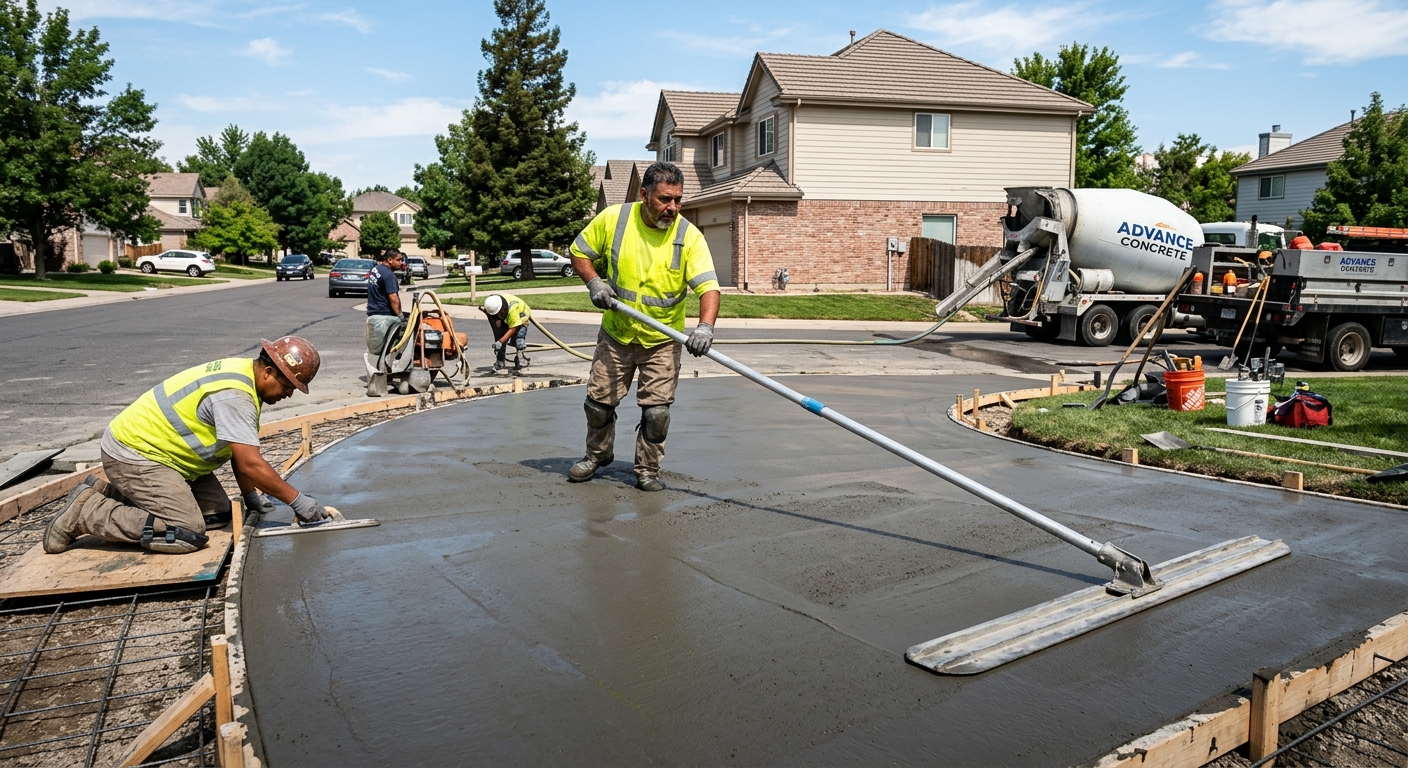
Concrete work options and costs in Port McNeill
Port McNeill is a small Vancouver Island community, and that matters for pricing because there’s less “bid competition” than in larger centres—so crews often price for mobilization, weather delays and material handling. With about 69.6% of households owning homes, and 71.9% of dwellings being single-detached houses, most concrete demand is for driveways, patios and walkways attached to family homes. The housing stock is also older: 62.3% of homes were built before 1981, which often means we’re retrofitting around existing grades, damaged slabs, settled pathways and older drainage layouts.
On Vancouver Island and the Coast, contractors design for a relatively shallow frost line but frequent freeze–thaw cycles, especially where soils stay wet after rainfall. That climate pushes costs in two directions: (1) we use air-entrained mixes and do better base prep to control scaling and random cracking, and (2) we protect curing when cool snaps hit the pour schedule. In practical terms, even “standard” broom-finished work isn’t just a flat pour—gravel depth, drainage, and control joints are priced in. Labour availability can also tighten during busy seasons in and around Campbell River, so scheduling a pour during dry windows affects total cost.
In Port McNeill, we typically see the strongest repeat demand in the residential core areas close to the harbour and along the main residential blocks where walkways and short drive extensions are common. Use the options below to compare what you’ll get at different finish levels, then we can match the spec to your site conditions.
| Application |
Typical Size |
Key Spec |
Finish Option |
Price Range |
| Concrete driveway (standard broom finish) |
350–480 sq. ft. |
Air-entrained exterior mix, control joints, compacted base & drainage |
Broom finish |
$16,000–$25,000 |
| Exposed aggregate driveway |
350–480 sq. ft. |
Air-entrained mix, proper curing to protect surface, sealed after cure |
Exposed aggregate |
$19,000–$30,000 |
| Stamped concrete driveway or patio |
250–500 sq. ft. |
Air-entrained mix, release agent and color hardeners, jointing plan |
Stamped (pattern + color) |
$22,000–$35,000 |
| Plain concrete patio or walkway |
120–280 sq. ft. |
Compacted granular base, air-entrained mix for freeze–thaw durability |
Broom or smooth trowel edge |
$14,000–$22,000 |
| Garage floor (interior slab) |
350–520 sq. ft. |
Vapour barrier (as required), fibre or mesh reinforcement, curing plan |
Power trowel / light broom |
$18,000–$28,000 |
| Foundation footings (structural, below frost) |
Varies by house footprint |
Excavation, forms, rebar, concrete below frost with approved granular support |
Structural concrete only |
$12,000–$22,000 |
Prices are estimates only and vary by project scope, site access and material selection.
What affects the price of concrete work in Port McNeill
Two homeowners in Port McNeill can receive bids that differ by 30–50% for what looks like the same concrete job, and the gap is usually explained by subgrade conditions, the frost-/freeze–thaw durability spec, and how much protection and labour the contractor includes. On Vancouver Island and the Coast, our designs assume shallow frost depths compared to interior provinces, but freeze–thaw cycling still punishes poorly prepped bases and low-durability mixes. That’s why air-entrainment and correct jointing are treated as “non-negotiable” rather than upgrades.
Here’s the core of the pricing variation: exterior footings and foundations must extend below the design frost depth to prevent frost heave. In coastal BC, frost depths are often in the 0.5–1.2 m range depending on design band and site conditions, which is shallower than colder provinces, but it’s still deep enough that incorrect excavation or insufficient granular support can force redesign. All exterior slabs require air-entrained concrete to survive repeated freeze–thaw cycles. When cold snaps or wet conditions interfere, contractors may need cold-weather curing precautions (insulating blankets, temperature monitoring, extended protection time), which adds labour and equipment costs. Also, de-icing salts can accelerate surface spalling—so sealing becomes part of the durability plan, not just “nice to have.”
In Port McNeill, a few site examples routinely move costs up or down: (1) bringing the base up to required compaction where old driveways have failed can add excavation and granular supply; (2) replacing soft spots near downspout discharge routes can add rework; and (3) easier truck access (shorter distances from road to forms) can keep a driveway in the lower end of the $16–$25 per sq. ft.-type band, while restricted access often pushes projects toward the top end. As a finishing example, a stamped driveway often costs more than plain patio work—sometimes you’ll see a difference of several thousand dollars because the labour for stamping, colouring and finishing is higher, even when the concrete quantity is similar.
| Price Factor |
Why It Matters |
Cost Impact |
| Frost line depth — determines footing depth and form height |
Footings must sit below design frost to limit heave |
More excavation and higher forming increases labour and concrete volume |
| Site preparation — excavation, grading, compacted granular base |
Wet soils and poor compaction lead to settlement and cracking |
Soft spots and extra haul/disposal push the price upward |
| Reinforcement — rebar or wire mesh requirement |
Controls cracking and supports load-bearing performance |
Material cost plus labour to place, tie and support reinforcement |
| Mix design — air-entrainment and compressive strength spec |
Air-entrainment improves freeze–thaw durability |
Upgraded mix can increase material cost but reduces premature scaling |
| Finish type — broom vs. stamped vs. exposed aggregate |
Finish drives labour time and curing/protection requirements |
Stamped/exposed often adds several thousand dollars over broom-finished |
| Pour size and concrete truck access to site |
Smaller, chopped-up pours can mean more formwork and labour |
Restricted access may require smaller loads or extra staging time |
| Cold-weather curing precautions — heating and blankets |
Cool temperatures slow strength gain and increase surface damage risk |
Blankets/heat monitoring add equipment and labour hours |
| Control joint pattern and sealing cost |
Joints manage cracking; sealing helps protect from salts and moisture |
Better jointing and sealing are small scope add-ons that prevent expensive repairs |
Permits & regulations in British Columbia
In British Columbia, structural concrete work typically needs a building permit, and it’s common to require engineered drawings and municipal review—especially for footings, foundation walls, and grade beams. In Port McNeill (as in the rest of BC), that means work that changes a home’s structural system should not start until the permit path is confirmed. Concrete flatwork—driveways, patios, and walkways—often does not require a permit by default, but it can still trigger requirements if it affects lot grading, drainage, or impervious surface coverage limits, or if the work impacts a municipal right-of-way or driveway approach.
To verify a contractor’s credentials, you can follow a simple homeowner checklist. First, ask the contractor for their certificate of insurance (liability coverage) and confirm the project address is covered. Second, check that they have the correct provincial worker coverage (WCB) for their employees—request documentation showing clearance or current coverage status. Third, confirm they hold the appropriate business licensing for contracting in BC (and that their team can safely perform the scope you’re hiring). If engineered drawings are required for the structural portion, request who prepares them and that the permit application will be supported with the right documentation.
As a final step, get everything in writing: who pulls the permit (if required), what’s included for inspections, and whether any revisions to excavation or reinforcement will affect schedule or cost.
Getting concrete right in Port McNeill's freeze-thaw climate
Concrete failures in Port McNeill usually come from moisture and temperature cycles working against weak details. The biggest risks are surface scaling, spalling, and random cracking—most often caused by inadequate base preparation, incorrect concrete mix (especially insufficient air-entrainment), and poor curing or jointing. To spec the job correctly, start at the bottom: base preparation should use compacted granular sub-base to the right depth for your soil and local frost considerations, with drainage working so water doesn’t sit under slabs. Next is the mix: for exterior flatwork, request air-entrainment (commonly 5–7% air content for durability) and a minimum 32 MPa compressive strength so the concrete can handle traffic and withstand freeze–thaw exposure.
Then control cracking. Use a joint plan with proper spacing (and relief joints where required around steps, walks, and transitions) so cracks form where they’re expected, not randomly through finish surfaces. Curing is equally important: plan for at least 7 days of protected curing under suitable conditions. In cool, wet weather, contractors should use blankets and monitor protection so the slab reaches adequate early strength. After curing, sealing matters where de-icing salts or salty spray exposure is realistic—ask about a penetrating sealer applied after the cure period (often around 28 days post-pour) to help repel water and salts.
For example, spending more upfront for air-entrainment and base corrections can be cheaper than chasing repairs later. If your driveway is priced around the $16–$25 range for standard broom work, a “value” quote that cuts corners on base depth or mix air can look good initially—but the surface damage risk in a freeze–thaw climate is what drives long-term costs.
| Spec |
Why It Matters in Port McNeill |
What to Ask For |
Impact if Skipped |
| Compacted granular base (depth?) |
Reduces settlement and helps manage moisture under the slab |
Base depth and compaction plan based on soil and slab thickness |
Settlement, rocking, and early cracking |
| Air-entrained concrete mix (target air %?) |
Improves freeze–thaw durability in exterior exposure |
Target air content for exterior flatwork (commonly 5–7%) |
Scaling and spalling from freeze–thaw damage |
| Compressive strength (MPa rating) |
Supports strength gain and load performance |
Minimum 32 MPa for exterior flatwork |
Surface wear, dusting, and reduced longevity |
| Control joints (spacing per ACI guidelines) |
Keeps cracking controlled and limits random shrinkage cracks |
Joint spacing plan matched to slab dimensions and exposure |
Uncontrolled cracks that may telegraph through finishes |
| Minimum 7-day curing period |
Cool, damp conditions slow strength development |
Protection plan if temperatures drop during the first week |
Weak early surface and higher risk of damage |
| Penetrating sealer (when applied after cure) |
Helps repel moisture and salts that worsen freeze–thaw deterioration |
Type of sealer and timing (commonly after cure; around 28 days) |
Faster surface deterioration and higher maintenance costs |
How to choose a concrete work contractor in Port McNeill
Choosing the right contractor in Port McNeill is less about flashy photos and more about proof: credentials, a clear scope, and durable specs that match our freeze–thaw climate. Start with licensing and insurance. In British Columbia, ask for their liability insurance certificate (and verify the address/project is covered). For worker coverage, request proof of current WCB coverage status for their employees—clearance documentation or current coverage information is the expectation. Also ask about how they manage subcontractors and whether the crews on your site are covered. If they can’t provide certificates promptly, that’s a practical red flag.
Next, get 2–3 itemised written quotes. You want a breakdown that separates labour, concrete, reinforcement, forms, excavation/grading, drainage work, finishing, sealing, and disposal. Avoid “lump sum” only proposals with vague wording like “typical base” or “standard mix.” Confirm what’s excluded: permit pull, traffic control, tree/root removal, saw-cutting, waste hauling, and any rework if subgrade is weaker than expected.
Warranty matters too. Ask for the length of the workmanship warranty and what it covers (cracks, scaling, settlement, surface delamination) and whether any product/manufacturer warranty is transferable. For payment scheduling, never accept large upfront payments; a good practice is 10–15% deposit at most, with the remainder tied to milestones. Finally, get a start date and completion estimate in writing so weather delays and curing time are planned—not treated as “extras” later.
- Request insurance certificate and confirm the policy is active for BC projects.
- Ask for WCB clearance/proof for their workforce.
- Get licence/business details and a contactable references list for similar Port McNeill scopes.
- Require itemised quotes (labour, materials, base prep, reinforcement, finishing, sealing, disposal).
- Confirm whether a permit is required for any associated structural work.
- Ask who measures and confirms slab grade and drainage falls before pouring.
- Verify air-entrainment and compressive strength are written into the quote/spec.
- Ask for the jointing plan (spacing and where control joints will go).
- Confirm curing/protection steps for cool, wet weather.
- Require a finishing plan: broom vs trowel vs stamped/exposed aggregate, including edge details.
- Ask about sealer type and timing after cure (don’t assume it’s included).
- Agree on payment schedule with a small deposit and holdback until completion and cleanup.
Concrete red flags I see in Port McNeill include: vague “standard mix” wording with no air-entrainment spec, skipping granular base depth/compaction details, no written joint layout, trying to pour through cold snaps without curing protection, and contractors asking for most of the money upfront before forms and inspection-ready prep are complete.
Frequently asked questions — concrete work in Port McNeill
How long does concrete take to cure?
In British Columbia, the short answer is: concrete needs curing protection beyond the day it’s poured. For most exterior slabs and patios, you should plan on at least 7 days of proper curing (keeping the surface protected from rain and temperature drops). Full strength development continues longer, but early strength is what matters most for finishing, sealing readiness and preventing surface damage during freeze–thaw. In Port McNeill’s coastal climate, heavy rain and cool snaps can slow strength gain, so a contractor should use blankets or other protection when temperatures fall. If your project is priced around the plain patio/walkway band (often $14,000–$22,000 depending on size and site work), ask how curing will be handled if the forecast turns wet or cold in the first week.
Do I need a permit for concrete work in British Columbia?
In Port McNeill, permit requirements depend on what you’re building. Structural concrete—like footings, foundation walls, and grade beams—usually requires a building permit and often engineered drawings reviewed by the municipality. Concrete flatwork such as driveways, patios, and walkways typically does not require a permit by default, but it can if the work affects lot grading, drainage, impervious surface coverage limits, or the municipal right-of-way. Before any digging, confirm with the local authority so you don’t end up with inspection or rework delays. Also verify your contractor has liability insurance and current WCB coverage so the project is properly covered in case of incidents. If the job is purely a driveway or walkway and stays within typical grading rules, permits are often not required, but don’t assume—ask.
Concrete vs pavers for a patio in Port McNeill?
For a patio in Port McNeill, concrete usually wins on cost predictability and smoothness, while pavers often win on look customization and easier “spot fixes.” Concrete flatwork—especially broom-finished or stamped—can be priced in the patio/walkway band of $14,000–$22,000 for typical residential sizes once you include base prep and proper jointing. The freeze–thaw issue still exists for pavers (water gets trapped under joints), so you still need correct base depth and drainage. With concrete, you get a continuous surface with a joint plan that controls cracking; with pavers, individual units can shift if the base isn’t compacted. If you want a durable, low-maintenance patio that manages moisture cycles well, ask a contractor to explain their drainage and base compaction details. If the site has tricky grades, pavers can be more forgiving, but concrete remains a strong choice for many older homes (62.3% built before 1981 in this area).
How long does a concrete driveway last?
With correct specs and installation, a concrete driveway in Port McNeill can last decades. The biggest determinants are subgrade preparation, air-entrainment for freeze–thaw durability, and joint spacing so shrinkage cracking is controlled. Poor drainage or inadequate granular base can shorten lifespan because water saturation under the slab accelerates freeze–thaw damage. A properly designed driveway that uses air-entrained concrete and has sealing where appropriate can hold up well even with repeated wetting and freezing. If your driveway quote is in the regional range of about $16,000–$25,000 for standard broom finish depending on size and access, it should include base work, proper jointing, and curing protection. If a bid looks too low, ask what was reduced—sometimes the mix spec or base depth is the “cut,” and that’s what causes early scaling or spalling.
What is air-entrained concrete and why does it matter here?
Air-entrained concrete is mixed with microscopic air bubbles that give water a place to expand when it freezes. In British Columbia—especially in Port McNeill where freeze–thaw cycling is common—this is one of the most important durability protections for exterior flatwork. Without the right air content (often targeted around 5–7% for exterior exposure), water can damage the paste as it repeatedly freezes and thaws, leading to scaling and spalling. That’s why a good contractor should write the air-entrainment and strength requirements into the quote/spec, not just say “standard mix.” If your driveway or walkway is exposed to rain and cold snaps, air-entrainment is not a luxury feature; it’s part of meeting durability expectations for the climate band on Vancouver Island and the Coast. For homeowners comparing bids, ask directly: “What is the planned air content and who confirms the mix on delivery?”
How do I prepare the base for a concrete slab?
Base preparation is where concrete performance is won or lost in Port McNeill. The goal is a compacted granular sub-base to the correct depth for your soil conditions, with grading that supports drainage so water doesn’t sit under the slab. Preparation usually includes removing unsuitable material, excavating to design depth, installing proper granular layers, and compacting them to spec. For freeze–thaw durability, the sub-base must be dense and stable so the slab doesn’t move as moisture changes. Ask your contractor how they’ll verify depth and compaction and what granular material they plan to use. Also ask about drainage details around downspouts and edges. If you’re budgeting for a plain patio or walkway, the finished cost commonly falls in the $14,000–$22,000 band depending on size and site work; a thorough base prep plan is usually a big part of what you pay for. A “cheap” quote that skips base depth or compaction will show up later as cracking or uneven settlement.