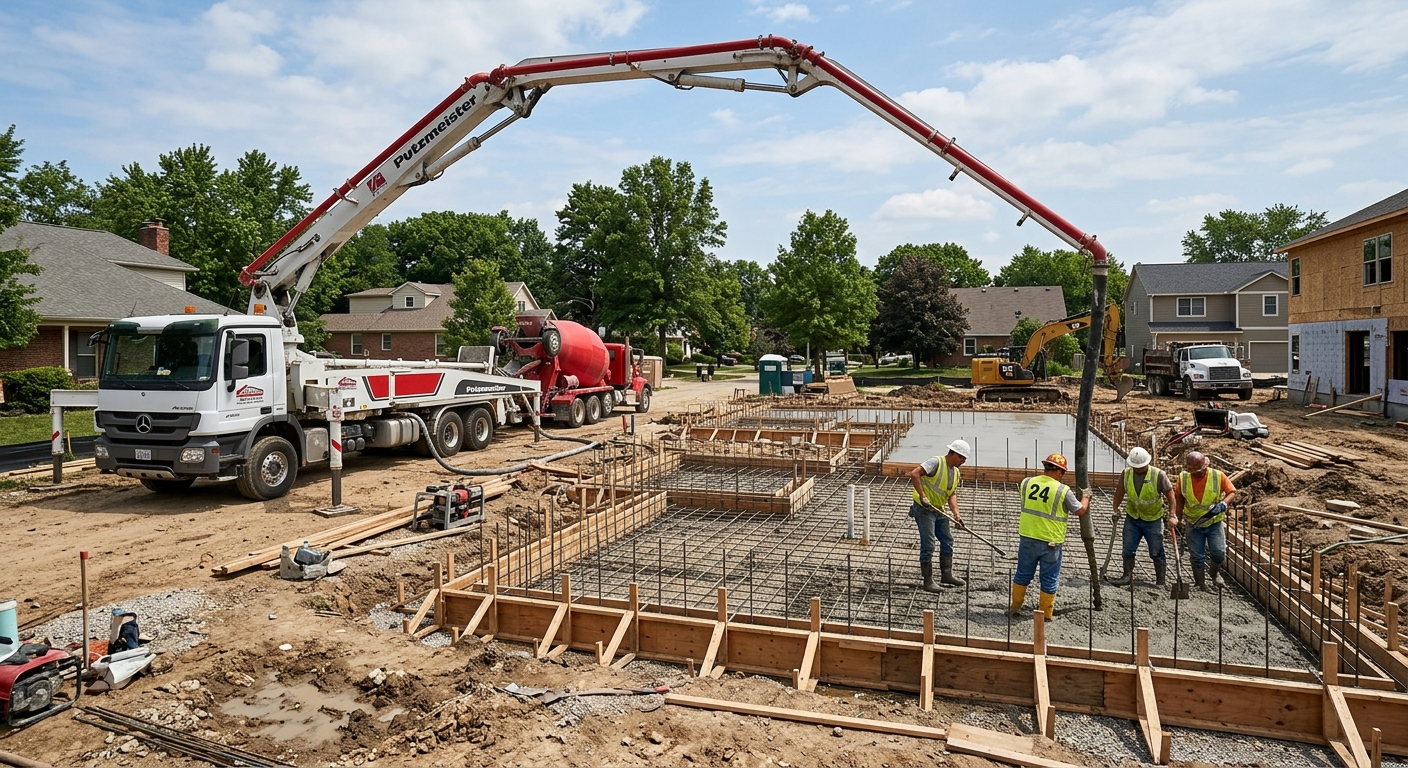
Concrete work options and costs in Prince George
Concrete work in Prince George is typically booked around one of the city’s busiest homeowner priorities: durable flatwork. With Prince George sitting in a cold-weather Cariboo market and many households living in single-detached homes (58.1% of dwellings), driveways, patios, and walkways are the most common projects that homeowners request. The affordability conversation also reflects local housing patterns—68.2% of households are owner households (Statistics Canada, 2021 Census)—so many families plan repairs during budgeting cycles rather than after emergency failures.
In the Cariboo, pricing is shaped by winter frost and freeze-thaw cycles. Frost can reach several feet, so structural work like foundation footings must be set below local frost depth to avoid frost heave and cracking. Exterior slabs also need air-entrained concrete mixes to resist scaling and spalling, and contractors plan control joints carefully. Costs rise in the cooler months because curing becomes a major driver: cold temperatures slow strength gain, so crews often use blankets, insulated forms, or accelerators to keep concrete in the right temperature band. Labour and equipment mobilization can also increase because the pour season tightens.
Demand is especially steady in established neighbourhoods such as College Heights, where many homes pre-date 1981 (61.7%), meaning upgrades to flatwork and drainage are frequently needed as people modernize entrances, garages, and backyard access. With those realities in mind, here’s how common concrete options typically price out before you compare contractor quotes.
| Application |
Typical Size |
Key Spec |
Finish Option |
Price Range |
| Concrete driveway (standard broom finish) |
400–600 sq. ft. |
Air-entrained mix; compacted base |
Broom finish with control joints |
$6,500 – $12,500 |
| Exposed aggregate driveway |
400–600 sq. ft. |
Air-entrained mix; proper drainage slope |
Exposed aggregate with sealer |
$9,500 – $17,500 |
| Stamped concrete driveway or patio |
300–500 sq. ft. |
Air-entrained mix; joint layout planned |
Stamped texture with release & seal |
$10,000 – $20,000 |
| Plain concrete patio or walkway |
200–400 sq. ft. |
Air-entrained mix; compacted base |
Float & broom/brush finish |
$3,000 – $8,500 |
| Garage floor (interior slab) |
400–600 sq. ft. |
Vapour control as needed; properly cured |
Plain finish; optional hardener |
$6,500 – $14,000 |
| Foundation footings (structural, below frost) |
Varies by house layout |
Engineered/required depth; rebar as specified |
Reinforced structural concrete |
$6,000 – $22,000 |
Prices are estimates only and vary by project scope, site access and material selection.
What affects the price of concrete work in Prince George
In Prince George and across the Cariboo region, it’s not unusual to see quotes for the “same” concrete job swing by 30–50% when specs differ—especially around excavation depth, reinforcement, mix design, and curing. The reason is simple: cold-weather conditions dictate how contractors build. If one contractor sizes the granular base loosely or pours exterior slabs without the right air content, you might save today but pay later in scaling, spalling, and cracking. Also, shoulder-season scheduling can increase mobilization costs because teams need the right temperature window and curing setup.
Frost line depth and freeze-thaw cycles affect every decision. Exterior slabs require air-entrained concrete mixes to handle expansion and contraction. In deeper-frost climates, footings must extend below the design frost depth, and that means more excavation, more granular base, and often more rebar. Even curing logistics can add cost: cold temperatures slow strength gain, so crews may use heated enclosures, insulating blankets, or accelerators to maintain the proper temperature band. On top of that, de-icing salt is a real factor here—salt increases surface deterioration—so sealing is often recommended for exterior concrete.
Local job examples make the pricing difference clear. A basic broom-finished driveway might land near the regional $16–$25 per sq. ft. range, but upgrading to stamped concrete typically moves into the $26–$40 per sq. ft. band because of finishing labour and material. Older homes (with many built before 1981) often have drainage issues around foundations; fixing grading and adding proper base preparation can raise the scope by thousands, but it can also prevent repeat repairs. If you’re comparing bids, insist that the excavation depth, base thickness, reinforcement notes, and curing plan are clearly written—not just “concrete will be poured.”
| Price Factor |
Why It Matters |
Cost Impact |
| Frost line depth |
Determines footing depth and form height |
Major swing where deeper excavation is required |
| Site preparation |
Excavation, grading, compacted granular base |
Can add or remove thousands depending on soil |
| Reinforcement |
Rebar or wire mesh requirement |
Moderate increase; essential for structural integrity |
| Mix design |
Air-entrainment and compressive strength spec |
Small material cost; big durability value |
| Finish type |
Broom vs. stamped vs. exposed aggregate |
Often the largest driver for decorative work |
| Pour size and concrete truck access to site |
Distance, pump needs, and staging time |
Access issues can increase labour and mobilization |
| Cold-weather curing precautions |
Heating and blankets |
Added equipment/time; can raise project cost notably |
| Control joint pattern and sealing cost |
Manages shrinkage and reduces salt-driven wear |
Small to moderate, but prevents costly failures |
Permits & regulations in British Columbia
In British Columbia, the rules are usually split between structural concrete and everyday flatwork. Structural concrete work—such as footings, foundation walls, and grade beams—typically requires a building permit and often engineered drawings reviewed as part of the municipal process. Concrete flatwork like patios, walkways, and driveways often does not require a permit by itself, unless the work affects lot grading, changes drainage direction, or touches municipal requirements around impervious surface coverage and right-of-way considerations. Always confirm with the local authority before starting, especially if you’re reworking slopes near a foundation or creating drainage swales.
Before you hire anyone in Prince George, verify insurance and coverage. Start by asking for proof of liability insurance and a clear statement that they carry WCB coverage (WSIB/WCB equivalent coverage in BC). Then ask whether the work is covered under their permit (if a permit is required) and whether an engineer is involved for structural components.
To check contractor credentials step-by-step: (1) search for the contractor’s public business registration details; (2) request a certificate of insurance and confirm the coverage is active and matches the job scope; (3) request confirmation of WCB clearance or equivalent proof; and (4) ask for references from similar-scale concrete pours in northern BC conditions so you can see their workmanship on air-entrainment, joints, and curing.
Getting concrete right in Prince George's freeze-thaw climate
The most common concrete failures in Prince George aren’t “mystery cracks”—they’re predictable results of base problems, mix design shortcuts, and poor curing during cold snaps. Freeze-thaw cycling pulls water in and out of the slab surface and edges; if the concrete isn’t air-entrained or if drainage is wrong, you can see scaling, spalling, and eventually spidery cracking. Because many homes are older (with a significant share built before 1981), you’ll also see more legacy grading and drainage issues around entrances and garages, which can keep bases saturated.
To spec the job correctly, focus on five parts of the system. First is base preparation: compacted granular sub-base to the correct depth for local soil and frost conditions, with slope graded to shed water away from buildings. Second is mix design: exterior flatwork should target air entrainment in the 5–7% range and use at least a 32 MPa compressive strength spec. Third is control joints: space them to limit random cracking and prevent joints from becoming uncontrolled failure points. Fourth is curing: plan for at least 7 days of curing under proper conditions—when it’s cold, curing requires protection so strength gain isn’t stalled. Fifth is sealing: for exterior concrete, apply a penetrating sealer after curing (commonly around 28 days) to help repel de-icing salts.
A practical example: a broom-finished driveway may price near the regional $16–$25 per sq. ft. band, while stamped concrete is often higher (the $26–$40 per sq. ft. band). But if you’re seeing slab edge deterioration, the real “value” isn’t only in the finish—it’s in the base thickness, correct air content, and curing protection. Those choices can be the difference between a slab that holds up through winter and one that needs early repairs.
| Spec |
Why It Matters in Prince George |
What to Ask For |
Impact if Skipped |
| Compacted granular base (depth?) |
Supports the slab through deep frost and freeze-thaw |
State granular thickness and compaction method |
Settlement, cracking, and moisture-driven failure |
| Air-entrained concrete mix (target air %?) |
Protects against scaling/spalling from freeze-thaw cycles |
Target 5–7% air for exterior flatwork |
Surface scaling and early spalling, especially with salt |
| Compressive strength (MPa rating) |
Ensures durability and adequate strength gain in cold weather |
Minimum 32 MPa spec |
Reduced long-term performance and higher cracking risk |
| Control joints (spacing per ACI guidelines) |
Manages shrinkage and thermal movement |
Planned joint layout and scheduled saw-cut timing |
Random cracking and difficult-to-repair damage patterns |
| Minimum 7-day curing period |
Cold temps slow strength gain in Prince George winters |
How curing is protected during cold conditions |
Weak near-surface concrete and premature wear |
| Penetrating sealer (when applied after cure) |
Repels de-icing salt and reduces water ingress |
Application after cure (commonly ~28 days post-pour) |
Faster salt-driven deterioration and surface breakdown |
How to choose a concrete work contractor in Prince George
Start by verifying credentials the same way you’d verify any critical home system. In British Columbia, ask for proof of liability insurance and confirmation of WCB coverage. The fastest path is to request (1) a certificate of insurance showing active coverage and job-site address/industry; (2) a clearance letter or documentation confirming WCB account status; and (3) a clear, written scope so you can match that coverage to what’s being built. Don’t rely on a verbal “we’re insured.” For northern work in Prince George, also ask about their specific experience with cold-weather curing practices—blankets, insulated forms, and scheduled joint cutting—because northern project realities can make or break the slab.
Next, get 2–3 itemised written quotes. You want labour and materials broken out: excavation and haul/disposal, granular base, reinforcement, concrete mix specification (including air entrainment for exterior work), forming, finishing, and curing/sealing. Avoid comparing only “lump sum” pricing because one contractor may include base depth, while another quietly excludes it or assumes easy truck access.
Read the scope for exclusions: Is permit pulling included if structural work requires it? Is disposal of unsuitable soil included? Are there allowances for de-icing salt exposure and sealing? Ask about warranty length for workmanship and whether product/manufacturer warranties are provided. For payment, a safe rule is never pay more than 10–15% upfront; use a holdback until the job is complete and clean-up and curing protection steps are done. Finally, insist on a written start date and a completion estimate you can hold them to.
- Ask for the concrete mix spec (air-entrainment and compressive strength) in writing.
- Confirm granular base thickness and whether compaction testing or documented compaction is included.
- Require a joint layout plan (spacing and where joints will be placed).
- Ask how they protect curing during cold nights or shoulder-season pours.
- Verify who supplies and installs reinforcement (rebar size/count or mesh specification).
- Ensure disposal/haul is clearly stated (included vs separate charge).
- Check if they’ll seal exterior slabs and when (after cure).
- Request a detailed breakdown: forming, finishing, saw-cut timing, and cleanup.
- Confirm liability insurance coverage is active and matches the scope.
- Request WCB coverage proof (clearance documentation) before work begins.
- Review warranty terms in plain language: what’s covered and for how long.
- Use a payment schedule with a holdback until final grading, edges, and cleanup are complete.
Concrete red flags for Prince George contractors: (1) vague promises like “we’ll pour and it’ll be fine” with no mix spec or air-entrainment statement; (2) skipping base compaction details and calling it “standard”; (3) rushing saw cuts/control joints or delaying them with no schedule; (4) no cold-weather curing plan when forecasts turn chilly; and (5) a quote that doesn’t mention sealing or drainage slope near the building—those are where freeze-thaw failures start.
Frequently asked questions — concrete work in Prince George
How do I seal concrete to protect it in Prince George?
In Prince George’s freeze-thaw climate, sealing helps reduce water and salt penetration, which lowers the risk of surface scaling and spalling over time. For exterior slabs, the most common approach is a penetrating sealer applied after the concrete has cured properly—typically around 28 days post-pour. Before sealing, make sure the slab is clean, dry, and free of laitance or curing residue; otherwise, sealer can’t bond well. If your driveway sees de-icing salt in winter, sealing becomes more important than with interior-only concrete. When you’re comparing quotes, ask whether sealing is included and whether the contractor is using a penetrating product (not just a topical “paint-like” coating) and confirming timing based on cure.
What is the difference between concrete and cement?
Concrete is the full structural material you see and walk on: cement plus water plus aggregate (sand and gravel) and often admixtures like air-entraining agents. Cement is only one ingredient inside concrete—it’s the binding component that reacts with water to form strength. In northern BC, the mix design details matter because air-entrainment is critical for exterior durability during freeze-thaw cycles. If the cement amount or total mix proportions are wrong, the concrete may not perform as expected even if it “looks good” right after the pour. That’s why you should ask contractors to specify the concrete mix (including air target and minimum strength) rather than only discussing the type of cement they use.
How much does concrete work cost in Prince George?
Pricing depends on size, excavation and base preparation, finish level, and whether cold-weather curing is needed. For basic exterior flatwork, the local regional band for a driveway or slab is about $16,000 – $25,000 as a per-project range based on typical square footage and scope, while patios and walkways commonly fall around $14 – $22 per sq. ft. (before taxes and site specifics). Decorative options cost more; stamped concrete is typically in the $26 – $40 per sq. ft. band because of labour and finishing materials. If you’re quoted a “low” number, check whether the quote includes proper air-entrained exterior mix, granular base thickness, and curing protection—those items usually separate a slab that lasts from one that cracks early.
How deep must footings be for Prince George's frost line?
For Prince George (and the broader northern interior), frost can reach several feet, so footings generally must be designed to bear below the local design frost depth to prevent frost heave. The exact depth for your property depends on soil conditions, drainage, and the engineered design for your foundation system. That means there isn’t one universal number you should accept from a contractor without looking at the engineered foundation requirements (or municipal-approved design for your project). When you review proposals, ask: what depth are you excavating to, what is the footing size and reinforcement spec, and who provided the structural design? If you’re dealing with an older home built before 1981, be cautious—retrofits often involve more excavation to correct base and drainage conditions.
Why does concrete crack in Prince George and how is it prevented?
Concrete cracks in Prince George mainly due to shrinkage, thermal movement, and frost-related moisture effects. Freeze-thaw cycles can worsen surface damage if water gets in—especially when exterior concrete isn’t air-entrained or when the base isn’t properly drained and compacted. Prevention starts before the pour: specify air-entrained exterior concrete (commonly targeting 5–7% air content), provide a properly compacted granular base to the right depth, and grade slopes away from the building. Control joints are also critical—plan the joint pattern and schedule saw-cut timing so cracking occurs at intended locations rather than randomly. Finally, curing matters: in cold weather, curing must be protected for adequate strength gain. If you see quotes that omit air content or curing blankets/heating in cool periods, that’s where cracks begin.
Stamped vs broom-finish concrete — cost difference?
Stamped concrete costs more than broom-finish because it requires additional steps: release agents, more complex form-and-texture finishing, often a more controlled workflow, and careful joint planning for the visual pattern. In Prince George’s Cariboo market, broom-finished driveways and exterior slabs typically price in the regional concrete flatwork band (roughly $16–$25 per sq. ft.), while stamped concrete commonly lands in the higher $26 – $40 per sq. ft. band for decorative work. The real decision isn’t only budget—it’s also expected performance. If both options use the correct air-entrained mix, proper base preparation, and cold-weather curing protection, both can perform well. But if a contractor cuts corners on mix or joints, decorative surfaces can show defects faster because the finish highlights them.