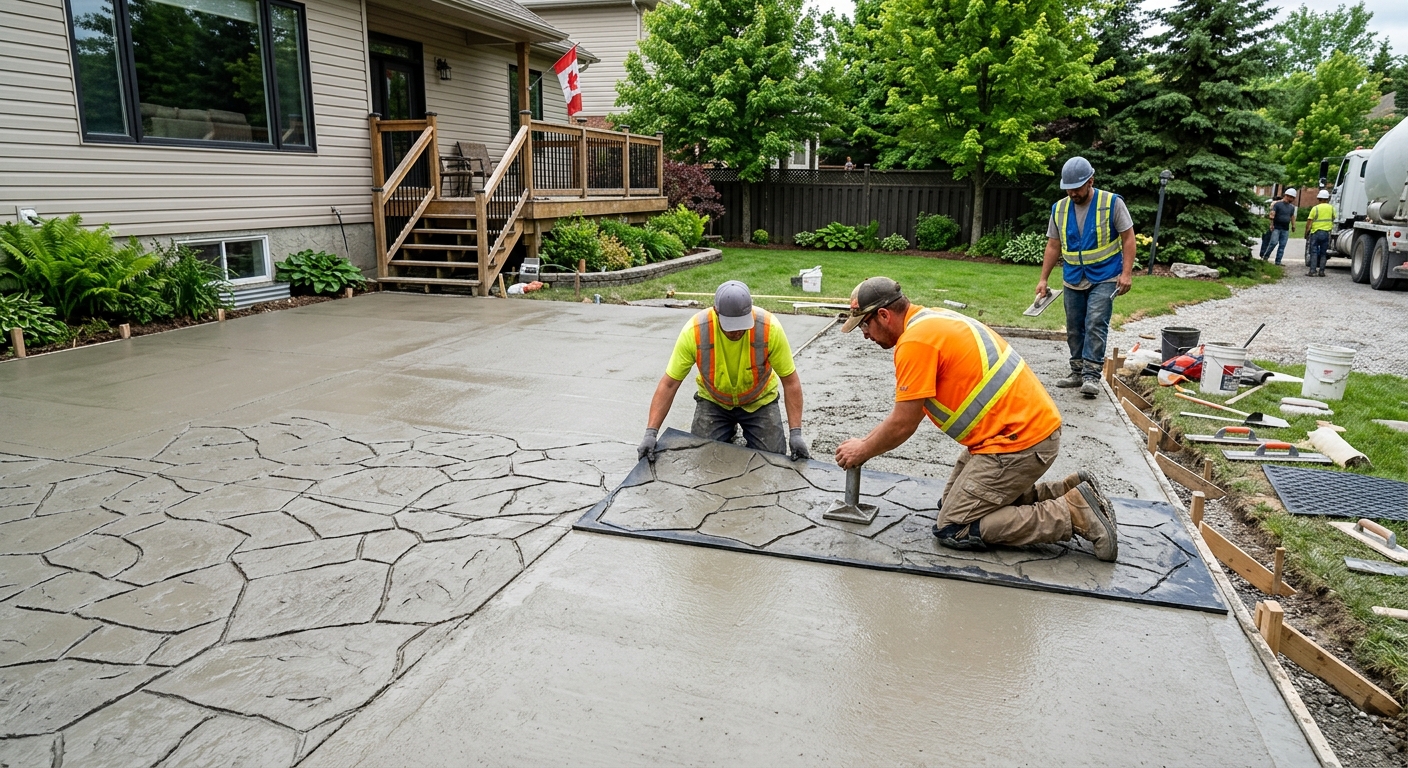
Concrete work options and costs in Chartwell
Concrete work is a common upgrade in Chartwell because homeowners want durable flatwork that handles our coastal-wet weather and the repeated freeze–thaw cycles that can damage slabs over time. Chartwell’s housing mix is also a big driver: with single-detached homes making up a large share of local households (Statistics Canada, 2021 Census), many projects start with driveway and patio renewals tied to aging entrances, rear yards, and garage expansions. In a small community of 1,383 people (Statistics Canada, 2021 Census), contractor scheduling can fill quickly in peak seasons, so planning and site access matter as much as the concrete price itself.
In the Lower Mainland–Southwest, costs are shaped by the relatively shallow frost depth, which local practice typically assumes at about 450 mm / 18". Even so, exterior slabs and structural elements still need protection below frost to reduce frost heave, and saturated soils require careful drainage and compacted granular base prep. We also plan for prolonged rain, cool nights, and high humidity—meaning longer curing and sometimes additional protection to reach design strength. For that reason, two quotes for the “same” driveway often differ in base depth, reinforcement, and curing approach, not just the surface finish.
Demand is especially strong in established residential pockets around Chartwell’s core neighbourhoods (near the busy commercial strip and surrounding streets), where driveways and entry pads are constantly being replaced. Below is a practical cost comparison for the most requested options, so you can align scope and expectations before you request itemized quotes.
| Application |
Typical Size |
Key Spec |
Finish Option |
Price Range |
| Concrete driveway (standard broom finish) |
400–600 sq. ft. |
Air-entrained mix, compacted granular base, control joints |
Broomed finish |
$18,000–$28,000 |
| Exposed aggregate driveway |
400–600 sq. ft. |
Proper base prep + mix design for durability |
Exposed aggregate finish |
$22,000–$34,000 |
| Stamped concrete driveway or patio |
300–500 sq. ft. |
Thickness as per design, release + stamping workflow |
Stamped pattern (colour optional) |
$20,000–$36,000 |
| Plain concrete patio or walkway |
150–300 sq. ft. |
Reinforcement as needed, joints and slope for drainage |
Float/trowel + light broom or broom finish |
$16,000–$26,000 |
| Garage floor (interior slab) |
300–600 sq. ft. |
Vapour barrier (as required), slab thickness per plan |
Smooth finish or light broom |
$18,000–$30,000 |
| Foundation footings (structural, below frost) |
Per linear metre (project dependent) |
Excavation below frost (~450 mm / 18" design baseline in region, often deeper in practice), rebar cage |
Structural concrete (no cosmetic finish) |
$6,000–$20,000 |
Prices are estimates only and vary by project scope, site access and material selection.
What affects the price of concrete work in Chartwell
In Chartwell and across the Lower Mainland–Southwest, it’s common to see the same “driveway replacement” or “patio pour” quoted 30–50% differently from one contractor to the next. The spread usually isn’t the ready-mix concrete price—it’s what’s included in the quote for excavation, base prep, reinforcement, and curing. In British Columbia more broadly, access constraints and the seasonal work window also affect crew availability and equipment rates. When rain and cool nights slow down curing, contractors may schedule around weather and add labour for protection, which increases total job cost.
Here in the region, the frost line depth and freeze–thaw cycles dictate every exterior spec. Even with a local design baseline around 450 mm / 18", footings and thickened edges still need to sit below the design frost depth to prevent frost heave. All exterior slabs should use air-entrained concrete mixes so the freeze–thaw cycle doesn’t accelerate scaling and spalling. In colder Canadian regions, shorter pour seasons lead to more cold-weather precautions (heating, insulated blankets), and that same principle carries some cost in coastal BC when nighttime temperatures dip—especially if you’re pouring right before a wet stretch. Finally, de-icing salt can speed up surface deterioration if you don’t plan for sealing after cure.
Two examples from Chartwell: (1) a standard broom driveway priced closer to the lower band (for instance, concrete flatwork often lands around $18–$28 per sq. ft. depending on scope) may cost more than expected if the contractor finds soft subgrade and must add granular base and drainage. (2) stamped concrete can come out near the higher end (often $22–$36 per sq. ft.) when colour, stamping mats, and crack-control planning are properly included—those add labour, but they also reduce the odds of early cosmetic cracking.
| Price Factor |
Why It Matters |
Cost Impact |
| Frost line depth |
Determines footing depth and form height |
Higher excavation and labour when deeper excavation is required |
| Site preparation |
Excavation, grading, compacted granular base |
Can add significant cost if soil is poor or drainage needs work |
| Reinforcement |
Rebar or wire mesh requirement |
Material + installation time; varies by slab thickness and use |
| Mix design |
Air-entrainment and compressive strength spec |
Better freeze–thaw durability; typically small-to-moderate cost increase |
| Finish type |
Broom vs. stamped vs. exposed aggregate |
Stamped/exposed add labour, tools, and colour/material handling |
| Pour size and concrete truck access to site |
How much concrete you need at once and how far it must be moved |
Reduced efficiency or extra pumping/hauling increases price |
| Cold-weather curing precautions |
Heating and blankets |
Extra labour and materials if nights are cool during pour/cure |
| Control joint pattern and sealing cost |
Crack control + protection against de-icing salts |
Lower risk of early surface damage; adds materials and scheduling |
Permits & regulations in British Columbia
In British Columbia, structural concrete work—such as foundation footings, foundation walls, and grade beams—typically requires a building permit and often engineered drawings reviewed by the municipality. Concrete flatwork (patios, walkways, and driveways) usually does not require a permit by itself, unless it affects lot grading, roof drainage routing, impervious surface coverage limits, or ties into municipal right-of-way requirements. Because rules can vary based on the exact location and impact to drainage, it’s smart to confirm with the local authority before breaking ground.
Step-by-step, here’s how a homeowner in Chartwell can verify a contractor’s credentials in BC:
- Confirm licensing/registration: Use the province’s online contractor registry/search tools (or ask the contractor for their permit/licence number and category) and verify it matches the work type.
- Request a Certificate of Insurance (COI): Ask for general liability coverage showing the current policy period and limits.
- Verify WCB/WCB coverage: Request evidence of WorkSafeBC coverage for the company and, if applicable, subcontractors.
- Ask for clearance documentation: A current clearance letter or proof of account status is typically available through the contractor’s WCB account.
- Check references locally: Look for similar-scale concrete work done in the Lower Mainland–Southwest climate so you can judge finishing, jointing, and curing practices.
Getting concrete right in Chartwell's freeze-thaw climate
Concrete failure in Chartwell usually comes down to water and temperature: if water gets trapped in the slab or base, freeze–thaw cycles can cause scaling and spalling, especially along edges and around joints. In a coastal-wet climate with frequent precipitation, the job needs the right base prep, the right mix, and the right curing and sealing schedule. Specifying correctly is the difference between a driveway that looks good for years and one that starts flaking within a winter or two.
Start with base preparation: compacted granular sub-base to the right depth for local soil conditions and frost protection. Next, specify air-entrainment—typically 5–7% air content for exterior flatwork—plus a minimum compressive strength of 32 MPa so the mix meets durability targets. Then control cracking using a proper joint pattern: place control joints early enough and at planned spacing so cracks form where they can be managed. Curing matters in our humidity and cool nights; plan on minimum 7 days of curing under good conditions, and when it’s cold, use curing blankets or other approved protection to keep the slab from dropping below safe curing temperatures. Finally, sealing should be applied after cure (often at 28 days) using a penetrating sealer to repel de-icing salts and reduce water uptake.
Concrete work costs reflect these choices. For example, moving from a basic “poured and broomed” patio to a properly engineered exterior slab with air-entrained concrete and a disciplined joint/seal plan may push you toward the higher end of the patio band (around $16–$26 per sq. ft.). That difference is justified when you want long-term surface durability—because repairs later (spot chipping, partial replacement, or full driveway rehab) cost far more than doing it right the first time.
| Spec |
Why It Matters in Chartwell |
What to Ask For |
Impact if Skipped |
| Compacted granular base (depth?) |
Supports the slab and controls moisture movement through freeze–thaw cycles |
Granular base depth and compaction requirements for your soil conditions |
Settlement, pumping, and early cracking/spalling at weak spots |
| Air-entrained concrete mix (target air %?) |
Helps concrete survive repeated freeze–thaw and surface scaling risk |
Air content target (typically 5–7% for exterior flatwork) on the spec sheet |
More scaling and spalling, especially on edges and shaded areas |
| Compressive strength (MPa rating) |
Ensures durability and meets design performance under local exposure |
Minimum 32 MPa at specified test age as stated in contract documents |
Reduced strength and increased deterioration under moisture cycling |
| Control joints (spacing per ACI guidelines) |
Directs cracking to predictable locations instead of random splits |
Joint spacing plan and saw-cut timing |
Random cracking and water intrusion along uncontrolled cracks |
| Minimum 7-day curing period |
Builds strength and reduces surface weakness in cool, humid weather |
Documented curing method and protection plan during cold or wet periods |
Weak surface, higher risk of scaling and surface defects |
| Penetrating sealer (when applied after cure) |
Repels de-icing salts and reduces water absorption |
Sealer application after cure (commonly at 28 days) and product type |
Faster staining, moisture ingress, and accelerated spalling risk |
How to choose a concrete work contractor in Chartwell
When you’re hiring concrete contractors in Chartwell, don’t rely on a quote alone—verify credentials and scope. In British Columbia, confirm the contractor’s licensing/registration (appropriate category for the work). Ask for a Certificate of Insurance (general liability) and ensure it’s current and includes sufficient limits for your project. For worker protection, verify WorkSafeBC coverage (WCB): request proof of account coverage or a clearance letter showing the company is in good standing. If subcontractors will pour or place reinforcement, ask how their coverage is handled.
Next, get 2–3 itemised written quotes. You want labour and materials broken out (excavation/granular prep, reinforcement, formwork, concrete supply, finish labour, saw cutting, curing protection, and sealing). Make sure the scope clearly states what’s included and what’s excluded—especially demo removal, hauling/disposal, edge forms, and whether permits are included (when required). A proper workmanship warranty should be in writing with a clear start date and duration. Also ask about product/manufacturer warranties (and whether they’re transferable if you sell the home). For payment scheduling, never pay more than 10–15% upfront; keep a holdback until the job is complete and deficiencies are addressed.
Finally, insist on a written timeline with a start date and completion estimate. In our Lower Mainland–Southwest climate, weather windows matter: the best contractors schedule responsibly and plan for curing protection when cool nights or prolonged rain show up.
- Provide your address and scope for an accurate site-specific plan (access, grades, drainage).
- Verify contractor licensing/registration for the project type in BC before work begins.
- Request a current Certificate of Insurance naming you/your property as needed.
- Confirm WorkSafeBC/WCB coverage with proof or clearance documentation.
- Get at least two itemised quotes (labour + materials, not one lump figure).
- Check thickness, base depth, and reinforcement details—not just “concrete” on paper.
- Ask how control joints will be laid out (spacing and saw-cut timing).
- Confirm air-entrainment and curing method for exterior pours.
- Clarify disposal: is demolition removal included, and where does material go?
- Ask for sealing details: product, timing after cure, and who applies it.
- Review warranty terms and what counts as a workmanship versus materials issue.
- Use a payment schedule with a holdback until final inspection/acceptance.
Concrete red flags in Chartwell: contractors who won’t specify air-entrainment and curing protection; vague statements like “standard base” with no depth/compaction plan; skipping control joint layout or sealing schedule; asking for large upfront payments beyond 10–15%; and quoting only based on surface finish without discussing drainage, access, and demolition/disposal.
Frequently asked questions — concrete work in Chartwell
How long does concrete take to cure?
In Chartwell and across British Columbia, the timing depends on temperature, wind, and humidity, but a good rule is: concrete gains strength steadily, while “set” happens fast and full performance takes longer. Most exterior flatwork should cure for at least 7 days under proper conditions before you expect heavy use, and many specs assume 28 days to reach design strength for sealing and long-term durability. In our Lower Mainland–Southwest freeze–thaw pattern and frequent wet weather, curing protection matters—cool nights can slow strength gain. If your contractor plans to seal (often at about 28 days post-pour), it should be based on the curing conditions, not just the calendar. A reputable contractor will explain their curing blankets/sealer workflow if rain or cool temperatures are forecast.
Do I need a permit for concrete work in British Columbia?
Usually, simple concrete flatwork like patios, walkways, and standard driveways does not require a permit in British Columbia by itself—unless the work affects lot grading, drainage routing, impervious surface coverage limits, or municipal right-of-way conditions. Structural items such as foundation footings, foundation walls, and grade beams generally require a building permit and often engineered drawings. For homeowners in Chartwell, the safest approach is to ask your contractor whether a permit applies to your specific scope and to confirm directly with the municipality before starting. Also, make sure your contractor understands the drainage and frost protection expectations typical for our coastal-wet climate and freeze–thaw cycles, because those details affect how the work is built even when permits are not required.
Concrete vs pavers for a patio in Chartwell?
Both concrete and pavers can work well in Chartwell, but they fail differently. Concrete patios—especially with air-entrained concrete, proper base prep, and a controlled joint plan—hold up well when freeze–thaw cycles and saturated soils are managed. Pavers can be a good choice if you want easier localized repairs later, but they still require correct compaction, edge restraints, and drainage design to prevent shifting or weed growth. Cost-wise, concrete patio work often lands within the $16–$26 per sq. ft. range depending on finish and thickness, while pavers can vary widely based on materials and base thickness. If you’re dealing with tight drainage slopes or want a low-maintenance surface that resists de-icing salt impacts, a properly sealed concrete patio may be the more predictable long-term option.
How long does a concrete driveway last?
A well-built concrete driveway in Chartwell commonly lasts 20–30 years or more, but longevity depends heavily on base preparation, freeze–thaw durability, joints, and curing. Exterior slabs should be air-entrained to resist scaling and spalling from repeated wetting and freezing. Proper joint spacing helps control cracking so water doesn’t find pathways into the base. Curing under cool, humid conditions is also crucial, because an under-cured surface is more vulnerable. If you use de-icing salt, sealing after cure (often around 28 days) can help repel moisture and slow surface deterioration. If your current driveway shows edge scaling or random cracking, it’s often less about “concrete quality” and more about missing or inadequate drainage/base depth—things contractors should explain up front in their quote.
What is air-entrained concrete and why does it matter here?
Air-entrained concrete is mixed with tiny, evenly distributed air bubbles that create space for water to expand when it freezes. In Chartwell and the Lower Mainland–Southwest, exterior slabs are exposed to repeated freeze–thaw cycles, coastal rainfall, and saturated soils—conditions that can drive water into the concrete and near-surface pores. Without air entrainment, the freeze–thaw expansion can damage the surface faster, leading to scaling and spalling, especially along edges, shaded areas, and around joints. This is why quotes should explicitly state air-entrainment and the intended exterior mix spec. While the best practices don’t always add a huge dollar amount, they can move a driveway or patio toward the higher end of the typical price bands (for example, exterior flatwork often falls into $18–$28 or higher per sq. ft. based on scope and finish) because the durability requirements are part of the mix design.
How do I prepare the base for a concrete slab?
Base prep is the foundation of a durable slab in Chartwell. The contractor should excavate to the planned depth, remove unsuitable material, and build a compacted granular sub-base designed for local soil conditions and frost protection. The goal is a stable, well-draining layer that won’t pump water or settle under vehicle loads. In a coastal-wet climate, drainage details (slopes, sub-drainage if required, and proper edge grading) matter because freeze–thaw damage is driven by moisture. Ask your contractor what the granular base depth is, what compaction testing method they use (or how they confirm compaction), and how they’ll handle soft spots. Then tie it back to the concrete: they should specify an air-entrained exterior mix and a joint plan so the finished surface can last through seasons.