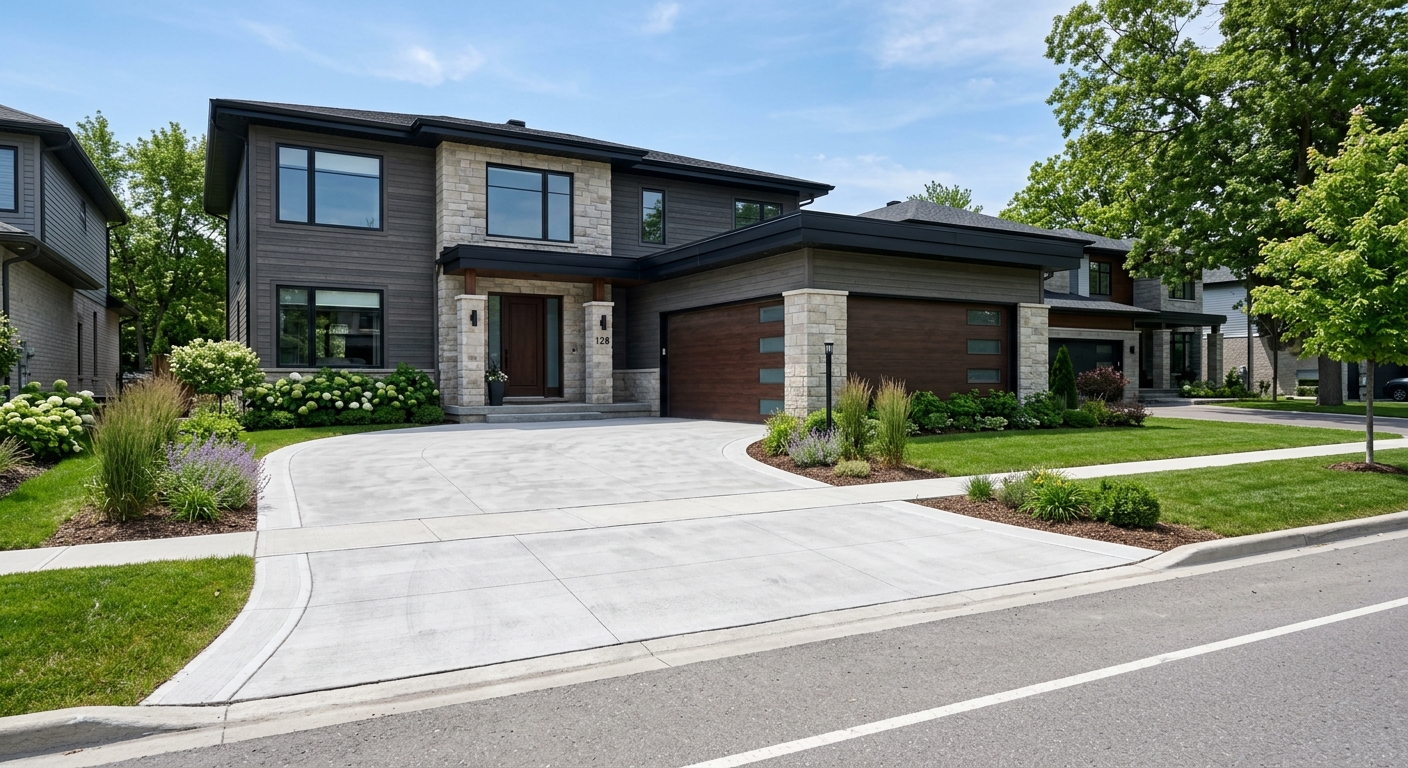
Concrete work options and costs in Kitsilano
Kitsilano homeowners typically choose concrete for driveways, patios, walkways, and foundation-related work because it delivers a clean, long-lasting surface with a predictable installation process. In a city of 43,045 people (Statistics Canada, 2021 Census), much of the housing stock is family-oriented, and concrete flatwork is especially in demand around the Fairview and York Street corridor where lots are often narrow and access can be tight. In the Lower Mainland–Southwest, mild winters and a shallow frost line help keep exterior slab designs leaner than in the rest of BC—but we still plan for freeze–thaw cycles, saturated soils, and heavy coastal rainfall. That means reliable base prep, air-entrained concrete, and proper control joints are non-negotiable for protecting slabs and thickened edges. Contractor availability also affects pricing: during spring and early summer, demand can spike as curb cuts, drainage tie-ins, and regrading schedules line up across nearby neighbourhoods.
What you’re really paying for in Kitsilano is the full system: footings or thickened edges placed below the design frost depth (typically around 450 mm / 18" in this region’s practice), engineered granular base, mix design, and curing/scheduling to manage cool nights and high humidity. That’s why two bids for the same driveway can still differ meaningfully—especially when one includes proper drainage and curing blankets for a rainy forecast. Use the table below to compare common options and see how finish type and structural requirements change the price range.
| Application |
Typical Size |
Key Spec |
Finish Option |
Price Range |
| Concrete driveway (standard broom finish) |
400–600 sq. ft. (approx. 20' x 20' to 20' x 30') |
Compacted granular base; air-entrained mix; control joints; thickened edge where required |
Broom finish |
$18,000–$28,000 |
| Exposed aggregate driveway |
400–600 sq. ft. |
Compacted base; air-entrained mix; retarder/finishing process; joints and sealer included in scope |
Exposed aggregate |
$22,000–$34,000 |
| Stamped concrete driveway or patio |
250–450 sq. ft. |
Compacted base; air-entrained mix; integral colour or release system; joint pattern |
Stamped + integral/overlay colour |
$22,000–$36,000 |
| Plain concrete patio or walkway |
200–350 sq. ft. |
Compacted granular base; air-entrained mix; broom finish or smooth trowel for walk areas |
Broom or light broom |
$16,000–$26,000 |
| Garage floor (interior slab) |
300–500 sq. ft. |
Vapour barrier (where specified); reinforcement/welded wire mesh as required; slab thickness per design |
Light broom (trowel finish as needed) |
$14,000–$24,000 |
| Foundation footings (structural, below frost) |
Per linear footing + typical rebar set-up |
Excavate to below design frost depth; formwork; engineered reinforcement; concrete pour for footings |
Structural concrete |
$200–$350 |
Prices are estimates only and vary by project scope, site access and material selection.
What affects the price of concrete work in Kitsilano
Even when two contractors are quoting the “same” driveway, price differences of 30–50% across the Lower Mainland–Southwest—and compared with other parts of BC—are common. In practical terms, the quote is driven by how much of the durability system each bid includes: base thickness and drainage, frost protection details, air-entrainment and cement content, and curing/scheduling to reach design strength in humid, rain-prone weather. Kitsilano sits in a coastal climate where concrete can start curing well, then lose performance if it’s kept too wet or too cold during early strength gain. So the bid isn’t just materials; it’s labour sequencing and weather management.
Frost line depth and freeze–thaw cycles dictate every exterior spec in this region. Practice typically assumes a frost depth around 450 mm / 18", and exterior elements need to be placed below that to prevent frost heave. All exterior slabs require air-entrained mixes to handle repeated wetting and thawing; the wrong mix can lead to scaling and spalling later. Colder regions face a shorter pour season and often require heated spaces or curing blankets to protect early strength gain—those cold-weather precautions raise costs. In Kitsilano, de-icing salt can still accelerate surface damage, which is why sealing is often recommended for driveways and entry walkways.
For real-world cost impacts: (1) a tight-access driveway in older homes near the York Street area often increases labour time for forming and pump/placement logistics; (2) if your subgrade is wet or poorly drained, the excavation and granular replacement can add substantial dollars compared with a straightforward “dry” base. Conversely, a simple plain patio at $16,000–$26,000 can be the best value if you already have good drainage and minimal grades. By contrast, stamped or exposed finishes at the $22,000–$36,000 level are usually justified when you want higher curb appeal, consistent colour, and a controlled joint plan to keep the surface looking sharp.
| Price Factor |
Why It Matters |
Cost Impact |
| Frost line depth — determines footing depth and form height |
Footings and thickened edges must extend below design frost depth to reduce frost heave risk |
Higher excavation and forming; increases cost mainly for foundation-style work |
| Site preparation — excavation, grading, compacted granular base |
Proper subgrade and drainage prevent settlement, pumping, and premature cracking |
Can swing the quote significantly if soils are saturated or grades are off |
| Reinforcement — rebar or wire mesh requirement |
Controls cracking and supports structural load paths for slabs and footings |
Material + labour time; required in many garage floors and thick slabs |
| Mix design — air-entrainment and compressive strength spec |
Air-entrainment protects against freeze–thaw scaling in coastal-wet conditions |
Direct materials cost; also affects finishing behaviour |
| Finish type — broom vs. stamped vs. exposed aggregate |
Finish determines additional labour steps, curing/retarder timing, and aesthetics |
Stamped and exposed work typically costs more than plain broom finish |
| Pour size and concrete truck access to site |
Access limits can force pumps, smaller batches, or more labour handling |
Tight sites around Kitsilano can increase placement time |
| Cold-weather curing precautions — heating and blankets |
Protects early strength gain and reduces surface defects when nights are cool |
Higher labour + materials in shoulder seasons |
| Control joint pattern and sealing cost |
Joints manage shrinkage cracking; sealing helps repel de-icing salts and moisture |
Added line-items for cutting/sealing, but it reduces long-term maintenance |
Permits & regulations in British Columbia
In British Columbia, it’s important to separate structural concrete from exterior flatwork when thinking about permits. Structural concrete work—such as footings, foundation walls, grade beams, and any work that changes structural support—requires a building permit and often engineered drawings that the municipality reviews. Concrete flatwork (patios, walkways, driveways) typically does not require a permit by default, but it can require municipal approval if it impacts lot grading, drainage, impervious surface coverage limits, or the municipal right-of-way (for example, a new or modified driveway approach). Always confirm with the local authority before breaking ground, especially if you’re changing drainage patterns or connecting to existing services.
Before the contractor starts, verify that they carry liability insurance and are properly covered for workers. In practice for BC homeowners, you should do three things step-by-step: (1) check the contractor’s licence/eligibility information through the relevant BC licensing/registry tools (and ensure the contact details match the quote); (2) ask for a certificate of insurance showing liability coverage and the effective dates—confirm the certificate is issued for the correct legal name; and (3) confirm worker coverage via the applicable coverage clearances for the employer named on the quote. Then, ask for references on similar Kitsilano projects (driveways and foundations are different work), and request photos of completed surfaces after a full winter season where possible.
Getting concrete right in Kitsilano's freeze-thaw climate
Concrete fails in Kitsilano when the early-age strength and long-term durability system aren’t matched to wet coastal conditions and freeze–thaw cycling. The most common homeowner-visible problem is spalling or scaling—often tied to inadequate air-entrainment and finish timing. To spec the job correctly, start with (1) base preparation: build a compacted granular sub-base to the required depth for your soil conditions and frost protection. If the base is too thin or drainage is poor, water sits under the slab and accelerates deterioration during repeated thawing. Next (2) mix design: for exterior flatwork, request air-entrained concrete (targeting about 5–7% air) and minimum 32 MPa compressive strength. Then (3) control joints: cut joints on a consistent pattern to limit random shrinkage cracking in large panels. (4) curing: plan for at least 7 days of proper curing conditions; in cool, humid weather you may need curing blankets or surface protection to maintain temperature and prevent premature drying. Finally (5) sealing: apply a penetrating sealer after cure—commonly at 28 days post-pour—so the surface resists moisture and de-icing salt intrusion.
When you ask technical questions, focus on failure modes. A good contractor can explain how they’ll prevent freeze–thaw damage and how joint spacing, air content, and curing protect your investment. For a dollar example: if a standard broom-finish driveway fits your needs at $18,000–$28,000, you might skip decorative extras. But if you choose stamped concrete, the added steps and tighter timing can push you toward $22,000–$36,000—that premium is justified only when the contractor also includes correct base prep, air-entrainment, and a realistic curing plan that matches Kitsilano’s rain and cool nights.
| Spec |
Why It Matters in Kitsilano |
What to Ask For |
Impact if Skipped |
| Compacted granular base (depth?) |
Kitsilano’s wet conditions increase the risk of water pooling under slabs; frost protection depends on base depth |
“What is the granular base depth and what compacted lift thickness do you use?” |
Settlement, pumping, cracking, and faster freeze–thaw degradation |
| Air-entrained concrete mix (target air %?) |
Freeze–thaw cycling in the Lower Mainland–Southwest demands air voids to resist scaling |
“What target air content (around 5–7%) are you batching for exterior work, and how is it controlled?” |
Spalling/scaling, surface breakdown, and premature repairs |
| Compressive strength (MPa rating) |
Higher early and design strength helps concrete resist moisture and temperature swings during curing |
“What MPa mix are you using (minimum 32 MPa) for exterior flatwork and how is it verified?” |
Reduced durability and increased risk of surface defects |
| Control joints (spacing per ACI guidelines) |
Joints manage shrinkage so cracking is controlled and predictable |
“What joint spacing and layout will you use for my slab size, and when will joints be cut?” |
Random cracking across visible panels, harder-to-repair damage |
| Minimum 7-day curing period |
Cool nights and coastal humidity can slow strength gain if curing isn’t protected |
“How do you maintain curing conditions, and what protection do you use in rain/cold?” |
Weaker early-age concrete, surface dusting, and long-term durability loss |
| Penetrating sealer (when applied after cure) |
Sealing helps repel moisture and de-icing salt—both common durability stressors |
“What sealer system do you use and when do you apply it after the 28-day cure?” |
More water absorption and faster surface deterioration |
How to choose a concrete work contractor in Kitsilano
Start by verifying the contractor’s ability to work legally and safely in British Columbia. First, confirm their licensing/registration status using the BC tools applicable to their trade category, and make sure the legal name matches the quote. Next, request a certificate of liability insurance and check the effective dates cover your project period. Then verify worker coverage (WSBC/WCB coverage for the employer listed on the paperwork) and keep a copy of any clearance information. If a contractor can’t provide clear documentation, treat that as a warning—especially for foundation or footing work where liability exposure is higher.
For pricing, ask for 2–3 itemised written quotes with labour and materials breakdowns rather than a single lump sum. Include line items for excavation/disposal, granular base, reinforcement, concrete supply, finishing, saw-cut control joints, and sealing (if recommended). Read the scope carefully: are permits included, or are they your responsibility? Is concrete truck access included, or is a pump allowed for? Is there a rain-day plan and what happens if cure conditions aren’t met? A strong warranty should be spelled out as workmanship warranty length, and you should ask whether manufacturer product warranties apply (e.g., sealers/admix) and whether those are transferable to future owners.
For payment, never agree to more than 10–15% upfront. Use a holdback until completion and final cleanup are done. Finally, insist on timeline details in writing: proposed start date, curing/weather contingency, and estimated completion date for each phase.
- Ask what frost protection and thickened-edge details they use for exterior work in Kitsilano’s conditions.
- Confirm they’re using air-entrained concrete for all exterior slabs.
- Request proof of insurance and worker coverage before any excavation.
- Get itemised labour/materials quotes (not lump sums).
- Verify whether disposal/haul-away is included in the price.
- Ask about truck access and whether a pump is included if the site is tight.
- Confirm reinforcement type: welded wire mesh vs rebar and where it’s installed.
- Check their control joint plan for your slab size and joint timing.
- Ask how they protect curing in rain or cool nights (blankets/cover plan).
- Ask whether they will seal and when (after the cure window).
- Review the warranty wording for workmanship and exclusions for repairs.
- Use a clear payment schedule with a holdback until final inspection and cleanup.
In Kitsilano, red flags include: “all-in” quotes with no base thickness or drainage notes, refusing to discuss air-entrainment or control joints, missing insurance/coverage documentation, vague weather/cure practices, and pushing for large upfront payments without a written schedule.
Frequently asked questions — concrete work in Kitsilano
When is the best time to pour concrete in Kitsilano?
In Kitsilano and the Lower Mainland–Southwest, the best window is typically late spring through early fall when you can count on fewer heavy rain periods and more stable daytime temperatures. That said, we do pours outside that window when needed, but we manage the curing conditions closely—using curing blankets or protective coverings during cool nights and watching for prolonged rain. Because our practical design frost depth is often around 450 mm / 18", exterior specs still must hold up through freeze–thaw cycling even if winter is relatively mild. If you’re planning a driveway or patio, aim to schedule when subgrade can be prepared and kept workable, since saturated soils add excavation and base-replacement costs. For budgeting, standard broom-finish driveways commonly land in the $18,000–$28,000 range, while finishing-heavy options can rise with seasonal scheduling.
How long does concrete take to cure?
Concrete curing has two timelines: initial set and strength gain. For most exterior flatwork in British Columbia, you should plan for at least 7 days of good curing conditions to achieve a practical strength for light exposure, assuming temperature and moisture are controlled. Full design strength is typically reached later (often around 28 days), which is why sealer is commonly applied after cure rather than right away. Kitsilano’s coastal humidity and cool nights can slow early strength gain, so contractors should protect the surface during that window—especially if rain is expected. This is also why skip-cure shortcuts can lead to surface dusting or early wear. If you’re comparing quotes, ask how they’ll handle curing blankets/protection, not just “we’ll cure it.”
Do I need a permit for concrete work in British Columbia?
In BC, structural concrete typically requires a building permit—this includes footings, foundation walls, grade beams, and any work that changes how the home is supported. Concrete flatwork (driveways, patios, walkways) usually doesn’t require a permit on its own, but it can if your project affects lot grading, drainage, impervious surface rules, or touches areas connected to municipal right-of-way requirements (such as changing a driveway approach). Because local interpretation can vary, the safe approach is to confirm with the municipality before you pour. Also, don’t rely on the contractor to “assume” it’s exempt: ask for what permits are included in the quote and who is responsible for approvals. For your own protection, verify the contractor’s liability insurance and worker coverage/clearance documentation before excavation.
Concrete vs pavers for a patio in Kitsilano?
Concrete and pavers both work well in Kitsilano, but they behave differently during freeze–thaw cycles and wet seasons. Concrete patios are a monolithic slab system; they crack eventually if jointing isn’t planned, but with proper control joints and air-entrained mix they can hold up very well. Pavers are modular, which can help visually because individual units can be replaced if settlement occurs, but the base build-up and edge restraint still have to be excellent. In terms of cost, a plain concrete patio or walkway often falls around $16,000–$26,000 depending on size and site access, while pavers can vary widely based on unit selection, base depth, and labour intensity. If you want the lowest maintenance and a clean, modern look, concrete is often the straightforward choice—provided the contractor addresses drainage and joint/sealing details.
How long does a concrete driveway last?
A well-built concrete driveway in Kitsilano commonly lasts 20–30 years, sometimes longer, but durability depends heavily on the specs and maintenance—not just the finish. The Lower Mainland–Southwest climate means freeze–thaw cycling, saturation from coastal rainfall, and de-icing salts can stress the surface. That’s why air-entrained concrete, proper compacted granular base, and correctly cut control joints matter. Sealing after full cure (often around 28 days) helps repel moisture and salts and can slow surface breakdown. If your driveway is exposed to a lot of vehicle turning loads or if water can’t drain away from the edges, life expectancy drops. When budgeting, remember finish choice affects both appearance and labour time: standard broom driveways often start in the $18,000–$28,000 band, while decorative finishes can be higher—especially when jointing and curing are planned for a long service life.
What is air-entrained concrete and why does it matter here?
Air-entrained concrete is a mix designed with microscopic air bubbles that allow water within the concrete to expand during freezing without causing the same level of internal damage. In Kitsilano and across British Columbia’s Lower Mainland–Southwest, we deal with wet weather and repeated freeze–thaw cycles that can lead to scaling and spalling if the mix isn’t right. Exterior flatwork—including driveways, patios, and walkways—should therefore use an air-entrained specification appropriate for freeze–thaw exposure. A contractor should be able to tell you the target air content (for many exterior applications, about 5–7% air) and how it’s controlled during batching. If air-entrainment is skipped or poorly controlled, you may see surface deterioration sooner, even if the driveway looks fine in the first season. That’s one reason comparing quotes should include mix design details, not just decorative finishes.