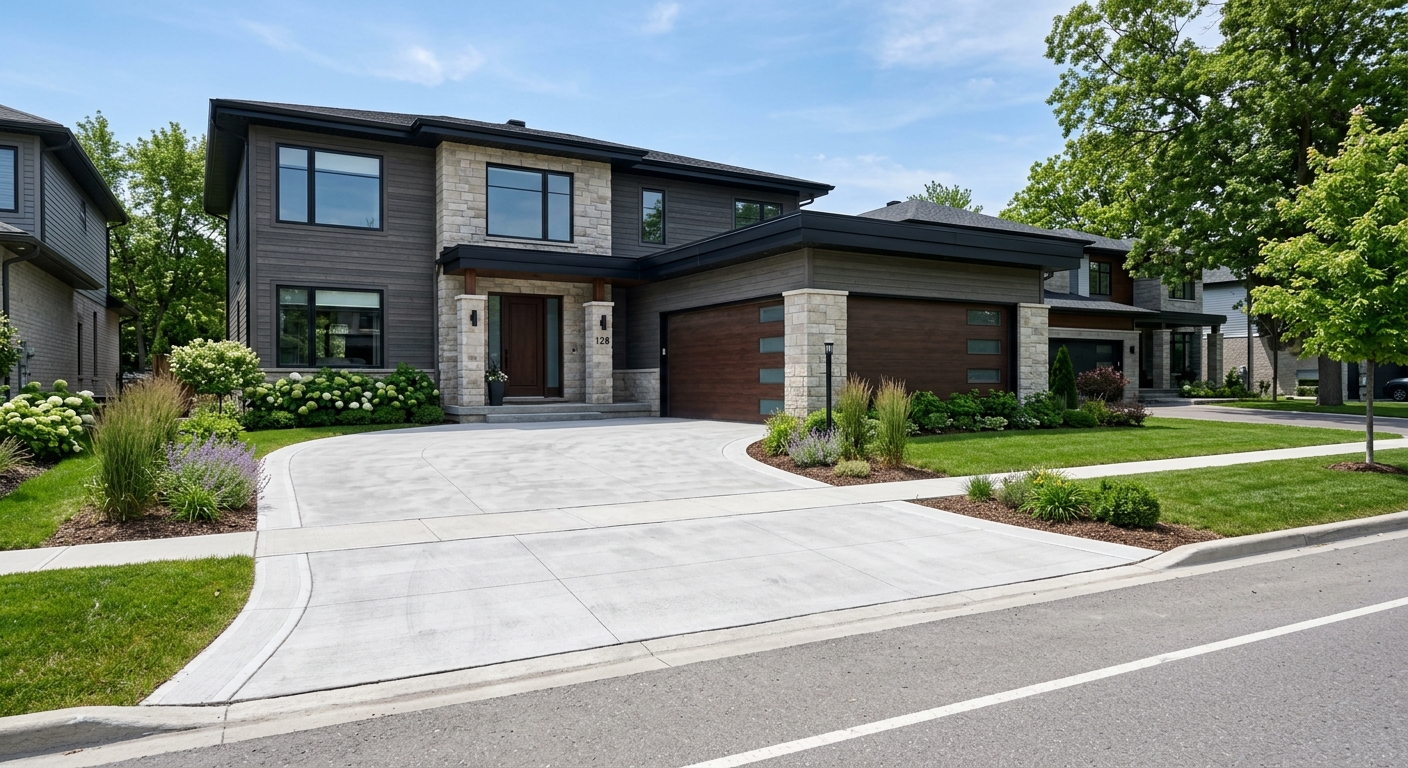
Concrete work options and costs in Salmon Arm
Salmon Arm is a very practical place to spend money on concrete because a lot of homes are built for year-round use, not just summer curb appeal. With 62.4% of dwellings being single-detached homes (Statistics Canada, 2021 Census), the most common jobs I see are driveways, patios, walkways, and garage slabs—flatwork where the finish and durability matter every time you park, walk, or move snow.
Our Thompson–Okanagan concrete pricing is shaped by the interior freeze–thaw reality. Contractors design around a frost depth assumption of roughly 45–60 cm for exterior flatwork and ensure footings sit below frost, not the bare minimum often quoted online. In cold shoulder seasons, the practical pour window shortens, so excavation, forming, and curing protection (like insulating blankets) cost more than “easy BC” estimates. That’s also why you’ll notice stronger availability for trades in areas that have steady renos and new builds—north shore corridors and the West Broadview / Downtown access routes tend to be especially busy for driveway and sidewalk replacements.
Homeowners also feel cost differences because Salmon Arm has an older housing stock: 38.6% of homes were built before 1981 (Statistics Canada, 2021 Census). That often means you’re not replacing a like-for-like slab—you’re correcting drainage, adding base, and updating jointing to stop future cracking and scaling. With that in mind, the comparison below uses realistic ranges for common options in this city tier, then you can dial specs up or down based on access, thickness, and surface selection.
| Application |
Typical Size |
Key Spec |
Finish Option |
Price Range |
| Concrete driveway (standard broom finish) |
300–500 sq. ft. |
Typically 4–5 in. thick; air-entrained mix for exterior |
Broom finish + perimeter control joints |
$18,000–$28,000 |
| Exposed aggregate driveway |
300–500 sq. ft. |
Air-entrained mix; proper base for frost |
Exposed/washed aggregate + sealer |
$22,000–$34,000 |
| Stamped concrete driveway or patio |
200–450 sq. ft. |
Reinforced flatwork; integral colour (where selected) |
Stamp pattern + release agent + sealing |
$15,000–$27,000 |
| Plain concrete patio or walkway |
150–300 sq. ft. |
4 in. slab typical; compacted granular base |
Broom/steel trowel; simple edging |
$3,000–$7,000 |
| Garage floor (interior slab) |
400–600 sq. ft. |
Typically 4 in.; vapour barrier + reinforcement as required |
Float/steel trowel + light broom edges |
$6,000–$13,000 |
| Foundation footings (structural, below frost) |
Per linear foot |
Engineered bearing width/depth; excavation + formwork |
Concrete to spec; rebar per drawings |
$220–$350 |
Prices are estimates only and vary by project scope, site access and material selection.
What affects the price of concrete work in Salmon Arm
In the Thompson–Okanagan, two homeowners can submit the “same” concrete request and still see quote differences of 30–50% across regions and contractors. The gap usually isn’t the concrete itself—it’s the frost-safe design and the production reality. In interior BC, frost depth assumptions used in standard practice (often in the 45–60 cm range for flatwork) lead to deeper excavation and thicker base prep so the slab behaves consistently through winter. For foundations and footings, contractors must build below the design frost depth to prevent heaving and cracking; that means more digging, more forming, and more rebar than many generic estimates assume.
Freeze–thaw cycling is another driver. Exterior slabs require air-entrained concrete to handle repeated expansion and contraction. When crews pour in cooler conditions, cold-weather curing precautions—heating, insulating blankets, and longer protected cure time—can add measurable labour and material costs. Then consider de-icing salts: they can accelerate surface spalling if the mix and finishing aren’t dialled in and if sealing is skipped. In Salmon Arm’s older neighbourhoods, you often also pay for “making it right” after removing failed existing slabs—extra haul-off, subgrade correction, and drainage upgrades.
For example, a standard broom-finished driveway might land near the $18–$28 per sq. ft. backbone for this city tier, while stamped concrete can climb into the $24–$38 band because you’re paying for colour/stamp materials, extra finishing labour, and tighter scheduling. If the site requires more truck access management (tight turns near the street or slope), the same stamped patio can cost closer to the high end because placement and finishing timing gets more expensive. Where a job stays simple—good access, level base, and no major drainage issues—you’ll often see pricing closer to the lower end of the range.
| Price Factor |
Why It Matters |
Cost Impact |
| Frost line depth — determines footing depth and form height |
Footings must sit below frost to prevent heaving and structural cracking. |
More excavation/formation; higher labour and materials. |
| Site preparation — excavation, grading, compacted granular base |
Slabs fail when the base isn’t compacted or drainage is poor. |
Extra material haul-off and base material increases total cost. |
| Reinforcement — rebar or wire mesh requirement |
Helps control cracking, especially on larger exterior flatwork. |
More steel, tie-wire, chairs/dowels; labour for proper placement. |
| Mix design — air-entrainment and compressive strength spec |
Interior freeze–thaw requires air entrainment for durability. |
Higher-grade concrete and quality control usually increases cost. |
| Finish type — broom vs. stamped vs. exposed aggregate |
Decorative finishes demand extra labour, materials, and curing control. |
Stamped/exposed options can move you from basic to premium bands. |
| Pour size and concrete truck access to site |
Long carries, tight access, or delays complicate placement and finishing. |
Added labour time, pump/minimum charges, and scheduling costs. |
| Cold-weather curing precautions — heating and blankets |
Protection is critical to achieve strength and avoid freeze damage. |
Increases consumables and labour during shoulder seasons. |
| Control joint pattern and sealing cost |
Joints manage shrinkage; sealing protects from salts and moisture. |
More layout time and sealer adds cost, reduces long-term repairs. |
Permits & regulations in British Columbia
In British Columbia, most structural concrete work requires a building permit. That includes footings, foundation walls, and grade beams, where municipalities often expect engineered drawings and formal reviews. For concrete flatwork—like patios, walkways, driveways, and garage floors—permits typically aren’t required as a stand-alone project, unless the work affects lot grading, changes stormwater/flow patterns, or triggers municipal requirements tied to impervious surface coverage or drainage.
To protect yourself in Salmon Arm, treat it as two checks: permit scope and contractor compliance. Step one is confirming whether your driveway or patio touches any lot drainage, regrading, or right-of-way constraints—ask the City/municipality before excavation. Step two is contractor verification: request proof of liability insurance and workers’ compensation coverage, then confirm the contractor’s business details match what you’re hiring.
Where to look (practical homeowner checklist): (1) licence/registration info and business standing from the appropriate provincial/public-facing registry resources, (2) a certificate of insurance showing liability limits and effective dates, and (3) a clearance letter or equivalent workers’ compensation proof showing the contractor is in good standing. Also ask for references on similar-scale Salmon Arm jobs—decorative flatwork and freeze–thaw prone driveways should have before/after photos.
Getting concrete right in Salmon Arm's freeze-thaw climate
Concrete tends to fail in Salmon Arm when freeze–thaw cycles get a pathway into the slab—through poor base prep, inadequate air entrainment, or badly managed joints and drainage. To spec correctly, start with (1) base preparation: you need compacted granular sub-base sized for the soil conditions and built for frost movement control. That generally means excavation to stable material and proper compaction, not “topping up” with loose fill. Second, (2) mix design: for exterior flatwork, use air-entrained concrete (commonly around 5–7% air content for exterior exposure) and a minimum compressive strength target such as 32 MPa unless your engineer/contract requires more.
Third, (3) control joints: random cracking is normal in concrete, but you want cracks to occur where you planned them. Use joint spacing and depth appropriate for the thickness and intended panel sizes. Fourth, (4) curing: protect and cure concrete for at least 7 days under proper conditions; in cold snaps, crews often use insulating blankets or other cold-weather measures so the surface doesn’t freeze before strength develops. Fifth, (5) sealing: apply a penetrating sealer about 28 days post-pour to repel moisture and reduce the damage salts can do to the surface.
When you ask the right questions, you prevent the most expensive failure mode: spalling caused by inadequate air-entrainment. If you’re choosing between finishes, consider value. For instance, a broom-finished driveway may fall in the $18–$28 range, while stamped concrete is typically higher (the $24–$38 band). That price difference is justified if you want the decorative look and you’re willing to pay for the extra finishing labour and careful sealing, not if you just want “something that lasts” because a well-built broom finish can be very durable in Thompson–Okanagan conditions.
| Spec |
Why It Matters in Salmon Arm |
What to Ask For |
Impact if Skipped |
| Compacted granular base (depth?) |
Controls frost movement and reduces voids under the slab. |
Base depth and compaction proof (stable subgrade + granular layers). |
Settlement and early cracking; uneven heaving. |
| Air-entrained concrete mix (target air %?) |
Freeze–thaw durability depends on proper air voids. |
Exterior air content around 5–7% (per mix design) and documentation. |
Spalling and scaling after winters and de-icing. |
| Compressive strength (MPa rating) |
Strength gain affects abrasion resistance and long-term performance. |
Minimum 32 MPa (or higher if engineered) mix spec. |
Surface wear, reduced durability, and faster deterioration. |
| Control joints (spacing per ACI guidelines) |
Joints steer shrinkage cracking away from random weak points. |
Planned panel sizes and joint spacing matched to slab thickness. |
Random cracks, water intrusion, and freeze damage escalation. |
| Minimum 7-day curing period |
Cold snaps and dry winds can stall strength development. |
Protection plan and curing time (blankets/heat if needed). |
Reduced strength and higher risk of early surface defects. |
| Penetrating sealer (when applied after cure) |
Salt and moisture exposure are winter realities in interior BC. |
Apply penetrating sealer around 28 days post-pour (after full cure). |
Faster water/salt penetration and increased scaling risk. |
How to choose a concrete work contractor in Salmon Arm
Start by verifying compliance in British Columbia, because a “cheap” concrete bid often hides missing coverage or rushed timelines. Ask every contractor for their liability insurance certificate and confirmation of workers’ compensation coverage (clearance letter or equivalent proof). For licensing and business standing, check the relevant provincial registry information available online and ensure the business name on the quote matches the insured entity on the certificate of insurance.
Next, get 2–3 itemised written quotes, not lump sums. You want a breakdown for excavation/base prep, reinforcement, formwork, concrete supply, finishing, curing protection (if shoulder-season), joints, and sealing (if included). Carefully review what’s excluded: disposal/haul-off, permit pull (if required), snow removal for access, and whether the contractor includes dowels/tie-ins for repairs or just pours a new surface.
Warranty matters. Ask for a clear workmanship warranty length for installation and understand whether there’s a separate product/material warranty for items like sealer or decorative systems—and whether it’s transferable to future owners. For payment, use a realistic schedule: never pay more than 10–15% upfront, and hold back a portion until the final walkthrough and finish corrections are done. Finally, require a written timeline with a start date and estimated completion date, including what happens if weather forces a delay—important in Salmon Arm where cold nights can affect curing protection.
- Request proof of liability insurance and workers’ compensation before signing.
- Confirm the business name and address match the insurance documents.
- Get quotes with line items for base prep and reinforcement, not just “concrete”.
- Ask for mix specs: air-entrainment for exterior flatwork and minimum strength target.
- Confirm footing depth approach if any structural concrete is included (below frost).
- Ask how they handle drainage and existing soil conditions (not just thickness).
- Verify joint layout: panel sizes, saw-cut plan, and sealing plan if exterior.
- Ask about curing protection for cold/wet weather pours (blankets/heating).
- Confirm whether haul-off/disposal is included for removed concrete and spoils.
- Get a clear accessibility plan for the pump/truck or conveyance method.
- Require a written start date, completion estimate, and weather-delay terms.
- Set a payment schedule with a holdback after final finishing and cleanup.
Concrete red flags I see in Salmon Arm: contractors who won’t discuss air entrainment for exterior slabs, quotes that don’t address base prep depth/compaction, “no-joint” plans that rely on hope, vague curing promises for cool-season pours, and payment terms that demand a large upfront deposit without a detailed scope.
Frequently asked questions — concrete work in Salmon Arm
How long does a concrete project take in Salmon Arm?
In Salmon Arm, the schedule is mostly driven by access, excavation/base prep, and cure conditions during Thompson–Okanagan cold snaps. For a typical driveway or patio, production can be quick (a crew may pour and finish in a day), but the timeline for a homeowner is longer because you need at least proper curing protection and time for strength gain. Many projects are planned as “working days” plus curing time: concrete is usually left protected during the initial set and then monitored; practical use timelines often depend on thickness and weather. If you’re doing decorative concrete (stamped/exposed), drying and finishing windows matter more, so crews often book earlier. If shoulder-season freezing risk is present, expect additional curing precautions (like insulating blankets) that can extend the completion window. (Statistics Canada, 2021 Census)
What is a concrete overlay and is it suited to Salmon Arm?
A concrete overlay is a new surface layer installed over an existing concrete slab, usually to restore appearance without full removal. In Salmon Arm and interior BC generally, overlays can work if the existing slab is still structurally sound and the base underneath isn’t pumping water or settling—otherwise the overlay can crack or debond when freeze–thaw stresses continue. Overlays also depend on surface preparation: correct grinding/scarification, proper bonding materials, and attention to drainage. If your current slab is already spalling or lifting, full removal with base correction is often the more durable fix. From a pricing perspective, overlays can sometimes be cheaper than full replacement, but you still may end up close to standard driveway replacement costs once prep and repairs are included. As a reference point for full flatwork, driveway concrete often falls in the $18–$28 tier for this city category, while decorative work can climb into the $24–$38 band.
How do I seal concrete to protect it in Salmon Arm?
Sealing is a smart step in Salmon Arm because de-icing salts and moisture exposure increase the chance of surface scaling when concrete isn’t properly protected. The key is timing: for most sealers, apply after the concrete has fully cured—typically around 28 days post-pour—so you don’t trap moisture under the coating. Ask your contractor for the specific type of sealer (penetrating vs. topical film-forming) and confirm it’s intended for freeze–thaw durability and salt resistance. Before sealing, the surface should be clean and dry; stains or construction residue can cause uneven penetration and poor performance. While sealing isn’t a substitute for correct specs (air entrainment, jointing, and proper base), it helps reduce water/salt intrusion. If you’re doing a stamped or exposed aggregate driveway, sealing is usually part of the finish system and should be included in the scope and warranty discussion.
What is the difference between concrete and cement?
In plain terms, cement is one ingredient; concrete is the finished building material. Cement is the binding component, while concrete typically includes cement, water, and aggregates (sand and gravel/crushed stone), plus sometimes admixtures like air-entraining agents. In Salmon Arm’s Thompson–Okanagan freeze–thaw climate, the difference matters because it’s not just “cement quality”—it’s the overall concrete mix design. Exterior durability depends heavily on air entrainment for freeze–thaw resistance, plus achieving the right compressive strength and using proper curing. When a contractor quotes, ask what the concrete mix is designed to achieve (air content and strength target), not just whether they’re using “good cement.” If they can’t explain the mix spec and exterior exposure requirements, that’s a reason to get a more detailed quote. (Statistics Canada, 2021 Census)
How much does concrete work cost in Salmon Arm?
Concrete pricing in Salmon Arm depends on thickness, base prep, reinforcement, finish type, and how much curing protection is needed during cold or wet conditions. For this city tier, a standard concrete driveway is often budgeted within the $18–$28 range for concrete flatwork, while stamped & decorative concrete commonly sits higher, roughly $24–$38 for that premium category. Plain patios and walkways typically run lower than driveways, while garage interior slabs are usually priced separately due to vapour barrier and reinforcement needs. If structural concrete is included, foundation/footings pricing is often quoted per linear foot and commonly falls in the $220–$350 band for structural below-frost work. To keep quotes comparable, ask for itemised line entries—excavation/base prep, reinforcement, concrete supply, finishing, joints, and sealing—so you aren’t comparing a “thin slab” bid to a frost-safe spec.
How deep must footings be for Salmon Arm's frost line?
Footing depth in Salmon Arm should be determined based on the design frost depth approach used for the site and the specific structural requirements of your foundation plan—then built below frost to prevent heaving and cracking. While some online references mention “minimum footing depth” rules of thumb, that’s not how we typically protect concrete longevity in Thompson–Okanagan winters. The practical takeaway for homeowners is that structural footings must extend below the design frost depth used by engineers/your drawings, and contractor excavation/form heights will reflect that. For exterior flatwork (like a driveway slab), the frost depth assumption is often handled through proper base prep and insulation/curing practices rather than deep footings, but for true foundation elements the depth requirement is structural. If you’re planning anything beyond simple flatwork—like foundations or grade beams—ask to see the engineered drawings or footing specifications that show the below-frost design depth.