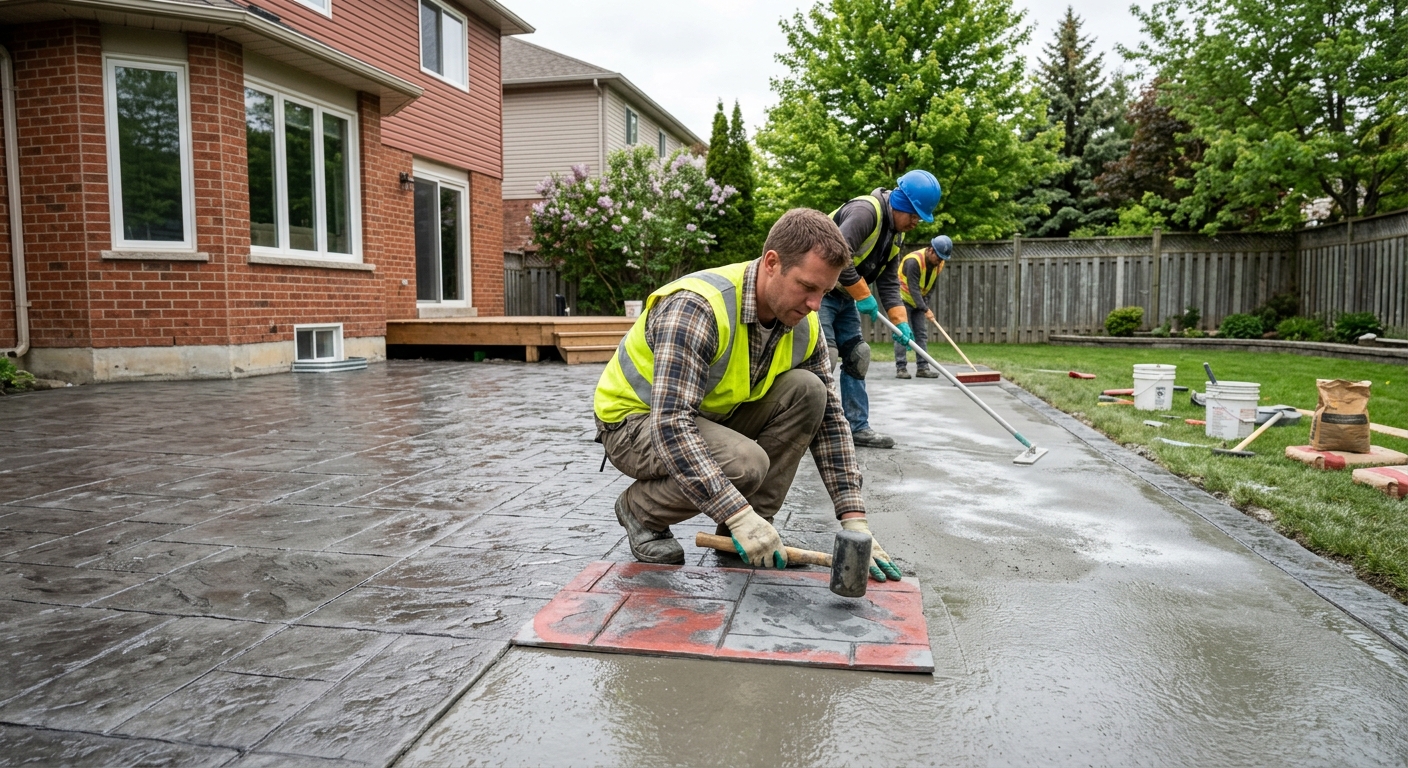
Concrete work options and costs in View Royal
View Royal is a coastal community on Vancouver Island where homeowners often choose durable concrete for driveways, patios and walkways—especially in older neighbourhood pockets where flatwork is due for replacement. With 36.0% of dwellings being single-detached houses (Statistics Canada, 2021 Census), there’s strong demand for exterior concrete flatwork, and many concrete jobs start as simple driveway or walkway upgrades that later expand into re-grading, drainage improvements and foundation-related work.
On Vancouver Island and the Coast, pricing is shaped by a relatively shallow frost line, but frequent freeze–thaw cycles and winter saturation. That combination means contractors must use air-entrained mixes, plan control joints carefully, and protect curing—factors that can push costs up compared with regions that freeze less often. Weather also affects scheduling: cool, wet periods can slow strength gain, increase the need for granular base remediation, and lead to short-notice rescheduling when heavy rain hits job sites.
In View Royal—particularly around the Langford border area and the busier corridors near the highway access points—concrete crews are frequently in-demand because there are many residential upgrades and parking/pad refresh projects tied to active home renovations. The good news is that you can still choose from several finish levels, from practical broom-finished concrete to decorative stamped concrete, depending on your budget and how much appearance matters.
Below is a typical cost comparison for common concrete options, moving from straightforward flatwork to structural work below frost, so you can discuss the scope with contractors and compare like-for-like.
| Application |
Typical Size |
Key Spec |
Finish Option |
Price Range |
| Concrete driveway (standard broom finish) |
16’ x 20’ (320 sq. ft.) |
Air-entrained exterior mix, compacted base, control joints |
Broom finish |
$6,000–$8,000 |
| Exposed aggregate driveway |
16’ x 20’ (320 sq. ft.) |
Air-entrained mix, proper curing and wash timing |
Exposed aggregate |
$7,200–$9,600 |
| Stamped concrete driveway or patio |
12’ x 18’ (216 sq. ft.) |
Air-entrained mix, release agent, sealed finish |
Stamped pattern + sealer |
$5,300–$8,300 |
| Plain concrete patio or walkway |
12’ x 12’ (144 sq. ft.) |
Air-entrained exterior mix, compacted base, joints |
Float/screed + broom or light brush |
$2,000–$3,200 |
| Garage floor (interior slab) |
24’ x 22’ (528 sq. ft.) |
4” slab typical, vapour barrier, proper base compaction |
Plain finish, steel trowel or broomed |
$9,000–$14,500 |
| Foundation footings (structural, below frost) |
Typical 4–8 lin. ft. perimeter per run |
Engineered thickness/steel, below-frost embedment, drainage |
Structural concrete |
$11,000–$20,000 |
Prices are estimates only and vary by project scope, site access and material selection.
What affects the price of concrete work in View Royal
In View Royal, it’s common to see quotes for the same concrete driveway or patio differ by 30–50% across Vancouver Island and Coast—and even more when comparing contractors who spec for durability versus those who price for speed. The biggest drivers are frost-depth expectations, freeze–thaw durability requirements, site conditions, and how much prep work is included (excavation, granular base, drainage, and remediation).
Frost line depth and freeze–thaw cycles dictate every spec in this region: exterior footings must extend below the design frost depth to prevent frost heave, and all exterior slabs need air-entrained concrete mixes to handle repeated wetting and freezing. While winter temperatures are milder than the interior parts of BC, coastal saturation still fuels freeze–thaw action, so the mix and detailing can’t be skipped. Colder regions usually have shorter pour seasons and higher cold-weather curing costs, and while our conditions are less extreme, a cool, rainy week in the shoulder season can still force contractors to use curing blankets or adjust schedules to protect the slab.
De-icing salts (especially near entry paths and driveways) also accelerate surface deterioration. Sealing isn’t just cosmetic—proper sealing after cure helps reduce salt ingress and surface scaling risk. Concrete design and prep can be priced efficiently or expensively depending on what’s included: for example, one quote might be based on your driveway being left as-is, while another includes removing and replacing a failed base, which is often necessary on older homes.
Local housing stock plays in too. With 28.6% of homes built before 1981 (Statistics Canada, 2021 Census), many upgrades start after decades of settlement and drainage issues. A job that simply “pours over existing base” can look cheaper, but a properly prepared driveway often lands near the mid-range, such as $16–$25 per sq. ft. for driveway work, or $14–$22 per sq. ft. for patios and walkways—especially when the contractor is building in the right granular depth, air-entrained mix, and a control joint pattern.
| Price Factor |
Why It Matters |
Cost Impact |
| Frost line depth — determines footing depth and form height |
Footings must sit below frost to control heave and cracking |
+10% to +25% on structural work if deeper excavation/steel is required |
| Site preparation — excavation, grading, compacted granular base |
Weak subgrade is the #1 cause of slab settlement and early failure |
+5% to +30% depending on how much removal/rebuild is needed |
| Reinforcement — rebar or wire mesh requirement |
Controls cracking and improves load performance for driveways and garage slabs |
+3% to +15% based on slab thickness and reinforcement specification |
| Mix design — air-entrainment and compressive strength spec |
Air entrainment is critical for freeze–thaw durability in exterior slabs |
+2% to +10%, but often prevents expensive rework |
| Finish type — broom vs. stamped vs. exposed aggregate |
Labour time and materials (stamping mats, timing, washout/exposure) increase complexity |
Stamped/exposed can add roughly +20% to +60% over broom/plain |
| Pour size and concrete truck access to site |
Narrow access increases labour, waiting time, and skip-to-site logistics |
+0% to +25% depending on access and placement plan |
| Cold-weather curing precautions — heating and blankets |
Ensures strength gain and surface protection in cool, wet periods |
+3% to +12% depending on conditions and timing |
| Control joint pattern and sealing cost |
Joints reduce random cracking; sealing helps repel salts and reduces scaling |
+2% to +8% for sealing and joint materials/labour |
Permits & regulations in British Columbia
In British Columbia, many homeowners hear “concrete doesn’t need a permit,” but the truth is more specific. Structural concrete work—such as foundation footings, foundation walls, and grade beams—typically requires a building permit and, in many cases, engineered drawings reviewed by the municipality. That includes any concrete that supports the structure or is part of the load path. In contrast, concrete flatwork like patios, walkways and driveways usually does not require a permit unless it affects lot grading, drainage, or municipal requirements around impervious surface coverage and right-of-way constraints.
For View Royal homeowners, the best approach is to confirm scope with the local authority before breaking ground, especially if your project involves lowering/raising grade, tying into existing drainage, or changing runoff direction. Also verify your contractor’s insurance and compliance: ask for proof of liability insurance and coverage through the provincial workplace system (WCB) or the appropriate equivalent documentation for their trade status. These checks protect you if there’s damage, injury, or a workmanship dispute.
To verify eligibility step-by-step, you can:
- Ask for the contractor’s business details and trade status, then check licensing information through the provincial online registry.
- Request a current certificate of insurance (COI) naming you as a certificate holder where applicable; confirm coverage limits.
- Request proof of WCB clearance/coverage (or documentation confirming how they handle coverage).
- Check references for similar work in Vancouver Island and Coast, ideally projects with freeze–thaw exterior exposure.
Once you confirm permitting needs and insurance, you can compare quotes with confidence that you’re building to BC expectations, not just pouring concrete.
Getting concrete right in View Royal's freeze-thaw climate
Concrete failures in View Royal are usually not “mystery concrete problems”—they’re predictable results of poor subgrade preparation, wrong mix design, weak or mistimed curing, or missing control joints. In a coastal freeze–thaw environment, water gets into the slab edges, joints, and surface pores. If the mix isn’t properly air-entrained, that water expands during freezing and can cause scaling and spalling. The right specification prevents freeze damage and reduces random cracking even when the ground moves slightly.
Start with base preparation: compacted granular sub-base needs to be at the right depth and well compacted for local soils and frost behavior. Next is mix design: for exterior flatwork, insist on air-entrainment (commonly 5–7% air content) and a minimum 32 MPa compressive strength specification. Then plan control joints: spacing should limit cracking to predictable lines. Curing matters just as much as the pour day—plan for at least 7 days of curing under proper conditions, and protect the slab in cool or wet weather with blankets or curing practices appropriate for the temperature. Finally, sealing should be done after cure (often at the 28-day mark) with a penetrating sealer that helps repel de-icing salts and reduces surface scaling risk.
When you compare options, ask what’s included. For example, a standard broom-finish driveway might cost in the $16–$25 per sq. ft. band, while a stamped driveway often sits higher in the $22–$35 range. That price difference is justified when stamping is paired with correct air entrainment, base prep, joints and sealing—otherwise you pay extra for a decorative surface that will still deteriorate if the spec is wrong.
| Spec |
Why It Matters in View Royal |
What to Ask For |
Impact if Skipped |
| Compacted granular base (depth?) |
Controls settlement and reduces water pumping in freeze–thaw cycles |
Granular sub-base depth and compaction method (proof of compaction) |
Uneven settlement, cracking, and faster edge deterioration |
| Air-entrained concrete mix (target air %?) |
Prevents freeze-related scaling/spalling on exterior surfaces |
Confirm air content (commonly 5–7% for exterior flatwork) on the batch ticket |
Scaling/spalling and surface pop-outs after winters |
| Compressive strength (MPa rating) |
Strength and durability under repeated moisture and temperature swings |
Minimum 32 MPa compressive strength spec for the slab |
Lower durability and increased risk of early cracking |
| Control joints (spacing per ACI guidelines) |
Limits random cracking to manageable areas |
Joint spacing plan and details for edges/near openings |
Random cracks that can widen and allow water intrusion |
| Minimum 7-day curing period |
Ensures strength gain and surface integrity before exposure |
How they protect the slab in cool/wet weather for at least 7 days |
Weak surface layer, higher chance of scaling and staining |
| Penetrating sealer (when applied after cure) |
Helps repel de-icing salts and limits moisture uptake |
Penetrating sealer after cure (often around 28 days post-pour) |
Salt damage accelerates spalling and surface breakdown |
How to choose a concrete work contractor in View Royal
Choosing the right concrete contractor in View Royal comes down to proof of coverage, clarity of scope, and realistic scheduling for our Vancouver Island and Coast weather. First, verify British Columbia compliance. Ask for their licensing/business credentials through the provincial registry, then request a certificate of insurance (liability) showing current coverage and adequate limits. For workplace coverage, ask for WCB clearance/coverage documentation (or the correct provincial equivalent for their trade status). You’re protecting yourself—COIs and coverage letters are non-negotiable before any excavation starts.
Next, get 2–3 itemised quotes instead of lump-sum numbers that hide differences. You want a breakdown that includes labour and materials, excavation and disposal, compacted base depth, reinforcement details, concrete mix spec (including air entrainment), finishing plan, and curing/sealing timing. Confirm whether permits are included (if required), whether drainage adjustments are included, and what’s excluded (for example, removal of unsuitable subgrade, saw-cutting, or hauling).
Warranty should be in writing. Ask for the workmanship warranty length and what it covers, plus any product/manufacturer warranties if they supply specialty materials. Also check whether the warranty transfers to future owners.
For payment, never pay more than 10–15% upfront. Hold back a final portion until completion and cleanup are verified. Finally, require a start date and completion estimate in writing, because cool wet periods can extend cure protection needs in British Columbia.
- Request COI and confirm coverage limits before any work begins.
- Ask for WCB clearance/coverage proof for the crew handling the work.
- Get a detailed scope: demo/removal, excavation, disposal, and granular base depth.
- Require concrete mix details: air entrainment and minimum strength spec.
- Confirm reinforcement type (wire mesh vs. rebar) and where it’s placed.
- Ask for joint layout (spacing, edge details, and sealing plan if applicable).
- Clarify curing and protection procedures for cool, wet weather.
- Confirm sealing timeline (often after cure) for exterior flatwork.
- Make sure finishing specs match the quote (broom vs. stamped vs. exposed aggregate).
- Insist on a disposal plan and whether hauling is included.
- Use a payment schedule tied to milestones and holdback.
- Verify crew experience with freeze–thaw exterior slabs on Vancouver Island.
Concrete red flags in View Royal: contractors who won’t discuss air-entrainment and joint spacing, quotes that skip granular base depth and compaction, no written curing/protection plan, vague timelines that ignore cool/wet curing needs, and requests for large upfront payments or “cash discount” with limited paperwork.
Frequently asked questions — concrete work in View Royal
How deep must footings be for View Royal's frost line?
For View Royal in coastal British Columbia, footing depth is driven by the design frost depth and local geotechnical/site conditions. In practice, many specifications target footings to sit below the design frost depth (often around 0.5–1.2 m for coastal BC climate bands), but your exact requirement depends on soil type, drainage, and what the engineered drawings or frost design calls for. Because Vancouver Island can be wet and prone to freeze–thaw action even without extreme cold, you don’t want to “guess” footing depth. The safe way is to confirm the depth on your engineer’s foundation details and ensure the contractor excavates to the approved elevation. If your quotes look too similar, ask both contractors what frost depth and embedment they’re using and whether they’ve allowed for proper drainage around the foundation.
Why does concrete crack in View Royal and how is it prevented?
Concrete cracks in View Royal mainly due to shrinkage, temperature changes, and—most importantly for exterior slabs—movement caused by moisture and freeze–thaw cycles beneath the slab. If the base isn’t properly excavated and compacted, water can migrate under the slab, leading to settlement and cracking. Prevention comes from strong specifications: adequate subgrade prep, an air-entrained exterior mix, and a control joint pattern that limits cracking to planned lines. Contractors should also seal appropriately where salts and wetting are expected. For many homeowners, the prevention work is “invisible” in the final product—yet it’s what makes a driveway last. A properly built broom-finish driveway often sits in the $16–$25 per sq. ft. band, and a good joint/sealer plan is part of that durability—not an optional extra.
Stamped vs broom-finish concrete — cost difference?
Stamped concrete costs more than broom-finish because you pay for extra labour and materials: stamp mats, release agent, timing and finishing discipline, and often an added emphasis on sealing for appearance longevity. In View Royal and across the Vancouver Island and Coast market, broom-finish exterior flatwork commonly aligns with the $16–$25 per sq. ft. pricing band for driveways, while stamped decorative work often lands higher—commonly in the $22–$35 per sq. ft. range depending on complexity, thickness, and base prep needs. The key point is that you should not “trade away” performance for appearance. Ask whether both options use air-entrained mix, the same granular base preparation, and a joint pattern that manages freeze–thaw movement. If the contractor can’t explain those specs, the stamped price premium won’t buy durability—only decoration.
When is the best time to pour concrete in View Royal?
The best time to pour concrete in View Royal is when temperatures are consistently workable for finishing and curing. While our winters are milder than interior BC, freeze–thaw and frequent rain can still slow strength gain and increase the risk of surface issues if protection isn’t used. Contractors typically schedule exterior slabs for stretches with favorable conditions, and they plan for cool-weather curing practices if there’s a cold snap forecast. For example, a driveway pour should include a protection plan (like blankets or curing practices) if night temperatures dip. If you’re doing decorative work such as stamping or exposed aggregate, timing is even more critical because finishing steps are sensitive to temperature and surface moisture. Ask your contractor for the anticipated weather window, how they protect the slab during the first days, and whether they’ll adjust the mix or use thermal blankets when needed.
How long does concrete take to cure?
Concrete curing has two common “checkpoints.” Most homeowners notice that work like foot traffic becomes practical after the slab reaches early strength, but proper curing for exterior durability is much more than a couple of days. In View Royal, plan for a minimum 7-day curing period under good conditions for strength gain and surface integrity. Full design strength is reached over time (often around 28 days), which is why many contractors schedule sealing around that time. Sealing—especially penetrating sealer used to repel de-icing salts—is typically applied after the cure period, often close to 28 days post-pour. If your contractor is rushing removal of protection or letting the slab sit exposed to rain and cold quickly, you’re increasing risk of scaling and weaker surface performance during the freeze–thaw season. A clear curing timeline is one of the best indicators of whether a quote is realistic.
Do I need a permit for concrete work in British Columbia?
In British Columbia, it depends on what you’re building. Structural concrete—like foundation footings, foundation walls, and grade beams—generally requires a building permit and often engineered drawings reviewed by the municipality. Concrete flatwork such as patios, walkways, and driveways usually does not require a permit, unless your work affects lot grading, drainage, impervious surface limits, or municipal right-of-way conditions. For View Royal projects, confirm with the local authority if you’re changing slopes, tying into drainage, or altering how water flows away from your foundation. Also verify the contractor carries liability insurance and has the appropriate WCB coverage documentation for their crew. A good contractor will tell you up front whether the scope is permit-driven and will coordinate any required steps before excavation starts.