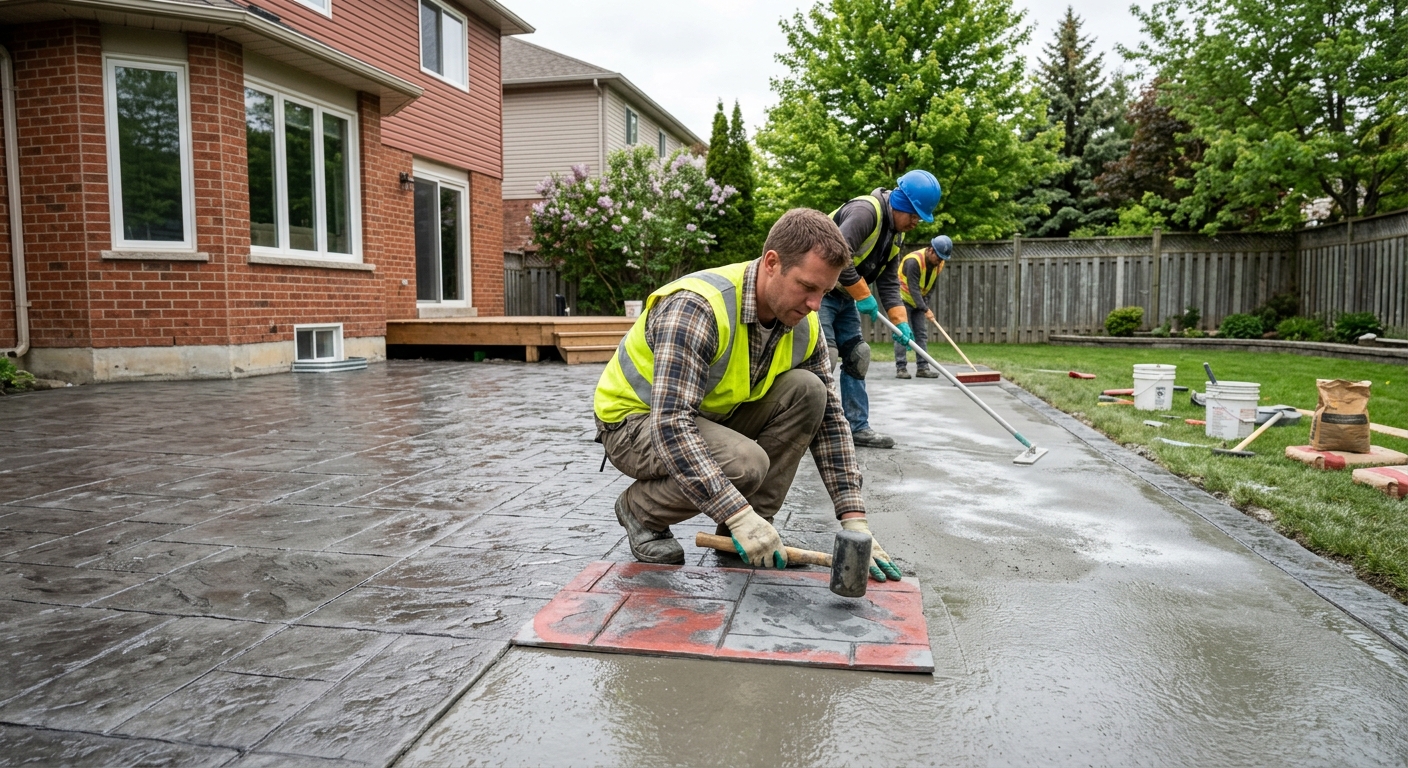
Concrete work options and costs in Queensborough
Concrete contractors in Queensborough build everything from simple slabs to engineered foundation work, and the cost usually starts with the type of application and the amount of site prep required. Queensborough’s housing stock is largely rooted in family neighbourhoods where long-lasting driveways and walkways are a daily expectation; in the broader Lower Mainland, single-detached homes make up about 31.9% of dwellings (Statistics Canada, 2021 Census). With a local population of about 11,000 (Statistics Canada, 2021 Census), the trade also stays busy—especially where homeowners are upgrading older flatwork and improving drainage before it damages adjacent landscaping.
In the Lower Mainland–Southwest, mild winters don’t eliminate cost drivers: the region still experiences frequent freeze–thaw cycles, saturated soils, and heavy coastal rainfall. Concrete work here is priced around a typical design frost depth of roughly 450 mm / 18", so footings and thickened edges are placed below that level to reduce frost heave risk. When rain is persistent, contractors must plan longer curing and protect surfaces to achieve design strength and durability—especially for exterior patios, garage slabs exposed to dampness, and driveways that get de-icing salt in shoulder seasons.
Demand is especially strong around the older residential pockets near the Queensborough waterfront and along the routes connecting local homes to Highway access, where homeowners tend to prioritize drainage improvements and low-maintenance finishes. Next, use the comparison table to align your scope with the right budget range for Queensborough projects.
| Application |
Typical Size |
Key Spec |
Finish Option |
Price Range |
| Concrete driveway (standard broom finish) |
480 sq. ft. (approx. 16' x 30') |
4" slab, compacted granular base, control joints, air-entrained mix |
Broom finish |
$8,600–$13,400 |
| Exposed aggregate driveway |
480 sq. ft. (approx. 16' x 30') |
4" slab, compacted base, air-entrained mix, polished aggregate exposure |
Exposed aggregate |
$10,900–$16,800 |
| Stamped concrete driveway or patio |
400 sq. ft. (approx. 20' x 20') |
4" slab (exterior), reinforced where needed, integral colour, release powder |
Stamped |
$8,800–$14,400 |
| Plain concrete patio or walkway |
250 sq. ft. (approx. 10' x 25') |
4" slab, compacted granular base, control joints |
Broom or smooth trowel (non-slip options) |
$4,100–$6,500 |
| Garage floor (interior slab) |
520 sq. ft. (approx. 22' x 24') |
4" slab, vapour control as applicable, reinforcement, sealed finish option |
Smooth trowel (option: light broom texture) |
$9,400–$15,000 |
| Foundation footings (structural, below frost) |
Typical single foundation wall section |
Excavation, forming, rebar, concrete placed below design frost line |
Structural concrete |
$3,800–$7,200 |
Prices are estimates only and vary by project scope, site access and material selection.
What affects the price of concrete work in Queensborough
In Queensborough and across the Lower Mainland–Southwest, two quotes for what looks like the same concrete job can vary by 30–50% because the scope is rarely identical once you account for base preparation, mix design, reinforcement, and curing/seasonal logistics. In other parts of British Columbia, the same material can still be similar, but labour productivity, excavation depth, and weather windows change—so contractors price in risk. For example, excavation and forming costs in colder regions rise as crews dig deeper and spend more time protecting concrete during cold snaps. Even here, coastal-wet conditions and freeze–thaw cycles mean contractors still plan for proper drainage, air-entrained mixes, and longer cure times, which affects scheduling and material costs.
Frost depth and freeze–thaw cycles dictate every spec: exterior work must be designed around a typical frost depth around 450 mm / 18" to prevent frost heave. That’s why footings and thickened edges are placed below that depth rather than “almost at grade.” Air-entrained concrete is essential for exterior slabs to manage scaling and surface damage from repeated wetting and cooling. When temperatures drop, cold-weather curing precautions (insulating blankets and/or heating blankets) can add cost; however, skipping them risks delayed strength gain and early cracking.
In Queensborough, a driveway replacement can move from a mid-band price to the higher end when drainage improvements are included (extra granular, sub-drain tie-ins, and regrading). A stamped driveway may cost noticeably more than broom-finish—sometimes near the higher side of the $22–$36 per sq. ft. decorative range—because colouring, stamping mats, and labour time are real. If you’re upgrading from plain patio work (often closer to the $16–$26 band) to a decorative finish, the extra cost is usually justified for curb appeal and reduced maintenance compared to patchy, poorly sealed surfaces.
| Price Factor |
Why It Matters |
Cost Impact |
| Frost line depth — determines footing depth and form height |
Controls excavation depth and minimum structural concrete cover to resist frost heave. |
High impact; deeper forming/excavation increases labour and disposal. |
| Site preparation — excavation, grading, compacted granular base |
Proper base prevents settlement and protects the slab from moisture. |
Medium to high; wet or rocky sites can add hours and truckloads. |
| Reinforcement — rebar or wire mesh requirement |
Improves load capacity and helps control cracking patterns. |
Medium; depends on slab thickness, intended loads, and design. |
| Mix design — air-entrainment and compressive strength spec |
Air content and strength influence scaling resistance and durability. |
Medium; exterior mixes cost more and require stricter placement. |
| Finish type — broom vs. stamped vs. exposed aggregate |
Finish determines labour time, tooling, and product system. |
Medium to high; decorative work uses specialized steps. |
| Pour size and concrete truck access to site |
Impacts how many loads, hose/pump requirements, and crew size are needed. |
High; poor access can add equipment and extra labour. |
| Cold-weather curing precautions — heating and blankets |
Protects early-age strength in cool, damp, or late-season weather. |
Medium; added materials/time to meet cure requirements. |
| Control joint pattern and sealing cost |
Limits random cracking and reduces water intrusion and de-icing salt damage. |
Low to medium; can prevent costly call-backs. |
Permits & regulations in British Columbia
In British Columbia, structural concrete work such as footings, foundation walls, grade beams, and other load-bearing elements typically requires a building permit, and engineered drawings are often reviewed through the municipality’s building process. Concrete flatwork—like patios, walkways, and driveways—usually does not require a permit by itself, unless it impacts lot grading, drainage planning, stormwater/impervious surface coverage limits, or municipal right-of-way requirements. Because waterfront and low-lying areas can be sensitive to runoff, it’s smart to confirm the specific conditions that apply to your lot before you break ground.
How homeowners in Queensborough can verify a contractor is properly set up:
- Check contractor licensing/registration through the province’s public online listings (search the contractor’s business name and/or individual trades as applicable).
- Request a certificate of liability insurance and verify the policy is current and matches the project address/scope.
- Ask for proof of workplace coverage where applicable (WSIB/WCB coverage depends on the contractor and workforce—ensure it’s in place for workers).
- Confirm the crew can supply job-specific references for similar concrete scopes (driveways, exterior slabs, or foundation prep).
- If structural concrete is involved, confirm who is taking responsibility for engineered drawings and permit coordination.
When in doubt—especially if you’re changing grading or adding drainage—ask the contractor to outline how they handle permits before scheduling the pour.
Getting concrete right in Queensborough's freeze-thaw climate
Concrete fails in Queensborough most often because moisture moves through an underprepared base and then expands/contracts through freeze–thaw cycles. In Lower Mainland–Southwest conditions, that translates to saturated soils, frequent wetting from coastal rainfall, and surface scaling when air content and curing aren’t right. To spec the job correctly, start with base preparation: compacted granular sub-base should be installed to the engineered depth for your subgrade, with proper grading and drainage to keep water from pooling under the slab.
Next, the mix design matters. For exterior flatwork, specify air-entrained concrete (commonly 5–7% air content for exterior work) and a minimum 32 MPa compressive strength. Then control joints: spacing should limit random cracking and guide where joints open so that moisture doesn’t infiltrate structural areas. Finally, curing: plan for a minimum 7-day curing period under proper conditions. In cool, damp shoulder seasons, crews may need curing blankets or temporary protection to reach strength safely. After the pour reaches full cure timing, apply a penetrating sealer (typically after 28 days) to repel de-icing salts and reduce water absorption.
Here’s a practical way to see value: if a plain patio is priced at the lower end of the typical $16–$26 band, but you add proper air-entrainment, correctly spaced control joints, and sealing, you’re paying for durability rather than decoration. Skipping sealing might save money upfront, but it increases the likelihood of surface deterioration where salt and puddling happen—so the “cheap” option often becomes a more expensive resurfacing later.
To avoid the most common failure—spalling from inadequate air-entrainment—ask your contractor to confirm the air content targets, the curing plan for rainy or cool days, and the joint spacing before any concrete is scheduled.
| Spec |
Why It Matters in Queensborough |
What to Ask For |
Impact if Skipped |
| Compacted granular base (depth?) |
Prevents settlement and helps drainage in wet, freeze–thaw conditions. |
Engineered base thickness and compaction method; confirm drainage grade away from the house. |
Uneven slab movement, early cracking, and moisture retention. |
| Air-entrained concrete mix (target air %?) |
Improves scaling and spalling resistance during freeze–thaw cycles. |
Confirm air content target (commonly 5–7% for exterior flatwork). |
Surface scaling/spalling and accelerated deterioration. |
| Compressive strength (MPa rating) |
Ensures durability and resistance to wear in damp coastal conditions. |
Minimum 32 MPa and verification of mix design documentation. |
Reduced strength gain, cracking, and lower long-term performance. |
| Control joints (spacing per ACI guidelines) |
Controls where cracks occur and limits water intrusion. |
Joint layout plan and spacing consistent with ACI-style guidance for slab thickness and exposure. |
Random cracking and higher chance of water getting under the slab. |
| Minimum 7-day curing period |
Allows strength development despite cool nights and high humidity. |
Curing method and protection plan (blankets/cover) when cool or rainy. |
Weak surface, increased cracking risk, and poor durability. |
| Penetrating sealer (when applied after cure) |
Repels water and helps protect against de-icing salts and repeated wetting. |
Sealer type and confirm application after full cure timing (commonly after 28 days). |
Higher absorption, faster wear, and more visible scaling. |
How to choose a concrete work contractor in Queensborough
Start by verifying British Columbia licensing/registration (and that the contractor’s business information matches the quote and invoice). Next, get proof of liability insurance and confirm coverage dates are current. For workplace coverage, ask for confirmation of WSIB/WCB coverage where applicable, and ensure the contractor will have insured workers on site. A reputable Queensborough crew should also provide job photos and references for similar exterior slabs and, if relevant, structural concrete scopes.
Then, request 2–3 itemised written quotes. You want a breakdown that separates labour and materials, and that clearly lists key items such as excavation depth, granular base quantities, reinforcement method (mesh vs. rebar), concrete mix type, jointing plan, finishing steps, and curing/protection. Be wary of quotes that only say “concrete supply and install” with no details. Also confirm what’s excluded: permit pull, disposal/dump fees, saw cutting for tie-ins, electrical/robotics for curing blankets, and any sub-drain or drainage work.
Warranty should be in writing: confirm workmanship warranty length and whether it covers cracking beyond control-joint lines, spalling, and uneven settlement. Ask if the product/manufacturer warranty applies to the specific concrete system or sealer and whether it’s transferable to future property owners.
Payment schedule matters: never pay more than 10–15% upfront. Hold back a portion until final inspection and cleanup are complete. Ask for a start date and completion estimate in writing, and build in weather contingencies for rain and cool nights typical of the Lower Mainland.
- Ask whether the concrete is air-entrained for exterior exposure.
- Request the target mix strength (MPa) and how it’s documented.
- Confirm the design frost-depth approach for footings/thickened edges where required.
- Ensure base prep includes compacted granular and drainage/grading details.
- Get joint layout spacing and a plan for sealing (if applicable).
- Ask who handles saw cutting, disposal, and any utility locating.
- Verify liability insurance and the certificate expiry date.
- Confirm workplace coverage (WSIB/WCB) for their crews.
- Review the quote for truck access, pumping/hosing method, and pour staging.
- Check if curing blankets or protection are included for cool/rainy days.
- Demand a clear schedule: start date, pour day, finish day, and cure/seal timing.
- Make sure the warranty terms are specific and not just “as per standard industry practice.”
In Queensborough, red flags include: vague pricing with no breakdown of base prep or mix design, refusing to confirm air-entrainment for exterior slabs, rushing the pour without a stated curing/protection plan, “low” decorative pricing that skips integral colour/release steps for stamped work, and warranty language that excludes cracking where control joints were not followed.
Frequently asked questions — concrete work in Queensborough
Stamped vs broom-finish concrete — cost difference?
In Queensborough, stamped concrete typically costs more than broom-finish because you’re paying for extra steps like integral colour, stamping mats, and additional finishing and detailing time. As a ballpark, stamped & decorative concrete commonly falls into the $22–$36 per sq. ft. range, while standard driveway/surface work is often closer to the $18–$28 band for plain concrete applications. If your contractor is quoting a driveway “close to plain,” ask what’s included: integral colour or just surface treatment, stamp release timing, and whether joints and sealing are still planned for freeze–thaw durability. In the Lower Mainland–Southwest, even decorative concrete still needs air-entrained mix and correct joint spacing; otherwise, the look may last less than expected.
When is the best time to pour concrete in Queensborough?
The best time is generally when you have stable temperatures and fewer prolonged rain periods. In Queensborough and the broader Lower Mainland–Southwest, crews commonly schedule pours to avoid cold nights that can slow early-age strength and increase surface issues, while also planning around rainfall that can delay finishing and affect curing. That said, because freeze–thaw cycles and coastal humidity are part of the year, reputable contractors build protection into the plan: curing blankets, surface protection, and sealing logistics. If you’re aiming for exterior flatwork, ask your contractor about their “weather window” approach and whether they’ll include cold-weather curing precautions if the forecast turns. For homeowners, that planning is often what separates a driveway that performs from one that needs patching sooner.
How long does concrete take to cure?
Concrete curing has two timeframes homeowners should know. The minimum curing period for safe strength development is typically at least 7 days under proper conditions, but full performance depends on mix, temperature, and protection during the early days. In Queensborough’s damp coastal setting, curing can be slower on cool nights, so crews may use insulating blankets or cover systems to keep conditions consistent. For sealing exterior concrete, many contractors apply penetrating sealer after the concrete has fully cured—often around 28 days—so the sealer can bond to a stable, dry surface and better repel water and de-icing salts. If your contractor is trying to seal immediately after the pour on a rainy timeline, ask how they’ve verified the surface is ready for sealing.
Do I need a permit for concrete work in British Columbia?
In British Columbia, structural concrete work such as footings, foundation walls, and grade beams typically requires a building permit and often engineered drawings reviewed through the municipality’s process. Concrete flatwork—like a driveway, patio, or walkway—usually does not require a permit by itself, unless it affects lot grading, drainage plans, impervious surface coverage considerations, or municipal right-of-way concerns. Because Queensborough projects can involve runoff management near older neighbourhood drainage patterns, it’s smart to confirm whether your specific work changes drainage or affects how water flows on the lot. Practically, you should ask your contractor to confirm whether a permit is required for your scope and to clearly state in the quote whether permit pulling and related documentation are included.
Concrete vs pavers for a patio in Queensborough?
Concrete and pavers both work well for patios, but the “best” choice depends on how your patio is exposed to moisture and how much movement you expect from the base. Concrete patio costs often land in the $16–$26 per sq. ft. range for plain work, and it can be a more continuous, easier-to-maintain option when the base is properly compacted and the joints are correctly planned for freeze–thaw. Pavers can be excellent aesthetically and allow section-by-section repairs, but they depend heavily on the base structure and edging restraint to prevent shifting during wet seasons. In Queensborough’s coastal-wet climate, ask about drainage grading either way, and ensure joints and sealing are addressed for concrete. If you want a clean, durable finish without many individual units, concrete frequently wins.
How long does a concrete driveway last?
With proper base prep, air-entrained mix, correct jointing, and good curing, a concrete driveway in Queensborough is often expected to perform for decades—many homeowners see long service when drainage and de-icing salt exposure are managed. The Lower Mainland–Southwest climate can still be hard on concrete due to freeze–thaw cycles and persistent moisture, so the “lifespan” is tied to details: whether the contractor placed slab thickness and base depth appropriately, used proper air content (commonly 5–7% for exterior work), and planned sealing when needed. Budget also matters—if your driveway quote is near the lower end of the $18–$28 band, confirm what’s included (granular depth, reinforcement, curing protection, and sealing). Cutting corners on base prep or air-entrainment is what typically shortens lifespan and leads to scaling.