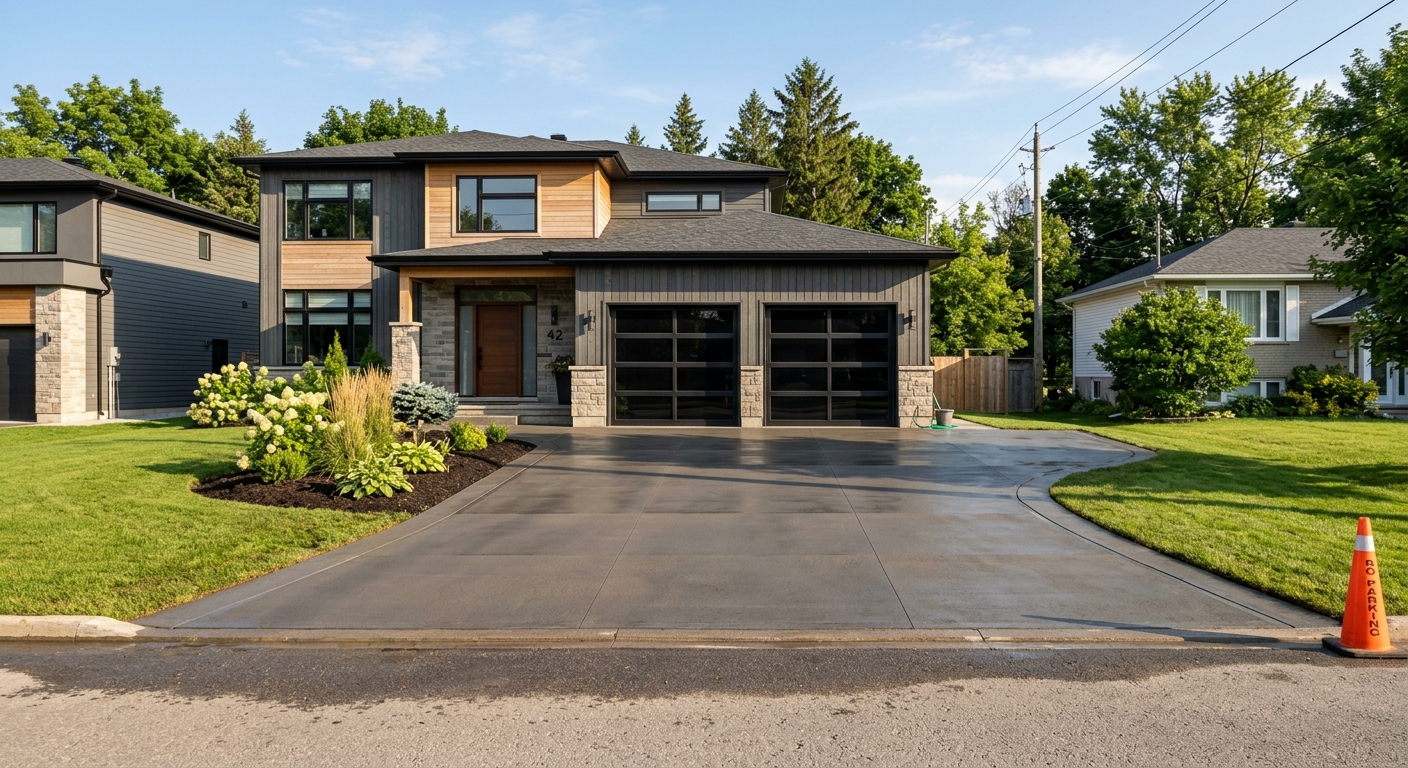
Concrete work options and costs in Coal Harbour
Concrete contractors in Coal Harbour, British Columbia typically get asked about driveway and patio work first, because the flatwork affects curb appeal, drainage, and winter durability. With a population of 10,441 in the area (Statistics Canada, 2021 Census), the local customer base is small but steady, and many homeowners are focused on maintaining older coastal properties and waterfront-access lots. The Lower Mainland–Southwest market also includes a mix of housing types, and concrete flatwork demand is especially strong where renovations are frequent—think established neighbourhood pockets around the Coal Harbour waterfront and nearby harbourfront streets. (Statistics Canada, 2021 Census)
In the Lower Mainland–Southwest, costs are shaped by mild winters paired with a shallow frost line and frequent coastal-wet conditions. In practice, local specs often assume a frost depth around 450 mm / 18", so footings and thickened edges are placed below that level to reduce frost heave risk. Contractors also plan around prolonged rain, cool nights, and high humidity, which can slow curing; that’s why air-entrained mixes, proper drainage, and curing blankets or sealers show up in most reliable budgets.
You’ll also see differences in availability and scheduling between contractors because some crews focus on structural work (foundations, piers, grade beams), while others specialize in decorative surfacing (stamped or exposed aggregate). If you’re comparing bids, use the table below as your baseline, then align each quote to the same specs—base depth, mix, joints, and curing—before you judge price.
| Application |
Typical Size |
Key Spec |
Finish Option |
Price Range |
| Concrete driveway (standard broom finish) |
400–500 sq. ft. (approx. 20' x 20') |
Air-entrained exterior mix, compacted granular base |
Broomed, control joints, seal-ready surface |
$18,000–$28,000 |
| Exposed aggregate driveway |
400–500 sq. ft. (approx. 20' x 20') |
Air-entrained mix, correct exposure timing |
Exposed aggregate, densifier/sealer recommended |
$22,000–$34,000 |
| Stamped concrete driveway or patio |
300–450 sq. ft. |
Air-entrained mix, integral colour or base colour system |
Stamped pattern, release agent, seal coat |
$24,000–$42,000 |
| Plain concrete patio or walkway |
200–300 sq. ft. |
Air-entrained mix, drainage slope, joints |
Float/skim then light broom, edges |
$8,000–$18,000 |
| Garage floor (interior slab) |
400–550 sq. ft. |
Vapour barrier (if specified), mesh/rebar as required |
Standard trowel finish or broom as needed |
$16,000–$30,000 |
| Foundation footings (structural, below frost) |
House perimeter: varies by design |
Excavation to design depth below frost, rebar as required |
Structural concrete only (no decorative finish) |
$20,000–$55,000 |
Prices are estimates only and vary by project scope, site access and material selection.
What affects the price of concrete work in Coal Harbour
In the Lower Mainland–Southwest, quotes for what looks like the “same” concrete job can swing 30–50% because specs are rarely identical—especially in a wet coastal climate. A driveway bid can differ dramatically between contractors if one includes deeper excavation below frost, proper subdrainage, and air-entrained concrete with the correct joint pattern, while another trims those items to hit a lower number. That same pattern shows up across British Columbia: contractors farther north or in colder regions commonly face deeper seasonal ground impacts and shorter pour windows, which raises labour and curing-related costs. In Coal Harbour, you may still avoid the deepest frost values seen inland, but we still build for freeze–thaw cycles and saturated soils, so the details that prevent cracking and scaling aren’t optional.
Here’s the practical part: local practice typically assumes a frost depth around 450 mm / 18", and exterior footings and thickened edges are placed below that to prevent frost heave. Exterior slabs also require air-entrained mixes to manage freeze–thaw damage and scaling risk. When crews pour in cool, humid weather, they may need curing blankets or longer cure times to reach design strength—both add cost. On top of that, de-icing salts (even when used minimally) can accelerate surface spalling, so sealing is a sensible line item rather than an upsell.
Two common examples from Coal Harbour: (1) a “standard” patio that skips engineered base prep can look fine in year one, then heave or settle near doorways—often turning a repair into a larger rebuild; (2) switching from a broom finish to stamped or exposed aggregate can add meaningful labour and material handling, which is where stamped/exposed budgets often land in the $22–$36 per sq. ft. range (depending on scale and base requirements). If you’re budgeting for flatwork, a plain driveway/flatwork budget typically aligns with the $18–$28 per sq. ft. backbone, while decorative systems land higher because of additional finishing steps and sealer materials.
| Price Factor |
Why It Matters |
Cost Impact |
| Frost line depth — determines footing depth and form height |
Footings must extend below design frost depth to reduce heave |
Higher excavation and forming costs if deeper than assumed |
| Site preparation — excavation, grading, compacted granular base |
Controls settlement and manages coastal-wet drainage |
More granular, more labour; better stability reduces future repairs |
| Reinforcement — rebar or wire mesh requirement |
Improves slab performance and reduces cracking (when detailed correctly) |
Cost rises with steel, chairs/supports, and placement labour |
| Mix design — air-entrainment and compressive strength spec |
Air-entrainment helps resist freeze–thaw scaling and spalling |
More expensive mix + quality control at batching/pour time |
| Finish type — broom vs. stamped vs. exposed aggregate |
Finishing complexity changes labour time and material systems |
Stamped/exposed typically costs more than plain broomed |
| Pour size and concrete truck access to site |
Traffic control, line pumping, or wheelbarrowing changes effort |
Limited access can add pump charges and extra labour hours |
| Cold-weather curing precautions — heating and blankets |
Ensures strength gain in cool nights/high humidity |
Heating/blanket rental and longer scheduling adds cost |
| Control joint pattern and sealing cost |
Joints guide cracking; sealing protects from salts and water |
Proper saw-cut/seal products increase material and labour but reduce failures |
Permits & regulations in British Columbia
In British Columbia, the rule of thumb is: structural concrete work generally needs a permit, while most concrete flatwork does not—unless it triggers grading, drainage, or surface coverage concerns. Typically, permits are required for concrete involved in foundations and structural systems such as footings, foundation walls, grade beams, and engineered foundation components. Municipalities often require engineered drawings reviewed as part of the permit process. For flatwork like driveways, patios, sidewalks, and walkways, permits are often not required unless the project affects lot grading, stormwater and drainage, impervious surface limits, or impacts the municipal right-of-way.
For a Coal Harbour homeowner, the verification steps should be practical. First, ask your contractor for their BC licence documentation (as applicable to the scope), then request their certificate of liability insurance and confirm the coverage limits match the job size and site conditions. Next, ask for proof of worker coverage under the WCB/WCB-equivalent (or the applicable provincial coverage evidence) and ensure it’s current for the crew doing the concrete work. If you can’t get clear documentation up front, that’s a red flag.
Then confirm with the local authority whether a permit is needed before breaking ground—especially if you’re adjusting slopes, touching drainage, or adding new impervious area near the house. Finally, get clarity on who pulls the permit (if required) and what the inspection checkpoints are.
Getting concrete right in Coal Harbour's freeze-thaw climate
Concrete failures in Coal Harbour usually come down to three things: water management, mix durability, and curing timing. Even though the frost depth is shallower in coastal BC (local practice often assumes about 450 mm / 18"), freeze–thaw cycles and saturated soils still stress exterior slabs. If the base isn’t compacted to the right depth or if drainage isn’t handled, the slab can settle, and that creates stresses where cracking starts. If the mix isn’t air-entrained, freeze–thaw scaling and surface spalling become much more likely—especially when de-icing salts are used on driveways.
To spec the job correctly in Coal Harbour, insist on: (1) base preparation with compacted granular sub-base to the required level for your soil and frost protection needs; (2) a mix design with air-entrainment typically in the 5–7% range for exterior flatwork, plus a minimum 32 MPa compressive strength spec; (3) a control joint plan that limits random cracking; (4) curing with at least 7 days under proper conditions, which is critical when cool nights and high humidity slow strength gain; and (5) sealing with a penetrating sealer applied about 28 days post-pour to help repel de-icing salts and water.
Here’s a concrete example: if a contractor quotes you a lower price on a broom-finished patio but skims on base compaction or uses the wrong mix, the “savings” can disappear quickly. In practice, adding proper base prep and air-entrainment typically aligns with the standard flatwork bands (for plain patios/walkways commonly around $16–$26), while the cost to remove and rebuild a failing slab is many times higher.
Use these questions to avoid the most common failure: “What air content are you targeting, who verifies it, and what joint spacing are you using?” That one conversation often determines whether your patio survives the next winter well.
| Spec |
Why It Matters in Coal Harbour |
What to Ask For |
Impact if Skipped |
| Compacted granular base (depth?) |
Stable support to handle coastal wetting and shallow frost effects |
Base thickness to design, compaction method, drainage consideration |
Settlement, cracking near edges, and uneven surfaces |
| Air-entrained concrete mix (target air %?) |
Resists freeze–thaw scaling and spalling in exterior exposure |
Target air content (commonly 5–7% for exterior flatwork) |
Surface deterioration and premature scaling |
| Compressive strength (MPa rating) |
Affects durability and long-term performance in wet/cool conditions |
Minimum 32 MPa (or higher if your engineer/spec requires) |
Lower strength gain; increased cracking and durability loss |
| Control joints (spacing per ACI guidelines) |
Guides cracking to intended locations in slabs exposed to cycling |
Joint spacing plan + saw-cut timing |
Random cracks, water infiltration, and faster deterioration |
| Minimum 7-day curing period |
Strength gain is slower in cool, humid weather |
How curing blankets/conditions will be managed in rainy periods |
Weak surface, higher risk of scaling and cracking |
| Penetrating sealer (when applied after cure) |
Helps repel water and de-icing salt intrusion during winters |
Sealer type and timing (about 28 days post-pour) |
More moisture movement and accelerated surface wear |
How to choose a concrete work contractor in Coal Harbour
Choosing the right concrete contractor in Coal Harbour is less about flashy photos and more about paperwork, workmanship details, and jobsite discipline. Start with licensing and credentials relevant to the scope you’re hiring for, then verify liability insurance. Ask for a certificate of insurance and confirm the coverage dates match the project period and that the named insured aligns with the company you’re paying. Next, request proof of worker coverage under WCB/WCB-equivalent for the crews who will pour and finish—this protects you if an injury happens on your property.
Then get 2–3 itemised written quotes that break down labour and materials (concrete, rebar/mesh, base prep, joints, disposal, sealers/curing blankets). Don’t accept “lump sum only” unless it’s paired with a detailed scope—what’s included and what’s excluded. Make sure each quote includes whether permits are required and who pulls them when structural concrete is involved. Confirm disposal and haul-away: removing old concrete can be a substantial hidden cost if it isn’t specified.
Warranty matters too. Ask for the workmanship warranty length, whether there’s a separate product/manufacturer warranty, and if that warranty is transferable if you sell the home. For payment, a good rule is: never pay more than 10–15% upfront; hold a portion until the job is complete and cleanup is done. Finally, require a written timeline with a start date and completion estimate—especially important in Coal Harbour when rain and cool nights can affect curing and scheduling.
- Confirm the contractor’s coverage documents before you sign anything (liability insurance + WCB/WCB-equivalent proof).
- Ask who supplies the concrete and what mix spec is being used (air-entrainment and strength).
- Require base prep details: excavation depth, granular type, and compaction method.
- Verify reinforcement: rebar/mesh type, size, and support (“chairs”) to keep steel at the right elevation.
- Get joint spacing and saw-cut timing in writing.
- Ask how curing will be handled in rainy/cool conditions (blankets/sealers/curing procedures).
- Confirm whether sealing is included and when it will be applied (typically after cure).
- Request disposal/haul-away included or listed separately.
- Check access logistics: truck placement, pumping needs, protection of landscaping and property.
- Require an itemised materials-and-labour breakdown, not just a total price.
- Review warranty terms in plain language (workmanship, exclusions, and timelines).
- Lock in a payment schedule with a holdback until final cleanup and walk-through.
Concrete red flags in Coal Harbour include: quotes that don’t specify air-entrainment or joint plan, “too-good-to-be-true” prices that omit base compaction, contractors who won’t discuss curing blankets or minimum curing time, unclear insurance/WCB coverage, and failure to explain how they’ll protect the slab from rain during early strength gain.
Frequently asked questions — concrete work in Coal Harbour
Do I need a permit for concrete work in British Columbia?
In British Columbia, it depends on what you’re building. Concrete work that is part of the structure—such as footings, foundation walls, and grade beams—usually requires a building permit and often engineered drawings reviewed through the municipal process. Many flatwork projects like patios, walkways, and driveways typically do not require a permit unless they change lot grading, affect stormwater/drainage, exceed impervious surface expectations, or impact the municipal right-of-way. For Coal Harbour homeowners, the quickest path is to ask the contractor whether permits are required for your scope and then confirm directly with the local authority before breaking ground. Also verify your contractor carries current liability insurance and worker coverage (WCB/WCB-equivalent) before work begins.
Concrete vs pavers for a patio in Coal Harbour?
Concrete and pavers can both perform well in Coal Harbour, but the decision often comes down to maintenance expectations and how each system handles freeze–thaw and coastal wetting. Concrete patios are one continuous surface, so if you get the base prep, joints, and air-entrained mix right, they tend to age predictably. Pavers can shift if the bedding and drainage aren’t engineered, though they’re often easier to repair area-by-area. Cost-wise, plain concrete patio work commonly sits around $16–$26 per sq. ft., while decorated concrete (stamped/exposed) typically costs more. If you expect heavy seasonal water exposure near the house, a sealed, properly jointed concrete slab can be a durable choice. If you want easy spot repairs later and prefer varied colour/texture, pavers may suit you—just ensure the contractor addresses drainage and compaction.
How long does a concrete driveway last?
A well-built concrete driveway in Coal Harbour can last 20–30 years or more, mainly because the mix durability, base preparation, and joint/sealing strategy determine how it survives wet seasons and freeze–thaw cycles. Exterior driveways need air-entrained concrete and correctly planned control joints to manage cracking. Sealing—usually after curing—also helps repel water and reduce surface wear when de-icing salts are used. If a contractor cuts corners on excavation depth below design frost protection or skips proper granular base compaction, you may see heaving, scaling, or spalling much sooner. Budgeting within the typical driveway range helps ensure specs aren’t downgraded; local backbone pricing for concrete driveway/flatwork commonly lands around $18–$28 per sq. ft., with decorative finishes costing more.
What is air-entrained concrete and why does it matter here?
Air-entrained concrete is mixed with tiny, evenly distributed air bubbles designed to provide “space” for water to expand during freeze–thaw cycles. In British Columbia’s Lower Mainland–Southwest, even with a shallower frost line (often planned around ~450 mm / 18"), exterior concrete still experiences temperature swings and moisture exposure. Without adequate air entrainment, water can freeze inside the concrete and cause surface scaling or spalling. That’s a major reason quotes should specify the air content target and not just “regular concrete.” For exterior flatwork in Coal Harbour, contractors commonly target roughly 5–7% air and include proper control joints and curing. Ask how they confirm the mix spec at batching and what curing plan they’ll use during cool, humid, rainy periods.
How do I prepare the base for a concrete slab?
Base prep is where most driveway and patio performance is won or lost, especially in Coal Harbour’s wet coastal climate. A proper base typically starts with excavation to the required depth, followed by grading and installing compacted granular to support the slab and manage moisture movement. The exact depth depends on your soil conditions and how the project is designed for frost protection, but the principle is consistent: provide a stable, well-compacted foundation and address drainage so the slab doesn’t sit on saturated, weak material. Your contractor should explain granular depth, compaction method, and whether additional drainage measures are needed. Also confirm steel support (rebar/mesh chairs) if reinforcement is included. When base prep is skipped or rushed, you can get settlement and random cracking, and the slab’s expected life drops fast.
How do I compare concrete quotes?
Comparing concrete quotes in Coal Harbour is mostly about making sure you’re comparing the same scope and specs. Start by requesting itemised quotes that separate labour, concrete supply, base prep, reinforcement, finishing, sealing, and disposal. Then verify each quote includes: base preparation details (depth and compaction), air-entrained concrete with a stated air target, minimum compressive strength (often 32 MPa for many flatwork specs), control joint plan, and curing procedures. Finally, check access and scheduling: limited truck access or rain-cure precautions can change the actual labour/time requirement. As a benchmark, plain patio/flatwork pricing commonly aligns with $16–$26, and driveways typically follow about $18–$28 per sq. ft. If a bid is far below that without explaining missing items, it often means key durability steps were excluded.