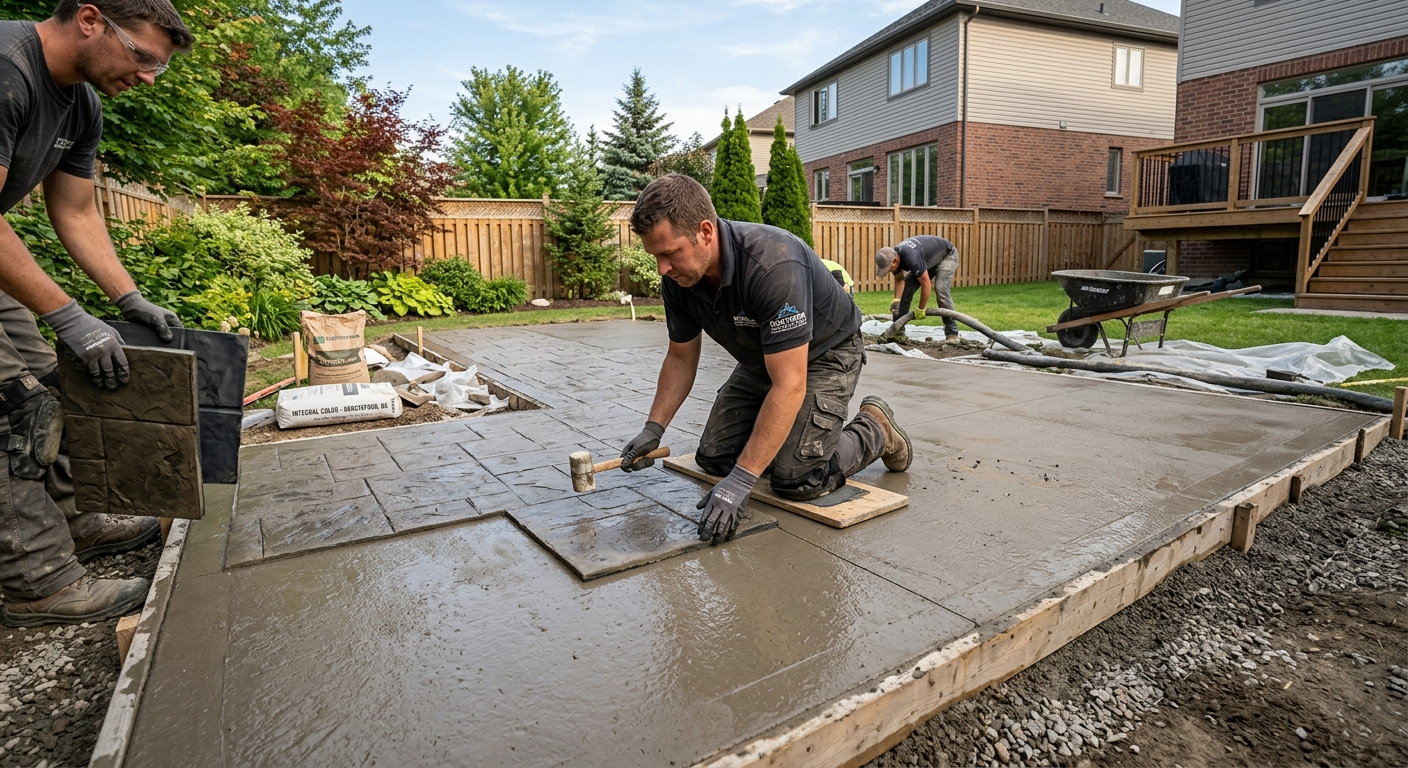
Concrete work options and costs in Oakalla
In Oakalla, concrete flatwork is a practical upgrade for homeowners—especially in a neighbourhood that’s seeing steady infill and exterior renovations. With a population of 1,577 (Statistics Canada, 2021 Census), the market is small enough that scheduling can be tight, and the crews that do driveways and patios often get booked around school-year lead times and weather windows. Oakalla’s housing stock is also dominated by single-detached living patterns, which typically means more demand for driveways, front walks, and backyard patios that sit through the Lower Mainland–Southwest’s cool, wet seasons. (Statistics Canada, 2021 Census)
In the Lower Mainland–Southwest, mild winters and a shallow frost line still matter because freeze–thaw cycles plus coastal rainfall can saturate soils and attack poorly drained edges. Typical concrete design in this region assumes a frost depth around 450 mm (about 18"), so footings and thickened edges are placed below that line to reduce frost heave. That means excavation and base prep are not “optional” extras—they’re directly tied to durability. Curing also costs time: prolonged rain, cool nights, and high humidity can slow strength gain, so contractors often plan for longer cure windows, curing blankets, and sealing to protect surfaces.
In Oakalla, you’ll often see higher demand around the Oxbow/Deer Lake-side corridors where homeowners commonly update driveways and entryways. From there, the best way to compare contractor options is to look at application, thickness expectations, and finish type—then use the price ranges below as your baseline.
| Application |
Typical Size |
Key Spec |
Finish Option |
Price Range |
| Concrete driveway (standard broom finish) |
240–320 sq. ft. |
Air-entrained mix, compacted base, control joints |
Broomed surface, sawcut joints, basic edging |
$18,000–$28,000 |
| Exposed aggregate driveway |
240–320 sq. ft. |
Air-entrained mix, proper curing, consistent wash timing |
Exposed aggregate (broom-wash/crushed stone look) |
$22,000–$36,000 |
| Stamped concrete driveway or patio |
200–300 sq. ft. |
Air-entrained mix, release agents, colour hardeners |
Stamp pattern + colour (anti-slip sealer recommended) |
$22,000–$40,000 |
| Plain concrete patio or walkway |
120–220 sq. ft. |
Air-entrained mix, drainage slope, control joints |
Float + light broom, basic staining optional |
$16,000–$26,000 |
| Garage floor (interior slab) |
300–480 sq. ft. |
Vapour barrier (as required), mesh or fibres, proper base |
Steel trowel finish, or broom finish if preferred |
$19,000–$34,000 |
| Foundation footings (structural, below frost) |
Varies by house footprint |
Below design frost depth (~450 mm/18" region assumption), rebar cage |
Structural finish (no decorative surface) |
$200,000–$350,000 |
Prices are estimates only and vary by project scope, site access and material selection.
What affects the price of concrete work in Oakalla
In the Lower Mainland–Southwest, two contractors can price what looks like the same concrete job 30–50% apart because concrete isn’t just “pouring a slab”—it’s designing for freeze–thaw durability, managing drainage, and sequencing work around rain and curing. Even within British Columbia, the pricing profile changes with frost behaviour, soil moisture, and how long crews can reliably pour and finish. In colder regions you typically see deeper excavations and shorter pour seasons, which drives up excavation, forming, and curing labour. In Oakalla specifically, the frost line is shallower than interior provinces, but the shallow frost depth (regionally around 450 mm/18") still influences footing and thickened-edge requirements, and saturated soils amplify freeze–thaw damage risk. (Statistics Canada, 2021 Census)
For exterior flatwork, the big spec cost drivers are the air-entrained mix and the base preparation. Air-entrainment helps concrete resist freeze–thaw scaling and spalling; without it, the surface can deteriorate faster, especially where de-icing salts and wet cycles combine. You’ll also see different numbers on finishing: a plain broom driveway typically tracks the region’s driveway slab baseline of about $18,000–$28,000 for a typical sized pour, while decorative options like stamped concrete often move into the $22,000–$36,000 range depending on pattern complexity, thickness, and colour system.
In Oakalla, local conditions raise or lower costs in concrete-ready ways: (1) a poorly draining subgrade or frequent ponding can add granular drainage and slope corrections; (2) tight access (narrow lanes, trees, or steep driveways) can require smaller equipment, more labour hours, or alternate truck placement; (3) older homes with thicker edges or limited removal access can increase demo and disposal. And because many Oakalla properties were renovated over time, you may find mismatched elevations—raising the scope to re-level edges and adjust approaches rather than “just topping up.”
| Price Factor |
Why It Matters |
Cost Impact |
| Frost line depth — determines footing depth and form height |
Footings and thickened edges must sit below design frost depth to limit frost heave. |
Higher excavation and forming complexity; can swing the structural portion substantially. |
| Site preparation — excavation, grading, compacted granular base |
Proper sub-base reduces settlement and prevents water from undermining edges. |
More over-excavation and granular/compaction labour increases cost. |
| Reinforcement — rebar or wire mesh requirement |
Controls cracking under loads and improves slab performance. |
Material and labour add cost, especially for larger garage slabs. |
| Mix design — air-entrainment and compressive strength spec |
Air-entrainment is critical for freeze–thaw resistance in exterior concrete. |
Specialty mix and batch verification can raise concrete material cost. |
| Finish type — broom vs. stamped vs. exposed aggregate |
Decorative finishing increases labour time and product systems (release, colour, wash timing). |
Stamped/exposed options often add a meaningful premium. |
| Pour size and concrete truck access to site |
Long carries, limited reach, and multiple chute placements increase labour. |
Truck logistics can add labour and may require smaller-volume batching strategies. |
| Cold-weather curing precautions — heating and blankets |
Cool nights slow strength gain; curing protection helps reach design performance. |
Added materials and labour can increase costs during shoulder seasons. |
| Control joint pattern and sealing cost |
Joints manage shrinkage cracking; sealing reduces moisture and salt intrusion. |
Precision sawcutting and sealer application are extra line items. |
Permits & regulations in British Columbia
In British Columbia, structural concrete work such as footings, foundation walls, grade beams, and other load-bearing foundation elements generally requires a building permit and is often supported by engineered drawings that the municipality reviews. For concrete flatwork—patios, walkways, and many driveways—permits are commonly not required unless the work affects lot grading, alters impervious surface coverage in a way that triggers stormwater requirements, or touches municipal right-of-way rules (for example, work near a boulevard, sidewalk tie-ins, or driveway approaches).
Before breaking ground in Oakalla, confirm the scope with the local authority and ask your contractor to clearly state whether any permits or inspections are required for your project. Also verify the contractor carries liability insurance and has the appropriate workplace coverage (commonly referenced as WSIB/WCB coverage depending on their work and registration). Request references from homeowners with similar scope—especially projects that had comparable access, thickness, and drainage conditions.
Step-by-step checks for an Oakalla homeowner:
- Ask for the contractor’s licence information (and trade/registration details where applicable) and compare it to the online registry listing.
- Request a current certificate of insurance showing general liability and the correct project address or named insured.
- Ask for proof of coverage (WSIB/WCB as applicable) and confirm the dates are valid for your scheduled work window.
- Get it in writing: who pulls the permit (if required), who schedules inspections, and what is excluded.
- Confirm the contractor understands local freeze–thaw specs: air-entrained concrete, sub-base compaction, and control joints.
Getting concrete right in Oakalla's freeze-thaw climate
Concrete fails in Oakalla’s freeze–thaw climate mainly when water finds a path into the slab or subgrade—then expands during cold cycles and repeats it. If the base isn’t compacted to the right depth, if drainage is missing, or if the mix isn’t air-entrained, you can see scaling, surface spalling, and uncontrolled cracking. The fix is not “a thicker slab”—it’s the full system: base prep, mix design, jointing, curing, and sealing.
For Oakalla exterior flatwork, spec the base first. That means compacted granular sub-base to suit local soil conditions and to sit in the frost-protected zone (regionally anchored to a frost depth around 450 mm/18"). Next, require an air-entrained exterior mix with typical target air content around 5–7% (as delivered for the exposure). Pair that with a minimum compressive strength of 32 MPa for many driveway and patio applications. Third, add control joints with spacing designed to limit random cracking—then sawcut promptly and seal later if recommended for the exposure.
Curing is where homeowners often lose durability. Concrete needs at least 7 days curing under proper conditions. In cool, humid Lower Mainland weather, contractors may use curing blankets and tighter temperature control to protect early-age strength gain. Finally, apply a penetrating sealer after the concrete cures (commonly around 28 days post-pour) to repel de-icing salts and reduce moisture penetration.
Is the price difference justified? Yes—often a standard broom driveway in the $18,000–$28,000 band costs less than stamped concrete in the $22,000–$36,000 band, but if your driveway sees heavy winter wetting and you choose decorative finishes, insist the same durability specs (air-entrainment, joints, curing, sealing) are included—not traded away to “fit the budget.”
| Spec |
Why It Matters in Oakalla |
What to Ask For |
Impact if Skipped |
| Compacted granular base (depth?) |
Reduces settlement and prevents water from undermining edges during wet seasons. |
Ask for granular base thickness and compaction method (proof by lift thickness/coverage). |
More cracking, uneven slab, and edge deterioration after freeze–thaw cycles. |
| Air-entrained concrete mix (target air %?) |
Air-entrainment improves freeze–thaw durability where surface scaling risk is higher. |
Ask for target air content typically 5–7% for exterior flatwork and record of batch parameters. |
Spalling and scaling can appear sooner, especially with salt exposure. |
| Compressive strength (MPa rating) |
Strength gain supports performance under loads and exposure conditions. |
Ask for minimum 32 MPa (or higher if engineered by the design). |
Surface wear, reduced longevity, and poorer resistance to cracking. |
| Control joints (spacing per ACI guidelines) |
Controls shrinkage cracking so cracks form where they can be managed. |
Ask for joint spacing and timing (sawcut schedule) appropriate to your slab dimensions. |
Random cracks that allow water ingress and freeze–thaw damage. |
| Minimum 7-day curing period |
Ensures design strength and surface integrity in cool/wet Lower Mainland conditions. |
Ask how temperature/humidity will be managed; confirm blankets or curing protection in cold spells. |
Weak, porous concrete that scales and deteriorates faster. |
| Penetrating sealer (when applied after cure) |
Helps repel moisture and reduce salt penetration for exterior durability. |
Ask for a penetrating sealer applied after cure—commonly around 28 days post-pour. |
Higher moisture/salt absorption leading to spalling and surface breakdown. |
How to choose a concrete work contractor in Oakalla
Choosing the right concrete contractor in Oakalla is about verification and clarity, not just a low number. Start with British Columbia licensing/registration: ask for their current licence information and then confirm it through the relevant online registry. Next, request proof of general liability insurance—your certificate of insurance should show the correct business, policy limits, and that you’re protected for the period of the work.
For coverage, ask for WSIB/WCB proof (as applicable based on the contractor’s registration and the nature of the work). Don’t accept “it’s covered” verbally—request the certificate, check the dates, and ensure the coverage will remain active during your scheduled pour and completion window.
Then get 2–3 itemised written quotes that break down labour and materials (not just one lump sum). Look specifically for what’s included: excavation and disposal, granular base and compaction, reinforcement (mesh or rebar), the exact concrete mix spec (air-entrainment and strength), formwork, control joints, curing plan, and whether sealing is included. Also ask whether permit pull and any required inspections are included or excluded. A solid workmanship warranty should be written (and realistic), separate from manufacturer product warranties for sealers or decorative systems; ask if warranties are transferable to future owners.
For payment, never pay more than 10–15% upfront. Hold back remaining funds until completion, punch list items, and—where applicable—sealer is applied. Finally, insist on a start date and completion estimate in writing, with weather contingency language for curing and rain delays.
- Confirm BC registration/licence details via the online registry before booking.
- Verify current general liability insurance via a certificate of insurance.
- Request WSIB/WCB coverage proof (as applicable) with valid dates.
- Ask for 2–3 itemised quotes with labour + materials breakdown.
- Confirm excavation scope: removal thickness, disposal, and haul distance allowances.
- Check base spec: granular depth and compaction method, not just “good base.”
- Verify reinforcement: mesh vs. rebar, placement and coverage in the slab.
- Require mix details: air-entrainment target for exterior flatwork and strength spec (e.g., 32 MPa).
- Confirm control joint plan: spacing and sawcut timing for your dimensions.
- Ask about curing protection in cool/wet periods (blankets, sealers timing, temperature management).
- Clarify sealing: penetrating sealer inclusion and when it’s applied after cure (often around 28 days).
- Review warranty terms in writing and ask what’s excluded for homeowner maintenance (e.g., sealing intervals).
In Oakalla, concrete red flags include: vague “we’ll use concrete” wording with no air-entrainment/strength spec, skipping or delaying sawcuts and jointing, poor drainage promises (especially where the base is left insufficient), contractors asking for large upfront payments, and no written curing plan for cool, rainy weather that can affect early strength gain.
Frequently asked questions — concrete work in Oakalla
What is air-entrained concrete and why does it matter here?
Air-entrained concrete is mixed with tiny, evenly distributed air bubbles that give water a place to expand when freezing happens. In Oakalla and across the Lower Mainland–Southwest, exterior slabs still experience freeze–thaw cycles when moisture is trapped under or around the surface and edges. That’s why quotes should specify air-entrainment for driveways, patios, and walkways. If it’s not included, you’re more likely to see surface scaling and spalling over time—especially where de-icing salts are used. When you compare quotes, don’t just look at the total: confirm the air-entrainment target and that the contractor is using an exterior exposure mix. For a typical broom-finished driveway, prices often land around $18,000–$28,000, but durability depends more on mix quality and jointing than on appearance alone.
How do I prepare the base for a concrete slab?
Base preparation starts with correct excavation and grading so water can’t pond and undermine the slab. For Oakalla, contractors typically remove organic material, then place compacted granular base in lifts and compact to a specified density (not just “we tamped it”). The goal is a stable, well-draining foundation that sits in the frost-protected zone and supports loads without settlement. Ask your contractor how much granular base depth you’re getting and how they’ll handle soft or saturated subgrade—if they see pumping or mud during rain, the scope usually increases with drainage or deeper replacement. A properly prepped base is a major reason exterior slabs last, particularly through humid, wet seasons and repeated cold nights. This is also where quotes can vary significantly, because scope and compaction quality drive labour and material costs.
How do I compare concrete quotes?
Start by comparing quotes line-by-line, not by total price. Ask each contractor to provide an itemised breakdown: excavation and disposal, granular base thickness and compaction, reinforcement type (mesh or rebar), the exact concrete spec (air-entrained for exterior exposure and minimum compressive strength), and the finishing method. For driveways and patios, confirm control joint spacing and whether sawcut timing is included. Then compare the curing and sealing plan—this matters in Oakalla’s cool, wet conditions. Many homeowners end up surprised when one quote includes sealing and proper curing protection and another doesn’t. Use the local price bands as a sanity check: a standard driveway slab commonly sits around $18,000–$28,000, while stamped options often trend higher, like $22,000–$36,000, depending on thickness and design complexity. If a “decorative” quote is too close to a basic broom finish, ask what they’re leaving out.
Can concrete be poured in cold weather in Oakalla?
Yes, concrete can be poured in cold weather in Oakalla, but it requires proper cold-weather curing precautions. The concrete needs time to gain early strength, and cool nights plus high humidity can slow setting. A reputable crew will discuss temperature management, curing blankets, and whether they’ll use heaters or wind protection to protect the slab until it reaches safe strength for finishing and form removal. You should also ask how they’ll manage rain risk during finishing and how long curing protection will remain in place. Even though the frost depth in the Lower Mainland–Southwest is relatively shallow compared with colder parts of BC, freeze–thaw exposure still threatens exterior durability if the early-age cure is compromised. That’s why “poured in the rain and hope for the best” is a serious red flag—your quote should include a curing plan, not just a pour date.
How do I maintain concrete in Oakalla's freeze-thaw climate?
Maintenance is mainly about controlling moisture and managing surface exposure. For exterior flatwork in Oakalla, a penetrating sealer applied after curing (often around 28 days post-pour) helps repel water and reduce how easily salts penetrate the surface. Reapply sealing at intervals recommended by the sealer manufacturer—especially if you use de-icing products. Keep gutters and downspouts directed so water doesn’t run onto the slab edges for long periods. If you notice small cracks, don’t ignore them: address them early so water doesn’t work deeper into the slab and under the base during freeze–thaw cycles. Also, avoid aggressive mechanical removal of ice that can damage the top surface. Good jointing and proper sealing are the real foundations, but homeowner upkeep protects the investment over the long run.
What causes concrete to spall in Oakalla winters?
Concrete spalls when water enters the concrete and freezes repeatedly, expanding and breaking apart the surface. In Oakalla winters, this is most often linked to inadequate air-entrainment, poor curing, or missed control joints that allow water pathways. It can also happen when the base is under-compacted or drainage isn’t addressed, so water sits at slab edges and works the frost zone. Another contributing factor is de-icing salt: salts increase chemical and moisture exposure at the surface, which can accelerate scaling if the concrete isn’t properly designed for exterior freeze–thaw durability. The best way to prevent spalling is to require exterior air-entrained mix, verified strength and curing protection, properly spaced and timely sawcut joints, and sealing after the concrete cures. When you get a quote, ask specifically how they’ll prevent spalling rather than only how it will look at the end of the pour.