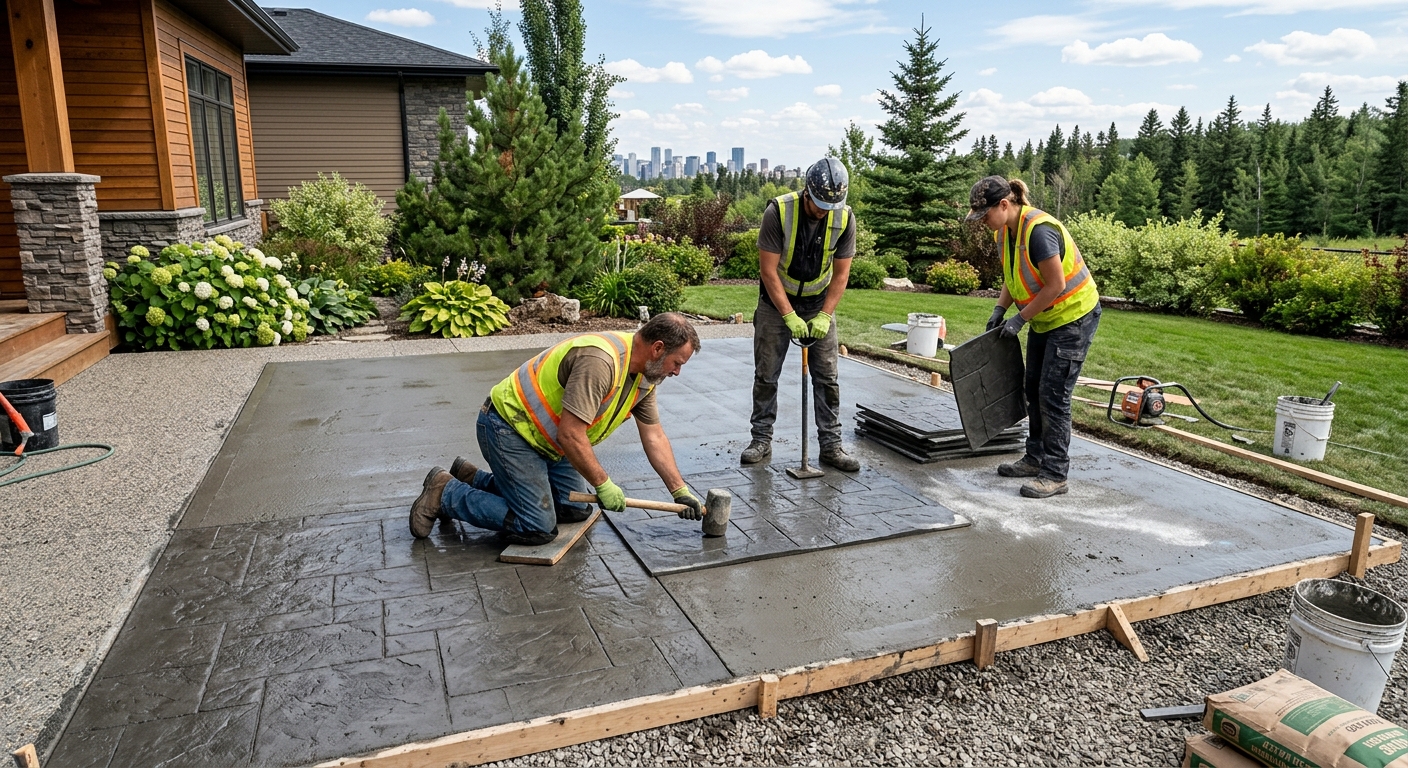
Concrete work options and costs in Bowen Island
Bowen Island is a small, coastal community (4,256 residents per the 2021 Census) where a lot of homes are built around straightforward vehicle and pedestrian traffic needs—especially since single-detached houses make up about 89.0% of dwellings. For most homeowners, that translates into practical concrete flatwork like driveways, patios, and walkways, along with occasional updates to older foundations. It also helps explain why you’ll see steady demand for trades that do exterior concrete near areas where daily access matters most; one place we frequently get called is around the town’s core approach routes and shoreline-adjacent homes where grades and drainage are always a factor.
In the Lower Mainland–Southwest, concrete pricing is driven by climate even when the weather looks “mild.” We still design for a shallow-but-real frost line (commonly assumed around 450 mm / 18"), and we protect foundations and thickened edges from freeze–thaw damage with proper base prep, drainage, and air-entrained mixes. Coastal rainfall and cool, humid curing conditions can also extend timelines—contractors often schedule pours around wet periods and use curing blankets or sealers to help concrete reach durability.
Because Bowen Island is smaller and job access can be more constrained (materials delivery and truck access), crews may charge more for logistics even on similar slab sizes. That’s why the same “type” of concrete can land in different bands: a broom-finished driveway is usually the most economical, while stamped or exposed aggregate adds labour and surface prep.
Below is a practical comparison of common options so you can sanity-check your quote before we talk specs and site conditions.
| Application |
Typical Size |
Key Spec |
Finish Option |
Price Range |
| Concrete driveway (standard broom finish) |
400–600 sq. ft. |
Air-entrained exterior slab, proper base + drainage |
Broom finish with control joints |
$18,000 – $28,000 |
| Exposed aggregate driveway |
400–600 sq. ft. |
Air-entrained mix + washed finish prep |
Exposed aggregate with seal (recommended) |
$22,000 – $34,000 |
| Stamped concrete driveway or patio |
250–500 sq. ft. |
Air-entrained exterior mix, colour hardener |
Stamped patterns + release + seal |
$22,000 – $36,000 |
| Plain concrete patio or walkway |
150–400 sq. ft. |
Exterior base, joints, air-entrained mix |
Broom or light trowel finish |
$16,000 – $26,000 |
| Garage floor (interior slab) |
400–600 sq. ft. |
Vapour barrier + reinforcement as required |
Float + broom (or polished look) |
$14,000 – $24,000 |
| Foundation footings (structural, below frost) |
Per linear foot / small section varies |
Excavate to frost depth, form + reinforce |
Unfinished structural concrete |
$200 – $350 |
Prices are estimates only and vary by project scope, site access and material selection.
What affects the price of concrete work in Bowen Island
In Bowen Island and the wider Lower Mainland–Southwest, it’s common to see quotes for the “same” concrete job differ by 30–50% once you account for frost protection, drainage detailing, and the realities of scheduling and curing in a coastal-wet climate. That gap gets wider across British Columbia because frost depth assumptions and construction seasons change. Even though our frost depth is often designed around roughly 450 mm / 18" for the Lower Mainland, the goal is always the same: keep footings and thickened edges below the design frost line to prevent freeze–thaw heave and settlement.
Another driver is concrete durability. Exterior slabs exposed to wetting and drying cycles need air-entrained concrete mixes and correct control joint placement, otherwise you’ll see scaling or spalling. When the season turns cool or rainy, contractors often need cold-weather curing precautions—curing blankets, surface protection, and longer cure times to reach target strength—which can add labour and material costs. Also, Bowen Island households typically de-ice at least occasionally; de-icing salts are rough on under-protected surfaces, so sealing becomes more than an aesthetic add-on.
Here are a few local examples of cost-ups and cost-downs: (1) older homes (36.8% of dwellings are built before 1981, per the 2021 Census) often need regrading or drainage fixes before a driveway replacement can last, which increases excavation and base work; (2) limited truck access on steep or vegetated lots can add forming, smaller pours, or extra time—pushing a driveway closer to the $18–$28 per sq. ft.-equivalent band even before finish upgrades; and (3) choosing broom finish can stay closer to the economical end, while stamped or exposed aggregate adds prep labour and typically lands in the $22–$36 band depending on pattern complexity and area.
Bottom line: the “price of concrete” is only part of the bill. The spec and the site conditions—especially freeze–thaw and drainage—usually decide the final number.
| Price Factor |
Why It Matters |
Cost Impact |
| Frost line depth — determines footing depth and form height |
Footings and thickened edges must be below design frost to prevent heave |
Higher excavation and forming; can shift foundation work by tens of percent |
| Site preparation — excavation, grading, compacted granular base |
Proper drainage and base compaction reduce settlement and cracking |
Extra trucking, grading and granular material; major swing factor on sloped or wet lots |
| Reinforcement — rebar or wire mesh requirement |
Controls cracking and improves slab performance under loading |
Material + labour; more costly when access requires more careful placement |
| Mix design — air-entrainment and compressive strength spec |
Air-entrained concrete resists freeze–thaw scaling and spalling |
Modest material cost but high value for exterior durability |
| Finish type — broom vs. stamped vs. exposed aggregate |
Labour, surface prep, curing protection, and seal requirements differ |
Stamped/exposed often add significant labour, commonly moving into higher finish bands |
| Pour size and concrete truck access to site |
Smaller pours or limited access can require pump/handwork and extra coordination |
Access constraints can materially increase labour and equipment charges |
| Cold-weather curing precautions — heating and blankets |
Cool nights and high humidity slow strength gain and increase defect risk |
Blankets/sealers/heating rental and longer timelines add cost |
| Control joint pattern and sealing cost |
Joints manage shrinkage cracking; sealing helps repel salts and water |
Often small relative to total cost, but omission can shorten service life |
Permits & regulations in British Columbia
In British Columbia, the permitting expectation depends on what concrete you’re building. Structural concrete work—such as footings, foundation walls, and grade beams—typically requires a building permit and is often based on engineered drawings that the municipality reviews. Concrete flatwork—such as driveways, patios, and walkways—usually does not require a permit unless it affects things like lot grading, impervious surface coverage, drainage patterns, or impacts municipal right-of-way requirements. Before any excavation or demolition, confirm the requirements with the local authority for Bowen Island.
Homeowners should also treat insurance paperwork as part of due diligence. Step-by-step, verify the contractor: (1) request their proof of liability insurance and ensure the coverage is current for the project’s start date; (2) confirm they have WSIB/WCB coverage (or the appropriate coverage status for their business) and ask for a clearance/coverage letter where applicable; (3) ask for their municipal permit experience on structural jobs (who pulls the permit, and who is responsible for inspections); and (4) check references for projects of a similar scale in the Lower Mainland–Southwest coastal conditions.
To verify licence/registration in BC, use the appropriate provincial online registry search for your contractor’s business number and responsible party, then match the listed entity name to the certificate of insurance you receive. Don’t rely on a verbal assurance—ask for documents before work begins.
Getting concrete right in Bowen Island's freeze-thaw climate
Concrete fails in Bowen Island mainly when water and salts find weaknesses and then freeze. Even with Lower Mainland–Southwest’s relatively mild winters, repeated freeze–thaw cycles and coastal rainfall can work concrete from the outside in. The most preventable failures are usually tied to four things: (1) base preparation that doesn’t drain or isn’t compacted to the right depth; (2) a mix that isn’t properly air-entrained; (3) control joints that are missing or incorrectly spaced; and (4) curing/sealing schedules that don’t match the real moisture and temperature conditions on your pour date.
Spec the job to survive Bowen Island’s conditions. Use a compacted granular sub-base sized for local soil and frost protection, and set exterior slabs with air-entrained concrete (commonly 5–7% air content for exterior flatwork) so the freeze–thaw process doesn’t scale the surface. For structural durability, target a minimum 32 MPa compressive strength. Add control joints at appropriate spacing to keep shrinkage cracking predictable rather than random. Plan for curing: in practice, we treat a minimum 7-day curing period as the baseline, and in cool or wet weather we may extend curing time and protect the surface.
Sealing matters for the salt-wetting cycle typical in driveways. Apply a penetrating sealer after curing (often around 28 days) to help repel de-icing salts and reduce water absorption.
When homeowners ask about cost, a concrete example helps: upgrading from a plain broom-finish driveway to a sealed broom finish may be a relatively small line-item compared to moving to stamped concrete. That’s why we often recommend sealing and correct air-entrainment first—then discuss decorative finishes if budget allows. Sealing without proper mix design won’t solve the main freeze–thaw vulnerability; air content plus base drainage is the foundation of long-term performance.
| Spec |
Why It Matters in Bowen Island |
What to Ask For |
Impact if Skipped |
| Compacted granular base (depth?) |
Controls settlement and provides drainage below the slab where water can move |
“Confirm excavation depth for frost + sub-base thickness and compaction testing method.” |
Soft spots, premature cracking, pumping, and water-driven deterioration |
| Air-entrained concrete mix (target air %?) |
Resists freeze–thaw scaling in wet coastal conditions |
“Provide air content target (5–7%) and mix design sheet.” |
Spalling and surface scaling, especially in driveways that get salted |
| Compressive strength (MPa rating) |
Ensures adequate durability and strength gain before traffic and weather exposure |
“Confirm minimum 32 MPa and curing plan to reach strength.” |
Surface weakness, increased cracking risk, and reduced life span |
| Control joints (spacing per ACI guidelines) |
Keeps shrinkage cracking controlled in freeze–thaw environments |
“Ask for joint layout drawings and sawcut timing.” |
Random cracking, water entry, and freeze–thaw damage at edges |
| Minimum 7-day curing period |
Cool nights and high humidity slow curing—proper protection prevents early damage |
“Confirm curing protection and when forms/loads come off.” |
Lower strength development and higher risk of defects and scaling |
| Penetrating sealer (when applied after cure) |
Repels salts and reduces water absorption on exterior surfaces |
“Confirm sealer type and application timing (often around 28 days).” |
Faster deterioration and increased spalling risk over winter cycles |
How to choose a concrete work contractor in Bowen Island
Choosing the right contractor in Bowen Island is mostly about paperwork, details, and schedule control. In British Columbia, verify three essentials before you sign: (1) licensing/registration for the business and responsible parties (check the provincial online registry using their legal entity name); (2) liability insurance—ask for a certificate of insurance matching your project address or at least the contract period; and (3) WSIB/WCB coverage—request proof/clearance documentation so you’re not exposed if there’s a jobsite injury. If they can’t provide these quickly, move on.
Next, get 2–3 itemised written quotes rather than one lump-sum number. Ask for a breakdown for excavation, base material, reinforcement, concrete supply, forming, finishing, joints, sealing, and disposal. Confirm whether a permit is included (structural work usually requires it) and what’s excluded (for example, tree removal, bed rock removal, pump costs, or trucking limitations). For timelines, ask for a start date window and completion estimate in writing, including how rain delays will be handled.
Warranty should be explicit: a workmanship warranty length (and what it covers), plus any manufacturer product warranty details. Also clarify transferability if you sell your home.
Payment schedule matters. Never pay more than 10–15% upfront. Use a holdback tied to substantial completion and final finishing quality checks.
- Provide their BC business details and match them to the quote paperwork.
- Show current liability insurance and confirm the policy covers the contract period.
- Provide WSIB/WCB clearance or proof of coverage.
- Submit a written scope with material specs: air-entrained concrete, strength target, and base prep.
- Include control joint layout and sawcut timing.
- Confirm whether compaction testing is included for the base.
- List disposal and haul-away costs separately.
- Clarify access limits: crane/pump costs, geotextile use, or handwork allowances.
- Ask what curing method is used in cool or rainy stretches.
- Ask for sealer type and whether it’s penetrating (recommended) and when applied.
- Get the schedule in writing, including weather delay communication.
- Confirm warranty terms and what happens if repairs are needed.
Concrete red flags in Bowen Island include: quoting decorative work without confirming air-entrainment and joint specs, using “cheap” base without drainage details, starting pours during unsettled rainy windows with no curing plan, vague warranties (“call us if there’s a problem” with no coverage length), and quotes that don’t clearly list truck access, disposal, or sealing timing.
Frequently asked questions — concrete work in Bowen Island
How long does a concrete project take in Bowen Island?
Timelines in Bowen Island usually depend less on forming speed and more on weather windows, base prep, and curing protection. For flatwork like a driveway or patio, you typically plan for: excavation and base compaction (often 1–3 days depending on access), forming and reinforcement (often 1 day), then the pour day plus finishing. Even after the surface can be walked on, concrete needs proper curing—commonly at least a 7-day curing period for strength development. In cool, rainy stretches typical of the Lower Mainland–Southwest, contractors may extend protection using curing blankets and scheduling buffer to reach design performance. If your project includes foundation footings or any structural concrete, the timeline can stretch because inspections and engineered steps may be required before the next phase.
What is a concrete overlay and is it suited to Bowen Island?
A concrete overlay is a new wearing surface installed over an existing slab (sometimes with surface profiling and bonding agents). It can be a good option when the original slab is still structurally sound but the top surface is worn, stained, or lightly spalled. In Bowen Island’s freeze–thaw and coastal-wet conditions, overlays need strict prep: surface cleaning, crack assessment, proper bonding, and often a mix designed for exterior durability. If the old concrete has active settlement or widespread cracking, an overlay may fail because movement will reflect through the new surface. Pricing varies, but you should compare it to replacement—simple plain patios and walkways typically align with the $16–$26 band, while decorative works land higher. If your base is compromised, replacement can be the more durable value.
How do I seal concrete to protect it in Bowen Island?
For Bowen Island, sealing is about water and salt resistance. We generally recommend a penetrating sealer because it helps repel moisture rather than just forming a surface film. Timing matters: the sealer is typically applied after curing—often around the 28-day mark—so the concrete has developed the strength and is no longer releasing excess moisture. Before sealing, the slab should be clean and fully dry; leaving construction residue or trapped moisture reduces performance. Also, don’t treat sealing as a substitute for correct air-entrained concrete and proper control joints. In the Lower Mainland–Southwest, that combination is what prevents freeze–thaw scaling. If you use de-icing salts in winter, sealing becomes even more valuable, particularly for driveways that experience repeated wetting and drying cycles.
What is the difference between concrete and cement?
In everyday language people use “concrete” and “cement” interchangeably, but they aren’t the same thing. Cement is a powder (the binder) that reacts chemically with water to create strength. Concrete is the final product made by mixing cement with water, plus aggregates (sand and gravel) and often additives like air-entrainment for exterior freeze–thaw durability. For Bowen Island’s conditions, the “concrete” design—especially the air content and strength target—matters as much as the cement component. This is why two quotes can differ significantly even if they both say “concrete”: the mix design, curing plan, and base prep details determine performance in the coastal-wet climate and during freeze–thaw cycles.
How much does concrete work cost in Bowen Island?
Concrete pricing in Bowen Island is commonly quoted by scope and finish, then adjusted for site access and the engineering of frost protection and base prep. For driveway and slab work, many homeowners see totals that align with local pricing bands such as concrete driveway/slab around $18–$28 and plain patio/walkway around $16–$26. Decorative options typically cost more—stamped & decorative concrete often falls in the $22–$36 range depending on pattern complexity and area. Foundation footings are costed differently (often per linear foot) and commonly sit around $200–$350 based on excavation and reinforcement needs below frost. Your final number depends on whether your project includes drainage upgrades, reinforcement, disposal, and how difficult access is for the truck and materials.
How deep must footings be for Bowen Island's frost line?
Footing depth is designed below the local frost depth to reduce frost heave risk. In the Lower Mainland–Southwest, practice commonly assumes a design frost depth around 450 mm / 18", but the safe detail is still “below the design frost line” for your specific foundation layout and soil conditions. That means excavation, form height, and reinforcement placement are driven by what the engineer or foundation design specifies—not just a single number. If you’re upgrading a footing or doing new structural work, you should expect engineered drawings and permit steps, because foundation geometry can affect both performance and inspection. On the contractor side, we plan frost protection and drainage so the foundation stays stable through freeze–thaw cycles and heavy coastal rainfall. Your quote should show how the excavation depth and footing thickness align with the design.