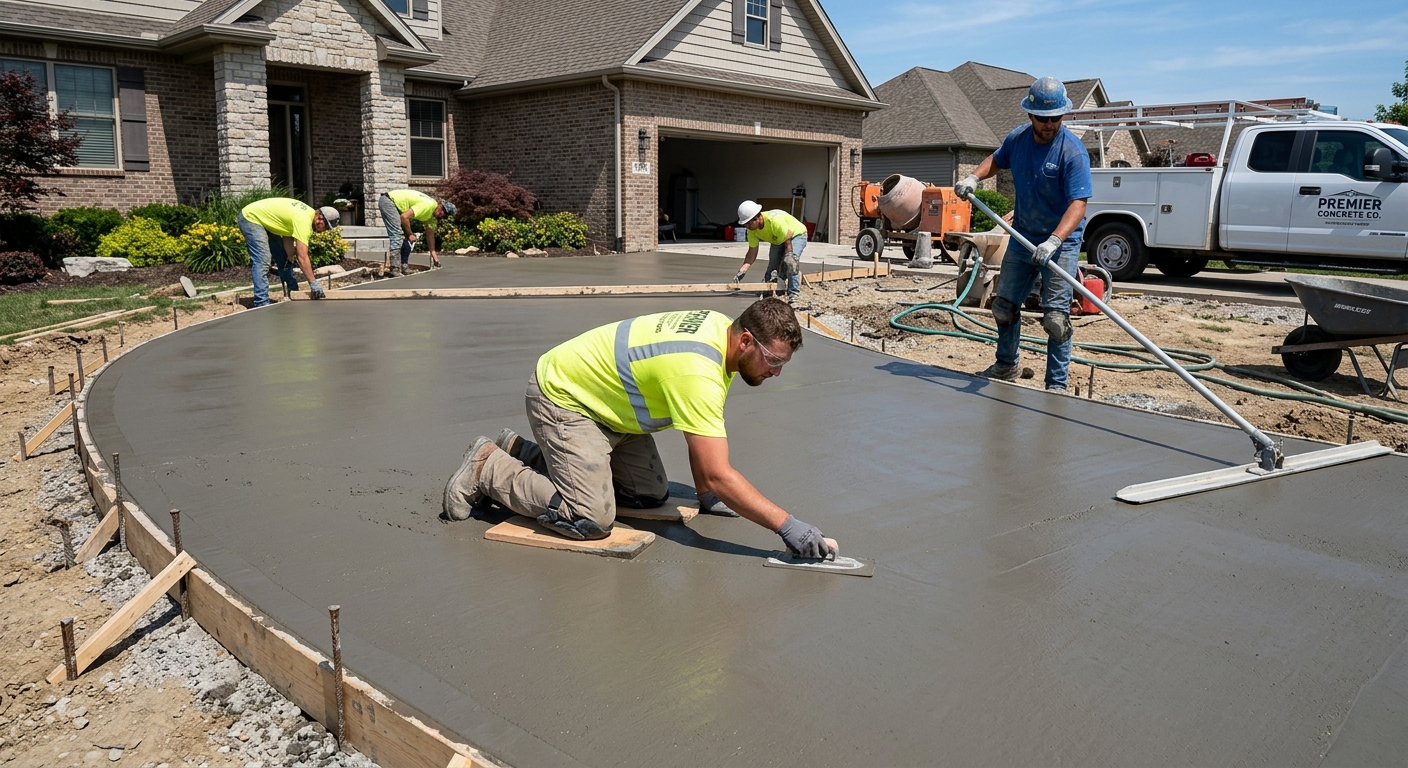
Concrete work options and costs in Clearwater
Concrete work in Clearwater is shaped by a tough freeze–thaw climate and the way locals build for frost, especially for the majority of homes that are single-detached (72.6% of dwellings). With 800 homeowner households in the area and a median household income of $68,000 (Statistics Canada, 2021 Census), most concrete projects are about practicality: driveways, walkways, patios, and repairs that hold up through winter traction and spring thaw. You’ll also notice a lot of older housing stock—50.5% of homes were built before 1981 (Statistics Canada, 2021 Census)—which often means existing flatwork needs re-lift, re-base, or proper drainage corrections before a new pour will last.
In the Thompson–Okanagan, contractors price concrete based on frost depth assumptions and freeze–thaw frequency. Typical building practice here assumes frost in the 45–60 cm range, but the design response is what drives cost: footings and foundations need to sit below frost, not just “minimum” shallow depth. Exterior slabs also require air-entrained concrete, control joints, and well-compacted granular base with good drainage—otherwise you’ll see scaling and random cracking sooner. Clearwater’s shorter pour season and shoulder-season weather can add labour and material costs for cold-weather protection (insulating blankets, curing blankets/compounds, and careful scheduling). If you’re in demand around the downtown corridor and older neighbourhood pockets near the river and hillsides—where drainage and access can be tricky—that complexity often means higher excavation and more detailed forming.
Below are typical size/finish options you can use to compare quotes, then match the line items to your exact site conditions before you commit.
| Application |
Typical Size |
Key Spec |
Finish Option |
Price Range |
| Concrete driveway (standard broom finish) |
12' x 24' (288 sq. ft.) |
4" slab, air-entrained mix, control joints |
Broomed, sealer recommended |
$5,200–$7,200 |
| Exposed aggregate driveway |
12' x 24' (288 sq. ft.) |
4" slab, air-entrained mix, aggregate exposure |
Exposed aggregate with curing & bonding steps |
$6,600–$9,100 |
| Stamped concrete driveway or patio |
10' x 20' (200 sq. ft.) |
4" slab, air-entrained mix, release agent & curing |
Stamp pattern + colour hardener |
$5,900–$7,600 |
| Plain concrete patio or walkway |
10' x 12' (120 sq. ft.) |
4" slab, compacted base, joints as needed |
Light broom or smooth trowel edge |
$1,700–$2,900 |
| Garage floor (interior slab) |
20' x 22' (440 sq. ft.) |
4" slab, fibre or mesh, vapour barrier |
Broom finish + densifier optional |
$7,200–$10,500 |
| Foundation footings (structural, below frost) |
Typical 24' perimeter + interior |
Excavation, forms, rebar, concrete below frost |
Engineered footing concrete |
$8,500–$15,000 |
Prices are estimates only and vary by project scope, site access and material selection.
What affects the price of concrete work in Clearwater
In Clearwater and across the Thompson–Okanagan, it’s common to see the same type of concrete job quoted 30–50% apart—especially when crews differ on base preparation, frost-appropriate design, and the exact mix spec. That gap isn’t just “labour”—it’s excavation volume, forming complexity, reinforcement amount, and cold-weather precautions. Compared with warmer parts of BC, interior work often costs more because footings and foundations must extend below local design frost to prevent heave and cracking, and because exterior slabs must be air-entrained to survive freeze–thaw cycles. If a contractor under-specs air content or shortcuts the granular base and drainage, you may get a cheaper price now, but you pay later in patching.
Here’s what drives the numbers in Clearwater. Frost depth assumptions determine footing depth and form height, and that increases excavation and concrete volume. Freeze–thaw also means exterior slabs typically use air-entrained mixes, plus a well-managed control joint plan. Shoulder-season pours can require heating and insulating blankets; those add direct costs and also limit scheduling. Finally, de-icing salt accelerates surface damage, so sealing and a proper curing window (not rapid drying) become more than “nice to have.” When concrete is priced in the driveway band of $18–$28 per square foot for typical work, a contractor’s true spec (base, air-entrainment, joints, finishing) is what pushes you toward the top end.
Two quick Clearwater examples: (1) Removing and replacing an existing driveway that failed due to poor drainage can add $1,000–$2,500 in extra demo and base rebuild—often worth it because it prevents repeat failure. (2) Upgrading a plain patio to stamped work can move you from a $14–$24 patio/walkway band into a higher $24–$38 stamped range, but the price is usually justified by labour-heavy stamp, colour, and careful surface preparation.
| Price Factor |
Why It Matters |
Cost Impact |
| Frost line depth — determines footing depth and form height |
Prevents frost heave and foundation movement |
Higher excavation depth can add significant material and labour |
| Site preparation — excavation, grading, compacted granular base |
Improves load support and drainage performance |
Can swing costs widely if access or soils are poor |
| Reinforcement — rebar or wire mesh requirement |
Controls cracking and improves slab durability |
Extra rebar placement raises labour and material |
| Mix design — air-entrainment and compressive strength spec |
Survives freeze–thaw cycles; resists scaling |
Better mix spec typically increases per-metre cost but lowers failures |
| Finish type — broom vs. stamped vs. exposed aggregate |
Surface performance and complexity of finishing |
Stamped/exposed generally costs more in labour and materials |
| Pour size and concrete truck access to site |
Limits delays and extra handling |
Hard access can add machinery/time or reduce pour efficiency |
| Cold-weather curing precautions — heating and blankets |
Protects strength gain and reduces early-age freeze damage |
Adds equipment and labour during shoulder seasons |
| Control joint pattern and sealing cost |
Reduces random cracking; improves salt resistance |
Joints are labour; sealing is materials and scheduling after cure |
Permits & regulations in British Columbia
In British Columbia, concrete work splits into two common buckets. Structural concrete—typically footings, foundation walls, grade beams, and other load-bearing elements—requires a building permit and often engineered drawings that the municipality reviews as part of the permit process. Concrete flatwork (patios, walkways, driveways) usually does not require a building permit on its own, but it can require review if it affects lot grading, drainage, or impervious surface coverage limits, or if it ties into municipal right-of-way/culverts. In Clearwater, always confirm with the local authority before breaking ground, especially if you’re changing slopes for water management or lowering/raising the driveway profile.
For contractor oversight, verify three things before you sign: (1) the contractor carries liability insurance, (2) they have the right coverage for workers (WSIB/WCB coverage where applicable), and (3) they can provide references for similar-scale concrete jobs in interior BC. A practical step-by-step homeowner check is: request their insurance certificate (COI) and make sure it lists the correct business name and covers the scope you’re hiring; ask for a certificate/clearance for worker coverage; and confirm their business/contractor credentials through the appropriate provincial registry or licensing information available online. Then, compare the quote’s scope line-by-line to what will be built: base depth, reinforcement, concrete mix requirements, joint pattern, protection during cold weather, and whether disposal is included.
Getting concrete right in Clearwater's freeze-thaw climate
Concrete failures in Clearwater usually come from the same root causes: water in the sub-base, poor drainage, and early-age damage from freeze–thaw. In the Thompson–Okanagan, the fix is in the spec—not just the pour day. Start with (1) base preparation: you want a compacted granular sub-base to the correct depth for local soil support and frost considerations, with proper grading so water doesn’t sit under the slab. Next (2) mix design: exterior flatwork should use air-entrainment (commonly 5–7% air content for exterior) and a minimum compressive strength around 32 MPa to resist scaling and freeze damage. (3) control joints: spacing should be planned to limit random cracking; joints should be cut or formed at the right time so they don’t open unpredictably. (4) curing: allow at least 7 days curing under proper conditions; in cold snaps, crews may need insulating blankets/curing protection to prevent early freezing. (5) sealing: apply a penetrating sealer 28 days after the pour to help repel de-icing salts and reduce surface deterioration.
Ask technical questions to avoid spalling caused by inadequate air-entrainment. If a contractor won’t tell you the target air content and strength, or they treat “air-entrained” as optional, that’s a warning sign. A real-world price example: a plain broom-finished patio might land in the $14–$24 per square foot band, while a stamped option can push toward the $24–$38 range. That higher cost is justified when stamping includes proper thickness, surface prep, and cold-weather curing steps—because those are what protect the colour and reduce premature cracking.
With a lot of older homes and driveways being retrofitted, getting these fundamentals right is especially important for Clearwater properties that see repeated winter salt and spring thaw.
| Spec |
Why It Matters in Clearwater |
What to Ask For |
Impact if Skipped |
| Compacted granular base (depth?) |
Prevents settlement and reduces trapped moisture |
Base thickness and compaction method for your soil |
Uneven surface, early cracking, scaling from water |
| Air-entrained concrete mix (target air %?) |
Improves freeze–thaw durability in exterior exposure |
Target air content (commonly 5–7% for exterior flatwork) |
Higher risk of spalling and surface breakdown |
| Compressive strength (MPa rating) |
Ensures strength gain and long-term wear resistance |
Minimum compressive strength (commonly 32 MPa) |
Lower durability and faster deterioration under load |
| Control joints (spacing per ACI guidelines) |
Limits random shrinkage cracking |
Planned joint spacing and timing for cutting/formation |
Wider cracks and more frequent repairs |
| Minimum 7-day curing period |
Protects strength development during cold periods |
How curing is managed if temperatures drop |
Reduced strength and increased cracking risk |
| Penetrating sealer (when applied after cure) |
Helps repel salts and water after freeze events |
Sealer schedule (typically after 28 days cure) |
Faster surface wear and salt damage |
How to choose a concrete work contractor in Clearwater
Choosing a concrete contractor in Clearwater is mostly about verification and clarity. Start with British Columbia compliance checks: ask for their liability insurance certificate (COI) and confirm the business name and address on the COI match the contractor you’re hiring. Next, verify worker coverage (WSIB/WCB coverage where applicable). Then, confirm they’re properly registered/licensed for the work they’re doing, using the online registry or licensing information available in BC. Don’t be shy—request these documents in advance, not after you’ve accepted a price.
Next, get 2–3 itemised written quotes. You want a breakdown that shows labour and material separately, and ideally includes subgrade prep/base, reinforcement, concrete strength/air-entrainment, finishing method, joints, curing protection, and disposal. Avoid “lump sum” quotes that don’t specify thickness or specs; in a freeze–thaw area, those details matter. Read exclusions carefully: is demolition included? Is hauling/disposal included? Are forms removed and disturbed areas reinstated? For warranty, ask for the workmanship warranty length, whether the manufacturer/material warranty applies to you, and if that coverage is transferable.
Payment schedule should be conservative: never pay more than 10–15% upfront. Use a holdback until the job is complete and any touch-ups are finished. Also demand a start date and an estimated completion date in writing—seasonal conditions can impact curing timelines, especially if the crew must use insulating blankets and curing protection.
- Ask for the concrete mix spec: strength (MPa) and air-entrainment target for exterior work.
- Confirm slab thickness and base thickness before you sign.
- Get the reinforcement plan (mesh vs rebar, and where it’s placed).
- Review the control joint plan: spacing and when joints are cut/formed.
- Ask how they handle cold nights (blankets/heating/curing compound).
- Confirm whether they include drainage grading and how water will shed.
- Request dust control and site protection for older residential lots.
- Make sure disposal/removal of excess soils and concrete is included (or priced separately).
- Verify they seal exterior flatwork if you want salt resistance (and when after cure).
- Check they carry liability insurance with coverage limits suited to the job size.
- Confirm worker coverage (WSIB/WCB where applicable) and request proof.
- Get a written warranty and clarify what “repair” includes.
In Clearwater, 4–5 concrete contractor red flags include quotes that avoid specifying air-entrainment or compressive strength, proposals with no plan for control joints, vague “we’ll figure it out on site” wording for base depth, offers that schedule pours without addressing cold-weather curing protection, and contractors who request large upfront payments or won’t provide insurance/coverage documentation.
Frequently asked questions — concrete work in Clearwater
How much does concrete work cost in Clearwater?
Concrete costs in Clearwater typically follow the interior Thompson–Okanagan freeze–thaw reality, so pricing is often a bit higher than “generic BC” estimates. For example, standard driveway work commonly lands in the $18–$28 per square foot range once you include proper base prep, air-entrained concrete for exterior exposure, and a joint plan. A plain patio or walkway often sits around $14–$24 per square foot depending on size and access, while stamped work can move toward the $24–$38 range because finishing is more labour-intensive and requires careful curing. Your final number depends heavily on excavation depth, truck access, and whether you need demolition and re-base of an older failing slab. If your home is in an area with drainage challenges (common around older neighbourhoods), expect base correction to influence the quote.
How deep must footings be for Clearwater's frost line?
Clearwater’s design approach is “below frost,” not the minimum shallow depth sometimes mentioned online. In the Thompson–Okanagan interior, local building practice assumes frost in the 45–60 cm range, but actual engineered footing depth is determined by the frost design and site conditions (soil and drainage). That’s why good contractors don’t just talk inches—they confirm excavation depth to get the footing below the design frost plane. For homeowners, the key is that structural concrete like footings and foundation components usually require engineered drawings and permits in British Columbia. Ask your contractor to state the planned footing elevation relative to finished grade and confirm they’re following the engineered plan for your property. This is one place where trying to “value-engineer” depth can lead to heaving and long-term cracking.
Why does concrete crack in Clearwater and how is it prevented?
Concrete cracks in Clearwater mainly because of movement and water: shrinkage, temperature changes, and freeze–thaw expansion/contraction. In interior BC, exterior slabs face frequent freeze–thaw cycles, so prevention starts with a properly compacted granular base and good drainage to avoid water being trapped under the slab. Next, air-entrained concrete helps resist freeze-related scaling and spalling. Finally, control joints are essential: they should be spaced to limit random cracking and cut/formed at the right time. Without joints, cracks will appear where the slab “chooses” to relieve stress, often through the most visible areas of driveways and patios. In older Clearwater properties (many built before 1981), subgrade changes and drainage differences can amplify movement—so base prep and joint planning usually matter more than cosmetic finishing.
Stamped vs broom-finish concrete — cost difference?
Stamped concrete costs more than a broom finish mainly due to labour and the finishing system. In Clearwater, stamped driveways and patios often land around the $24–$38 per square foot range, while broom-finished concrete commonly sits closer to the $18–$28 per square foot driveway band (or $14–$24 per square foot for simpler patio/walkway work). The price increase is justified when the contractor also does the “unseen” specs correctly: proper thickness, base preparation, air-entrained mix for freeze–thaw durability, and curing protection. If a crew cuts corners on those items, stamped surfaces can still fail—just with higher repair cost because the decorative finish has to be redone. When comparing quotes, ask if both options include the same base depth, reinforcement approach, and curing steps; otherwise you won’t be comparing apples to apples.
When is the best time to pour concrete in Clearwater?
In Clearwater and the Thompson–Okanagan interior, timing matters because curing is sensitive to temperature and frost risk. The “best time” is generally when daytime temperatures support normal curing and nights don’t force aggressive protection measures. That often means late spring through early fall windows, but exact dates depend on the forecast and the contractor’s cold-weather plan. If you must pour near shoulder seasons, crews may use insulating blankets and, in some cases, heating to prevent early-age freezing. Even if the concrete is placed correctly, rapid drying or freezing during the first days can reduce long-term strength and increase cracking risk. When you request a quote, ask for their cold-weather curing approach and how they manage curing time so the slab reaches strength properly under Clearwater conditions.
How long does concrete take to cure?
Concrete gains strength over time, and “cure” is more than just waiting for it to harden. For most structural and exterior flatwork applications, a minimum curing period of about 7 days under proper conditions is a practical baseline before heavy use, but full performance continues beyond that. In freeze–thaw environments like Clearwater, curing protection becomes more important during cold spells because early-age freezing can damage strength development. For sealing exterior flatwork (recommended with de-icing salt exposure), most penetrating sealers are applied after the concrete cures long enough—commonly around 28 days—so the slab is ready to accept treatment. If you’re scheduling stairs, driveway openings, or drainage modifications, ask the contractor for their curing timeline and what conditions (temperature, blankets, curing compounds) they’ll use to protect the pour through the next week.