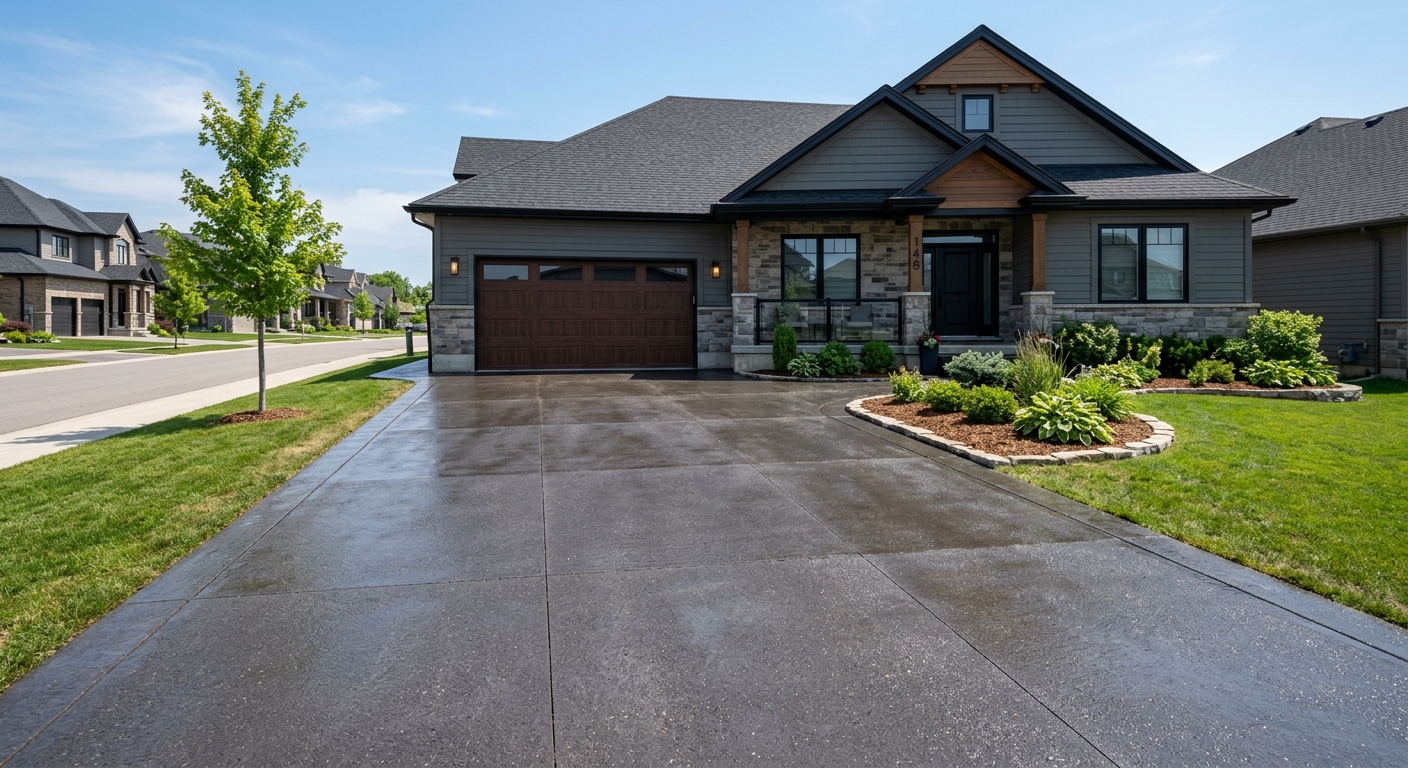
Concrete work options and costs in Vedder Crossing
Concrete work in Vedder Crossing is all about balancing durability with the way our Lower Mainland–Southwest climate stresses slabs. With a population of 22,620 (Statistics Canada, 2021 Census), the Abbotsford area supports a steady supply of crews who understand the shallow frost depth reality—still around 450 mm / 18" in local practice—but also the wet, freeze–thaw cycles that can trigger scaling and spalling when mix design and drainage are wrong. That’s why contractors price concrete flatwork with specific specs (air-entrainment, compaction, jointing and curing), not just “a per-square-foot” number.
In many neighbourhoods around Vedder Crossing, flatwork demand is highest where homeowners are improving driveways and outdoor living areas—especially near the service-and-housing pockets along Promontory Road and surrounding residential blocks that connect into the Abbotsford corridor. Driveways, patios and walkways are typically the first projects tackled because they’re visible, add usability, and can be scheduled alongside landscaping.
In the Lower Mainland, mild winters help the season length, but coastal rainfall, cool nights, and frequent freeze–thaw still affect labour time, curing protection, and inspection/coordination. You’ll often see the price gap between standard broom-finished concrete and decorative options because stamped or exposed-aggregate work requires more formwork detailing, extra steps, and careful curing.
Use the table below as a practical comparison for common concrete options you’ll likely get quoted on in Vedder Crossing.
| Application |
Typical Size |
Key Spec |
Finish Option |
Price Range |
| Concrete driveway (standard broom finish) |
400–600 sq. ft. |
4" slab, air-entrained, proper base compaction |
Broom finish, joints/sealing as recommended |
$7,500–$12,500 |
| Exposed aggregate driveway |
400–600 sq. ft. |
4" slab, air-entrained, controlled surface exposure |
Exposed aggregate (stone reveal) |
$9,000–$16,500 |
| Stamped concrete driveway or patio |
250–500 sq. ft. |
4" slab, air-entrained, harderwearing release system |
Stamp pattern + colour options |
$8,500–$17,500 |
| Plain concrete patio or walkway |
150–350 sq. ft. |
4" slab, compacted granular base, joints |
Float/steel trowel (light broom for slip resistance) |
$2,400–$7,000 |
| Garage floor (interior slab) |
300–500 sq. ft. |
Slab thickness to spec, vapour considerations as needed |
Plain broom or trowel-finish |
$5,500–$12,500 |
| Foundation footings (structural, below frost) |
Typical single-family footing runs |
Below frost depth, rebar + formwork |
Structural concrete only |
$6,500–$14,000 |
Prices are estimates only and vary by project scope, site access and material selection.
What affects the price of concrete work in Vedder Crossing
If you get three quotes for the “same” concrete job in the Lower Mainland–Southwest, it’s normal to see variation of 30–50%. Concrete pricing shifts because the Lower Mainland trades work with the climate realities of saturated soils, frequent freeze–thaw cycles, and rain-heavy shoulder seasons—while crews in other parts of BC may face colder nights, longer hauling, or a shorter pour season. Even within the region, site conditions (slope, drainage, excavation depth, and access) change the amount of granular base, rebar, and labour time required to build a slab that won’t fail.
Design specs are driven by frost depth and freeze–thaw performance. In our practice, exterior footings and foundation elements are placed below the design frost depth (around 450 mm / 18" commonly assumed in local code-adjacent practice) to avoid frost heave. All exterior slabs generally use air-entrained concrete to survive repeated wetting and cooling, and proper control joints to manage cracking. Colder regions require heating and cold-weather curing measures that add cost; while Vedder Crossing is milder than interior BC, cool nights and high humidity still mean crews may use curing blankets and longer cure schedules. Also, de-icing salt accelerates spalling when the mix or surface protection isn’t right—so sealing and good curing timing matter.
Two concrete examples from Vedder Crossing that move the needle: (1) a driveway over saturated or poorly draining soil often needs extra excavation and granular drainage layers, which can move a standard broom-finished driveway from the lower end of the $18–$28/sq. ft. band up toward the high end; and (2) choosing stamped or exposed aggregate can be justified when you want higher curb appeal and you’re getting the right air-entrainment and finishing schedule, not just decorative stamps—those projects typically fall into the higher decorated range compared to plain patio pricing (often starting around the $16–$26 patio band).
| Price Factor |
Why It Matters |
Cost Impact |
| Frost line depth — determines footing depth and form height |
Footings must extend below frost to reduce frost heave |
More excavation + taller forms = higher labour/material cost |
| Site preparation — excavation, grading, compacted granular base |
Weak subgrade leads to settlement and premature cracking |
Extra truckloads of granular and compaction time can add cost |
| Reinforcement — rebar or wire mesh requirement |
Controls cracking and supports loads (driveways/garage slabs) |
Rebar spacing, chairs, and cutting/bending increase labour |
| Mix design — air-entrainment and compressive strength spec |
Exterior freeze–thaw durability depends on correct air content |
Specified mix can cost more but reduces failures and rework |
| Finish type — broom vs. stamped vs. exposed aggregate |
Decorative finishes require additional steps and tighter timing |
Higher labour for stamping/reveal/colour = higher price |
| Pour size and concrete truck access to site |
Small, tight sites may need pumping or more manpower |
Access limits can increase labour hours and pump/extra handling fees |
| Cold-weather curing precautions — heating and blankets |
Cold nights and rain prolong set time and affect strength gain |
Heating blankets, sealers, and longer scheduling add cost |
| Control joint pattern and sealing cost |
Joints manage cracks; sealing helps resist salt scaling |
Material + labour for jointing and sealing increases project total |
Permits & regulations in British Columbia
In British Columbia, the permit rules depend on what you’re building and how it interfaces with the structural system and site servicing. As a homeowner in Vedder Crossing, you can expect that structural concrete work—including footings, foundation walls, grade beams, and any reinforced structural elements—requires a building permit. Those jobs typically also rely on engineered drawings reviewed by the municipality. For concrete flatwork like driveways, patios, and walkways, permits are often not required if you’re not changing lot grading significantly and not adding impervious coverage beyond local limits. However, if your work affects drainage patterns, lot grading, setbacks, or municipal right-of-way, you may need approvals before excavation.
Before breaking ground, step through contractor verification:
- Confirm the contractor is registered/eligible for the work category with the province’s online resources (use the contractor’s legal business name).
- Ask for a Certificate of Insurance showing general liability coverage and the project/location listed.
- Inquire about WCB coverage for their workers and request proof/clearance documentation.
- Request references for similar-size projects in the Lower Mainland–Southwest (driveway-to-patio transitions, similar frost-protection approaches).
- Get written confirmation of who pulls permits (if required) and what’s included in the scope.
If you’re uncertain whether your job triggers permitting due to grading or drainage impacts, call the local building department before the formwork ever goes in.
Getting concrete right in Vedder Crossing's freeze-thaw climate
Concrete failures in Vedder Crossing typically come down to three things: water movement, freeze–thaw stress, and weak or improperly finished surfaces. In our Lower Mainland–Southwest conditions, saturated soils can undermine support if the base is not engineered with the right depth and compaction. Then repeated cooling/wetting cycles challenge the slab surface, especially when de-icing salts are used. If the concrete isn’t air-entrained correctly or joints and curing are handled poorly, you can see spalling and scaling within a few seasons.
To spec the job correctly, focus on: (1) base preparation—a compacted granular sub-base to the correct depth for local soils and frost protection; (2) mix design—exterior flatwork should use air-entrainment (commonly targeted at 5–7% air for many exterior applications) and at least 32 MPa compressive strength; (3) control joints—timed and spaced to encourage cracking in predictable locations; (4) curing—minimum 7 days under the right conditions, using blankets or curing measures when nights are cool or rain is likely; and (5) sealing—a penetrating sealer applied after the concrete is fully cured (commonly around 28 days) to repel de-icing salts and reduce moisture ingress.
Ask your contractor questions like: “What air-entrainment target are you using for exterior exposure?” “How long will curing protection last?” and “What joint spacing are you following?” That’s where you prevent the most expensive failure mode—spalling caused by inadequate air-entrainment.
Dollar reality check: if an exposed-aggregate or stamped driveway quote looks only a little higher than a standard broom finish, it might be worth it only if the base, air-entrainment and curing plan are equally strict. If those aren’t upgraded, the savings usually show up later as repairs—often costing more than the original difference.
| Spec |
Why It Matters in Vedder Crossing |
What to Ask For |
Impact if Skipped |
| Compacted granular base (depth?) |
Supports the slab and manages moisture under freeze–thaw cycles |
Granular depth and compaction test approach for your soil |
Settlement and cracking, uneven slabs |
| Air-entrained concrete mix (target air %?) |
Creates resistance to freeze–thaw damage in exterior exposure |
Target air content (commonly 5–7% for exterior flatwork) |
Spalling/scaling after winters and salt exposure |
| Compressive strength (MPa rating) |
Strength gain affects durability and surface resistance |
Minimum 32 MPa (or higher if specified) |
Surface wear and increased early-age damage risk |
| Control joints (spacing per ACI guidelines) |
Controls random cracking from shrinkage and temperature movement |
Planned joint spacing, timing, and sawcut/cut method |
Random cracks and harder-to-repair water paths |
| Minimum 7-day curing period |
Cold nights and humidity can slow strength development |
How they protect curing (blankets/sealer plan) during cool/rainy spells |
Weaker surface and higher scaling risk |
| Penetrating sealer (when applied after cure) |
Helps repel moisture and de-icing salt intrusion |
Applied after cure (commonly ~28 days) with product suitability |
Faster moisture uptake, salt damage, and surface deterioration |
How to choose a concrete work contractor in Vedder Crossing
Start by verifying the contractor’s credentials the same way you’d verify a builder’s materials: specifically. In British Columbia, ask for proof they are properly registered for the work they’re advertising, then request a Certificate of Insurance (general liability) for your address or project description. For labour coverage, ask about WCB and request clearance/proof documentation—don’t rely on verbal reassurance. A reputable Vedder Crossing crew will also carry the right equipment to place concrete efficiently (finish crews, cutting tools, curing blankets) because access and scheduling directly affect slab quality in our wet-cool climate.
Next, get 2–3 itemised written quotes, not lump sums. You want line items for excavation/site prep, granular base, reinforcement, concrete supply and mix spec, formwork, finishing, joints, curing protection, and sealing. Confirm what’s excluded: permit pull fees, trucking/pumping, disposal of unsuitable material, and any needed drainage adjustments.
For warranty, ask how long the workmanship coverage lasts and what it covers (often surface-related vs structural-related issues). Also confirm whether product/manufacturer warranties apply to admixtures, sealers, or specific mix components and whether they’re transferable to you.
Payment schedule matters: never pay more than 10–15% upfront. Hold back a portion until the final clean-up, cutting/sawing of joints, and any sealing schedule are completed. Finally, request a start date and completion estimate in writing, including how weather/rain delays are handled.
- Ask for their exact concrete mix spec (air content target and compressive strength rating).
- Confirm base depth, compaction method, and whether they test or verify it.
- Request a jointing plan (spacing and timing for sawcuts/control cuts).
- Check that they include curing protection for cool/rainy nights.
- Verify sealing is included (or excluded) and when it will be applied (after cure).
- Ensure reinforcement details are listed: mesh vs rebar, size, and placement.
- Confirm truck access method (direct chute vs pumping) if the site is tight.
- Ask who supplies and installs edges/borders, forms, and expansion joints.
- Look for line items on disposal and haul away for excess/unsuitable soils.
- Check whether they carry insurance with your job address named.
- Request references for similar Vedder Crossing-style driveways and patios.
- Make sure the scope states what happens if rain delays the pour.
Concrete red flags in Vedder Crossing: (1) quotes that talk price per sq. ft. but don’t specify air-entrainment or strength; (2) no mention of joint spacing or sealing plans; (3) “we’ll pour whenever” scheduling with no weather/cure protection plan; (4) vague base prep descriptions (“we’ll level it”) without compaction details; and (5) asking for large upfront payments before any protection, forms, or excavation work begins.
Frequently asked questions — concrete work in Vedder Crossing
How long does a concrete driveway last?
A well-built concrete driveway in Vedder Crossing often lasts 20–30 years, and in good conditions longer, but the timeline depends heavily on freeze–thaw durability and drainage. The biggest drivers are whether the contractor used air-entrained concrete for exterior exposure, built a properly compacted granular base, and installed control joints to limit random cracking. Because our winters include freeze–thaw cycles and our coastal-wet conditions can keep soils saturated, skipping sealing or not curing adequately can shorten service life through scaling and spalling. As a homeowner, you’ll typically see better longevity when the quote includes a realistic curing plan and surface protection—especially if you’re comparing a standard broom-finish driveway (often priced around the lower end of the $18–$28 pricing band) versus decorative finishes.
What is air-entrained concrete and why does it matter here?
Air-entrained concrete is mixed with microscopic air bubbles that help the material tolerate freezing and thawing. In British Columbia—especially in the Lower Mainland–Southwest corridor where soils can stay wet—water can get into small pores. When temperatures drop, that water expands; without correct air entrainment, the expansion pushes concrete apart and you can get surface scaling or spalling. That’s why exterior slabs and driveway surfaces should be specified with a targeted air content (commonly in the 5–7% range for many exterior flatwork applications) plus proper curing and jointing. If a contractor can’t tell you the air-entrainment target and compressive strength rating, treat that as a major quality gap.
How do I prepare the base for a concrete slab?
Base prep is where concrete performance is won or lost in Vedder Crossing. Your contractor should excavate to the correct depth, remove unsuitable material, and place compacted granular base to support the slab and manage moisture. In our frost-protection context (with a common local design assumption around 450 mm / 18"), exterior elements must also be built to the right depths so freeze–thaw doesn’t lift the slab. The granular should be compacted in lifts to achieve stable bearing—suitable drainage matters just as much as thickness. When you compare quotes, ask whether they’re describing granular depth, compaction method, and drainage detailing—not just “we’ll level and pour.”
How do I compare concrete quotes?
Start by comparing apples to apples. In Vedder Crossing, you’ll often see price differences because one quote includes proper air-entrainment and curing protection while another treats them as optional. Request itemised line items so you can compare excavation and site prep, reinforcement (if applicable), concrete mix specs (air content and strength), finish type, joints, and sealing. Confirm whether permit handling is included when your project affects lot grading or drainage. A good way to sanity-check is to compare against local price bands: standard concrete driveway work often aligns with the $18–$28 range, while patios and walkways often fall in the $16–$26 band. Decorative work can be higher—so the key is that the durability specs stay consistent across options.
Can concrete be poured in cold weather in Vedder Crossing?
Yes—concrete can be poured in cold weather in Vedder Crossing, but it must be handled correctly. Lower Mainland winters are milder than interior BC, yet cool nights and moisture can still interfere with set and early strength gain. Contractors should use cold-weather curing precautions such as heated protection, curing blankets, and scheduling tactics to maintain proper curing conditions. They also need to plan around rain and manage finishing timing so the surface quality doesn’t suffer. Ask your contractor what temperatures trigger additional protection, how long curing protection will run, and whether they adjust the mix/schedule to reach the required strength. If a quote doesn’t mention curing protection, that’s a quality concern.
How do I maintain concrete in Vedder Crossing's freeze-thaw climate?
Maintenance in British Columbia’s freeze–thaw climate is mainly about controlling water and reducing salt exposure. Clean debris regularly so water doesn’t pond, and address minor surface chips early to prevent deeper moisture intrusion. Sealing is your best first line of defence when de-icing salts are used—penetrating sealers are typically applied after full cure (often around 28 days post-pour). Avoid using harsh chemicals that can degrade surfaces. In winter, use de-icing products thoughtfully and avoid heavy salt loads that accelerate spalling where the surface is already porous. When you plan repairs or re-sealing, ask for products compatible with your original finish (broom, stamped, exposed aggregate) so you keep a consistent appearance and performance.