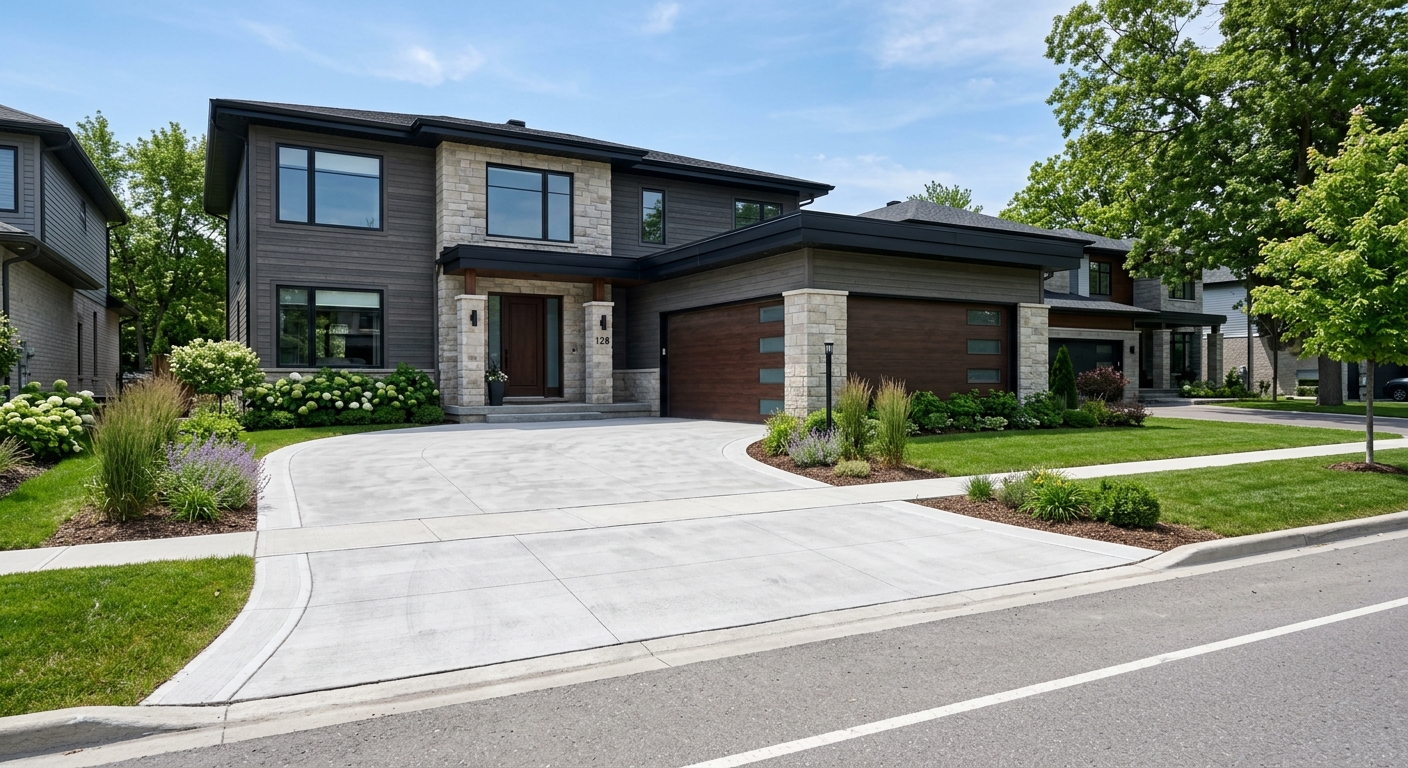
Concrete work options and costs in Port Coquitlam
Concrete work in Port Coquitlam is a practical choice for homeowners because it handles heavy rain, winter dampness, and the area’s freeze–thaw cycles better than many alternatives—when it’s built to the right spec. Most of the housing stock is owner-occupied (homeowner households make up 77.1% of households) and a large share of homes are single-detached (36.7% of dwellings), which means driveways, patios, and entry walkways are common upgrades. At the same time, many neighbourhoods in and around central Port Coquitlam have older homes—32.9% were built before 1981—so you’ll often see replacement or reinforcement work where settlement or failing drainage has already occurred.
In the Lower Mainland–Southwest, pricing is shaped less by extreme cold and more by shallow frost depth (practice commonly assumes roughly 450 mm / 18" for design) plus frequent wetting and drying. Footings and thickened edges are still placed below the design frost level to reduce frost heave risk, and exterior slabs typically use air-entrained concrete with proper control joints. Add coastal humidity, prolonged rain, and cool curing nights, and you’ll see contractors plan around scheduling, curing blankets, and longer cure times—especially for driveways and patios.
Demand is especially steady in family-oriented areas like Lincoln Park, where lot access and landscaping tie directly into excavation and formwork time. Below is a straightforward comparison of typical options so you can line up like-for-like scope before you request quotes.
| Application |
Typical Size |
Key Spec |
Finish Option |
Price Range |
| Concrete driveway (standard broom finish) |
400 sq. ft. (approx. 20' x 20') |
4" slab, compacted granular base, air-entrained mix |
Broom finish + control joints |
$5,800–$11,200 |
| Exposed aggregate driveway |
400 sq. ft. (approx. 20' x 20') |
4" slab, air-entrained mix, proper curing for surface retention |
Exposed aggregate (acid/wash finish) |
$7,200–$13,500 |
| Stamped concrete driveway or patio |
300 sq. ft. (approx. 15' x 20') |
4" slab, reinforced where required, air-entrained mix |
Stamp + integral color or base color + sealer |
$8,000–$14,800 |
| Plain concrete patio or walkway |
200 sq. ft. (approx. 10' x 20') |
4" slab (or 4"–5" depending on sub-base), air-entrained mix |
Float trowel light broom + control joints |
$3,600–$7,200 |
| Garage floor (interior slab) |
500 sq. ft. (approx. 20' x 25') |
4" slab, vapour control (if required), reinforcement where specified |
Power-trowel / smooth finish |
$8,500–$16,000 |
| Foundation footings (structural, below frost) |
Typical footing scope varies |
Excavation + formwork + rebar; placed below design frost |
Structural concrete only |
$3,000–$9,000 |
Prices are estimates only and vary by project scope, site access and material selection.
What affects the price of concrete work in Port Coquitlam
In the Lower Mainland–Southwest, it’s common to see quotes for the “same” concrete project vary by 30–50% once you compare actual specifications, not just the finishing. The biggest driver is foundation and slab design to manage freeze–thaw and water movement—because even with a shallow frost line, saturated soils and repeated wetting create real durability challenges. In older Port Coquitlam neighbourhoods with clayey pockets and limited drainage, we often plan thicker base prep and additional drainage work, which moves the job up the cost range quickly.
Frost line depth and freeze–thaw cycles dictate the spec everywhere in British Columbia: exterior concrete should use air-entrained mixes, and footings must extend below the design frost depth (practice commonly targets roughly 0.5–1.2 m in coastal BC). Colder regions require deeper excavations and more winter protection, which is why “north of here” quotes can rise faster; in Port Coquitlam we still pay for frost-depth excavation, but we tend to pay more in scheduling and curing precautions. De-icing salts later in the season can accelerate spalling if the concrete isn’t air-entrained and if surface protection isn’t planned.
Two practical examples: (1) switching from a plain broom-finish driveway to exposed aggregate or stamped can add labour-time and finishing materials—often aligning with the regional ranges like driveway concrete at about $18–$28 per sq. ft. before decor upgrades. (2) if your patio or walkway needs regrading and improved sub-drainage, costs can jump even if the concrete area stays the same, because the granular base prep and compaction work is what really protects the slab.
For homes built before 1981 (32.9% in Port Coquitlam), it’s also more common to find past patch repairs or uneven settlement that requires extra saw-cutting, removals, and sometimes deeper base rebuilds before we can pour. That’s why a “standard” slab can land near the lower price band when conditions are clean, but closer to the upper band when the site needs drainage and structural attention.
| Price Factor |
Why It Matters |
Cost Impact |
| Frost line depth — determines footing depth and form height |
Footings below design frost reduce frost heave risk |
Higher excavation increases labour and disposal; can swing costs by thousands |
| Site preparation — excavation, grading, compacted granular base |
Prevents settlement and controls water under slabs |
Unfavourable soil or poor drainage pushes you toward the higher band |
| Reinforcement — rebar or wire mesh requirement |
Controls cracking from shrinkage and load |
Adds material and placement time; more required on driveways and garage slabs |
| Mix design — air-entrainment and compressive strength spec |
Air-entrainment protects against freeze–thaw scaling/spalling |
May increase material cost but is essential for durability |
| Finish type — broom vs. stamped vs. exposed aggregate |
Finishing method affects labour and material processes |
Stamped/exposed aggregate often raises labour and product costs |
| Pour size and concrete truck access to site |
Long carries and multiple placements add time |
Tight driveways/back lanes can increase forming and logistics costs |
| Cold-weather curing precautions — heating and blankets |
Reaching design strength requires stable curing conditions |
Cool nights and humidity can extend cure time and add materials/crew monitoring |
| Control joint pattern and sealing cost |
Controls where cracks form; sealing limits moisture intrusion |
Proper jointing and sealer add cost but reduce future deterioration |
Permits & regulations in British Columbia
In British Columbia, structural concrete work generally requires a building permit, and the municipality often expects engineered drawings or sign-offs for items like footings, foundation walls, and grade beams. For Port Coquitlam homeowners, the key distinction is whether the concrete is part of the load-bearing system. Structural pours—such as new foundation footings, foundation walls, underpinning-related concrete, and engineered grade beams—typically need a permit, plus inspection at the stages required by the project.
Concrete flatwork (patios, walkways, and standard driveways) usually does not require a permit unless it affects lot grading, impervious surface coverage limits, or municipal right-of-way conditions (for example, work tied into boulevard areas or drainage that impacts neighbouring lots). Even when a permit isn’t required for the slab itself, the drainage approach and regrading can still be scrutinized, so it’s smart to confirm before breaking ground.
Step-by-step, here’s how a homeowner in Port Coquitlam can verify a contractor’s credentials in BC: (1) confirm they have the right provincial business registration and are eligible to perform the type of work they’re offering; (2) ask for a current Certificate of Insurance (liability) showing adequate coverage for concrete work and jobsite operations; (3) ask for proof of coverage for workers—WSIB/WCB clearance or equivalent documentation; and (4) request references from similar-scale projects locally (Port Coquitlam, Coquitlam, or nearby Lower Mainland work) so you can verify finish quality and durability in a wet coastal climate.
Getting concrete right in Port Coquitlam's freeze-thaw climate
Concrete failures in Port Coquitlam are rarely about “bad concrete” from the plant—most problems come from how the base is built, how the mix is designed for freeze–thaw, and whether curing and protection are handled correctly. Our Lower Mainland–Southwest conditions include coastal-wet rainfall, cool nights, and freeze–thaw cycles that can repeatedly drive moisture into the surface and edges. The most common visible issue is spalling (pitting/scaling), often linked to inadequate air-entrainment or poor finishing/cure practices.
To spec the job correctly, start with base preparation: use compacted granular sub-base to the right depth for your local soil and frost considerations, then verify grading so water doesn’t pond at the slab edges. Next, require an air-entrained mix (commonly targeting about 5–7% air content for exterior flatwork) and a minimum 32 MPa compressive strength so the slab holds up after seasons of saturation and temperature swings. Third, build control joints into the plan—spacing matters because joints control where shrinkage cracks form. Fourth, curing: plan for at least 7 days under proper conditions, and treat cold, damp weather seriously with curing blankets or other protection to reach design strength before heavy use. Finally, sealing: apply a penetrating sealer after curing (often around 28 days post-pour) to help repel de-icing salts and limit water intrusion.
Here’s where the pricing logic shows up: moving from a basic broom-finish patio to a higher-spec exterior mix and better curing practices might only add a modest amount, but it can prevent early surface scaling that otherwise forces costly rework. For example, if a plain walkway is projected in the $16–$26 per sq. ft. band, paying for proper jointing and sealer is usually far cheaper than removing and replacing a prematurely spalled section.
| Spec |
Why It Matters in Port Coquitlam |
What to Ask For |
Impact if Skipped |
| Compacted granular base (depth?) |
Stabilizes soil and drains water under the slab through wet coastal cycles |
Depth and compaction method (DCP/proof of compaction where used) + drainage/grading plan |
Settlement, rocking, and early cracking; slab can lift or fail at edges |
| Air-entrained concrete mix (target air %?) |
Air voids protect against freeze–thaw scaling and spalling in exterior conditions |
Target air content and confirmation it’s specified for exterior exposure |
Surface pitting/spalling; accelerated deterioration during winter temperature swings |
| Compressive strength (MPa rating) |
Strength at cure supports durability through seasons of moisture exposure |
Minimum 32 MPa (or project-spec rating) and mix submittals on request |
Reduced longevity, increased wear and crumbling under loads |
| Control joints (spacing per ACI guidelines) |
Controls where shrinkage cracks form instead of random cracking |
Joint layout, saw-cut or tooled timing, and spacing plan for your slab size |
Random cracks and moisture pathways that worsen freeze–thaw damage |
| Minimum 7-day curing period |
Proper curing is crucial in cool/humid Lower Mainland weather |
Curing approach (blankets if needed), protection from foot traffic and washout |
Lower surface strength; increased cracking and scaling risk |
| Penetrating sealer (when applied after cure) |
Repels water and reduces salt-driven deterioration on exterior slabs |
Use a penetrating sealer and apply after full cure (often around 28 days) |
Higher moisture ingress; faster surface damage and staining |
How to choose a concrete work contractor in Port Coquitlam
Choosing the right concrete contractor in Port Coquitlam starts with verifying credentials and then demanding itemized, like-for-like quotes. In British Columbia, ask for (1) proof of liability insurance (Certificate of Insurance showing jobsite coverage and limits), and (2) proof of workers’ coverage for WSIB/WCB or the relevant clearance documentation they carry for the crew doing your pour. If you’re hiring for structural concrete (footings/foundation walls), ensure the company is comfortable coordinating permit/engineered requirements and inspections—this is where documentation matters most.
Then get 2–3 itemised written quotes. I strongly recommend a breakdown that separates labour, concrete supply, excavation/grading, forms, reinforcement (rebar/mesh), saw-cut joints, disposal, and finishing/sealer. Avoid “lump sum” quotes that don’t list what’s included. Confirm whether permit pulls (when required), inspection scheduling, and disposal are included, and whether they’re assuming any existing base conditions.
Warranty matters too. Ask for a workmanship warranty length (and what it covers), and whether product/manufacturer warranties apply to any specialty materials like sealers or engineered mixes. Also confirm if warranties are transferable if you sell your home.
For payment schedule, never pay more than 10–15% upfront. Use a holdback until the job is complete and cleaned, and verify curing/protection steps are finished. Finally, require a written start date and completion estimate, especially because Port Coquitlam weather can extend cure times when rain or cool nights slow strength gain.
- Request proof of current liability insurance before signing anything.
- Request WSIB/WCB clearance or equivalent coverage documentation for workers.
- Ask for 3–5 references from similar Lower Mainland exterior concrete projects.
- Insist on itemized quotes (labour, materials, excavation, reinforcement, finish, sealer).
- Confirm whether removal/disposal of existing concrete is included or an add-on.
- Ask who provides and places the air-entrained mix and the target strength spec.
- Verify base depth and compaction expectations for your specific site.
- Ask for the control joint layout and when joints will be cut or tooled.
- Confirm curing plan (blankets/curing compound) if temperatures are cool or rainy.
- Clarify timeline responsibilities if weather delays the pour or cure milestones.
- Agree on payment milestones tied to completed stages, not just “progress”.
- Confirm warranty terms in writing, including workmanship and specialty materials.
Concrete contractor red flags in Port Coquitlam include: vague scopes that don’t mention air-entrained concrete, refusing to show insurance/coverage documents, quotes that omit base preparation depth or compaction, promising “same-day curing” without protection in cool damp weather, and schedules that ignore rain and curing blankets (leading to weak surfaces and early scaling).
Frequently asked questions — concrete work in Port Coquitlam
What is a concrete overlay and is it suited to Port Coquitlam?
A concrete overlay is a thin layer of new concrete placed over an existing slab (often after surface prep and repairs). In Port Coquitlam, an overlay can be suited to driveways and patios when the original concrete is structurally sound—meaning it’s not badly heaved, extensively cracked, or failing underneath. The key is careful preparation: grinding/surface profiling, addressing weak areas, and ensuring proper bonding so water can’t work under the overlay. Because Port Coquitlam sees wet coastal conditions and freeze–thaw cycles, overlays must include appropriate mix design and an exterior-grade approach, including sealing after cure. Pricing varies, but homeowners often find overlays can be cheaper than full replacement when the base is stable; however, if drainage is poor and the slab is already moving, a full rebuild is usually the better long-term investment.
How do I seal concrete to protect it in Port Coquitlam?
Sealing helps protect against moisture intrusion and surface wear—important in British Columbia’s coastal-wet climate where repeated wetting and freeze–thaw cycles can drive deterioration. For exterior flatwork in Port Coquitlam, the usual approach is to let the concrete cure first, then apply a penetrating sealer after full cure—commonly around 28 days post-pour. Before sealing, the surface must be clean and dry, and any contaminants like dirt, algae, or curing residue need to be removed. Choose a penetrating sealer designed for exterior use so it doesn’t form a slick surface and it can reduce water absorption that contributes to scaling. If you plan to use de-icing salts, sealing becomes even more important. Your contractor should specify the sealer type, coverage rate, and application conditions (temperature and rain risk).
What is the difference between concrete and cement?
Concrete is the final construction material, made from cement plus aggregates (sand and gravel), water, and often admixtures like air-entrainment for freeze–thaw durability. Cement is only one component inside concrete—typically a powder that reacts with water to bind the mix together. In Port Coquitlam and across British Columbia, the concrete mix design is what matters for performance: for exterior slabs, you generally want air-entrained concrete and the right strength specification so the slab survives moisture exposure and winter temperature swings. You might hear people say “we need better cement,” but the durability you pay for is really in the complete concrete mix: air content, strength, and curing practices.
How much does concrete work cost in Port Coquitlam?
Concrete pricing in Port Coquitlam depends heavily on prep, reinforcement, finish complexity, and site access. For basic expectations, regional cost bands for the city tier commonly land around $18–$28 per sq. ft. for concrete driveways and $16–$26 per sq. ft. for concrete patios and walkways. Stamped & decorative options usually run higher—often about $22–$36 per sq. ft. once you factor in colour, tooling and finishing steps. As an example, a 300 sq. ft. stamped driveway or patio can land roughly in the $8,000–$14,800 range depending on sub-base conditions and whether your project includes extra drainage/grading. Always compare quotes by the included base prep, mix requirements, jointing, curing, and sealing—those details are what separate a “cheap” price from a durable one in our coastal freeze–thaw climate.
How deep must footings be for Port Coquitlam's frost line?
Footings must be placed below the design frost depth to reduce frost heave risk. In coastal British Columbia practice, the frost depth is often assumed around 450 mm / 18" for slab/frost-protection design, but structural footings are still placed below the design frost level based on the project’s geotechnical and structural requirements. The exact depth should come from the engineer’s foundation design (and it can vary with soil conditions and drainage). This matters most because even though Port Coquitlam winters are mild compared to inland BC, freeze–thaw cycles paired with saturated soils can still create movement if footings are too shallow. If someone is quoting foundation concrete without discussing frost depth and the specific placement depth, that’s a major scope gap you should clarify before signing.
Why does concrete crack in Port Coquitlam and how is it prevented?
Concrete cracks are normal to some extent—especially in exterior slabs—because concrete shrinks as it cures and expands/contracts with moisture and temperature changes. In Port Coquitlam, the freeze–thaw cycle and repeated wetting increase the importance of controlling crack locations and managing water at the surface and edges. Prevention focuses on the spec: use an air-entrained mix for exterior durability, build a properly compacted granular base, include reinforcement where needed, and install control joints with the right spacing so shrinkage cracks form where you expect them. Curing also matters: allow at least 7 days under proper conditions so the concrete reaches strength before heavy exposure. Finally, sealing helps reduce moisture ingress after cure (often around 28 days), which lowers the risk that cracks become pathways for freeze–thaw damage.