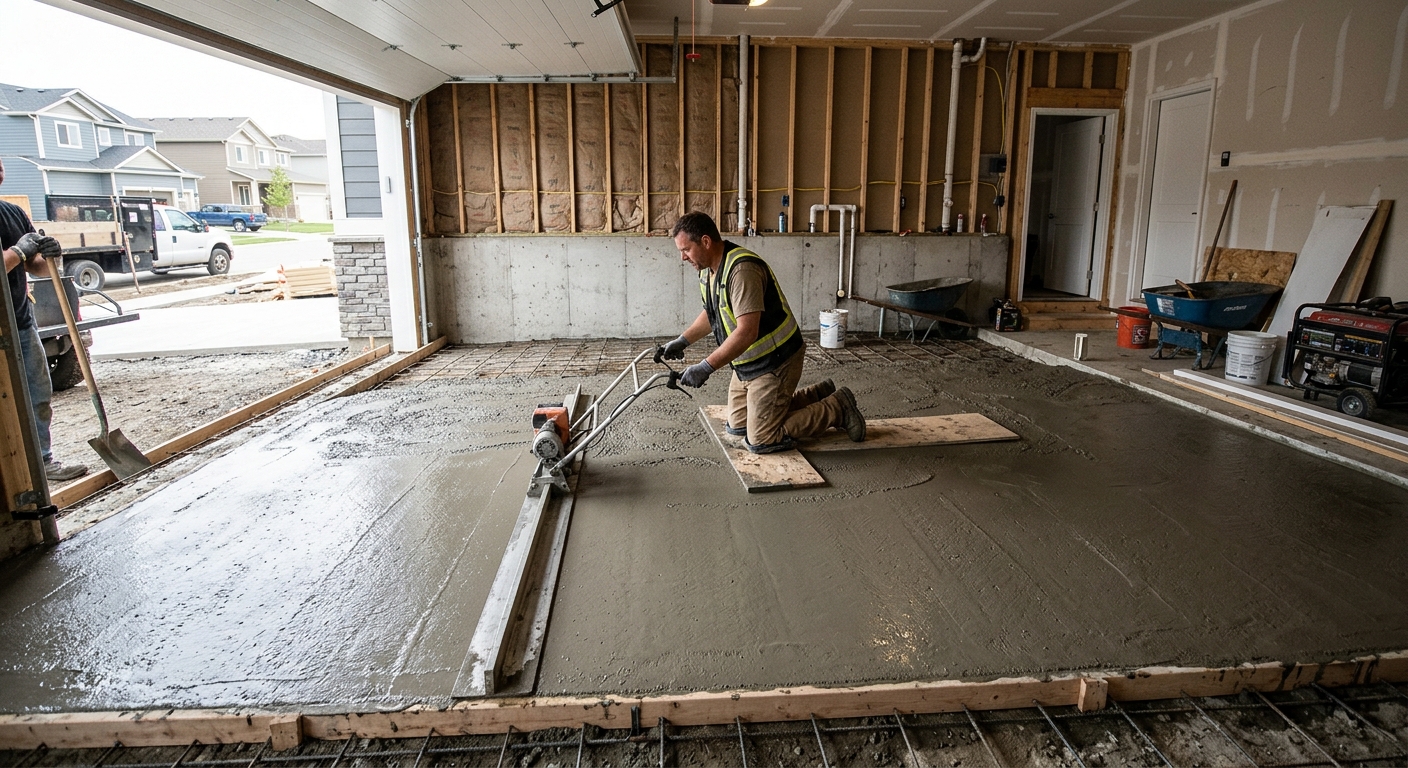
Concrete work options and costs in East Newton South
Concrete work in East Newton South is all about matching the right scope to the local climate and the type of housing you see around you. In a community of 7,881 people (Statistics Canada, 2021 Census), most flatwork demand comes from single-detached neighbourhood streets where driveways and patios are high-visibility upgrades—and where good drainage matters just as much as the finish. Lower Mainland–Southwest contractors also face competitive scheduling because trades are busier during the drier stretches between rainy weeks, and that affects both labour availability and cure-time planning.
In this part of the Lower Mainland, the frost line is relatively shallow compared with inland and northern BC, but it still drives the design: typical practice assumes frost depth around 450 mm (18") for exterior work, and structural footings are placed below that to reduce freeze–thaw heave risk. Saturated soils and frequent wetting mean base prep and mix design are rarely “optional.” Even standard broom-finished slabs are usually poured with air-entrained concrete, proper granular base, and control joints to manage cracking and surface scaling.
East Newton South clients in the Sullivan area (and nearby family neighbourhoods) commonly ask for driveways that look clean with practical snow-and-salt durability. That’s where the price differences between broom, exposed aggregate, and stamped work make sense—and where you’ll see the biggest swings driven by excavation depth, reinforcement, truck access, and the curing plan. Use the table below as a starting point before you request itemised quotes.
| Application |
Typical Size |
Key Spec |
Finish Option |
Price Range |
| Concrete driveway (standard broom finish) |
400–600 sq. ft. |
Air-entrained mix, compacted base, control joints |
Broom finish |
$18,000 – $28,000 |
| Exposed aggregate driveway |
400–600 sq. ft. |
Air-entrained mix, properly controlled wash/expose timing |
Exposed aggregate |
$22,000 – $32,000 |
| Stamped concrete driveway or patio |
300–500 sq. ft. |
Air-entrained mix, stamped pattern, sealer |
Stamped concrete |
$22,000 – $36,000 |
| Plain concrete patio or walkway |
200–400 sq. ft. |
Vibration/finishing control, joints, compacted base |
Float + light broom |
$3,200 – $10,400 |
| Garage floor (interior slab) |
450–600 sq. ft. |
Vapour barrier (as specified), mesh/rebar (if required), proper curing |
Steel trowel (light burnish) or broom |
$10,500 – $18,500 |
| Foundation footings (structural, below frost) |
Varies by house plan |
Concrete below design frost, reinforcement per engineering |
Structural forming + finishing to foundation grade |
$200 – $350 |
Prices are estimates only and vary by project scope, site access and material selection.
What affects the price of concrete work in East Newton South
If you get quotes for the same driveway or patio in East Newton South, it’s common to see differences of 30–50% across the Lower Mainland–Southwest and the broader British Columbia market—even when the finish looks similar. The drivers aren’t just “concrete costs.” In this region, the shallow frost depth still requires footings and thickened edges to sit below design frost to limit frost heave, and saturated soils make drainage and base prep a bigger part of the budget than homeowners often expect. That’s why one contractor can price closer to the typical driveway band of $18–$28 per sq. ft. (depending on size), while another lands higher after including deeper excavation, engineered reinforcement, or a more controlled curing plan.
Every exterior slab and walkway in the Lower Mainland is designed for freeze–thaw cycles using air-entrained concrete and properly spaced control joints. Colder regions of BC face a shorter pour season, but here in coastal-wet conditions you still get cool nights and high humidity—so we plan for longer cure protection and sometimes curing blankets to reach strength before rain. De-icing salts also accelerate surface deterioration when the concrete mix and curing aren’t right, which is why sealing is often recommended for driveways and garage approaches.
In East Newton South, cost can go up when your soil is soft or poorly drained (extra granular base and improved drainage are added), when truck access is tight (smaller pours or more labour for formwork and hauling), or when you need reinforcement beyond minimal wire mesh. It can come down when the site is already well-graded, the subgrade is stable, and you stay with a simpler broom finish. For a typical stamped driveway or patio, it’s easy to see costs climb from standard driveway pricing toward the $22–$36 per sq. ft. decorative band—usually justified by the pattern mats, labour-intensive finishing, and extra sealing.
| Price Factor |
Why It Matters |
Cost Impact |
| Frost line depth |
Determines footing depth and form height |
Higher excavation + more concrete/steel below frost; can move structural costs up or down materially |
| Site preparation |
Excavation, grading, compacted granular base |
Soft soils/soggy subgrades increase base thickness and labour; stable sites reduce prep time |
| Reinforcement |
Rebar or wire mesh requirement |
Rebar cages, spacers, and tying add labour; thin slabs with minimal reinforcement cost less |
| Mix design |
Air-entrainment and compressive strength spec |
Air-entrained mixes and strength requirements affect material selection and testing; typically modest but non-negotiable for exterior |
| Finish type |
Broom vs. stamped vs. exposed aggregate |
Stamped/exposed work adds labour and time; standard broom remains the lowest-cost option |
| Pour size and concrete truck access to site |
Staging, coordination, and haul time |
Tight access or multiple stages increase crew hours and logistics |
| Cold-weather curing precautions |
Heating and blankets |
Cool, wet periods require protection; this can add blanket rentals and labour to the schedule |
| Control joint pattern and sealing cost |
Crack control + surface durability in salt/wet conditions |
Joints are labour-intensive to plan/install well; sealing adds material cost but reduces long-term surface issues |
Permits & regulations in British Columbia
In British Columbia, many homeowners assume “concrete is concrete,” but the permit requirements depend on what the concrete supports and whether it changes drainage or site grading. Structural concrete work—such as footings, foundation walls, grade beams, and any engineered foundation elements—generally requires a building permit and often engineered drawings that get reviewed by the municipality. Concrete flatwork (patios, walkways, and driveways) usually does not require a permit when it stays within typical lot grading, but it can require review if it affects lot grading, increases impervious surface beyond what your site can handle, or impacts municipal right-of-way or drainage patterns. Because rules and thresholds can vary, confirm with the local authority before breaking ground.
For contractor accountability in East Newton South, verification matters before you sign. Step-by-step: (1) Check the contractor’s licence status using the appropriate provincial online registry for general contractors/builders as applicable in BC; (2) Request a certificate of insurance showing liability coverage that matches the project scope—ask for it to list your address or at least your project name; (3) Ask for proof of work coverage for workers (commonly WCB/WCB coverage in BC) and ensure the certificate is current; (4) Get references from recent jobs that are similar in scale—especially exterior flatwork in wet coastal conditions. If a contractor can’t provide documentation promptly, that’s usually a sign the paperwork workflow (and sometimes the job planning) isn’t tight.
Getting concrete right in East Newton South's freeze-thaw climate
Concrete failures in East Newton South are usually about water management and freeze–thaw durability, not just “bad finishing.” When the base isn’t compacted to the right depth, drainage is poor, or the mix isn’t air-entrained as required for exterior exposure, water gets under or into the slab. Then, during cold snaps, the freeze–thaw cycle expands that moisture and stresses the surface—leading to scaling, spalling, and random cracking that homeowners notice within a few seasons. The Lower Mainland–Southwest approach balances a shallow frost depth with frequent wetting: we still design footings below design frost (commonly treated around 450 mm / 18" practice for many exterior thickened elements), but we pay extra attention to subgrade preparation because saturated soils and cool damp curing periods are common.
To spec the job correctly, focus your discussion on five areas. Base prep: compacted granular sub-base to the right thickness for the soil you’re building on. Mix design: air-entrainment for exterior flatwork (commonly targeted around 5–7% air content) and a minimum 32 MPa compressive strength. Control joints: a planned spacing pattern so cracks form where you expect, not randomly through driveway edges. Curing: protect the slab for at least 7 days under suitable conditions; in cool, damp weather we often use curing blankets to keep strength gain on track. Sealing: apply a penetrating sealer after the slab has cured (often at or after 28 days) to repel de-icing salts and reduce moisture uptake.
Here’s a practical example: moving from a plain broom-finished patio to a sealed finish package can add material and labour cost, but it’s often a better trade than repairing spalled edges later. Likewise, adding proper air-entrainment and control joints may cost less than a “cheap mix” approach, yet it directly prevents the spalling that costs thousands to replace.
| Spec |
Why It Matters in East Newton South |
What to Ask For |
Impact if Skipped |
| Compacted granular base (depth?) |
Reduces pumping, settles less, and supports the slab through wet seasons |
Granular type and compacted depth plan based on site conditions |
Settlement, cracking, and water infiltration under the slab |
| Air-entrained concrete mix (target air %?) |
Improves freeze–thaw durability in coastal-wet freeze cycles |
Target air content (commonly 5–7% for exterior flatwork) |
Spalling/scaling from moisture expansion during freeze–thaw |
| Compressive strength (MPa rating) |
Ensures the slab reaches adequate strength for traffic and drainage exposure |
Minimum 32 MPa compressive strength (per mix design/spec) |
Surface wear, reduced durability, and higher risk of early damage |
| Control joints (spacing per ACI guidelines) |
Controls where cracking happens during temperature movement |
Proposed joint spacing, layout, and sealant plan (if included) |
Random cracking and larger repair patches |
| Minimum 7-day curing period |
Strength gain depends on temperature and moisture—especially in cool, rainy periods |
How you’ll protect curing at night/high humidity (blankets if needed) |
Weak surface, increased scaling risk |
| Penetrating sealer (when applied after cure) |
Repels water and reduces damage from de-icing salts and repeated wetting |
Sealer type and target application timing after cure (often 28+ days) |
Faster moisture uptake, blotchy weathering, and salt-related deterioration |
How to choose a concrete work contractor in East Newton South
Start with verification. In British Columbia, confirm the contractor is properly licensed for the type of work they’re claiming, and request a current certificate of liability insurance before work begins. For labour coverage, ask for proof of WCB/WCB coverage for workers—don’t rely on “we’re covered” verbal statements. You should also ask who will be on-site (crew size and foreman), because concrete quality is jobsite-controlled: base prep, mix handling, timing, and curing all happen while you’re waiting. If a contractor won’t explain their process clearly, that’s a red flag.
Next, get 2–3 itemised written quotes. Ask for a labour + materials breakdown rather than only a lump sum: excavation, granular base, reinforcement, concrete supply (including air-entrainment and compressive strength), forms, finishing, joints, curing protection, disposal, and sealing if specified. Read exclusions carefully: is permit pull included if required for structural components? Is removal/disposal of old concrete included? Are site access constraints handled with haul/staging costs stated upfront? Confirm warranty terms in writing: workmanship warranty length, whether any product/manufacturer warranty applies, and if it’s transferable to future owners.
For payment, never pay more than 10–15% upfront. Hold back a portion until the job is complete and deficiencies are corrected. Finally, request a start date and completion estimate in writing, with what weather conditions would pause the work—especially relevant in East Newton South where rain and cool nights can delay curing.
- Provide licence/registration details and confirm they match the scope of work.
- Request certificate of liability insurance and verify project address/name.
- Ask for proof of WCB/WCB coverage for workers and check that it’s current.
- Get 2–3 quotes with labour + materials line items (not just a final total).
- Confirm mix design includes air-entrainment for exterior exposure.
- Ask for base prep specifications: compacted granular type, depth, and compaction method.
- Require reinforcement details: wire mesh vs. rebar, and where it’s placed.
- Ask about control joint spacing and who marks the layout.
- Confirm curing protection plan (blankets/curing timing in cool, wet spells).
- Clarify whether sealing is included and when it will be applied after cure.
- Check disposal/replacement scope if old concrete is being removed.
- Review schedule: start date, weather contingencies, and final cure/sealing timeline.
Red flags in East Newton South include: ignoring air-entrainment for driveways/patios, giving a low price without explaining base prep or joints, refusing to provide insurance/licence documentation, starting without a cure/weather plan, and offering a vague warranty (“we’ll fix it if it cracks”) without a written term.
Frequently asked questions — concrete work in East Newton South
How long does a concrete project take in East Newton South?
Timelines in East Newton South are usually measured in days for placement, but in weeks for safe use. A small patio or walkway often takes about 1–3 days on-site (prep, forms, pour, finishing), while larger driveway work can be 3–6 days depending on excavation and reinforcement. The bigger schedule driver is curing in Lower Mainland–Southwest conditions: even with mild winters and a shallow frost line, cool nights and frequent rain can slow strength gain, so we protect the slab for at least 7 days. Full durability improves over time, and if you’re sealing, we typically target application after cure—often at/after 28 days. If your project needs structural concrete components (like footings), that can extend the calendar because of permit/engineering steps.
What is a concrete overlay and is it suited to East Newton South?
A concrete overlay is a new concrete layer placed over an existing slab (after surface preparation), usually to improve appearance and cover surface deterioration. In East Newton South and across British Columbia’s wet coastal climate, overlays can be suitable when the existing slab is structurally sound—meaning there’s no major settlement, widespread base failure, or significant differential movement. If the original problem is water movement, poor base, or freeze–thaw damage beneath the slab, an overlay can hide symptoms but won’t always fix the cause. Ask contractors whether they’ll do grinding/scarification, how they’ll assess adhesion, and whether they’ll install proper drainage and joints. Overlay pricing varies, and for reference, many new exterior flatwork projects still start around the $16–$26 band for plain patios/walkways, while decorative options like stamped concrete run higher (often $22–$36).
How do I seal concrete to protect it in East Newton South?
Sealing in East Newton South is mainly about repelling water and limiting salt and moisture intrusion during freeze–thaw cycles. The common best practice is to use a penetrating sealer applied after the concrete has cured—often at 28 days—so the concrete isn’t still releasing moisture internally. Before sealing, the slab should be clean and fully dry; any curing residue, dirt, or poor surface condition can prevent proper penetration. For homeowners, ask your contractor what sealer type they use (penetrating versus film-forming) and whether it’s designed for de-icing salts. Also confirm prep steps: light cleaning, surface testing/coverage rate, and whether they’ll protect landscaping and neighbouring surfaces. Sealing isn’t a replacement for air-entrainment, base prep, and control joints, but it’s a solid durability add-on in the Lower Mainland’s wet, salty winter reality.
What is the difference between concrete and cement?
In everyday conversation, people mix up terms, but in British Columbia the distinction matters. Cement is a binder powder (the “glue”)—it reacts chemically with water to form paste. Concrete is the full material made from cement plus water, sand, gravel (or crushed stone), and often admixtures such as air-entrainment and plasticizers. For exterior work in East Newton South, the concrete specification is the key: you want air-entrained concrete (commonly targeted around 5–7% air content for exterior flatwork) and adequate compressive strength (often at least 32 MPa for the mix design). Finish and performance depend on the whole concrete system, not just the cement brand.
How much does concrete work cost in East Newton South?
Concrete pricing in East Newton South generally follows regional price bands for the Vancouver–Surrey–Abbotsford corridor. For plain exterior flatwork, patios and walkways commonly land around $16–$26 per sq. ft. depending on thickness, base prep needs, and access. Driveways typically run higher—commonly $18–$28 per sq. ft.—because excavation, reinforcement, and drainage prep are often more involved and the slab takes more traffic. Decorative options like stamped concrete can move upward into the $22–$36 per sq. ft. band due to pattern work and extra finishing time. Foundation/footing costs are often quoted structurally (materials and forming/reinforcement), and price can vary significantly with engineering, but you may see per-unit budgeting in the $200–$350 range depending on scope. Your final number depends on truck access, subgrade condition, and whether sealing and longer cure protection are included.
How deep must footings be for East Newton South's frost line?
Footings must be placed below the design frost depth to reduce frost heave risk. In the Lower Mainland–Southwest, typical practice assumes a frost depth around 450 mm / 18", but structural footings and engineered foundation elements are designed based on the project’s soil conditions and engineering requirements. That means contractors generally excavate deeper than the “surface” frost line guideline, then place footings below it with reinforcement as specified. If you’re building or altering a foundation, the exact depth can be set by geotechnical and structural drawings, and the municipality may require engineering for structural work in British Columbia. For homeowners, the practical takeaway is: don’t accept a “typical depth” guess without engineering/site confirmation. Ask for the footing depth stated on drawings and how the contractor will protect the subgrade during excavation and pour.