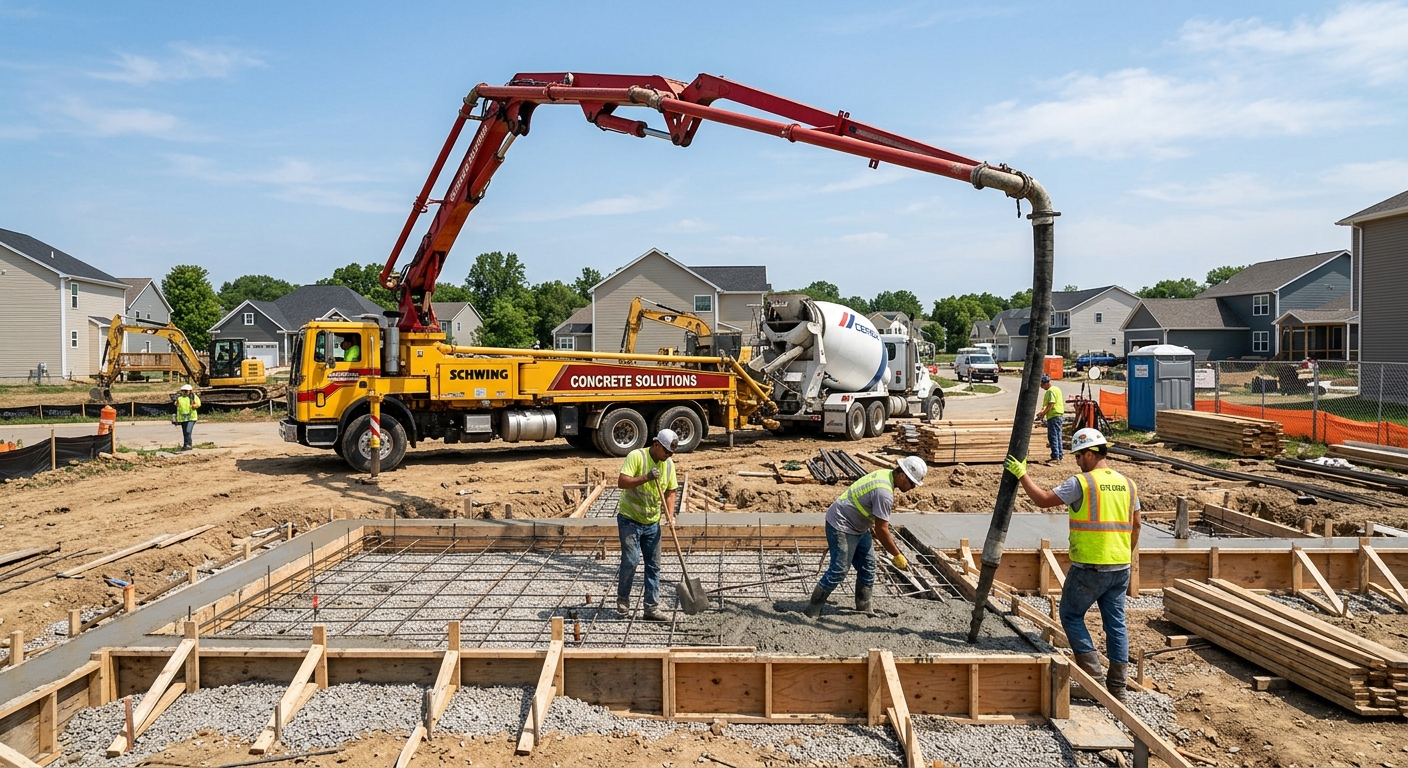
Concrete work options and costs in Lougheed
Lougheed, British Columbia is a small community, but it sits in the busy Lower Mainland–Southwest construction belt where concrete crews get booked quickly—especially near the new-growth corridors around Lougheed Highway (high demand for driveways and backyard flatwork). With a population of 15,300 (Statistics Canada, 2021 Census), most concrete work is tied to single-family homes, where homeowners commonly add or renew driveways, patios, and entry walks. That housing pattern drives steady demand for durable exterior surfaces that can handle the region’s mild-but-wet winters and frequent freeze–thaw cycles.
In the Lower Mainland–Southwest, pricing is shaped by practical frost protection and drainage. Even with a shallow frost depth assumed around 450 mm / 18", footings and thickened edges are placed below frost to reduce freeze–thaw movement. Exterior slabs also need air-entrained concrete, proper compacted base, and controlled curing around cool nights and rain—because surface scaling and early deterioration are real risks when curing is rushed. Contractor availability and scheduling can also move costs: late-season rain can force rescheduling, and that affects labour productivity and costs for blankets, sealers, and extended cure time.
Below is a realistic snapshot of what homeowners in Lougheed typically pay for common concrete options, then you can use the spec notes to compare quotes apples-to-apples.
| Application |
Typical Size |
Key Spec |
Finish Option |
Price Range |
| Concrete driveway (standard broom finish) |
400–550 sq. ft. |
Compacted granular base, rebar or wire mesh, air-entrained |
Broomed surface with control joints |
$9,000 – $15,500 |
| Exposed aggregate driveway |
400–550 sq. ft. |
Compacted base, air-entrained, consistent mix and wash timing |
Exposed aggregate with sealer plan |
$11,500 – $18,500 |
| Stamped concrete driveway or patio |
250–450 sq. ft. |
Compacted base, air-entrained, integral colour (as selected) |
Stamp + release + joint pattern |
$8,000 – $16,000 |
| Plain concrete patio or walkway |
200–400 sq. ft. |
Compacted base, air-entrained, control joints |
Light broom or smooth steel float |
$3,200 – $8,800 |
| Garage floor (interior slab) |
400–600 sq. ft. |
Vapour barrier (as required), mesh reinforcement, 32 MPa typical |
Broom finish |
$6,000 – $13,000 |
| Foundation footings (structural, below frost) |
Varies by house plan |
Excavation, formwork, rebar, concrete below design frost |
Structural finish (utility-grade) |
$25,000 – $55,000 |
Prices are estimates only and vary by project scope, site access and material selection.
What affects the price of concrete work in Lougheed
In Lougheed and across the Lower Mainland–Southwest, it’s common to see quotes for the “same” concrete job land 30–50% apart once you look behind the mix number. Differences usually come from frost-safe excavation depth, how well the base is built, reinforcement type and quantity, mix design (especially air-entrainment), and how the contractor handles curing and drainage in wet, cool conditions. When comparing Lower Mainland bids to other parts of British Columbia, the timing of pours and cold-weather precautions can also shift costs—even if the frost line is comparatively shallow here.
The Lower Mainland–Southwest climate is a cost driver because freeze–thaw cycles and saturated soils dictate every exterior spec. Footings and thickened edges must extend below the design frost depth (practically ~450 mm / 18" as a planning reference), otherwise the slab/edge can heave and crack. Exterior slabs also need air-entrained concrete so the mix resists repeated expansion and scaling. Meanwhile, farther north or in colder regions, contractors face shorter pour seasons and higher heating/blanket costs; that’s why their unit costs often come in higher than the Lougheed baseline, even for similar square footage.
Two real examples I see in Lougheed: (1) a 450–550 sq. ft. driveway can move from the $18 – $28 per sq. ft. tier to the higher end when poor drainage or saturated subgrade forces deeper base and more granular replacement; (2) stamped work often starts near the $22 – $36 per sq. ft. tier, but it doesn’t make sense to pay extra if the joint pattern and base prep are weak—decorative concrete only looks good when the structure is sound.
Finally, local housing age matters. Older lots often have uneven fill or prior driveways; correcting grade and reworking base can add hundreds to thousands depending on how much excavation and hauling is required, and that can rival the difference between a plain broom finish and a decorative option.
| Price Factor |
Why It Matters |
Cost Impact |
| Frost line depth — determines footing depth and form height |
Footings and thickened edges must sit below frost to prevent heave |
More excavation and formwork can add major labour and material hours |
| Site preparation — excavation, grading, compacted granular base |
Concrete lasts when the base drains and compacts correctly |
Bad subgrade often requires granular replacement and added compaction time |
| Reinforcement — rebar or wire mesh requirement |
Controls cracking and improves load capacity for driveways and slabs |
Extra rebar chairs, tying time, and material weight increase the total |
| Mix design — air-entrainment and compressive strength spec |
Air-entrainment is critical for freeze–thaw durability; strength supports long-term performance |
Higher-spec air content and strength may cost more per yard but reduces failure risk |
| Finish type — broom vs. stamped vs. exposed aggregate |
Complex finishes need tighter workmanship and timing |
Stamped and exposed aggregate typically cost more than plain broom |
| Pour size and concrete truck access to site |
Large pours and limited access affect staging and concrete placement efficiency |
Extra crew time, pumping needs, and waiting time can increase costs |
| Cold-weather curing precautions — heating and blankets |
Cool nights and rain/humidity slow strength gain and increase surface defects |
Blankets, sealing timelines, and possible heating add direct materials and labour |
| Control joint pattern and sealing cost |
Joints manage cracking; sealing helps repel salts and moisture |
Proper jointing and a post-cure sealer step typically increases line items |
Permits & regulations in British Columbia
In British Columbia, it’s usually straightforward to find what needs a permit, but homeowners still need to confirm before breaking ground—especially in Lougheed where lot grading and drainage details can trigger municipal conditions. Structural concrete work like foundation walls, grade beams, and footings typically requires a building permit, and many projects also rely on engineered drawings reviewed by the municipality. For concrete flatwork—driveways, patios, and walkways—permits are often not required on their own, unless the work affects lot grading, changes stormwater flow, touches impervious surface coverage limits, or impacts the municipal right-of-way (for example, curb ties or sidewalk interfaces).
Step-by-step, here’s how a homeowner should verify the contractor is properly set up in BC:
- Request proof of liability insurance before signing; the certificate should show your project address or an appropriate coverage period.
- Ask for their Workers’ compensation coverage (WSBC) documentation—concrete crews are trade workers and should be covered.
- Confirm the contractor’s business registration and qualifications using the online listings or professional directory they provide.
- Ask for recent references for similar-scope flatwork or foundation work in the Vancouver–Surrey–Abbotsford corridor.
- Confirm with the municipality (or your designer) whether a permit is required for your specific scope and whether drawings are needed.
If a contractor won’t provide insurance paperwork or refuses to discuss permitting responsibilities clearly, that’s a red flag—particularly in BC where drainage and structural compliance are taken seriously.
Getting concrete right in Lougheed's freeze-thaw climate
Concrete failures in Lougheed usually come down to water movement, weak base prep, and not enough durability in the mix. In our Lower Mainland–Southwest setting, freeze–thaw cycles plus saturated subgrade can push moisture through the slab edge and into weak spots. Over time, that can lead to scaling, spalling, and random cracking—especially on driveways and steps where de-icing salt is used.
To spec the job correctly, start with base preparation: excavate to the right depth for the local soil and frost protection, then place compacted granular sub-base with the drainage layer designed for your site. Next, specify mix design: for exterior flatwork, require air-entrained concrete with an air content target of about 5–7% and a minimum 32 MPa compressive strength. Third, use control joints to manage shrinkage and reduce uncontrolled cracking—joints are a planned feature, not an afterthought.
Curing is where many jobs quietly lose quality. Plan for minimum 7 days of curing under proper conditions, and when nights are cool or rain is persistent, crews should use curing blankets or protective methods so the slab reaches strength without surface damage. Finally, schedule a penetrating sealer applied after cure (commonly around 28 days) to improve resistance to salts and moisture. If you get these right, a broom finish can look good for years—if you skip air-entrainment or rush base prep, you may pay again.
Dollar example: a plain broom patio can be in the $16 – $26 per sq. ft. band, but spending the extra on correct air-entrainment, proper base depth, and sealing can prevent premature surface scaling. That added reliability usually costs less than replacing a failed slab section a year later.
| Spec |
Why It Matters in Lougheed |
What to Ask For |
Impact if Skipped |
| Compacted granular base (depth?) |
Ensures drainage and supports the slab under freeze–thaw movement |
Granular base depth and compaction method for your site conditions |
Settlement, cracking, and accelerated edge deterioration |
| Air-entrained concrete mix (target air %?) |
Improves durability against repeated freezing and thawing |
Target air content around 5–7% for exterior flatwork |
Higher risk of spalling and scaling after wet/cold cycles |
| Compressive strength (MPa rating) |
Supports long-term load capacity and surface performance |
Minimum 32 MPa compressive strength (confirm test/QA process) |
Slow strength gain and premature wear in traffic areas |
| Control joints (spacing per ACI guidelines) |
Limits random cracking and helps the slab behave predictably |
Joint spacing plan appropriate to slab thickness and panel size |
Wider cracks and appearance issues that often cannot be repaired cleanly |
| Minimum 7-day curing period |
Critical in cool nights and rainy stretches common in the Lower Mainland |
Curing duration and protection measures (blankets/sealing timing) |
Dusting, surface weakness, and reduced durability |
| Penetrating sealer (when applied after cure) |
Helps repel moisture and de-icing salts at the surface |
Sealer applied after full cure (commonly ~28 days) |
Faster salt/water intrusion and early surface breakdown |
How to choose a concrete work contractor in Lougheed
Choosing the right contractor matters in Lougheed because concrete quality is largely “set” before and during the pour—base prep, drainage, mix spec, and curing are where good contractors earn their reputation. Start by verifying British Columbia requirements and coverage. Ask for:
- Proof of liability insurance (certificate of insurance) showing your coverage period.
- WSBC coverage documentation for workers (you want a covered crew on your site).
- Business registration and any trade qualifications the contractor uses for concrete work.
- Recent photos and references for similar jobs—driveways, patios, and if applicable, footings in the Lower Mainland–Southwest.
Next, get 2–3 itemised written quotes (not one lump-sum number). You want a breakdown showing labour + materials and what’s included: excavation and disposal, granular base, reinforcement, concrete supply, finishing, curing products, and sealing (if offered). Also check exclusions such as site access limitations, unmarked utility locates, or extra haul for unsuitable soils.
For warranty, ask for both workmanship warranty length and whether there is any product/manufacturer warranty that applies to sealers or admixtures—and whether it’s transferable to future owners. For payment schedule, never pay more than 10–15% upfront; hold back funds until the job is fully complete and protected (especially curing/sealing steps). Finally, ask for a written start date and completion estimate; in BC’s wet shoulder seasons, timelines should include weather contingency.
- Confirm who orders and supplies the air-entrained mix and who controls batching.
- Ask for proposed base depth and compaction targets (not “we’ll prep it”).
- Request joint layout and thickness details before pricing is finalized.
- Verify reinforcement type: rebar vs wire mesh, and spacing/cover.
- Check whether disposal, hauling, and topsoil replacement are included.
- Ask about truck access—does the price assume pumping or short reach?
- Confirm curing plan for cool nights/rain: blankets, curing compound, or protection.
- Ask whether penetrating sealer is included and when it will be applied.
- Request samples or documentation for stamped/exposed aggregate systems.
- Make sure the quote includes protection of landscaping and clean-up.
- Ask who does cutting timing for control joints (same day where appropriate).
- Ensure permit responsibilities are clearly stated if any structural work is involved.
Concrete red flags I see around Lougheed: contractors who (1) won’t show insurance/WSBC coverage, (2) quote “cheap” concrete without air-entrainment specs for exterior work, (3) skip base compaction details, (4) refuse to discuss control joints and curing, or (5) ask for most payment up front with no holdback until sealer/cure steps are done.
Frequently asked questions — concrete work in Lougheed
Concrete vs pavers for a patio in Lougheed?
In Lougheed, the right choice usually comes down to how you want the patio to perform and how you plan to manage drainage. Concrete patios are strong and cost-predictable, especially when air-entrained mix, compacted granular base, and control joints are installed correctly. Pavers can look great and sometimes offer easier localized repairs, but they still need a properly graded base and edge restraint to avoid rocking. If your site gets heavy rainfall and freezes intermittently, the concrete spec (base depth, air content, curing and sealing) often provides a more uniform surface durability. As a reference, plain concrete patios/walkways often fall within the $16 – $26 per sq. ft. band, while more decorative work typically moves higher. Ask any contractor to show base and joint spacing details for both options—those specs matter more than the surface look.
How long does a concrete driveway last?
A well-built concrete driveway in British Columbia can last 20+ years, and often longer, but only if it’s designed for freeze–thaw exposure, moisture, and de-icing conditions common in Lougheed. The biggest longevity factors are: a compacted granular base that drains, air-entrained concrete suitable for exterior freeze–thaw cycles, correctly placed control joints, and curing that reaches the intended strength. Sealing after full cure also helps reduce salt/moisture intrusion. Cost matters here: paying for the correct spec is usually cheaper than replacing a failing section. In the Lougheed market, driveway bids typically start around the $18 – $28 per sq. ft. band depending on finish and reinforcement, and the higher end often reflects better base work, reinforcement, and curing/finishing quality. If a contractor can’t explain their mix air content or joint layout, that’s your cue to dig deeper before you sign.
What is air-entrained concrete and why does it matter here?
Air-entrained concrete is a mix designed to include tiny, evenly distributed air bubbles that help the concrete tolerate freezing and thawing. In Lougheed and the Lower Mainland–Southwest, the risk isn’t “deep frost” so much as repeated freeze–thaw conditions and wet ground that saturates the slab edges and surface. When water freezes, it expands; the controlled air bubbles give the concrete room to relieve that pressure, reducing the chance of scaling and spalling. For exterior slabs like driveways, patios, and steps, you should ask for an air content target around 5–7% and confirmation that the contractor is using a mix spec appropriate for freeze–thaw durability. This is one of the clearest reasons quotes can differ: two contractors may both say “concrete,” but only one may be pricing a proper air-entrained, exterior-grade mix. If you’re comparing prices, insist on the mix and spec—not just the finish.
How do I prepare the base for a concrete slab?
Concrete base prep is the foundation of the whole job (sometimes literally). In Lougheed, you want the contractor to excavate to a depth that supports frost-safe performance and then place a compacted granular base designed for drainage and stability. The granular should be compacted in lifts using proper equipment so it doesn’t “feel firm” but actually meets compaction requirements. If subgrade is saturated or soft, the contractor should replace unsuitable material rather than pour over it. You should also confirm the project includes drainage considerations—especially at slab edges—because poor drainage increases freeze–thaw pressure. When you compare quotes, ask for: base depth, material type (granular specs), compaction method, and whether reinforcement chairs/spacers are used. A lower bid that skips base depth or compaction will often show up later as cracking, settlement, or scaling—repairs usually cost more than doing the base right the first time.
How do I compare concrete quotes?
To compare concrete quotes in Lougheed, focus on scope and spec consistency—not just the final number. Ask each contractor to provide an itemised quote that separates labour and materials (concrete supply, base prep materials, reinforcement, finishing, curing products, and any sealer). Confirm what’s included for excavation and disposal, whether granular replacement is allowed for poor soils, and whether site access requires pumping or extra labour. Next, compare technical items: air-entrainment target for exterior work, minimum compressive strength (often 32 MPa for typical slabs), control joint plan (spacing and timing), and curing protection during cool or wet weather. Finally, check finish inclusions—standard broom, stamped, or exposed aggregate—because decorative work can add labour and materials. If one quote is in the lower end of the driveway band (like closer to $18 – $28 per sq. ft.), make sure it still includes air-entrainment and proper base prep. The lowest bid with weaker specs often costs more in the long run.
Can concrete be poured in cold weather in Lougheed?
Yes, concrete can be poured in cold weather in British Columbia, including Lougheed, but it must be planned and protected to reach design strength safely. The concern isn’t only “temperature”—it’s cool nights, moisture, wind, and the speed of early hydration. A reputable contractor will adjust with cold-weather procedures such as insulating blankets, proper curing protection, and sometimes using heating strategies to maintain concrete temperature and prevent freezing during the critical early period. You should ask how they’ll protect the slab, what curing method they’ll use, and whether they have a cold-weather plan in writing. You’ll also want to confirm that the mix design is appropriate for exterior freeze–thaw durability (air-entrainment for exterior flatwork) so scaling doesn’t develop later. If a contractor treats cold weather as “business as usual” without blankets or protection, you should be cautious. Weather-related scheduling can also affect cost, because protection steps and extended curing time take labour and materials.