Concrete work options and costs in Connaught Heights
Concrete work in Connaught Heights, British Columbia is shaped by a mild-but-wet coastal climate and a shallow design frost depth, which still must be respected to prevent freeze–thaw damage. With a population of 2,027 (Statistics Canada, 2021 Census), our neighbourhood is small enough that reliable crews can book up quickly during prime pour windows. Many properties here are single-detached homes, and that market drives steady demand for driveways, patios, sidewalks and front entries—especially in busier pockets such as Westminster Highway and the around the Gilmore area, where homeowners commonly upgrade exterior flatwork at the same time as landscaping and drainage improvements.
In the Lower Mainland–Southwest region, pricing is influenced by consistent engineering habits: footings and thickened edges are placed below the frost line (commonly assumed around 450 mm / 18" in local practice), base prep includes compacted granular and drainage attention, and exterior slabs are typically air-entrained. Coastal rainfall also affects schedules and curing—cool nights, high humidity, and wet weather mean contractors plan for longer curing and may use curing blankets or sealers to protect the surface durability. That’s one reason you can see quote differences even for “the same” driveway: mix design, rebar placement, and curing provisions change the labour time and material selection.
Below is a practical price comparison you can use to sanity-check bids before you compare details in the scope and specifications.
| Application |
Typical Size |
Key Spec |
Finish Option |
Price Range |
| Concrete driveway (standard broom finish) |
18 ft x 10 ft (180 sq ft) |
Air-entrained exterior mix, compacted base, control joints |
Broom finish |
$3,240 – $5,040 |
| Exposed aggregate driveway |
18 ft x 10 ft (180 sq ft) |
Air-entrained mix, washed aggregate surface, proper curing |
Exposed aggregate |
$3,960 – $6,480 |
| Stamped concrete driveway or patio |
12 ft x 16 ft (192 sq ft) |
Air-entrained mix, release agent, integral colouring |
Stamped + colour |
$4,224 – $6,912 |
| Plain concrete patio or walkway |
12 ft x 12 ft (144 sq ft) |
Reinforcement as required, joints as specified |
Steel-trowel + light broom or plain finish |
$2,304 – $3,744 |
| Garage floor (interior slab) |
20 ft x 22 ft (440 sq ft) |
Interior mix, vapour control as applicable, joints |
Plain trowel finish with broom edges |
$7,040 – $11,000 |
| Foundation footings (structural, below frost) |
Per linear metre (typical footing 12"–16" wide) |
Excavation, forming, rebar placement, pour below design frost depth |
Structural concrete (no decorative finish) |
$200 – $350 |
Prices are estimates only and vary by project scope, site access and material selection.
What affects the price of concrete work in Connaught Heights
In the Lower Mainland–Southwest, you can often see the same concrete scope land 30–50% apart across quotes and contractor styles. The biggest drivers aren’t “mystery markups”—they’re spec differences: how deep they excavate, how they build the granular base, what mix they order (air content and strength), and whether they include curing and sealing measures that protect concrete through coastal wetting and freeze–thaw cycles. The result is that two driveways that both “look broom-finished” can perform very differently—and cost differently—because the hidden work is different.
Frost line depth and freeze–thaw cycles dictate every exterior spec. Even in coastal BC, typical practice assumes a frost depth around 450 mm / 18", so exterior footings, thickened edges and structural elements must be placed below that zone to avoid frost heave. All exterior slabs generally require air-entrained concrete to manage freeze–thaw scaling risk. In colder regions, the shorter pour season and cold-weather curing precautions (heating, insulating blankets, extended protection) raise costs; in the Lower Mainland those precautions are still used on cool/rainy days, and that’s where the “quote spread” shows up. De-icing salt also accelerates surface damage—so sealing is often a wise add-on for driveways and walkways.
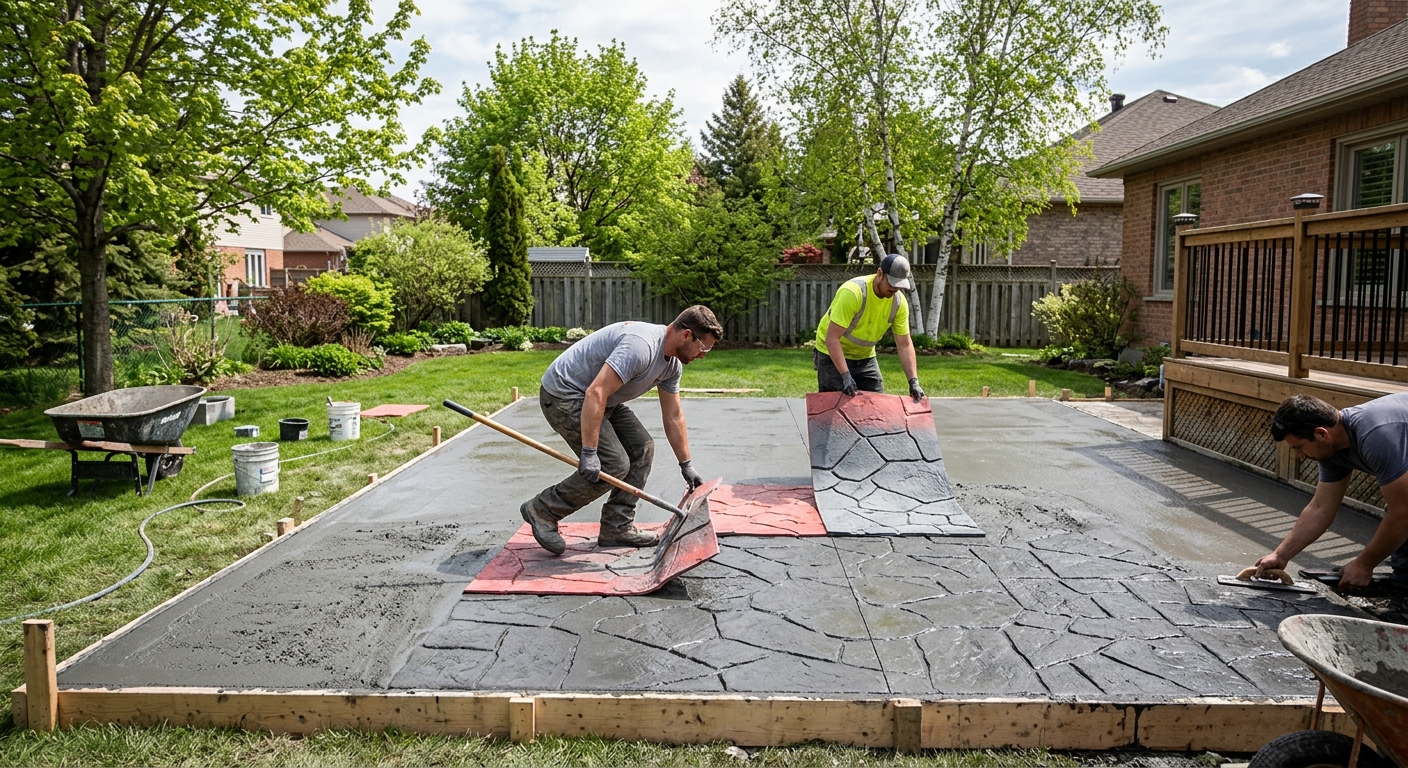
Concrete options price out clearly. If you compare a standard driveway in the $18–$28 per sq ft range to stamped finishes in the $22–$36 range, the jump is usually justified by labour time (forms, mats, release agent, colour) and more careful finishing. In Connaught Heights, older homes can mean tighter access and more grading/draintie-in work, which increases excavation and base prep. Conversely, a flatter backyard with good vehicle access can reduce truck access time and cleanup, bringing overall costs toward the lower band for patios and walkways.
| Price Factor |
Why It Matters |
Cost Impact |
| Frost line depth — determines footing depth and form height |
Footings must sit below the design frost zone to resist heaving |
Higher excavation and forming can add significant cost on structural elements |
| Site preparation — excavation, grading, compacted granular base |
Proper base prevents settlement and improves slab durability |
More haul/disposal and granular supply increases pricing |
| Reinforcement — rebar or wire mesh requirement |
Controls cracking for driveways, garage slabs and exterior slabs |
Additional material + labour for tying/placing raises the quote |
| Mix design — air-entrainment and compressive strength spec |
Air content helps resist freeze–thaw scaling and spalling |
Better mix control can raise material cost but reduces failures |
| Finish type — broom vs. stamped vs. exposed aggregate |
Finish affects labour time, materials and curing/handling |
Stamped and exposed finishes are typically higher per sq ft |
| Pour size and concrete truck access to site |
Large pours and limited access drive pumping, multiple loads, or waiting time |
Truck coordination and pumping can add labour and equipment charges |
| Cold-weather curing precautions — heating and blankets |
Cool, wet conditions can delay strength gain |
Protection measures add rental and crew time when required |
| Control joint pattern and sealing cost |
Joints guide cracking; sealing protects against moisture and de-icing salts |
Skipping these can lower the bid, but increases long-term repair likelihood |
Permits & regulations in British Columbia
In British Columbia, structural concrete work—such as footings, foundation walls, and grade beams—typically requires a building permit. Many projects also need engineered drawings reviewed by the municipality, especially where foundation size, rebar detailing, or soil conditions affect structural capacity. For concrete flatwork like driveways, patios and walkways, permits are often not required by default, unless the work changes lot grading, affects impervious surface coverage limits, or impacts municipal right-of-way areas. Even when a permit isn’t typical, you should confirm with the local authority before breaking ground—especially in older neighbourhoods where drainage patterns and service locations can be sensitive.
Before hiring anyone in Connaught Heights, verify three things step-by-step:
- Licence/registration: check the contractor’s business details through the appropriate provincial/business registry sources (and confirm the trade credentials if they self-identify as a licensed builder for the structural portion).
- Liability insurance: ask for a current Certificate of Insurance (COI) showing commercial general liability limits and that your address is covered for the project.
- WSBC coverage: confirm workers are covered through WSBC/WCB as applicable. You should receive clearance letter documentation or a COI that reflects the coverage status.
Also request references from similar-size exterior flatwork or foundation jobs in BC, and confirm the scope includes protection of adjacent landscaping, grading, and proper disposal of removed concrete.
Getting concrete right in Connaught Heights's freeze-thaw climate
Concrete commonly fails in Connaught Heights when the job is treated as “just pouring”—but here, winter wetting and freeze–thaw cycles expose any weakness. The two biggest problem patterns are (1) slabs built on insufficient base or drainage and (2) concrete mixed/finished without enough freeze–thaw resistance. To spec correctly, start with base preparation: contractors should place a compacted granular sub-base to the right depth for local soil conditions and expected frost influence, not just “fill to grade.” Then require an exterior mix with air-entrainment (typically 5–7% air content for exposed flatwork) and a minimum compressive strength of 32 MPa so durability is built in rather than hoped for.
Next, control joints: joint spacing should be designed to limit random cracking in driveway and patio panels. Finally, curing and sealing are essential. Plan for at least 7 days of curing under proper conditions, and in cool, rainy stretches use curing blankets or protection so surface strength isn’t delayed. Sealing is typically applied after the concrete has cured—often around 28 days—using a penetrating sealer to help repel moisture and reduce the surface impact of de-icing salts.
Ask yourself whether the price difference is actually buying durability. For example, if a standard driveway is quoted near the $18–$28 per sq ft band but the higher bid includes verified air-entrained mix design, reinforcement placement, curing blankets, and a joint/sealer plan, that premium is often justified. In contrast, “cheap” bids that omit air-entrainment or skip curing protection may look fine initially, but they’re the ones that tend to show early spalling and scaling after winter cycles.
| Spec |
Why It Matters in Connaught Heights |
What to Ask For |
Impact if Skipped |
| Compacted granular base (depth?) |
Prevents settlement and reduces moisture pumping from wet soils |
Base depth and material type (granular), compacted to spec |
Cracking, edge heaving, uneven settling and premature deterioration |
| Air-entrained concrete mix (target air %?) |
Helps concrete survive freeze–thaw and coastal wetting |
Air content target (commonly 5–7% for exterior flatwork) on mix ticket |
Higher risk of scaling and spalling during winter cycles |
| Compressive strength (MPa rating) |
Ensures durability and strength gain for traffic and weather exposure |
Minimum 32 MPa (or higher if specified for the application) |
Soft surface, faster wear and potential long-term cracking |
| Control joints (spacing per ACI guidelines) |
Directs cracking to predictable locations in slabs |
Joint layout plan and spacing for your slab dimensions |
Random cracking, loss of appearance and greater water infiltration |
| Minimum 7-day curing period |
Cold/rainy conditions in BC can slow strength development |
Curing method (blankets/protection) and conditions during the first week |
Weaker surface and higher chance of early damage |
| Penetrating sealer (when applied after cure) |
Repels moisture and reduces damage from de-icing salts |
Sealer type and timing (often after full cure, commonly around 28 days) |
More staining, freeze–thaw scaling and spalling risk over time |
How to choose a concrete work contractor in Connaught Heights
Choosing the right concrete contractor in Connaught Heights is less about slick marketing and more about proof: coverage, documentation, and a scope that matches local durability needs. For British Columbia, start with licensing/registration appropriate to their contracting role, then verify liability insurance with an up-to-date Certificate of Insurance (COI). For worker coverage, confirm WSBC/WCB status—ask for a clearance letter or documentation that confirms the business is set up for the work you’re hiring them to do. If they can’t produce these items quickly and clearly, that’s a red flag.
Next, request 2–3 itemised written quotes that break labour vs materials and list key specs: base prep depth, reinforcement type, concrete mix (including air-entrainment), curing approach and whether sealing is included. Avoid “lump sum” quotes with vague language like “standard mix” or “we’ll do joints as needed.” Read the scope for exclusions: permit pull (if required), excavation disposal, traffic control, pump needs, and site restoration.
For warranty, ask for (1) workmanship warranty length, (2) any product/manufacturer warranties for sealers/admix, and (3) whether warranties are transferable if you sell your home. For payment, never pay more than 10–15% upfront; use a holdback until completion and inspection. Get a timeline with a written start date and completion estimate—weather and curing can shift schedules in the Lower Mainland, and good contractors plan contingencies.
- Written scope with measurements, thicknesses and joint pattern
- Concrete mix ticket details: air-entrainment and strength requirements
- Base prep described (granular type and compacted depth)
- Reinforcement plan (rebar vs mesh, placement supports, overlaps)
- Drainage notes (especially where driveway meets slope/yard)
- Rain/cold-weather curing plan (blankets, protection method)
- Sealing included or priced separately with application timing
- Disposal and haul-off included for removed concrete/base
- Traffic protection and safety plan for your driveway/entry
- Permit responsibility clearly stated (who pulls what, if applicable)
- Warranty in writing and what it covers/doesn’t cover
- Payment schedule with a holdback until final acceptance
Red flags in Connaught Heights: crews that won’t show proof of WSBC/WCB coverage, quotes that omit air-entrainment specifics, “cheap” bids that don’t mention curing protection or sealing, vague joint layouts, and contractors who ask for most payment upfront without a written schedule and measurable scope.
Frequently asked questions — concrete work in Connaught Heights
How do I prepare the base for a concrete slab?
For Connaught Heights and the Lower Mainland–Southwest, base prep is what keeps your slab from settling and developing edge problems after wet winters and freeze–thaw cycles. A proper base typically includes excavating to the right depth for your soil conditions, then placing and compacting a granular sub-base in lifts to reach the target grade. Contractors should also check drainage and ensure water doesn’t sit under the slab or near edges, because saturated subgrade increases freeze–thaw stress. Ask your contractor to state the base depth and granular material type, and whether they include compacted bedding under reinforcement supports. Good prep is one of the reasons quality driveways in this region price closer to the $18–$28 per sq ft band rather than the “too-good-to-be-true” numbers.
How do I compare concrete quotes?
To compare concrete quotes in British Columbia, don’t just compare the bottom-line total—compare what’s inside the scope. Ask for an itemised breakdown: excavation/disposal, granular base, reinforcement (rebar/mesh type and placement), concrete mix design (including air-entrainment for exterior work), finishing method, curing provisions, and sealing timing if included. A quote for a standard driveway around the $18–$28 per sq ft band can still be inferior if it uses the wrong mix or skips curing protection. Similarly, stamped concrete in the $22–$36 range should explain where the additional labour/materials are coming from (colour, mats, release agent, and time for careful finishing). The best way to catch differences is to request mix-ticket evidence, thicknesses, and a joint layout.
Can concrete be poured in cold weather in Connaught Heights?
Yes, concrete can be poured in cold weather in Connaught Heights, but the key is controlling temperature and curing so the concrete reaches strength safely. In the Lower Mainland–Southwest, you’ll often see cold and damp conditions that slow hydration, even if winters are milder than interior BC. Contractors should specify cold-weather curing precautions such as insulating blankets, windbreaks, and sometimes concrete heating methods when temperatures require it. You should also confirm how they protect the slab after placement, especially during cool nights with rain or fog. If a contractor suggests pouring “no matter what” with only minimal cover, that’s risky. A quality crew plans around expected conditions and adjusts protection—this is one reason quotes vary between jobs.
How do I maintain concrete in Connaught Heights's freeze-thaw climate?
Maintenance in Connaught Heights is mostly about keeping water out and monitoring small issues before they expand. Start with sealing (commonly penetrating sealer applied after cure—often around 28 days) to repel moisture and reduce surface damage from de-icing salts. Use sand rather than aggressive salt whenever possible, and avoid repeated heavy de-icing on edges and joints. Inspect your driveway and walkways after winter for scaling at corners, joint deterioration, and trip hazards. If you see joint sealant failing, address it early so water doesn’t migrate under the slab. For patios, keep downspouts and grading directing water away from the slab. Proper air-entrained concrete and control joints reduce maintenance needs because cracking is controlled and water infiltration is limited.
What causes concrete to spall in Connaught Heights winters?
Spalling is usually caused by freeze–thaw pressure plus water. In Connaught Heights, the combination of coastal wetting, rain absorption, and then winter freeze cycles can push water inside concrete pores. If the mix doesn’t have proper air-entrainment or the concrete isn’t cured and protected correctly, water can freeze in a way that breaks the surface paste, leading to scaling and then spalling. The risk increases when joints are poorly planned (allowing random cracking) or when base drainage is inadequate and the slab stays wet. De-icing salts can worsen the surface chemistry and accelerate deterioration. That’s why reputable contractors specify air-entrained exterior mixes and include control joints and curing/possible sealing. Skipping those items is what turns a “looks fine” job into a winter repair problem.
What is rebar and when is it required in British Columbia?
Rebar is steel reinforcement used in concrete to improve strength and control cracking. In British Columbia, when rebar is required depends on the structural design and the slab’s application—driveways, garage slabs, and foundation elements often need reinforcement to manage tensile stresses and shrinkage cracking, particularly where loads or spans are higher. For exterior flatwork in Connaught Heights, many projects use rebar or wire mesh based on thickness, support conditions, and engineering/joint plan. The best approach is to ask your contractor whether they’re using rebar or mesh, how it’s positioned (with spacers so it’s in the slab’s correct zone), and how it ties into the joint layout. For structural concrete like foundation footings, reinforcement requirements are typically governed by engineered drawings submitted for permit review.