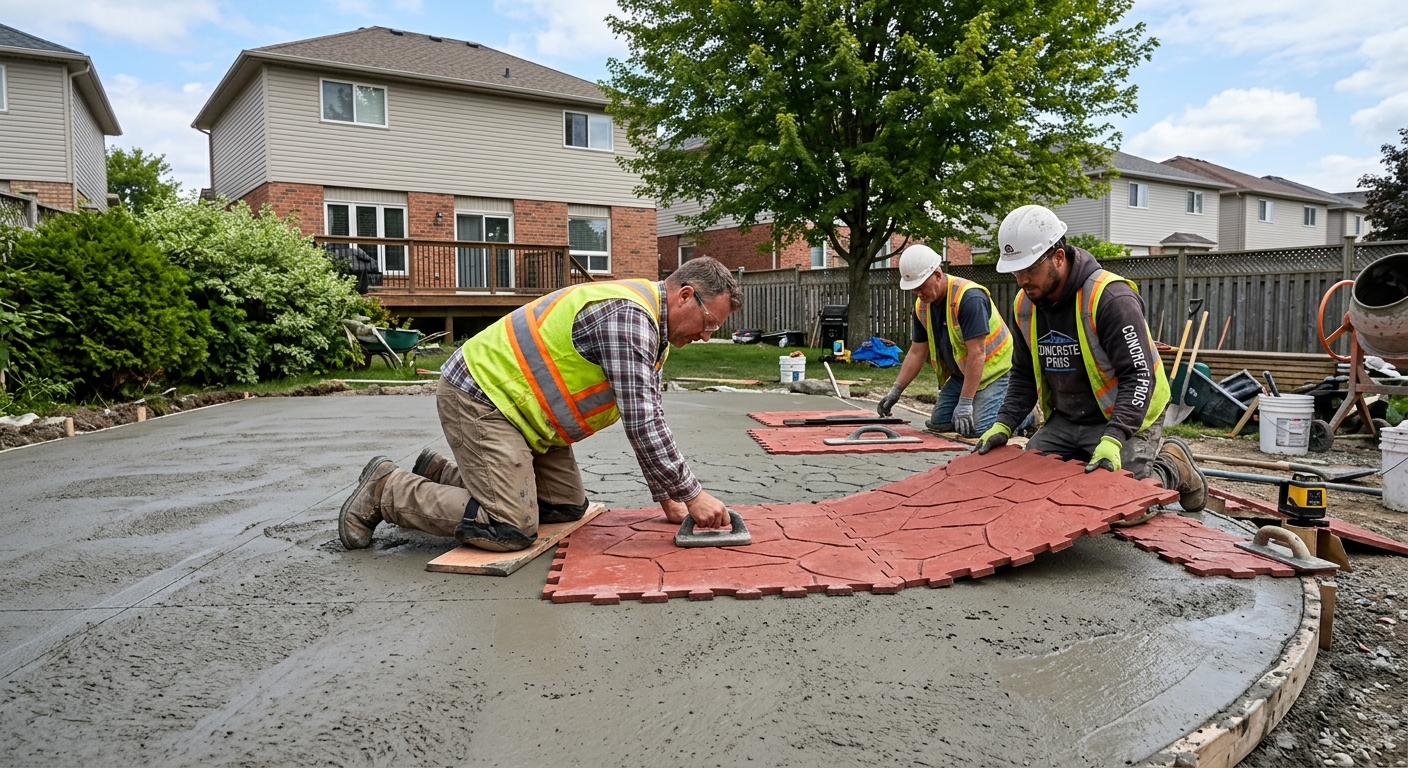
Concrete work options and costs in Marlborough
Marlborough, British Columbia is a practical place to build concrete flatwork because the Lower Mainland–Southwest climate gives you relatively mild winters, but it still brings freeze–thaw cycles, coastal rainfall, and saturated soils. With a 2021 population of 14,169 (Statistics Canada, 2021 Census), there’s steady demand from local homeowners for driveways, patios, walkways, and foundation work. Marlborough’s housing pattern typically leans on single-detached neighbourhood streets, which drives repeat business for concrete contractors—especially in areas like the East Tillicum/Goldstream corridor where families regularly upgrade curb appeal and backyard access.
In this region, costs are shaped by the way we design around a shallow—but still consequential—frost depth (commonly assumed around 450 mm / 18"). Footings and thickened edges are placed below that to reduce frost heave risk, and exterior slabs are built with air-entrained mixes plus drainage-focused base preparation. Scheduling also matters: prolonged rain, cool nights, and high humidity often mean we rely on curing blankets and longer cure times to reach reliable durability, particularly on driveways and patios.
Because those technical choices show up in every quote, you’ll see real differences between standard broom-finished slabs versus exposed aggregate or stamped work. Below is a homeowner-friendly comparison of common options—then you can match specs to your priorities in Marlborough.
| Application |
Typical Size |
Key Spec |
Finish Option |
Price Range |
| Concrete driveway (standard broom finish) |
480–600 sq. ft. |
Air-entrained exterior mix, compacted granular base, control joints |
Broom finish, cure & seal (optional) |
$10,000–$16,800 |
| Exposed aggregate driveway |
480–600 sq. ft. |
Air-entrained exterior mix, careful base grading and drainage |
Exposed aggregate (retarder process), cure & seal |
$13,700–$21,000 |
| Stamped concrete driveway or patio |
300–500 sq. ft. |
Air-entrained exterior mix, integral colour, non-slip sealer |
Stamp textures + release agent, edges detailed |
$12,900–$20,600 |
| Plain concrete patio or walkway |
200–350 sq. ft. |
Compacted granular base, control joints, exterior mix |
Float/trowel-to-satin with light broom edges |
$3,600–$7,900 |
| Garage floor (interior slab) |
400–520 sq. ft. |
Vapour barrier, compacted base, thicker section at loads |
Standard finishing (optional broom for traction) |
$7,200–$13,200 |
| Foundation footings (structural, below frost) |
Varies by plan |
Below-design frost depth, reinforced concrete per engineer |
Structural formwork + rebar + inspection-ready |
$4,800–$12,800 |
Prices are estimates only and vary by project scope, site access and material selection.
What affects the price of concrete work in Marlborough
In Marlborough, the same “concrete driveway” can come in very different directions across the Lower Mainland–Southwest—often by 30–50%—because the quote is really about specifications, site conditions, and scheduling, not just pouring concrete. A contractor can hit a low total by reducing base prep, using a less durable mix, or compressing curing timelines. Another contractor protects performance with the right air content, proper compaction, and drainage details, which costs more but holds up to our local freeze–thaw cycles and coastal-wet conditions.
Here’s the main driver: the frost depth assumption around 450 mm / 18" means exterior foundations and footings still need to extend below that design depth to prevent frost heave. Exterior slabs also need air-entrained concrete to manage freeze–thaw damage. Meanwhile, colder regions require deeper excavations and shorter pour seasons—raising excavation, forming, and heating/blanket costs—but in coastal BC we still pay for extended curing and careful moisture control. That’s why many driveways and patios require curing blankets, sealers, and longer protection windows when nights are cool or rain lingers.
Two local examples that swing pricing: (1) saturated subgrade or poor drainage can force thicker granular base and extra drainage work; (2) tight access for a concrete truck and pump can raise labour and equipment fees. If you’re choosing between options, standard broom-finished work typically aligns with the region’s backbone pricing (concrete driveway / slab roughly $18–$28 per sq. ft.), while stamped finishes and decorative systems (often $22–$36 per sq. ft.) justify their labour and material cost when you want patterning, colouring, and extra detailing.
Housing age also plays a role. Older properties often have uneven grades and buried drainage or fill materials that need correction—sometimes adding thousands to excavation and base replacement before a durable slab can be built.
| Price Factor |
Why It Matters |
Cost Impact |
| Frost line depth — determines footing depth and form height |
Footings/thickened edges must be below design frost depth to resist heave |
Can add $2,000–$8,000+ depending on excavation depth and rebar congestion |
| Site preparation — excavation, grading, compacted granular base |
Frozen/soft or saturated subgrade leads to settlement and cracking |
Typically $1,500–$6,000+; higher on poor-drainage lots |
| Reinforcement — rebar or wire mesh requirement |
Controls cracking and improves load capacity for driveways and slabs |
Often $500–$3,500 depending on slab thickness and spec |
| Mix design — air-entrainment and compressive strength spec |
Air-entrainment helps manage freeze–thaw scaling and spalling |
Usually $200–$1,200 more per load, but improves long-term durability |
| Finish type — broom vs. stamped vs. exposed aggregate |
Finishes affect labour, materials, and curing/sealer process |
Stamped/exposed often add $3–$8+ per sq. ft. |
| Pour size and concrete truck access to site |
Access determines whether you need a smaller truck, pump, or extra labour |
Can shift by $500–$4,000+ based on access and staging |
| Cold-weather curing precautions — heating and blankets |
Cool nights slow strength gain and increase surface risk |
Commonly $300–$2,000+ depending on timing and weather |
| Control joint pattern and sealing cost |
Joints guide cracking; sealing repels de-icing salts and moisture |
Often $250–$1,500+ depending on area and product choice |
Permits & regulations in British Columbia
In British Columbia, structural concrete work generally requires more oversight than simple flatwork. Permits are typically required for structural items like footings, foundation walls, grade beams, and other load-bearing concrete. In many cases, that also means you’ll see engineered drawings reviewed as part of permitting and inspection. For that work, the engineer’s dimensions (including reinforcement) and the contractor’s sequencing matter because it impacts safety and load transfer.
Concrete flatwork—like driveways, patios, and walkways—usually does not require a permit by default. That said, you should still confirm locally if your project affects lot grading, changes surface drainage, or impacts rules around impervious surface coverage and runoff control. If the work touches municipal right-of-way or involves curb/sidewalk modifications, approvals are more likely.
For a homeowner in Marlborough, verify your contractor step-by-step:
- Ask for their liability insurance certificate (COI) and confirm the project address is covered.
- Confirm WSBC/WCB coverage (workers’ compensation) so you’re not exposed if a worker is injured.
- Check licensing/registration through the appropriate provincial online registry channels (the contractor should provide their exact registration details).
- Request clearance letter or equivalent proof of standing coverage when applicable.
- Collect references from similar-scale concrete projects in BC (especially exterior flatwork).
Before breaking ground, confirm permitting requirements with the local authority for your specific scope.
Getting concrete right in Marlborough's freeze-thaw climate
Concrete failures in Marlborough usually trace back to moisture movement, weak base support, or poor durability spec. In our Lower Mainland–Southwest conditions, the key vulnerabilities are freeze–thaw cycling and prolonged wetting from coastal rainfall. When concrete isn’t properly air-entrained, water can freeze inside the paste and push surfaces off—showing up as spalling and scaling. The fix is not “stronger cement” after the fact; it’s the right mix and the right build details from day one.
To spec a long-lasting exterior slab, focus on five layers: (1) base preparation: compacted granular sub-base sized for local soil and built to the frost- and load-related depth; (2) mix design: air-entrainment typically in the 5–7% range for exterior flatwork, with at least 32 MPa compressive strength; (3) control joints: spacing that encourages cracking in the right places instead of random webbing; (4) curing: protect for at least 7 days, especially when nights are cool or rain is frequent; and (5) sealing: apply a penetrating sealer after cure (commonly at 28 days) to reduce moisture intrusion and help with de-icing salt exposure.
What questions should you ask? “Are you using an air-entrained mix for exterior exposure?” “What’s the target air content and the compressive strength?” “How are you curing when temperatures drop?” Those answers should be specific. A typical example: if a contractor is quoting a driveway near the lower band of concrete driveway / slab pricing (about $18 per sq. ft.), but skips proper curing protection and air-entrainment verification, the cost savings are often wiped out by early surface deterioration. In contrast, a more complete specification that fits the full-service band (closer to $28 per sq. ft.) is easier to justify because it’s tied to durability details that matter in Marlborough.
| Spec |
Why It Matters in Marlborough |
What to Ask For |
Impact if Skipped |
| Compacted granular base (depth?) |
Supports slab and controls settlement under wet/saturated soils |
State the base depth, compacted lifts, and drainage provisions |
High risk of cracking and uneven surface after wet seasons |
| Air-entrained concrete mix (target air %?) |
Manages freeze–thaw scaling and spalling during cold wet cycles |
Confirm air content target (typically 5–7% for exterior flatwork) |
Surface scaling/spalling and faster deterioration |
| Compressive strength (MPa rating) |
Ensures durability and adequate strength gain in cool, humid weather |
Confirm minimum 32 MPa rating and curing plan |
Reduced wear resistance and premature surface failure |
| Control joints (spacing per ACI guidelines) |
Limits random cracking from shrinkage and temperature changes |
Ask for intended joint spacing and saw-cut timing |
Random cracks that can widen and collect water |
| Minimum 7-day curing period |
Strength development is slower with cool nights and rain |
How curing is maintained if nights are cold (blankets/sealer timing) |
Surface weakness, dusting, and increased scaling risk |
| Penetrating sealer (when applied after cure) |
Reduces moisture and salt exposure from road/de-icing conditions |
Confirm sealer type and timing (commonly after 28 days cure) |
Faster water ingress and reduced long-term surface protection |
How to choose a concrete work contractor in Marlborough
Choosing the right concrete contractor in Marlborough is mostly about verification and clarity. Start with licensing/registration in British Columbia: ask the contractor to provide their exact registration details and any publicly verifiable licence number. Next, confirm liability insurance—you should receive a certificate of insurance naming your project/address or at least the correct legal entity coverage area.
For workers’ protection, verify WSBC/WCB coverage. Don’t accept verbal reassurance. Request confirmation documentation (often a clearance letter or standing proof) and confirm the coverage is active for the date range the project will run. These checks matter in BC because you’re dealing with excavation, saw-cutting, formwork and truck activity—mistakes are expensive, and you don’t want financial exposure.
Then get 2–3 itemised written quotes rather than lump sums. A solid quote breaks down labour and materials (concrete supply, rebar/mesh, forms, excavation, granular base, finishing, curing/sealer, disposal). Carefully read exclusions: is demo included? Is haul-away included? Are permit pulls included if needed for structural elements? What’s the timeline for rough and finish work?
Warranty and payment scheduling should also be straightforward. Ask for a clear workmanship warranty length and whether any product/manufacturer warranties apply and are transferable. For payment, never pay more than 10–15% upfront; use a holdback until completion and cleanup are done. Finally, get a written start date and a realistic completion estimate.
- Request proof of BC registration/licence and match it to the company legal name.
- Collect a COI for liability insurance and confirm jobsite/address coverage.
- Verify active WSBC/WCB clearance/standing documentation.
- Get 2–3 itemised quotes with separate line items for demo/base/reinforcement/finish/sealer.
- Confirm whether base prep includes compacted granular and drainage attention.
- Ask for air-entrainment and minimum compressive strength stated in writing.
- Require a joint plan (spacing and timing of saw cuts).
- Ask how they’ll cure in Marlborough’s cool, wet periods (blankets/sealer plan).
- Check whether sealer is included and when it will be applied after cure.
- Clarify disposal/haul-away and whether site restoration is included.
- Verify warranty: workmanship duration and what defects are covered.
- Use a payment schedule with a holdback until final inspection/cleanup.
Concrete red flags in Marlborough include: quotes that won’t specify air-entrainment or curing steps, skipping control joint details, vague base-prep descriptions, offering “best price” without drainage/excavation clarity, and demanding large upfront payments without a written schedule or scope.
Frequently asked questions — concrete work in Marlborough
How long does a concrete project take in Marlborough?
For most exterior flatwork in Marlborough, the actual pour day is only part of the timeline. A driveway or patio usually takes 1–2 days for demo/excavation and base preparation, 1 day to place forms/reinforcement and finish, and additional time for curing protection. Even though concrete may feel “hard” sooner, durable performance relies on proper curing—typically at least 7 days under favourable conditions. In the Lower Mainland–Southwest, cool nights and ongoing humidity can slow strength gain, so contractors often plan around rain and use curing blankets. That can extend the schedule slightly compared with inland BC. If your project includes sealing, that’s often applied closer to 28 days after the pour, which affects when you can expect a fully finished, protected surface. For pricing, many homeowners compare options around the driveway band of about $18–$28 per sq. ft., but the time needed for prep and curing is what differentiates “fast” from “built right.” (Statistics Canada, 2021 Census)
What is a concrete overlay and is it suited to Marlborough?
A concrete overlay is a bonded layer installed over existing concrete, intended to improve appearance and extend service life without full demo. In Marlborough, it can be suitable when the existing slab is mostly sound (no major settlement, widespread delamination, or heavy structural cracking) and when proper prep is completed—typically grinding, patching, and ensuring drainage paths remain functional. Overlays can be cost-effective compared with full replacement, especially when only the surface is worn. However, because Marlborough’s climate includes freeze–thaw cycles and wet conditions, overlays still need correct mix design, adequate bonding methods, and proper curing to avoid early failure. If the original concrete is failing due to inadequate air-entrainment or poor base drainage, an overlay may not fix the underlying cause. Ask contractors for a written assessment of the existing slab’s condition and their approach to moisture management and joint/edge detailing. If you’re comparing to a new concrete patio or driveway—often roughly $16–$28 per sq. ft. depending on type—the right overlay choice depends on your slab health and drainage.
How do I seal concrete to protect it in Marlborough?
Sealing in Marlborough is mainly about reducing moisture and chemical exposure that can accelerate surface wear. In our Lower Mainland–Southwest conditions—frequent dampness plus freeze–thaw exposure—water movement is a key cause of scaling and spalling when concrete isn’t properly protected. The usual approach is to apply a penetrating sealer after the slab has properly cured, commonly around 28 days post-pour. Before sealing, the surface must be clean and dry; otherwise, the sealer can’t penetrate effectively. Choose a sealer intended for exterior use and, for driveways, for durability against de-icing salts if you’re using them. Ask your contractor what product they use and whether they recommend reapplication intervals based on local weather. Sealing is often optional, but for exterior work it’s one of the most practical steps you can take to protect your finish. If you’re investing near the decorative bands (for example, stamped projects typically sit higher than basic broom finishes), sealing becomes even more important to preserve the look.
What is the difference between concrete and cement?
Concrete is the final construction material. Cement is one ingredient inside concrete. Cement (usually Portland cement) acts as the binder that reacts with water to form a paste, which then hardens and holds everything together. Concrete also contains aggregates (sand and gravel), water, and often admixtures such as air-entraining agents for durability in freeze–thaw climates. In British Columbia—like Marlborough—exterior concrete flatwork typically needs air-entrainment to help manage freeze–thaw scaling risk. That’s why reputable contractors specify performance requirements like air content (often 5–7% for exterior flatwork) and minimum compressive strength (commonly 32 MPa or more) rather than only talking about the cement brand. If a quote is vague about mix design and curing, it’s harder to judge durability. When comparing costs in Marlborough, you’ll still see price differences that align with typical driveway and patio bands, but those differences should reflect proper concrete design (including cement + air + aggregates + admixtures), not just “stronger cement.”
How much does concrete work cost in Marlborough?
Concrete pricing in Marlborough depends on size, demolition, base prep, reinforcement, finishing complexity, and weather-related curing precautions. For a homeowner reality check, the Lower Mainland–Southwest price bands for this tier are often used as a baseline: concrete driveway/slab typically falls around $18–$28 per sq. ft., and plain patios/walkways around $16–$26 per sq. ft. Stamped or decorative work usually costs more—often about $22–$36 per sq. ft.—because it includes extra materials, labour for patterning/colouring, and a more detailed finishing and sealing process. For example, a standard broom-finished driveway (480–600 sq. ft.) commonly lands in the tens of thousands, while a stamped driveway or patio of similar footprint is usually higher due to the decorative system. Foundation footings are priced very differently (structural items), and estimates are usually scoped by plan and excavation depth. Because freeze–thaw cycles and coastal rainfall affect drainage and curing, quotes that include proper base compaction, air-entrained exterior mixes, and curing protection are usually the ones that perform best over time. (Statistics Canada, 2021 Census)
How deep must footings be for Marlborough's frost line?
In Marlborough and across the Lower Mainland–Southwest, the commonly used design assumption for frost depth in local practice is around 450 mm / 18". That doesn’t mean you only dig exactly 18"—it means footings and thickened edges are set below the design frost depth to reduce the risk of frost heave. Exact footing depth in British Columbia still depends on engineering requirements for your structure, soil conditions, and local site factors, but the frost-depth concept is always part of the spec. Because we get wet soils and freeze–thaw cycles, contractors also pay close attention to drainage and base details around foundations. If soil is saturated or poorly drained, simply going “a bit deeper” may not be enough; drainage and proper granular placement matter too. For any structural work (like footings and foundation walls), confirm the engineered drawings and permit requirements, because that’s where the required dimensions and reinforcement are set. A good contractor will quote based on the engineered depth below frost and won’t guess.