Concrete work options and costs in Cowichan Bay
Concrete work in Cowichan Bay is all about getting the base, mix, and finish right for a coastal-wet climate and frequent freeze–thaw cycles. With a population of 2,799 (Statistics Canada, 2021 Census), the local market is smaller, so scheduling can tighten during peak driveway and patio season—especially in neighbourhoods that are actively adding flatwork, like the Oceanfront / Rocky Point area where properties are often closer to shoreline drainage and require careful base drainage. Cowichan Bay also has a housing mix where many owners are upgrading existing lots—typical for flatwork—so you’ll commonly see replacement driveways, patio extensions, and renewed steps on older homes. That matters because rework (demo, haul-off, tie-ins to existing slabs) usually costs more than starting fresh.
In the Lower Mainland–Southwest, mild winters and a shallow frost line still drive design. Local practice often assumes a frost depth around 450 mm / 18", so footings, piers, and thickened edges are typically placed below that to reduce frost heave risk. Costs are also shaped by rain-soaked site conditions and curing needs: we plan around prolonged drizzle, cool nights, and high humidity. For exterior flatwork, air-entrained mixes and proper control joints are essential to manage cracking and surface scaling.
Because contractors price around frost protection, base prep, mix selection, and seasonal curing, two “similar” slabs can land in different ranges. Use the table below as a starting point for typical Cowichan Bay options and how finish choices usually affect the budget.
| Application |
Typical Size |
Key Spec |
Finish Option |
Price Range |
| Concrete driveway (standard broom finish) |
400–600 sq ft |
Compacted granular base, air-entrained mix, control joints |
Broom finish, cut joints |
$7,200–$11,500 |
| Exposed aggregate driveway |
350–550 sq ft |
Air-entrained concrete, proper curing to expose stone uniformly |
Exposed aggregate (light brushing / wash) |
$8,200–$13,800 |
| Stamped concrete driveway or patio |
250–500 sq ft |
Air-entrained mix, release agent, integral colour (where used) |
Stamped patterns, sealed surface |
$9,000–$18,000 |
| Plain concrete patio or walkway |
200–450 sq ft |
Air-entrained concrete, compacted base, edge form support |
Float and broom / broom on walking surfaces |
$3,200–$10,000 |
| Garage floor (interior slab) |
350–600 sq ft |
Vapour barrier (as specified), appropriate reinforcement |
Steel-trowel or broom finish |
$6,500–$13,500 |
| Foundation footings (structural, below frost) |
Varies by design |
Excavation to frost depth and engineered rebar placement |
Structural concrete (not decorative) |
$3,000–$7,500 |
Prices are estimates only and vary by project scope, site access and material selection.
What affects the price of concrete work in Cowichan Bay
In Cowichan Bay and the broader Lower Mainland–Southwest, it’s not unusual to see the same basic concrete job vary by 30–50% across quotes. The biggest reason isn’t “greed”—it’s differences in base preparation, frost protection details, reinforcement, and seasonal curing. A contractor who builds to a tighter specification (engineered base, proper air-entrainment, correct jointing, and curing controls) will often spend more on labour and materials up front, but it’s usually what prevents early scaling and patchy performance.
Here’s the core technical driver: frost line depth and freeze–thaw cycles dictate every exterior spec. Even though the frost depth is commonly treated as shallow (around 450 mm / 18") in coastal BC practice, footings and thickened edges are still set below the design frost zone to prevent frost heave. Exterior slabs also need air-entrained concrete to survive repeated wetting, freezing, and thawing. When pours happen during cool, damp stretches, colder regions often add costs for heating and blankets; in the Cowichan Bay area we still plan for longer curing windows because coastal humidity and cool nights can slow strength gain and increase surface risk.
Two local examples show how this affects price. First, if your driveway is on a sloped lot in Oceanfront / Rocky Point areas, drainage and subgrade stabilization often become a line item—meaning the “concrete” price may rise because excavation and granular work increase. Second, if your home is older and the new flatwork must tie into existing steps, curbs, or a partially failed slab, demo and prep can push projects toward the higher end of the driveway band—so a standard broom-finish driveway may land near the lower end of the regional $18–$28 per sq ft, while exposed aggregate or stamped work typically pushes toward the upper end of decorative pricing.
| Price Factor |
Why It Matters |
Cost Impact |
| Frost line depth — determines footing depth and form height |
Footings and thickened edges must be below the design frost zone to reduce heave risk |
Higher excavation and forming can add material and labour |
| Site preparation — excavation, grading, compacted granular base |
Proper base prevents settlement and reduces cracking from weak subgrade |
More hauling/disposal and granular supply increases cost |
| Reinforcement — rebar or wire mesh requirement |
Controls cracking and improves slab performance under loads |
Material cost plus tying/placing labour |
| Mix design — air-entrainment and compressive strength spec |
Air entrainment improves freeze–thaw durability; strength supports long-term service |
Premium mix and tighter QC time on pour day |
| Finish type — broom vs. stamped vs. exposed aggregate |
Decorative finishes require extra steps, labour time, and sealing |
Typically shifts projects into higher price bands |
| Pour size and concrete truck access to site |
Smaller pours can require more mobilizations; poor access can require extra equipment |
More line-item time and possible added pumping/material handling |
| Cold-weather curing precautions — heating and blankets |
Protects against slow strength gain and surface defects during cool nights |
May add labour/equipment and extends schedule |
| Control joint pattern and sealing cost |
Correct jointing limits random cracking; sealing improves durability against moisture and de-icers |
Material and additional labour after cure |
Permits & regulations in British Columbia
In British Columbia, structural concrete work typically requires a building permit and often benefits from engineered drawings reviewed by the municipality. This includes foundation walls, grade beams, footings, and any other structural elements that support a building. For homeowners in Cowichan Bay, this usually means your contractor coordinates the permit process and your engineer/architect provides the structural details.
By contrast, concrete flatwork like driveways, patios, and walkways usually does not require a permit on its own—unless the work affects lot grading, changes stormwater/impervious surface coverage limits, or impacts the municipal right-of-way/sidewalk area. If you’re regrading to improve drainage, lowering to add slope, or working near a curb/road boundary, it’s worth confirming requirements before excavation.
Step-by-step, you can verify contractor readiness in Cowichan Bay: (1) Ask for their BC licence details or business registration information and confirm they’re in good standing using the appropriate online registry tools; (2) request a certificate of liability insurance that lists you as an additional interested party (where applicable) and confirms current coverage limits; (3) confirm WSIB or WCB coverage documentation (depending on their work classification) and ask whether they provide a clearance letter; (4) check references for similar-size flatwork or foundation scopes—especially projects that dealt with coastal wet conditions and drainage.
Getting concrete right in Cowichan Bay's freeze-thaw climate
Concrete fails in Cowichan Bay most often because the slab system—base, mix, joints, and curing—doesn’t match the local freeze–thaw and coastal-rain reality. When water gets into the surface microstructure and the concrete lacks sufficient air content, freeze–thaw cycles can lead to scaling and spalling. Poor base prep also causes settlement, creating edge cracking and premature joint failure.
To spec the job correctly, insist on a complete system approach. Start with (1) base preparation: a properly graded and compacted granular sub-base to the depth needed for your soil and load conditions, with drainage attention where water naturally collects. Next, (2) mix design: for exterior flatwork, air-entrainment is typically targeted around 5–7% air, with a minimum 32 MPa compressive strength (as commonly specified for durable flatwork in residential scopes). (3) control joints should be laid out to limit random cracking; the goal is predictable, straight cracks at joints rather than uncontrolled splitting. Then (4) curing: plan for at least 7 days of curing under suitable conditions—cool, damp periods may require additional protection to prevent surface defects and slow strength gain. Finally, (5) sealing: apply a penetrating sealer after the concrete has cured, commonly around 28 days, to repel moisture and help the surface tolerate de-icing salts and wetting cycles.
Ask the right technical questions: “What air-entrained mix are you using and how do you confirm the air content?” and “What joint spacing and curing method do you follow for coastal humidity?” For budgeting, stamped work costs more, but the price jump can be justified: a plain patio/walkway often fits the $16–$26 per sq ft band regionally, while stamped driveway/patio typically lands in the $22–$36 per sq ft band because of extra labour, pattern stamping, and sealing. If you’re trying to stretch budget, upgrade the base and mix first—those are the items that protect the concrete in Cowichan Bay.
| Spec |
Why It Matters in Cowichan Bay |
What to Ask For |
Impact if Skipped |
| Compacted granular base (depth?) |
Prevents settlement and protects against frost-related movement and trapped moisture |
Base thickness, granular type, compaction method and proof of drainage grading |
Uneven settlement, edge cracking, faster joint deterioration |
| Air-entrained concrete mix (target air %?) |
Improves resistance to freeze–thaw scaling in wet coastal conditions |
Target air content around 5–7% for exterior flatwork and mix documentation |
Spalling and surface scaling, especially after winter wetting |
| Compressive strength (MPa rating) |
Ensures the slab reaches durable strength for service life |
Minimum 32 MPa rating (or higher as required by the plan) |
Reduced durability, increased cracking risk under loads |
| Control joints (spacing per ACI guidelines) |
Directs shrinkage and temperature cracking to planned locations |
Proposed joint spacing and layout tied to slab dimensions and edge conditions |
Random cracks that are unsightly and harder to repair |
| Minimum 7-day curing period |
Strength gain and surface durability depend on curing in cool, humid periods |
How curing will be protected during rain/cool nights |
Surface weakness, dusting, higher risk of early damage |
| Penetrating sealer (when applied after cure) |
Helps repel moisture and de-icing salt exposure on exterior slabs |
Sealer type and timing, commonly around 28 days after pour |
Faster deterioration, staining and increased permeability |
How to choose a concrete work contractor in Cowichan Bay
Choosing a concrete contractor in Cowichan Bay is less about flashy photos and more about proof of competence, documentation, and jobsite discipline. Start with licensing and insurance. In British Columbia, ask for the contractor’s business/contractor registration information, then confirm they carry liability insurance and provide a current WSIB/WCB clearance or coverage documentation. Where possible, verify coverage details using the relevant online registry tools and insist on seeing the certificate of insurance before work starts. If they can’t provide documentation promptly, that’s a red flag.
Next, get 2–3 itemised written quotes—not a lump sum. A good quote breaks down labour and materials (excavation, granular base, reinforcement, concrete supply, formwork, finishing, sealing, and disposal/hauling). Read the scope carefully: what’s excluded (rock removal, rebar spacing adjustments, thicker sections at entrances, bump-outs), is a permit pull included when required, and is disposal of concrete and excess soil part of the price? In Cowichan Bay, rain can extend timelines, so ask about protections and what happens if weather delays the pour.
Warranty matters too. Ask for a workmanship warranty length (and exclusions). Confirm whether there’s a product/manufacturer warranty on sealers, and whether it’s transferable to you if you sell the home.
Payment schedule should be conservative: avoid paying more than 10–15% upfront. Use a holdback until completion and walk-through acceptance. Finally, request an in-writing start date and completion estimate so you’re not left waiting through coastal-weather interruptions.
- Verify insurance and coverage documents before signing anything.
- Request a quote that itemizes excavation, base, reinforcement, concrete supply, finishing, and sealing.
- Ask for the proposed mix spec (air content target) for exterior work.
- Confirm footing/pier details are built below frost depth where structural requirements apply.
- Check joint plan: spacing, locations, and tie-in to existing slabs.
- Ask how they protect curing during cool nights and rain.
- Clarify disposal/haul-off: is demo debris and excess soil included?
- Confirm truck access and whether pumping/equipment is needed.
- Ensure the quote includes edge finishing, dowels/anchors (if required), and any transitions.
- Ask for a detailed timeline: pour day, finishing day, and sealing schedule (if specified).
- Review warranty terms in writing before payment milestones.
- Get finish sample photos for the exact option you’re buying (broom, exposed aggregate, or stamped).
Concrete red flags in Cowichan Bay include: vague scope language (“miscellaneous excavation”), no mention of air-entrainment or curing protection, joints cut too late or with no spacing plan, unrealistic timelines in wet weather, and contractors who request large upfront payments without a detailed contract.
Frequently asked questions — concrete work in Cowichan Bay
Why does concrete crack in Cowichan Bay and how is it prevented?
Concrete cracking in Cowichan Bay usually comes from a mismatch between the slab system and the area’s coastal wetting and freeze–thaw cycles. Water expands as it freezes, and if the concrete isn’t properly air-entrained and the base isn’t well compacted, micro-cracking can grow into visible cracks. Another common cause is shrinkage without a smart control joint plan—then cracks happen randomly instead of at joints. Prevention is mostly about the “stack”: a compacted granular base, an exterior air-entrained mix (typically 5–7% air), and properly spaced control joints so shrinkage and temperature movement are controlled. Curing and sealing also help reduce early surface permeability. If you’re budgeting, the lower end of the regional driveway band (for example, broom-finish concrete often starts around the $18 per sq ft range) can still perform well—provided the contractor doesn’t cut corners on base prep, joints, and curing.
Stamped vs broom-finish concrete — cost difference?
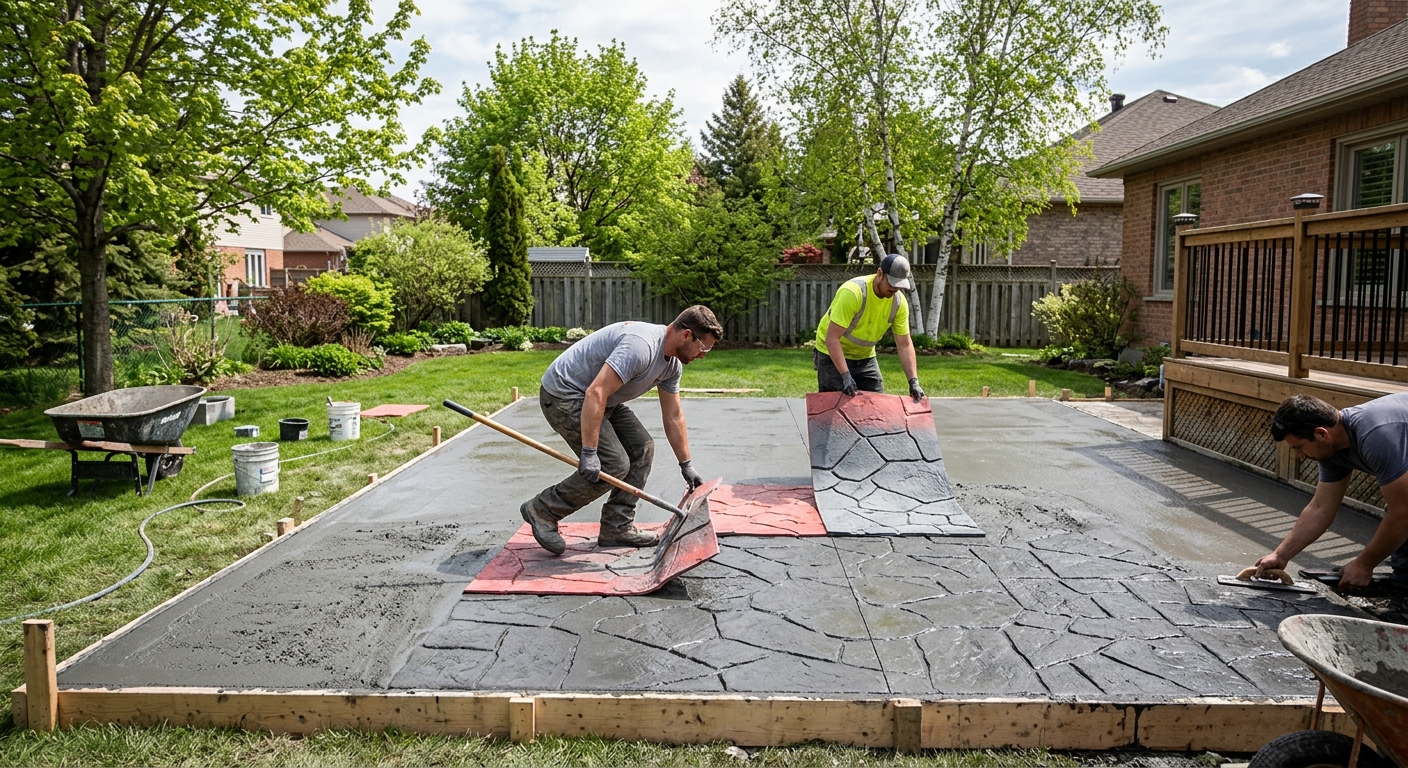
Stamped concrete costs more than broom-finish because it’s more labour-intensive and includes additional steps: colour/release preparation (if you choose integral colour), stamp placement, texture finishing, and typically a higher-spec sealer schedule to protect the surface. In the Lower Mainland–Southwest, that often places stamped driveways and patios closer to the higher end of the decorative bands—commonly around the $22–$36 per sq ft range for stamped work—while a standard broom driveway generally tracks closer to the $18–$28 per sq ft range. That doesn’t mean broom is “cheap” or inferior; broom-finished concrete can be very durable in British Columbia when you get air entrainment, base compaction, and control joints right. For homeowners, the best value approach is to invest first in the structural spec (base, reinforcement, mix), then spend on appearance where you want the look—especially on high-visibility areas in Cowichan Bay.
When is the best time to pour concrete in Cowichan Bay?
For Cowichan Bay, the best time to pour concrete is when you can protect curing from prolonged rain and cold nights. While Cowichan Bay benefits from milder coastal winters compared to interior BC, the freeze–thaw cycle risk is still real—particularly when nights drop below freezing after wet periods. Contractors often aim for late spring through early fall for driveways and patios so they can finish and cure under more consistent temperatures and lower rainfall pressure. That said, many concrete crews can still pour in shoulder seasons if they plan curing protection (covers, blankets, and careful scheduling) and use appropriate cold-weather precautions when needed. If your quote assumes “rain is fine” but doesn’t discuss curing protection, ask questions. A good contractor will coordinate with weather forecasts and show you the curing approach, not just the pour date.
How long does concrete take to cure?
Concrete curing is a process, not a single day event. For typical residential flatwork in British Columbia, you can expect finishing and early strength development within the first day, but full performance takes longer. Many contractors use a minimum of about 7 days of curing for basic flatwork strength before heavier use, with careful protection during cool, damp weather. However, for sealing and long-term durability, many homeowners schedule sealers after the concrete has cured for around 28 days so the surface is dry enough to accept the penetrating sealer properly. In Cowichan Bay’s coastal humidity, premature sealing can trap moisture and reduce effectiveness, so the timing matters. Your contractor should explain what curing method they use during wet or cool periods and how they plan to protect the slab until it reaches the required strength.
Do I need a permit for concrete work in British Columbia?
In British Columbia, whether you need a permit depends on what concrete work you’re doing. Structural concrete work—such as footings, foundation walls, and grade beams—typically requires a building permit and usually engineered details reviewed through the municipal process. Concrete flatwork like patios, walkways, and driveways often does not require a permit by itself, but permits can come into play if the project affects lot grading, stormwater management, impervious surface limits, or the municipal right-of-way. For Cowichan Bay homeowners, the practical approach is to confirm with the local authority before excavation if any grading changes are planned or if your work is near a curb/road boundary. Also verify your contractor carries liability insurance and provides documentation of WSIB/WCB coverage so you’re protected if anything goes wrong during the construction phase.
Concrete vs pavers for a patio in Cowichan Bay?
Concrete and pavers can both work well in Cowichan Bay, but they behave differently under freeze–thaw and wet coastal conditions. Concrete patios are typically faster to build, can provide a monolithic surface with proper jointing, and—when properly air-entrained and cured—deliver durable performance at a predictable cost. Regional pricing for plain concrete patios and walkways often sits around the $16–$26 per sq ft range, and stamped options land higher. Pavers offer flexibility in aesthetics and can be easier to repair in localized areas if a stone or base section fails. However, pavers rely heavily on bedding sand, base thickness, and edge restraint; if drainage isn’t managed, joints can shift and weeds/moving units can appear over time. A good contractor can recommend based on your drainage plan, slope, sun exposure, and whether de-icing or heavy vehicle traffic is expected.