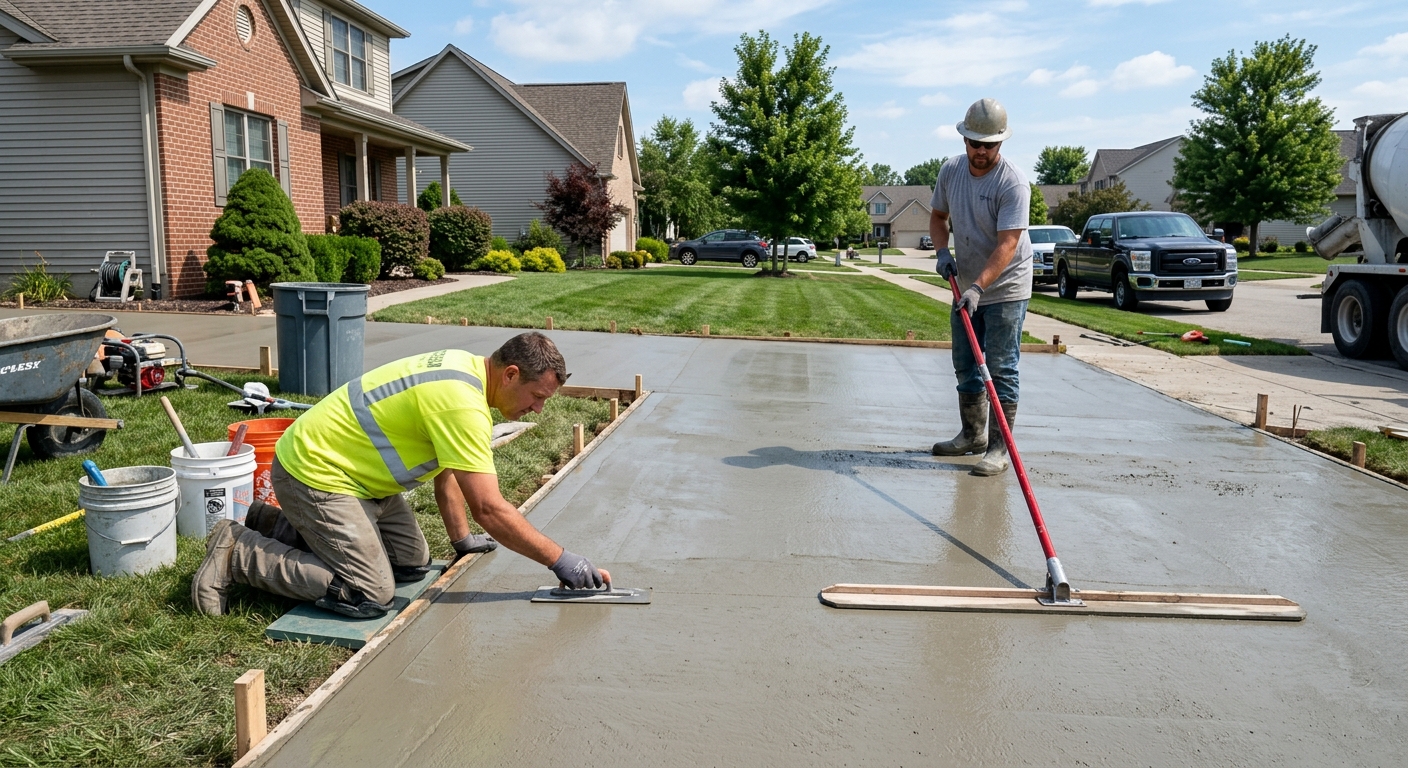
Concrete work options and costs in Puntledge
Puntledge, British Columbia is a small community (population 1,387 per the 2021 Census, Statistics Canada) where concrete flatwork is a practical fit for homeowners who want durable, low-maintenance surfaces. Most local concrete work is driven by the housing stock—single-detached homes remain a common foundation for driveways, patios, and walkways, and that means steady demand for contractors who can handle exterior freeze–thaw exposure and coastal-wet weather scheduling. In the Lower Mainland–Southwest, we still design around a shallow frost depth (commonly about 450 mm / 18" in typical local practice), but wet soils and frequent freeze–thaw cycles mean the details matter: proper base prep, air-entrained mixes, and well-timed curing to protect slabs from scaling and spalling.
Because of mild winters, it’s often easier to keep crews working than in colder parts of BC—but rain, cool nights, and high humidity still influence labour productivity and curing methods. When the ground is saturated or truck access is tight (common on smaller lots and older neighbourhood lanes), excavation, forming, and scheduling costs rise. In Puntledge, trade demand is especially noticeable around older residential areas where driveways and steps are being replaced or upgraded before the wet season—helping explain why “same-size” projects can land in different price bands.
Below are realistic starting points for common concrete options, so you can compare quotes apples-to-apples before you ask questions.
| Application |
Typical Size |
Key Spec |
Finish Option |
Price Range |
| Concrete driveway (standard broom finish) |
12 ft x 20 ft (240 sq ft) |
Air-entrained exterior mix, compacted granular base, control joints |
Broom finish, light trowel texture |
$4,320–$6,720 |
| Exposed aggregate driveway |
12 ft x 20 ft (240 sq ft) |
Air-entrained exterior mix, wash/expose method, sealed finish recommended |
Exposed aggregate with slip-resistant surface |
$5,520–$8,160 |
| Stamped concrete driveway or patio |
12 ft x 20 ft (240 sq ft) |
Air-entrained mix, integral colour (often), control joints |
Stamped pattern with colour |
$6,000–$9,500 |
| Plain concrete patio or walkway |
10 ft x 16 ft (160 sq ft) |
Air-entrained exterior mix, compacted base, saw-cut joints |
Float/straightedge with broom or lightly textured finish |
$2,560–$4,160 |
| Garage floor (interior slab) |
20 ft x 20 ft (400 sq ft) |
Vapor barrier, base prep, fibre or mesh reinforcement as specified |
Standard trowelled finish |
$8,000–$12,000 |
| Foundation footings (structural, below frost) |
Per typical house footing run (project varies) |
Excavate to below design frost depth, reinforced footings, proper drainage |
Unfinished structural concrete |
$200–$350 |
Prices are estimates only and vary by project scope, site access and material selection.
What affects the price of concrete work in Puntledge
In the Lower Mainland–Southwest, the same concrete job can come in 30–50% apart across quotes—mostly because the “cheap” option cuts on the parts you can’t see after the slab cures. Concrete isn’t just concrete: excavation depth, compacted granular base quality, reinforcement choice, mix design, and curing methods drive cost. In British Columbia, mild air temperatures can make it tempting to rush schedule—but freeze–thaw cycles and saturated subgrades still demand exterior specs. Footings must be carried below the design frost depth to prevent frost heave; typical coastal BC practice often lands in the 0.5–1.2 m range depending on soil and design, and that can change forming height and labour time even on modest foundations.
For exterior flatwork, we use air-entrained concrete mixes (to handle freeze–thaw), and we plan around prolonged rain, cool nights, and humidity. When cold-weather precautions are required—insulating blankets, curing protection, or limited heating—labour and materials rise. De-icing salt accelerates surface damage on unsealed or poorly specified slabs, so sealing is often a necessary add-on for driveways and walkways. That’s why broom-finish driveway work can land near the regional $18–$28 per sq ft band, while stamped or exposed aggregate can climb toward the $22–$36 per sq ft range.
In Puntledge specifically, two cost swings are common: (1) older lots with limited truck access and more excavation for thicker edges or step-downs, and (2) saturated soils where base prep must include better drainage and more granular thickness to protect the slab. On a 240 sq ft driveway, moving from plain broom-finish to stamped can be justified—if the quote includes proper base, air-entrainment, integral colour, and a sealing plan—because the finish and crew time increase, and the climate protection keeps the surface looking good through winter cycles.
| Price Factor |
Why It Matters |
Cost Impact |
| Frost line depth — determines footing depth and form height |
Footings must extend below design frost to prevent frost heave in wet/coastal soils |
Higher excavation and rebar/ form cost can add noticeable labour hours on footing projects |
| Site preparation — excavation, grading, compacted granular base |
Compaction and base thickness control settlement and reduce freeze–thaw damage |
More granular, more hauling, and longer labour can push projects upward in the price range |
| Reinforcement — rebar or wire mesh requirement |
Controls cracking and improves performance for thicker slabs and structural elements |
Material and placement time can add cost, especially where thickened edges are required |
| Mix design — air-entrainment and compressive strength spec |
Air entrainment supports freeze–thaw durability; strength supports long-term performance |
Specified exterior mix can increase material cost but reduces surface failures |
| Finish type — broom vs. stamped vs. exposed aggregate |
Finish affects labour time, tooling, and curing/colour schedule |
Stamped/exposed typically increases labour and material handling compared with broom finish |
| Pour size and concrete truck access to site |
Small pours with difficult access can increase truck staging, waiting, and extra labour |
Limited access can add mobilization cost and slow production |
| Cold-weather curing precautions — heating and blankets |
Cool nights/high humidity require protection to reach design strength and durability |
Blankets, heaters and added monitoring raise costs during shoulder-season pours |
| Control joint pattern and sealing cost |
Joints limit random cracking; sealing helps resist moisture and de-icing salt effects |
Sealer and saw-cut/grout schedule add cost, but reduce maintenance and surface spalling risk |
Permits & regulations in British Columbia
In British Columbia, structural concrete work—such as footings, foundation walls, and grade beams—generally requires a building permit, and it’s common for engineered drawings to be reviewed by the municipality as part of the permitting process. For concrete flatwork like patios, walkways, and driveways, a permit often isn’t required on its own; however, you should confirm if your project affects lot grading, changes drainage patterns, or increases impervious surface coverage beyond what local rules allow. If you’re altering slope to manage runoff toward a downspout, building permit requirements can still be triggered depending on the scope.
For a Puntledge homeowner, the safest approach is a quick, step-by-step check before breaking ground:
- Ask the contractor what permit (if any) they expect and who will pull it.
- Confirm the work is limited to non-structural flatwork if that’s your plan (patio/driveway/sidewalk-style pours).
- Request a certificate of insurance (liability) that lists your address or the project description.
- Verify workers are covered under WCB/WCB-equivalent coverage for the trades (the contractor should provide proof).
- Request references for similar-scale exterior concrete work in BC’s wet/cold seasonal conditions.
- Verify the contractor’s licensing/registration status via provincial and company listings, and cross-check that the named company on the quote matches the insurer and references.
- Keep all documentation in writing with the start date and scope so there’s no gap on responsibilities.
If anything touches structural elements (footings/walls) or drainage grading, treat it as permit territory and confirm with your municipality before work begins.
Getting concrete right in Puntledge's freeze-thaw climate
Concrete fails in Puntledge mainly when water gets into the slab or subgrade and then freezes repeatedly. The two big culprits are (1) inadequate base preparation that allows settlement or weak bearing, and (2) mixes that don’t include enough air entrainment for freeze–thaw durability. Salt and wet coastal conditions accelerate surface scaling on unsealed or poorly finished surfaces, which is why we spec properly and plan for curing. The correct approach is straightforward: first, build a compacted granular base to the right depth for local soil and the frost protection needed; second, use an air-entrained exterior mix with minimum 32 MPa compressive strength and the right air content for freeze–thaw; third, control cracking with a consistent joint layout; fourth, cure for at least 7 days under suitable protection; and fifth, apply penetrating sealer after the cure window to help repel moisture and de-icing salt.
When you’re comparing options, ask what you’re paying for. For example, upgrading from plain broom-finish driveway work (often near the $18–$28 per sq ft band) to stamped concrete can be a good value only if the quote also includes the same freeze–thaw durability measures—air entrainment, correct base, and proper jointing. If someone offers “stamped without the spec,” that’s where you risk early spalling and surface deterioration that costs more than the original finish difference.
To avoid spalling, make sure the quote explicitly includes air entrainment and jointing. For Puntledge’s wet winters, that’s usually the most important technical detail behind the scenes, and it’s where well-prepared crews can noticeably outperform “lowest bid” contractors.
| Spec |
Why It Matters in Puntledge |
What to Ask For |
Impact if Skipped |
| Compacted granular base (depth?) |
Supports the slab and controls moisture/vibration under freeze–thaw cycles |
Granular base depth and compaction method matched to your soil and slab thickness |
Settlement, cracking, and premature surface deterioration |
| Air-entrained concrete mix (target air %?) |
Reduces freeze–thaw damage by providing microscopic space for expansion |
Exterior air content target typically 5–7% for freeze–thaw exposed flatwork |
Higher risk of scaling and spalling during winter cycles |
| Compressive strength (MPa rating) |
Ensures the concrete reaches durable strength for exterior exposure |
Minimum 32 MPa at design age (as specified) |
Surface wear and reduced durability |
| Control joints (spacing per ACI guidelines) |
Limits random cracking by giving concrete a planned weak line |
Joint spacing plan (saw-cut timing and layout) consistent with industry guidance |
Random cracks that invite water infiltration |
| Minimum 7-day curing period |
Helps concrete reach strength while protecting from rain/cool nights |
Minimum 7 days of proper curing conditions (and protection in shoulder-season weather) |
Lower surface strength and higher long-term failure risk |
| Penetrating sealer (when applied after cure) |
Helps repel moisture and reduces de-icing salt-related surface damage |
Penetrating sealer applied after the cure window (commonly at/after 28 days) |
Faster staining, scaling, and surface breakdown |
How to choose a concrete work contractor in Puntledge
Choosing a contractor in Puntledge is less about flashy photos and more about verifying the basics that protect you if something goes wrong. First, confirm British Columbia licensing/registration where applicable for the business, and request proof of liability insurance for the exact company name on your quote. Next, verify workers are covered by the appropriate WCB/WCB-equivalent coverage—your contractor should provide a clearance letter or certificate upon request. If they won’t show documents, that’s a red flag.
Then, get 2–3 itemised written quotes. “Itemised” matters: you want labour and material breakdowns (excavation/base prep, reinforcement, concrete supply, forming, finish labour, curing/sealer, and disposal). Ask whether the quote includes pulling permits (if needed), disposal/hauling of spoils, and any traffic control or saw-cutting for tie-ins. Compare scope, not just the bottom line.
For warranty, ask for the workmanship warranty length in writing and whether it covers cracking, spalling, or joint seal failures. Also ask about product/manufacturer warranties on sealers, admixtures, or specialty finishes and whether warranties are transferable to future owners.
Payment schedule should protect your cash flow: never pay more than 10–15% upfront. Hold back a portion until the final inspection, cleaning, and any sealer/joint work are complete. Finally, insist on a written timeline with a start date and realistic completion estimate, especially because wet weather in BC can shift curing and finishing windows.
- Ask for insurance and WCB/WCB coverage documents before you sign anything.
- Ensure the quote’s legal company name matches the insured contractor.
- Request itemised costs (excavation/base, rebar/mesh, concrete supply, forming, finish, curing, sealer).
- Confirm disposal/hauling of excavated material is included.
- Ask about site access allowances (truck access, pumping/rigging, protection of landscaping).
- Get a clear spec sheet: air entrainment, minimum strength, and reinforcement plan.
- Ask for a joint layout plan and finishing sequence (saw-cut timing).
- Confirm curing method for wet/cool conditions (blankets/sealer curing protection if needed).
- Know who pulls permits if the project touches structural elements or drainage grading.
- Request warranty details in writing, including what is and isn’t covered.
- Verify payment terms: small deposit only, with holdback until completion.
- Require a written start/completion schedule and weather contingency plan.
Concrete contractor red flags in Puntledge include: quoting “flatwork only” but omitting air-entrained mix specs, vague descriptions like “we’ll pour it and see” for joints and curing, refusing to provide insurance/WCB proof, skipping site drainage details, or pushing full payment before sealing and final cleanup.
Frequently asked questions — concrete work in Puntledge
Stamped vs broom-finish concrete — cost difference?
In Puntledge and the wider Lower Mainland–Southwest, stamped concrete generally costs more than a broom-finish driveway or patio because the finish process is labour-intensive (colouring/texture setup, timing, and extra finishing steps). In our local price bands, broom-finish driveway work is typically in the $18–$28 range, while stamped & decorative concrete commonly lands in the $22–$36 range per sq ft. That difference is only “worth it” when the quote also includes the durability specs needed for our climate—air-entrained exterior mix, correct base prep, and proper control joints. If a cheaper quote excludes sealing or air entrainment, you may save upfront but pay later when winter freeze–thaw cycles cause scaling or spalling.
When is the best time to pour concrete in Puntledge?
For Puntledge, the best timing is typically late spring through early fall, when days are warmer and you can manage curing without heavy heating or prolonged protection. That said, Lower Mainland weather can still shift quickly—rain and cool nights can slow finishing and delay strength gain, even in “mild winter” periods. Contractors should schedule around forecasted precipitation, and for shoulder-season pours they may use curing blankets or other protection to help achieve proper curing and surface durability. If you pour during consistently wet/cold stretches without proper curing precautions, the risk of surface defects increases. If you’re replacing a driveway or patio before the wet season, plan early enough to allow at least 7 days of appropriate curing conditions.
How long does concrete take to cure?
Concrete curing is not a single-day event. For exterior flatwork in British Columbia, a minimum of 7 days of curing under proper conditions is a typical baseline for strength development before you treat the surface more roughly (foot traffic/normal use plans depend on the project scope). However, for durable surface protection like sealing, you usually wait until around 28 days post-pour so the concrete has dried and stabilized enough for the sealer to bond correctly. In Puntledge’s damp, cool-season weather, curing conditions can be harder to maintain, so reputable crews protect the slab and monitor temperatures to avoid premature surface wear. Always ask your contractor what curing method they’ll use and how they’ll handle rain or cold nights.
Do I need a permit for concrete work in British Columbia?
It depends on what you’re building in British Columbia. Structural concrete work—footings, foundation walls, and grade beams—typically requires a building permit and often engineered drawings reviewed through the municipal process. Concrete flatwork like patios, walkways, and driveways frequently does not require a permit by itself, but it can if your project affects lot grading, changes drainage patterns, or touches right-of-way/impervious surface limits. If you’re in Puntledge and your work involves drainage improvements, regrading, or any connection to foundation elements, confirm with the local authority. Also verify your contractor’s documentation: you should receive clear scope details on whether permits (if required) are included and who is responsible for pulling them.
Concrete vs pavers for a patio in Puntledge?
Concrete and pavers both work well in Puntledge’s wet coastal conditions, but they behave differently over time. Concrete patios are often faster to install and can be more affordable in the $16–$26 per sq ft band for plain concrete, assuming you get the base and curing right. Pavers can offer easier localized repairs if a small section shifts, and they provide design flexibility. The concrete value is strongest when the quote includes air-entrained mix, proper compaction, and control joints to manage cracking—because freeze–thaw cycles and water movement can damage poorly detailed surfaces. If you expect future landscaping changes or you want segmented repair capability, pavers may win. For homeowners comparing quotes, ask both options about base depth, drainage approach, jointing/sealing, and warranty coverage.
How long does a concrete driveway last?
A concrete driveway in British Columbia can last 20+ years when it’s built for our climate: proper base prep, air-entrained exterior concrete, good jointing, and correct curing. In Puntledge, freeze–thaw cycles and saturated soils are the main wear drivers, and surface scaling can appear sooner if the concrete isn’t protected against moisture and de-icing salt. Sealing after the cure window (commonly around 28 days) helps repel water and salt, improving surface longevity. If your driveway is in the typical $18–$28 per sq ft band for broom-finish flatwork, durability depends more on specifications than the price alone. If a low bid doesn’t address air entrainment, joints, and curing, the “cheaper” driveway can become a costly replacement sooner.