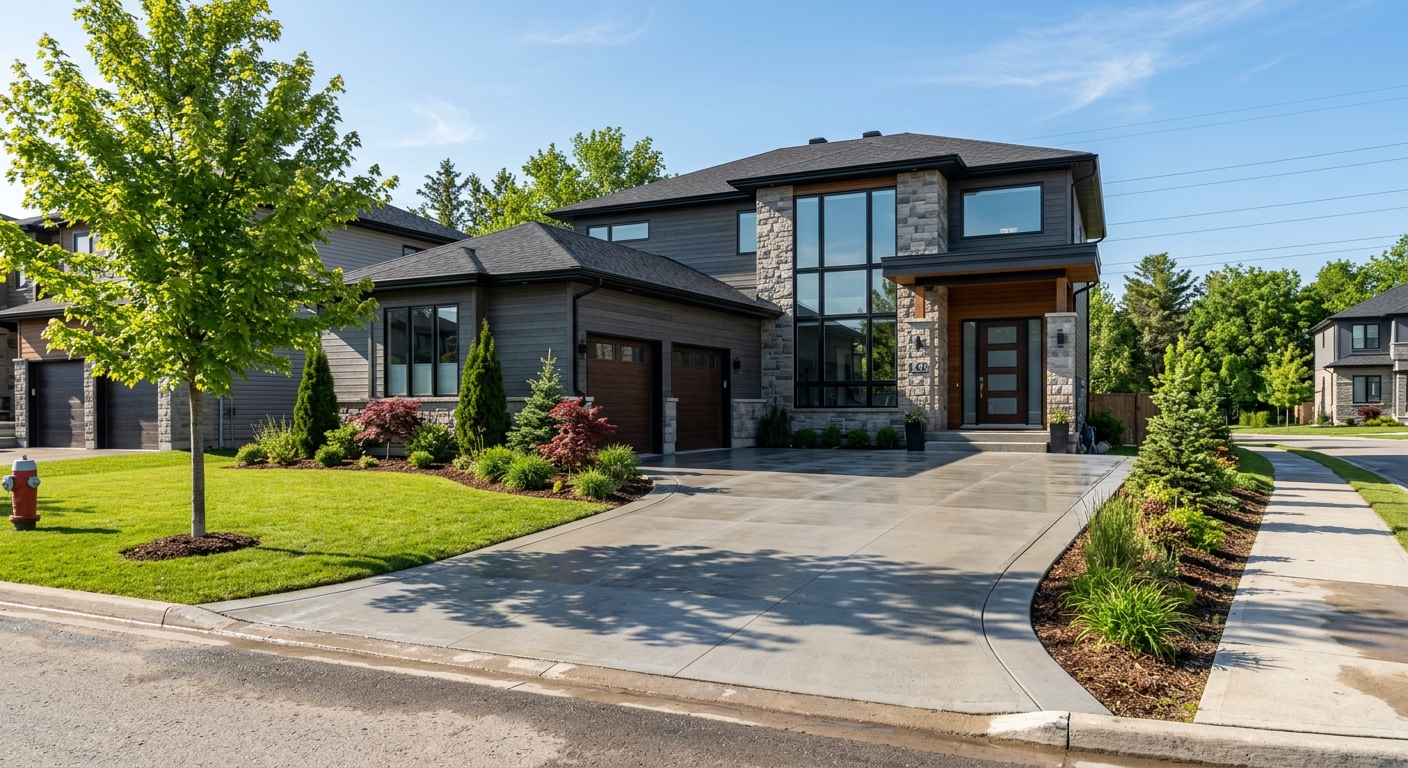
Concrete work options and costs in Jubilee
In Jubilee, British Columbia, concrete is a practical choice for the kind of homes and lots we see around the neighbourhood—low-maintenance flatwork that can handle coastal moisture and periodic freeze–thaw cycles. With a population of 5,290 (Statistics Canada, 2021 Census), local demand is driven largely by single-detached and townhome households that want driveways, patios, and walkways that stay serviceable for years. In Lower Mainland–Southwest, pricing and design are shaped by a frost depth assumption of roughly 450 mm / 18", so footings, piers, and thickened edges are typically placed below that to reduce frost heave risk. Even though winters are mild compared with inland BC, heavy rain and saturated soils still mean base prep and drainage aren’t optional. That’s why competitive quotes usually include engineered granular base work, careful compaction, and an air-entrained mix for exterior slabs to manage cracking and scaling. Scheduling matters too: cool nights and higher humidity can extend curing time, sometimes requiring curing blankets or longer wait times before sealing or heavy use.
Contractors also tend to be busiest in and around the North Jubilee area, where homeowners frequently upgrade aging flatwork that has begun to heave, crack, or show surface wear from de-icing and water intrusion. Below is a practical way to compare typical scope and price ranges before you ask for an itemised quote.
| Application |
Typical Size |
Key Spec |
Finish Option |
Price Range |
| Concrete driveway (standard broom finish) |
400–600 sq ft |
Air-entrained exterior mix; compacted granular base; control joints |
Broom finish, typical edges |
$18,500 – $28,000 |
| Exposed aggregate driveway |
400–600 sq ft |
Air-entrained mix; proper curing for surface durability |
Exposed aggregate (wash/surface retarder) |
$22,000 – $33,000 |
| Stamped concrete driveway or patio |
300–550 sq ft |
Air-entrained mix; release agent; joints planned to limit random cracking |
Stamp pattern + colouring + seal coat |
$24,000 – $40,000 |
| Plain concrete patio or walkway |
150–350 sq ft |
Compact base; drainage slope; control joints where needed |
Smooth or light broom |
$2,600 – $8,600 |
| Garage floor (interior slab) |
300–550 sq ft |
Vapour/insulation details as required; thicker sections at openings |
Steel trowel finish or broom-finished |
$10,000 – $18,000 |
| Foundation footings (structural, below frost) |
Per project |
Excavate below design frost depth; rebar cage; concrete for strength + durability |
Formwork + proper curing |
$35,000 – $70,000 |
Prices are estimates only and vary by project scope, site access and material selection.
What affects the price of concrete work in Jubilee
In Jubilee and across the Lower Mainland–Southwest, you can see the same concrete project come in 30–50% apart depending on how detailed the quote is and how the contractor protects the slab and foundation in our coastal-wet, freeze–thaw conditions. The main reason is that concrete isn’t just the cement and pour—it’s excavation, drainage, base compaction, mix design, reinforcement, finishing labour, and (in many cases) cold-weather and wet-weather curing controls. When you compare British Columbia bids, contractors may differ in how they design the base, whether they specify air-entrainment, how they handle curing time, and whether they include mobilization and concrete pump access. Those differences directly shift costs, especially for exterior flatwork where the frost depth assumption of about 450 mm / 18" still drives footing and thickened edge placement below frost.
Lower Mainland–Southwest projects also benefit from better accessibility than deeper hinterland areas, but the trade-off is that rain and high humidity can delay finishing windows and slow strength gain—meaning labour time and cure-protection materials can increase. In colder regions of BC, the longer excavations, shorter pour seasons, and heating/blanketing logistics can be higher; in our area you still pay for the protection plan, but not to the same extremes. In Jubilee, a driveway priced closer to the $18–$28 band is often a broom-finished scope with straightforward truck access. Move to stamped work and you’re closer to the $22–$36 band because labour, stamp mats, colouring, and sealing steps add time and material. For patios and walkways, plain slabs can land nearer the $16–$26 band, while upgrades like exposed surfaces or thicker reinforcement can nudge the total upward.
Two real-world examples I see here: older lots with saturated, fine-grained soil typically require more granular replacement and better sub-drainage to keep water from sitting under the slab; and driveways exposed to splash-off and de-icing often need the right air content plus sealing to slow scaling. Even small thickness increases—say from a lighter patio spec to a more robust driveway section—can change rebar usage, base depth, and haul time.
| Price Factor |
Why It Matters |
Cost Impact |
| Frost line depth |
Determines footing depth and form height below design frost |
More excavation and steel tie-in work |
| Site preparation |
Excavation, grading, compacted granular base, and drainage control |
Can raise costs if saturated soil/gravel replacement is needed |
| Reinforcement |
Rebar or wire mesh requirement for crack control and load transfer |
Additional materials + labour tying/bending |
| Mix design |
Air-entrainment and required compressive strength for durability outdoors |
Higher-spec mix can cost more per cubic metre |
| Finish type |
Broom vs. stamped vs. exposed aggregate affects labour hours |
Stamped/exposed typically increases man-hours and sealer steps |
| Pour size and concrete truck access to site |
Smaller access windows can require pumps or additional coordination |
Mobilization/pump costs can add significant dollars |
| Cold-weather curing precautions |
Heating/blankets to protect early strength gain |
Adds labour and blanket/heating rental costs |
| Control joint pattern and sealing cost |
Joints guide cracking; sealers protect against moisture and de-icing salt |
Better materials and timing add cost but reduce callbacks |
Permits & regulations in British Columbia
In British Columbia, the line is usually clear: structural concrete work typically needs permitting, while most standard flatwork does not. For Jubilee homeowners, confirm requirements with your local authority before starting, because scope details can change whether a permit is triggered. Work that DOES commonly require a building permit includes concrete foundation walls, grade beams, footings, and other structural elements that support the building. These projects often rely on engineered drawings reviewed as part of the permitting process, and the municipality may expect specific inspection milestones.
Concrete flatwork—patios, walkways, standard driveways, and non-structural slabs—typically does not require a permit unless it affects lot grading, drainage, or impervious surface coverage limits, or it ties into municipal right-of-way requirements. If the project involves changes near sidewalks/curbs, a permit or approvals can be needed even if the slab itself is “just flatwork.”
Before you sign, verify your contractor. Step one: ask for their certificate of liability insurance and read it—make sure it matches the legal entity on the contract and includes adequate coverage. Step two: request proof of coverage for required workplace protection (commonly WCB coverage or an exemption letter where applicable). Step three: check the contractor’s credentials using publicly available online registry listings, and confirm the company name and contact details match your proposal. Finally, ask for references on projects with similar concrete scope in coastal BC conditions, not just dry interior jobs.
Getting concrete right in Jubilee's freeze-thaw climate
Concrete failures in Jubilee almost always trace back to moisture management and early-age curing—especially once we’re dealing with rain, saturated soils, and freeze–thaw cycles. The two big culprits I see are inadequate base preparation (water trapped under the slab causing movement) and poor freeze protection (wrong mix or no air-entrainment). To spec the job correctly, start with the base: compacted granular sub-base to the right depth and profile for local soils, with drainage slope so surface and sub-surface water doesn’t pool. Next, mix design: for exterior flatwork, require air-entrained concrete typically in the 5–7% air content range, plus a minimum 32 MPa compressive strength target. Then control cracking with proper control joint placement and depth, because random cracking is where water finds its way in. Finally, curing: plan for at least 7 days of appropriate curing conditions, and in cool, damp weather use curing blankets or sealers on the correct schedule so the surface develops durable strength before heavy use.
Sealing is also a durability step in our climate. A penetrating sealer applied after the slab has fully cured (commonly 28 days post-pour) helps repel water and slows damage from de-icing salt and winter wetting. If you’re comparing options: a plain broom-finished patio might be nearer the $16–$26 per sq ft band equivalent, while stamped concrete tends toward the $22–$36 band equivalent due to extra labour and sealing. That price difference is justified when the contractor is also doing the “behind the scenes” work—base compaction, joint planning, and curing—rather than just adding texture.
Ask pointed questions: “What air content are you specifying?” “How deep is the base for my soil?” and “What curing plan do you use if rain or cold nights show up?” Those answers are the difference between a slab that lasts and one that starts scaling or spalling.
| Spec |
Why It Matters in Jubilee |
What to Ask For |
Impact if Skipped |
| Compacted granular base (depth?) |
Controls movement and drainage under the slab in wet coastal soils |
“How deep is the granular base for my site conditions?” |
Settlement, cracking, and accelerated freeze–thaw damage |
| Air-entrained concrete mix (target air %?) |
Protects against freeze–thaw scaling and spalling |
“What air content are you placing for exterior flatwork?” |
Higher risk of scaling/spalling during winter wetting cycles |
| Compressive strength (MPa rating) |
Ensures the concrete reaches design strength for durability |
“What’s the minimum MPa and cure method you’ll follow?” |
Weaker surface wear and reduced longevity |
| Control joints (spacing per ACI guidelines) |
Limits where cracking happens so water doesn’t infiltrate randomly |
“What joint spacing will you use and how will you seal later?” |
Random cracking, edge spalling, more maintenance |
| Minimum 7-day curing period |
Builds strength under Jubilee’s cool, humid conditions |
“How will you protect the pour in rain/cold nights?” |
Surface weakness and premature deterioration |
| Penetrating sealer (when applied after cure) |
Helps repel moisture and salt exposure in coastal winters |
“What sealer and what date after pour is planned (often 28 days)?” |
More staining, scaling, and higher freeze–thaw damage rate |
How to choose a concrete work contractor in Jubilee
Choosing the right concrete contractor in Jubilee comes down to proof, not promises. Start by verifying British Columbia licensing credentials through publicly available online listings (confirm the legal company name on the quote matches the registry entry). Then check liability insurance: request a certificate of insurance and confirm the coverage limits are appropriate for concrete work around homes—especially if they’ll cut/haul or work near driveways and occupied areas. For workplace coverage, ask for proof of WCB coverage or an exemption letter if applicable; this matters for your project safety and reduces risk if an injury occurs.
Next, get 2–3 itemised written quotes instead of one lump sum. A good quote breaks out excavation/grading, granular base, reinforcement, concrete supply, forming, finish labour, curing materials, and sealing or surface protection—so you can compare apples-to-apples. Read exclusions carefully: is disposal included? Is permit paperwork required for foundation scope included? What about pump access, saw-cutting joints, and winter curing protections?
Warranty should be in writing, with clear workmanship coverage and timelines, and you should ask whether product/manufacturer warranties apply to specific materials (like sealers or admixtures) and whether they transfer if you sell the home. For payment, never pay more than 10–15% upfront; hold back a meaningful portion until completion and final clean-up. Finally, insist on a written timeline with a start date window and completion estimate, since rainy stretches can shift curing schedules.
- Ask for insurance certificates and confirm the company name matches your contract.
- Request proof of WCB coverage (or exemption letter where applicable).
- Verify the contractor’s BC credentials using an online registry before signing.
- Get 2–3 quotes with an itemised labour and materials breakdown (not lump sum only).
- Confirm base depth and drainage plan for your specific soil conditions.
- Ask for the concrete mix specs: air-entrainment level and minimum MPa.
- Ensure the joint plan is included (where joints are placed and how they’re finished).
- Confirm curing method and minimum curing duration; ask what they do if rain/cold hits.
- Clarify whether sealing is included and the timing (after full cure).
- Check disposal and haul-away—soil and concrete removal often changes costs.
- Review warranty length and exactly what “workmanship” covers.
- Set a payment schedule with a holdback until final inspection/clean-up is complete.
Red flags I see in Jubilee: contractors who won’t discuss air-entrainment or curing; quotes that omit base preparation depth and drainage; “no problem” answers to rain/cold-weather curing; payment requests over 50% upfront; and vague warranties that don’t separate workmanship from product coverage.
Frequently asked questions — concrete work in Jubilee
How do I prepare the base for a concrete slab?
In Jubilee, base prep is where you protect the slab from moisture movement and freeze–thaw stress. The contractor should excavate to a firm, stable subgrade, then place compacted granular in lifts to the specified depth and profile. You want proper drainage slope so water can’t sit beneath the slab, and the base should be compacted with the right equipment (not just rolled lightly). For exterior work, also expect attention to subgrade and edge details—where water collects around driveways and walkways is where cracking and scaling often start.
When reviewing quotes, ask for the granular thickness and compaction approach, and confirm whether they’re designing for the local frost condition (BC practice typically assumes a frost depth around 450 mm / 18" for many slab/edge decisions). A contractor quoting only “concrete and finish” without base depth details is usually under-scoping the job.
How do I compare concrete quotes?
Compare quotes by scope, not just the final total. Ask each contractor to provide an itemised breakdown: excavation/grading, granular base materials, reinforcement, concrete supply specs (air-entrainment and MPa), forming, finishing labour, curing plan, saw-cut control joints, and whether sealing is included. In Lower Mainland–Southwest, the climate makes curing and mix design part of the price—so you should expect differences there. A broom-finished driveway may land nearer the $18–$28 band equivalent, while stamped or decorative options often move toward the $22–$36 band equivalent because they require additional labour and surface protection.
Also check exclusions: is disposal included, is truck access/pumping covered, and are rain/cold-weather precautions in the price? If one quote leaves out joints or curing blankets while another includes them, the cheaper number may simply be shifting cost to later repairs. For Jubilee’s rainy periods and cool nights, curing choices directly affect long-term durability.
Can concrete be poured in cold weather in Jubilee?
Yes, concrete can be poured in cold weather in Jubilee, but it must be protected to reach its early strength requirements. The risk isn’t that concrete “won’t set”—it’s that it can under-develop strength if temperatures drop during the critical early hours, especially when moisture is high and nights are cool. A proper crew uses cold-weather procedures such as insulating blankets, wind protection, and sometimes controlled heating of materials and the pour area, while monitoring conditions.
Ask what the contractor’s plan is if rain or cold nights arrive. Good contractors will spell out how long curing protection stays in place and how they’ll prevent surface damage. If you’re comparing quotes, look for whether cold-weather curing precautions are explicitly included, because those steps can add cost but are what prevent premature scaling and surface weakness. For exterior flatwork, don’t accept vague assurances—ask how they’ll keep the pour protected until strength is achieved.
How do I maintain concrete in Jubilee's freeze-thaw climate?
Maintenance in British Columbia is about controlling water and protecting the surface from salt and repeated wetting. Start with cleaning: remove debris regularly so water can’t pool, and avoid aggressive scraping that damages the surface. If your driveway is exposed to winter de-icing salts, that accelerates surface wear; a properly applied penetrating sealer after full cure (commonly around 28 days post-pour) helps reduce water absorption and slows scaling.
Watch for early signs: hairline cracks near edges and joints, shallow surface scaling, or small spalls around expansion points. Addressing these early—before water gets deeper—can be less expensive than replacing sections later. Keep gutters and downspouts directed away from slabs to reduce constant saturation. In Jubilee, the best “maintenance” is preventative spec and execution: adequate air-entrainment, correct control joint pattern, and curing that reaches durable strength.
What causes concrete to spall in Jubilee winters?
Spalling is commonly caused by freeze–thaw damage plus water intrusion. In Jubilee’s coastal-wet conditions, water gets into the concrete through cracks and poorly planned joints or through a surface that hasn’t been protected. When temperatures drop and water freezes inside pores, it expands and can break the surface apart. Another frequent cause is inadequate air-entrainment; air-void systems are crucial for durability outdoors in climates with recurring freeze–thaw cycles. If a mix isn’t properly specified, the concrete may look fine initially but scale or spall after several seasons.
Sometimes it’s also base-related: if the slab settles or edges allow water to pond, freeze–thaw impacts concentrate in those areas. De-icing salt can worsen deterioration by increasing moisture movement and chemical exposure. When you compare quotes, insist that the mix spec includes air-entrainment and that control joints and curing are included. Those details are often what separates a driveway that lasts from one that starts spalling early.
What is rebar and when is it required in British Columbia?
Rebar (reinforcing steel) is used to strengthen concrete and help manage cracking and load distribution. In British Columbia, whether rebar is required depends on the concrete element: structural members like foundation footings and foundation walls almost always use reinforcement per engineered design. For concrete flatwork, reinforcement requirements vary based on thickness, soil support, expected loads (like vehicle traffic), and how the contractor designs the slab system. In many driveway and garage floor scopes, reinforcement may be specified as rebar or wire mesh, but the “right answer” comes from the slab thickness and base preparation.
When reviewing quotes for Jubilee, ask if reinforcement is included, what type (rebar vs mesh), and how it’s supported (chairs/spacers) so it sits at the correct depth. For foundation footings below frost depth, engineered drawings typically control the reinforcement details. If a contractor won’t discuss reinforcement and slab design, treat that as a major gap—especially in an exterior environment where freeze–thaw durability depends on both structural and surface integrity.