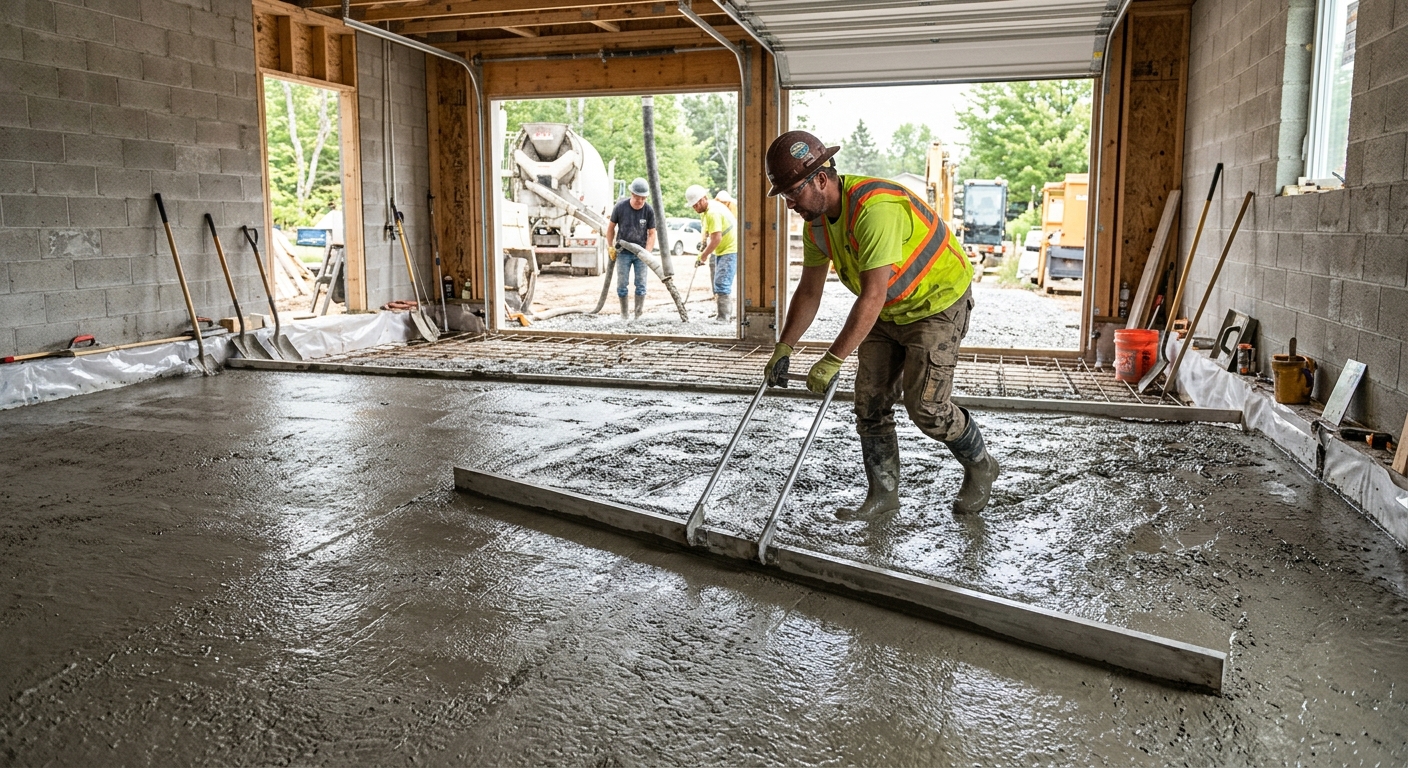
Concrete work options and costs in Lyndhurst
Concrete in Lyndhurst is typically all about choosing the right system for a wet, freeze–thaw climate. Homeowners around the community often need durable flatwork—especially in neighbourhoods like the residential corridors closer to the river valleys—where driveways and patios see heavy rain runoff and seasonal temperature swings. With a population of 5,370 (Statistics Canada, 2021 Census), you’ll notice a smaller pool of contractors than the bigger centres, which can tighten scheduling and influence pricing. The broader Lower Mainland–Southwest market also leans heavily toward single-detached housing, and that drives steady demand for concrete driveway slabs and garden-level patios, not just interior floors.
In the Lower Mainland–Southwest, even though winters are mild and the frost line is shallower than inland regions, concrete still must be designed for freeze–thaw cycles and saturated soils. Typical practice assumes a frost depth around 450 mm / 18", so footings, piers, and thickened edges are placed below that to help prevent frost heave. Coastal-wet conditions add cost through base preparation, drainage attention, and longer curing/scheduling around prolonged rain, cool nights, and high humidity—often with curing blankets or sealers to protect the surface durability of exterior slabs.
That’s why quotes can differ: one contractor may spec the right air-entrained mix, proper control joints, and curing steps, while another may treat those as “extras.” Use the table below as a budgeting starting point for Lyndhurst, then compare your quotes line-by-line.
| Application |
Typical Size |
Key Spec |
Finish Option |
Price Range |
| Concrete driveway (standard broom finish) |
400–600 sq ft (approx. 37–56 m²) |
4" slab, compacted granular base, air-entrained mix, control joints |
Broom finish + seal (optional) |
$18,000–$28,000 |
| Exposed aggregate driveway |
400–600 sq ft (approx. 37–56 m²) |
4" slab, proper curing schedule, drainage base attention |
Exposed aggregate (surface wash) |
$22,000–$34,000 |
| Stamped concrete driveway or patio |
250–500 sq ft (approx. 23–46 m²) |
4" slab, air-entrained mix, rebar/wire mesh as required |
Stamps + color hardener + release agent |
$22,000–$36,000 |
| Plain concrete patio or walkway |
200–400 sq ft (approx. 19–37 m²) |
4" slab, compacted granular base, air-entrained mix |
Wood float/broom edge + optional seal |
$3,200–$8,000 |
| Garage floor (interior slab) |
300–600 sq ft (approx. 28–56 m²) |
4"–5" slab, vapour barrier where required, jointing plan |
Steel trowel finish + optional curing compound |
$12,000–$22,000 |
| Foundation footings (structural, below frost) |
Per linear footing length (typ. 40–120 LF) |
Engineered reinforcement, excavate below frost depth, formwork + pour |
Structural concrete |
$8,000–$42,000 |
Prices are estimates only and vary by project scope, site access and material selection.
What affects the price of concrete work in Lyndhurst
In Lyndhurst and across the Lower Mainland–Southwest, it’s common to see the “same” concrete job come in 30–50% apart when you compare quotes closely. The main reasons aren’t just brand-name concrete—it’s the spec. In one proposal you might get a basic slab with minimum base, while another includes reinforced sections, engineered drainage work, air-entrainment controls, and curing precautions to reach proper durability in coastal-wet weather. Labour availability also tightens around seasonal scheduling, and contractors plan around rain windows, which can shift costs.
Frost line depth and freeze–thaw cycles dictate the design. Exterior slabs still rely on a shallow-but-real frost depth (practice typically around 450 mm / 18"), meaning footings and thickened edges are set below that line to reduce frost heave. Every exterior flatwork scope should use air-entrained concrete to survive repeated wetting and cooling. In colder regions, contractors must also add cold-weather measures—heating and insulating blankets—which raises their excavation, forming, and heating costs; in the Lower Mainland–Southwest the “cold-weather” cost is usually less intense than interior BC, but the schedule risk from cool nights and high humidity remains. De-icing salts can accelerate surface spalling on untreated slabs, so sealing becomes a value add.
Local examples in Lyndhurst: a driveway that requires deeper excavation for poor subgrade may push you from typical budget ranges into the upper end of the concrete driveway tier ($18–$28). A stamped patio with colour hardener and extra finishing time may justify the higher stamped & decorative band ($22–$36) because installation labour and consumables are substantially different from broom-finish work.
| Price Factor |
Why It Matters |
Cost Impact |
| Frost line depth — determines footing depth and form height |
Footings must sit below the design frost depth to prevent frost heave |
Higher excavation and more concrete/formwork can raise structural costs |
| Site preparation — excavation, grading, compacted granular base |
Wet soils and saturated subgrade can lead to settlement and cracking |
More hauling, granular supply, and compaction time increases price |
| Reinforcement — rebar or wire mesh requirement |
Helps control cracking and supports loads (especially near garage access) |
Material and labour for placing ties/spacers adds cost |
| Mix design — air-entrainment and compressive strength spec |
Air-entrainment improves freeze–thaw durability in exterior exposure |
Better mix and testing can add a moderate material premium |
| Finish type — broom vs. stamped vs. exposed aggregate |
Finishes require different tools, labour time, and surface procedures |
Stamped and aggregate options typically increase labour/consumables |
| Pour size and concrete truck access to site |
Restricted access means pump or additional labour to place and consolidate |
Haul, pump, and extra crew hours can move pricing significantly |
| Cold-weather curing precautions — heating and blankets |
Cold nights and cool, wet conditions slow strength gain and can harm surfaces |
Heating/blanket time raises costs during shoulder seasons |
| Control joint pattern and sealing cost |
Joints reduce random cracking; sealing protects against moisture and de-icing salts |
Sealing adds line-item cost but helps reduce early deterioration |
Permits & regulations in British Columbia
In British Columbia, structural concrete work typically needs a building permit. That includes footings, foundation walls, grade beams, and other elements tied to the structural system. In many cases, you’ll also need engineered drawings reviewed through the municipality as part of the permit process. For concrete flatwork—patios, walkways, and driveways—permits usually aren’t required unless the work affects lot grading, impervious surface coverage limits, stormwater management, or the municipal right-of-way (for example, work that changes access or drainage patterns). Because each lot has its own conditions, confirm what applies before excavation.
To verify a contractor in Lyndhurst, start with documentation before you sign:
Step 1: Licences/credentials. Ask for the contractor’s business and any applicable provincial registration details and confirm they match the company name on the quote.
Step 2: Liability insurance. Request an up-to-date certificate of insurance (COI) naming you (or your property interest) where required by your agreement. Ensure coverage limits make sense for concrete work with excavation and pump/boom activities.
Step 3: Coverage for workers. In BC, confirm they carry WCB coverage. If they provide a clearance letter, keep a copy for your files.
Step 4: References. Request photos and references from similar-scale projects—driveways and slabs in wet-coastal climates behave differently than dry sites.
Getting concrete right in Lyndhurst's freeze-thaw climate
Concrete in Lyndhurst most often fails for a few predictable reasons: water gets under or into the slab, freezing temperatures expand trapped moisture, and the surface scales or spalls. The fix isn’t “stronger concrete” alone—it’s the full system: base prep, correct mix for freeze–thaw durability, intentional cracking control, proper curing, and (for exterior surfaces) sealing.
1) Base preparation: Use compacted granular sub-base at the right depth for local soil conditions and frost protection. If the base is too thin or poorly compacted, the slab can settle and crack regardless of finish quality.
2) Mix design: Specify air-entrained concrete with a target air content around 5–7% for exterior flatwork, and minimum 32 MPa compressive strength (as designed/required). This is key to resisting freeze–thaw cycles and surface scaling. Without adequate air entrainment, you’re inviting spalling—especially where de-icing salts are used.
3) Control joints: Place joints on a spacing plan that limits random cracking. Random cracking isn’t automatically “bad,” but it often looks worse and can open pathways for water.
4) Curing: Plan for a minimum 7-day curing period under appropriate conditions. In cool, humid Lower Mainland weather, contractors may use curing blankets or extend curing time to reach strength properly.
5) Sealing: Apply a penetrating sealer after cure (often at 28 days post-pour) to repel moisture and reduce salt-related surface damage.
A dollar example: choosing stamped concrete in Lyndhurst can move you from the plain patio band (often closer to $16–$26 depending on size/finish) into the stamped/decorative band (often $22–$36) because stamping mats, colour work, and finishing labour take longer. That cost is justified when the base prep, joints, air-entrained mix, and curing steps are equally well specified.
| Spec |
Why It Matters in Lyndhurst |
What to Ask For |
Impact if Skipped |
| Compacted granular base (depth?) |
Reduces settlement and supports frost-resistant slab performance |
Base thickness to match site soil and frost protection plan, plus compaction proof |
Cracking, uneven surfaces, and premature failure from movement |
| Air-entrained concrete mix (target air %?) |
Improves durability under freeze–thaw cycling in wet exterior exposure |
Target air content in the 5–7% range for exterior flatwork |
Scaling/spalling and flaking, especially near edges and high-spray areas |
| Compressive strength (MPa rating) |
Controls strength gain and long-term load capacity |
Minimum 32 MPa (or project-specific spec) with batch documentation |
Reduced durability and higher risk of early surface damage |
| Control joints (spacing per ACI guidelines) |
Limits random cracking and reduces water entry points |
Joint spacing/layout plan drawn to suit slab dimensions |
Wider random cracks that undermine appearance and performance |
| Minimum 7-day curing period |
Ensures adequate strength development in cool, humid conditions |
Confirmation of curing method and minimum curing time for the season |
Surface weakness, dusting, and failure to achieve design durability |
| Penetrating sealer (when applied after cure) |
Helps repel moisture and reduce de-icing salt-related deterioration |
Penetrating sealer after cure (commonly around 28 days) |
Faster staining, scaling, and surface breakdown |
How to choose a concrete work contractor in Lyndhurst
Choosing the right concrete contractor in Lyndhurst comes down to proof and clarity. In British Columbia, verify three things: licensing/registration as applicable, liability insurance, and WCB coverage. Start by asking for a current certificate of insurance (COI) and ensuring coverage is active for the project timeline. For work involving crews and excavation, request confirmation of WCB coverage; if they can provide a clearance letter, that’s helpful for your records. Don’t be shy about asking who will be on-site—qualified lead finishers matter for exterior freeze–thaw durability.
Then get 2–3 itemised written quotes rather than comparing lump sums only. Look for a labour and materials breakdown: excavation/disposal, granular base, reinforcement (if required), air-entrained mix specification, jointing plan, curing steps, and whether sealing is included. Also confirm what’s excluded—common exclusions include site drainage adjustments, pump charges, tree/root removal, and disposal of surplus material.
Ask about warranty specifics: workmanship warranty length, whether the product/manufacturer warranty applies to the sealer/finish system, and whether it’s transferable to future owners. For payment, avoid large upfront deposits—never more than about 10–15%. Hold back a portion until the job is complete and you’ve accepted finish quality and proper jointing.
Finally, require a written timeline: start date window, concrete delivery/pour date plan, and estimated completion date (including curing and sealing lead times when applicable).
- Request itemised labour + materials (not just one total).
- Confirm air-entrained mix and target air content for exterior work.
- Ask for a joint layout plan and whether joints will be cut/specified correctly.
- Verify curing methods (blankets, curing time) for cool/wet forecasts.
- Confirm base thickness and compaction expectations, including drainage considerations.
- Check whether rebar or wire mesh is included where required by design.
- Ask if sealing is included and the product type (penetrating vs film-forming).
- Review what disposal/hauling is included (and what is not).
- Confirm concrete truck access plan or whether a pump is included.
- Get the warranty in writing, including coverage details and exclusions.
- Use a payment schedule with a holdback until acceptance.
- Ask for start/completion dates in writing, tied to weather windows.
Red flags in Lyndhurst: vague specs (no mention of air-entrainment, joints, or curing), “lowest price” quotes that omit base prep details, no proof of WCB coverage or liability insurance, promises to pour through heavy rain without curing protection, and refusal to provide an itemised scope for reinforcement, disposal, or sealing.
Frequently asked questions — concrete work in Lyndhurst
How deep must footings be for Lyndhurst's frost line?
For Lyndhurst and the Lower Mainland–Southwest, contractors generally design footings to sit below the frost depth used in local practice—often around 450 mm / 18"—to reduce the risk of frost heave during freeze–thaw cycles. In practice, the required depth also depends on your soil conditions, drainage, and engineered foundation design for the structure. A properly scoped job should include excavation below the frost line, formation to the right level, and structural reinforcement per drawings. Because BC coastal weather still brings cool nights and frequent wetting, good drainage and compacted granular under-and-around the foundation matter as much as the depth.
Why does concrete crack in Lyndhurst and how is it prevented?
Concrete cracks are common when temperature changes and moisture movement aren’t managed. In Lyndhurst, the combination of wet soil, rain, and freeze–thaw cycles means the slab expands and contracts, and water can increase swelling near the surface. The best prevention is not eliminating cracking entirely—it’s controlling it. Use a correctly compacted granular base, specify air-entrained concrete for exterior durability, and include a control joint pattern planned for your slab size. Proper curing helps the concrete reach design strength, which improves resistance to surface deterioration. If you’re budgeting, a plain patio or walkway is often closer to the typical patio band (for example, roughly $16–$26 depending on size), while stamped work adds labour—so the key is that both options still need the same jointing and air-entrainment specs to perform in BC’s climate.
Stamped vs broom-finish concrete — cost difference?
Stamped concrete costs more than broom-finish because the workflow is different. Broom-finish exterior slabs focus on grading, finishing, controlled joints, and optionally sealing. Stamped work requires additional materials (stamp mats, release agents, colour hardeners/colouring systems) and more labour time to place, stamp, texture, and cure-protect the surface correctly. In Lyndhurst, it’s common for stamped & decorative concrete to land in the higher tier, often around $22–$36, while plain driveways typically follow the lower concrete driveway band (about $18–$28). That price jump is usually justified when the contractor is also doing the right base prep and ensuring curing and sealing steps match the exposure conditions—otherwise the finish won’t help durability problems caused by poor air-entrainment or inadequate curing.
When is the best time to pour concrete in Lyndhurst?
The best time in Lyndhurst is typically during periods with stable weather—when rain is less persistent and night temperatures are workable for curing. Even in the Lower Mainland–Southwest, cool nights and high humidity can slow strength gain, so contractors plan pour schedules around forecasts and may use curing blankets or extend curing time if conditions are marginal. If you need to pour near the shoulder seasons, ask how the contractor handles cold nights: heated protection, insulation blankets, and revised curing timelines. Driveway and patio jobs are often easiest when you can protect the fresh slab from prolonged rain and allow proper curing without water pooling. A good contractor will explain their season plan in writing and tie it to your specific site conditions.
How long does concrete take to cure?
Concrete curing time depends on temperature and the mix design, but for most homeowner projects the key milestone is that the concrete must cure for at least a minimum period to reach sufficient strength for normal handling. In Lyndhurst and across BC, plan on a minimum 7-day curing period under proper conditions, and be realistic about cool, humid weather that may slow strength gain. Full performance continues developing well beyond that. For sealing, many systems are applied after the slab has properly cured—commonly around 28 days post-pour for best results. Ask your contractor what curing method they’ll use (blankets, curing compound, or other protection) and whether the schedule accounts for local rain patterns and temperature swings.
Do I need a permit for concrete work in British Columbia?
In British Columbia, permit requirements depend on what you’re building. Structural concrete—such as footings, foundation walls, and grade beams—typically requires a building permit and often engineered drawings that the municipality reviews as part of permitting. Concrete flatwork like patios, walkways, and driveways usually doesn’t require a permit unless it affects lot grading, stormwater/drainage, impervious surface limits, or work near the municipal right-of-way. For a Lyndhurst homeowner, the practical approach is to ask the contractor to confirm whether the work triggers any municipal review and, if needed, to coordinate the permit process before excavation. Independently verify the contractor’s liability insurance and WCB coverage before work starts, and don’t assume it’s “just a driveway” if drainage or access changes are involved.