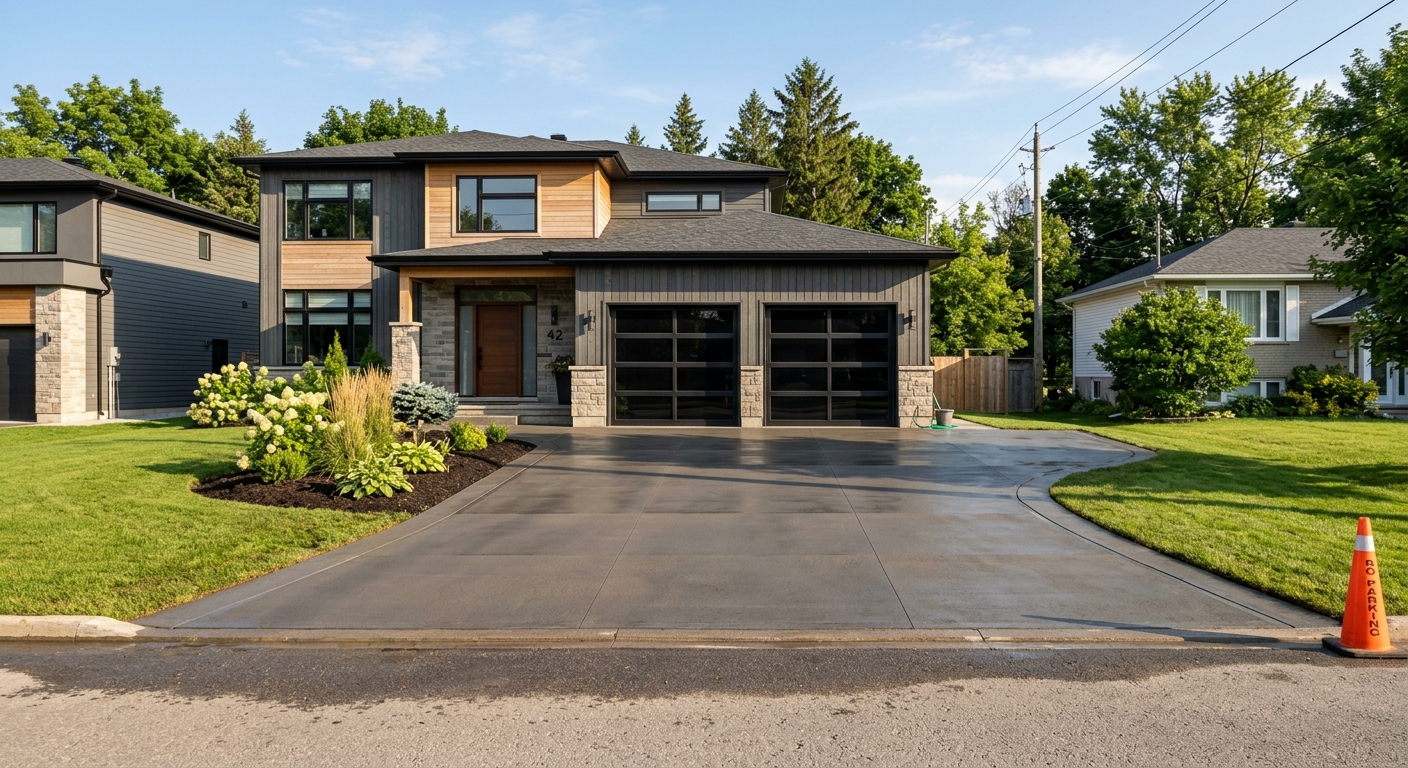
Concrete work options and costs in Maillardville
Maillardville is a great place to get durable concrete flatwork, but pricing still has to reflect local conditions. With a population of 15,837 (Statistics Canada, 2021 Census), the Lower Mainland–Southwest has steady demand for driveways, patios and walkways—most homeowners rely on concrete because it handles wet weather well when the base and mix are done correctly. Single-detached housing is common in the area, and that typically means more curb-to-garage driveway work each year. In and around Oxford Street / Cessna Drive and the wider Maillardville corridor, concrete contractors often stay busy because access from local streets plus frequent renovations drive seasonal scheduling.
Costs in the Vancouver–Surrey–Abbotsford corridor are shaped by a shallow but real frost depth (commonly planned around 450 mm / 18") and by coastal-wet weather. Even with milder winters, freeze–thaw cycles and heavy rainfall make drainage and curing critical—so quotes can shift when one plan includes a properly compacted granular base, air-entrained concrete, and longer curing/blankets versus a faster, lighter spec. Labour availability also affects pricing: rain-heavy weeks can compress timelines, and that can add labour hours for protection, form adjustments, and re-scheduling.
Below is a practical comparison of typical options, so you can match your needs to a realistic budget before you request itemized quotes.
| Application |
Typical Size |
Key Spec |
Finish Option |
Price Range |
| Concrete driveway (standard broom finish) |
400–550 sq. ft. |
Air-entrained exterior mix; compacted granular base; control joints |
Broomed surface |
$18,000–$28,000 |
| Exposed aggregate driveway |
400–550 sq. ft. |
Air-entrained mix; base prep; extra labour for wash/retard |
Exposed aggregate finish |
$24,000–$34,000 |
| Stamped concrete driveway or patio |
250–450 sq. ft. |
Air-entrained mix; release agent; colour hardeners/sealer |
Stamping + texture |
$22,000–$36,000 |
| Plain concrete patio or walkway |
200–350 sq. ft. |
Air-entrained mix; compacted base; edge forms |
Float + broom or hand-finished |
$16,000–$26,000 |
| Garage floor (interior slab) |
350–550 sq. ft. |
Vapour barrier (as needed); reinforcement/welded wire; proper thickness |
Light broom or trowel finish |
$14,000–$24,000 |
| Foundation footings (structural, below frost) |
Varies by house plan |
Engineer/structural spec; excavation below frost; rebar as required |
Structural concrete |
$200,000–$350,000 |
Prices are estimates only and vary by project scope, site access and material selection.
What affects the price of concrete work in Maillardville
In the Lower Mainland–Southwest, it’s common to see quotes for the “same” concrete job differ by 30–50%. That gap usually comes down to how a contractor handles the parts that protect concrete in our climate: base preparation, drainage, frost-related specs, and curing. In British Columbia, even a small change in thickness, reinforcement, or mix requirements can add labour, more materials, and scheduling time—especially when rain delays expose work to cooler nights and higher humidity. Those factors can force additional protection measures so the slab or footing reaches design strength.
Specifically, frost depth and freeze–thaw cycles drive the whole design conversation. Footings and thickened edges must extend below the design frost depth (local practice often plans around 450 mm / 18"), and all exterior slabs should be made with an air-entrained mix to resist freeze–thaw damage and scaling. When weather turns cold, cold-weather precautions (insulating blankets, sometimes controlled heating) can add cost, and de-icing salt can accelerate surface spalling—making sealing a worthwhile step for long-term durability.
In Maillardville, a few common drivers change the price quickly. For example, a driveway over saturated soil or a soft shoulder usually needs deeper/stronger granular base and more excavation. If you’re replacing an older slab that has poor drainage or settlement, demolition and disposal can add substantially to a standard driveway budget in the $18–$28 per sq. ft. band. By contrast, a smaller patio in a straightforward access zone may land closer to the $16–$26 band if excavation is shallow and the base is predictable. Housing-stock age matters too—older neighbourhood renovations often require harder demo work and more re-grading before the pour, which affects both labour and material quantities (and the chance of delays during wet weeks).
| Price Factor |
Why It Matters |
Cost Impact |
| Frost line depth |
Determines footing depth and form height for frost protection and stable bearing. |
Higher excavation and deeper forms; can add significant labour for foundations/footings. |
| Site preparation |
Excavation, grading and compacted granular base control settlement and drainage. |
More excavation/hauling increases costs; good prep can reduce later repairs. |
| Reinforcement |
Rebar or mesh helps control cracking and improves slab durability under loads. |
Adds material cost and labour for placement and chairing/spacers. |
| Mix design |
Air-entrainment and compressive strength requirements prevent freeze–thaw scaling/spalling. |
Air-entrained exterior mixes and spec testing can raise material price slightly. |
| Finish type |
Broom vs. stamped vs. exposed aggregate changes labour, materials and curing/sealer steps. |
Stamped and exposed finishes typically cost more due to extra labour and materials. |
| Pour size and concrete truck access to site |
Narrow access can require smaller loads, more repositioning and more labour. |
Truck access issues can add labour and sometimes require pump or extra logistics. |
| Cold-weather curing precautions |
Blankets/heating protect strength gain in cool, damp conditions. |
Can increase labour and equipment rental during shoulder seasons. |
| Control joint pattern and sealing cost |
Joint spacing limits random cracking; sealing helps with salt and moisture exposure. |
Proper joint layout and sealing add line items but reduce long-term surface damage. |
Permits & regulations in British Columbia
In British Columbia, structural concrete work needs permitting and often engineered input reviewed by the municipality. That typically includes foundation walls, grade beams, footings, and other structural concrete elements that carry loads or form part of the building’s support system. For concrete flatwork like driveways, patios, and walkways, permits are usually not required by default—unless the work impacts lot grading/drainage, changes stormwater patterns, or touches municipal right-of-way conditions (for example, certain sidewalk approaches or work that affects how water runs off your property). Because each site can be different, confirm requirements with the local authority before breaking ground.
For contractor compliance in BC, ask for proof of: (1) liability insurance, (2) WSIB/WCB coverage (as applicable to their workforce), and (3) a current business/contractor standing where required. Step-by-step for a Maillardville homeowner:
- Search the contractor’s business details in the appropriate BC registry or listing (based on their business entity name).
- Request a Certificate of Insurance and confirm the policy is active and includes general liability for the work scope.
- Ask for their WSIB/WCB clearance or proof of coverage for the crew doing the concrete work.
- Check references for similar-size pours in the Lower Mainland–Southwest (driveways, patios, or footings).
Good contractors will hand these items over without hesitation—because it’s normal due diligence, not “extra paperwork.”
Getting concrete right in Maillardville's freeze-thaw climate
Concrete in Maillardville can last for decades when it’s designed for our cycle of wetting, freezing, and thawing. The main failure mode homeowners notice is spalling—flaking or scaling on the surface—usually caused by inadequate air-entrainment, poor curing, and a weak or poorly drained base. When water gets trapped, freeze–thaw stresses build, and the surface breaks down first.
To spec the job correctly in the Lower Mainland–Southwest, start with base preparation: excavate to the right depth for local soils and frost protection, then compact a granular sub-base to reduce settlement and keep water from pooling. Next, choose the right mix design: for exterior flatwork, an air-entrained mix (commonly 5–7% air) and a minimum 32 MPa compressive strength help resist freeze–thaw damage. Control joints are another key: place them to limit random cracking and guide where shrinkage cracks will occur. Curing is where many jobs fall short—plan for at least 7 days under suitable conditions, with curing blankets or other cold-weather precautions when nights are cool. Finally, sealing: apply a penetrating sealer after the cure period (often around 28 days post-pour) to repel de-icing salts and reduce moisture ingress.
For budgeting, it can be tempting to reduce mix spec or skip sealer. For example, a stamped patio that includes proper air-entrainment and sealing may cost more than a plain patio, but the extra spend is justified because it reduces early surface deterioration and repairs. Meanwhile, a plain patio without the right base and joints may look fine initially and then crack or scale sooner—turning a $16–$26 type project into costly patch-and-reseal work.
| Spec |
Why It Matters in Maillardville |
What to Ask For |
Impact if Skipped |
| Compacted granular base (depth?) |
Controls settlement and keeps water moving away from the slab edge in our wet climate. |
Documented granular depth + compaction test method (as applicable) |
Uneven cracking, pumping/fouling at edges, and accelerated deterioration |
| Air-entrained concrete mix (target air %?) |
Improves resistance to freeze–thaw scaling/spalling. |
Air content target in the field spec (typically 5–7% for exterior flatwork) |
Spalling, scaling, and surface damage after a few winters |
| Compressive strength (MPa rating) |
Ensures long-term durability and strength gain through cool/wet periods. |
Minimum 32 MPa (or higher if engineered/required for the application) |
Reduced strength, higher risk of surface wear and premature failure |
| Control joints (spacing per ACI guidelines) |
Limits random shrinkage cracking under moisture swings. |
Joint spacing plan + saw-cut timing |
Random cracks that are harder to repair cleanly and may allow water intrusion |
| Minimum 7-day curing period |
Cold, damp nights can slow strength development. |
Curing method details (blankets/sealer cure compound as approved) |
Lower early strength, surface scaling risk, and worse long-term performance |
| Penetrating sealer (when applied after cure) |
Helps repel salt and moisture in our winter conditions. |
Sealer type + application timing (often about 28 days post-pour) |
Salt/meltwater attack and faster surface deterioration |
How to choose a concrete work contractor in Maillardville
Choosing the right concrete contractor in Maillardville is mostly about verification and clarity. Start with compliance: in British Columbia, you should confirm the contractor has liability insurance (for property damage and injury) and WSIB/WCB coverage for the workers they put on your site. To check each item, don’t rely on verbal reassurance—ask for documents. Request a Certificate of Insurance showing active coverage and the job scope, and ask for a WSIB/WCB clearance or proof of coverage for their crews.
Next, get 2–3 itemised written quotes instead of one lump sum. The best quotes break down labour and materials (demo, excavation, granular base, reinforcement, concrete supply, finish materials, sealer, and disposal). Read exclusions carefully: is permit support included (if required for structural work), is saw-cutting for joints included, and is concrete disposal/haul-away included for removal of old slabs? Also confirm whether traffic control or protection of landscaping is in the scope.
Warranty matters too. Ask for the length of the workmanship warranty, any product/manufacturer warranty tied to specialty materials, and whether the warranty is transferable to future owners.
On payment schedule, be cautious: never agree to pay more than 10–15% upfront. Hold back the remainder until the job is complete and walk-through punch items are addressed. Finally, get a start date and completion estimate in writing—rain delays are real in the Lower Mainland, and a contractor should tell you how they plan around them.
- Request proof of active liability insurance before signing.
- Confirm WSIB/WCB coverage for all workers on the job.
- Get itemised quotes (no “mystery” allowances).
- Ask for thickness and base depth in writing for exterior slabs.
- Verify air-entrainment for any exterior concrete exposed to freeze–thaw.
- Confirm reinforcement plan (mesh vs rebar, chairs/spacers, coverage).
- Ask when control joints will be cut/sawed and for joint spacing.
- Ask about curing method and minimum curing period.
- Confirm whether sealing is included and when it will be applied.
- Check whether demolition and disposal/haul-away are included.
- Discuss access: truck placement, hoses/pump needs, and soil protection.
- Review warranty terms in writing (workmanship + materials).
Local red flags in Maillardville: (1) no mention of air-entrained mix for exterior work, (2) vague specs on base depth/compaction, (3) unwillingness to provide insurance/coverage documents, (4) “fast-track” schedules with no plan for rain/curing blankets, and (5) payment demands that exceed 10–15% upfront.
Frequently asked questions — concrete work in Maillardville
What causes concrete to spall in Maillardville winters?
Spalling in Maillardville is usually a freeze–thaw problem amplified by moisture. When water enters the surface or cracks, it freezes, expands, and pushes material off the top layer—especially if the mix wasn’t properly air-entrained or if curing was rushed in cool, damp weather. Salt (from de-icing) can worsen the breakdown by increasing moisture and chemical attack at the surface. A weak or poorly drained base also contributes, because water pools near edges and joints, feeding the freeze–thaw cycle. The fix is always technical: specify an exterior air-entrained mix (often 5–7% air), ensure at least a 7-day cure with blankets if needed, and plan for a penetrating sealer after the cure period. If you’re budgeting, homeowners often compare a plain patio in the $16–$26 range to a higher-spec option that includes proper durability steps—spalling prevention is where that difference pays off in British Columbia’s coastal-wet climate.
What is rebar and when is it required in British Columbia?
Rebar (reinforcing steel) is embedded in concrete to help control cracking and improve load capacity. In British Columbia, whether rebar is required depends on the application and the design spec. For typical residential flatwork, many contractors use welded wire mesh or rebar depending on slab thickness, soil conditions, and whether the slab will carry vehicle loads. For structural elements—like foundation footings, foundation walls, and grade beams—engineered drawings commonly dictate reinforcement size, spacing and coverage. In Maillardville, the frost depth planning and freeze–thaw exposure influence the structural design concept, especially for parts below frost where engineered specs matter. Always ask your contractor for the reinforcement plan and thickness, and for structural work confirm the permit/engineering process. If you’re dealing with existing slabs or old foundations, reinforcement may be present or absent—repairs are best designed after a proper assessment.
How long does a concrete project take in Maillardville?
Project duration in Maillardville depends on weather, site prep, and the type of concrete work. Exterior flatwork may take only a few days for placement and finishing, but you must plan for curing time and scheduling around rain. For example, a driveway pour typically involves several steps: demo (if needed), excavation and compacted granular base, forms and reinforcement, and then the pour and finishing. Even though concrete can be walked on sooner, proper durability requires curing—often at least 7 days under suitable conditions—so contractors may schedule follow-up work and traffic protection around that. In wet weeks, crews sometimes add protection measures (covers/blankets) and adjust timing to reach design strength, which can stretch the overall timeline. If your plan includes sealing (commonly around 28 days post-pour), allow additional time for that final step. Your best timeline comes from an itemised schedule in your quote, especially if you want to stay within budget bands like $18–$28 for a standard driveway.
What is a concrete overlay and is it suited to Maillardville?
A concrete overlay is a new concrete layer installed over an existing slab. It’s sometimes used when the original surface is worn but the structure is still sound. In Maillardville, overlays can be a good option if the existing driveway or patio has stable support and you address moisture and drainage problems first; otherwise, new concrete can crack or debond because the movement and water pathways remain. The key question is whether the old slab has spalling, significant settlement, or active heaving—if it does, demolition may be more durable than covering it. Overlays also need correct surface prep (cleaning, profiling, and bonding agents as required) and a specified mix and reinforcement strategy. If your goal is long-term freeze–thaw resistance in British Columbia’s coastal-wet conditions, an overlay must still include air-entrainment and a curing plan. As a rule, overlays can sometimes fit a tighter budget than full replacement, but if repairs are extensive, a full rebuild may land more appropriately within the typical driveway ranges like $18–$28 depending on scope.
How do I seal concrete to protect it in Maillardville?
Sealing is one of the simplest durability steps you can add for Maillardville because winter exposure includes moisture and de-icing salts. A good approach is using a penetrating sealer designed for exterior concrete. Timing matters: most homeowners should plan sealing only after the concrete has cured sufficiently—often around 28 days post-pour for full curing—so the sealer can penetrate and perform correctly. Before sealing, the surface must be clean and dry; any dirt, paint residue, or curing compounds can reduce effectiveness. After installation, the sealer helps repel water and reduces salt attack at the surface, which in turn lowers the chance of scaling/spalling during freeze–thaw cycles. If your contractor includes sealing in the quote, confirm the sealer type, the expected coverage rate, and whether they will document the cure/measurement conditions before application. Sealing is usually more cost-effective than repeated repairs, and it complements the stronger base and air-entrained mix spec needed for exterior slabs.
What is the difference between concrete and cement?
Concrete and cement are related, but they are not the same thing. Cement is one ingredient—essentially the binder—that reacts with water to create strength. Concrete is the final product made by combining cement with water, sand, and gravel (and sometimes admixtures like air-entrainment chemicals). That distinction matters in Maillardville because the performance homeowners experience depends on the full concrete mix design, not just the cement content. For exterior flatwork in British Columbia, contractors specify air-entrainment (commonly 5–7% air for exterior exposure) and a strength requirement (often at least 32 MPa) because these properties directly help concrete survive freeze–thaw cycles and coastal wetting. So when you compare quotes for a driveway or patio—whether you’re closer to the standard driveway range of $18–$28 or considering higher-finish options—you’re really comparing the total concrete recipe and execution: base prep, reinforcement, curing, joints, and sealing.