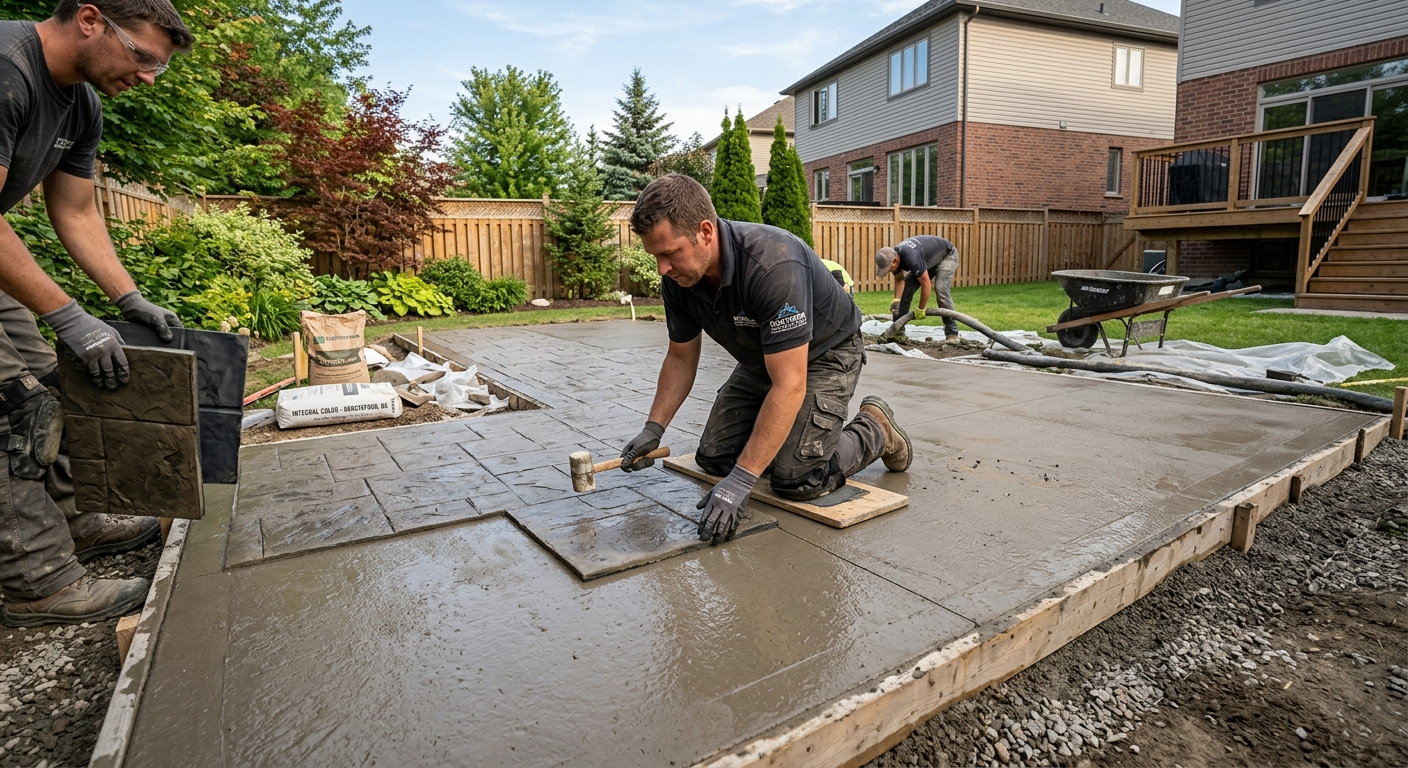
Concrete work options and costs in Surrey Centre
Concrete work in Surrey Centre is a mix of everyday flatwork and structural foundations, driven by what most homeowners build and maintain in the Lower Mainland. Surrey Centre’s population was 11,370 in 2021 (Statistics Canada, 2021 Census), and the broader Lower Mainland–Southwest housing stock includes many single-detached homes—the primary market for driveways, patios, and walkways that need a tough, freeze–thaw resilient surface. In this corridor, concrete pricing isn’t just about volume; it’s about how we build for a frost depth of roughly 450 mm (18") in local practice and how we manage wet, coastal rain and cool curing conditions.
Even with milder winters than interior BC, Surrey’s combination of shallow frost, frequent freeze–thaw cycles, saturated soils, and heavy rainfall means contractors spend more time on drainage, base prep, and curing control than you’d see in hotter, drier regions. It also affects availability: popular trades cluster around active neighbourhoods where flatwork is common, especially in areas like North Surrey and near Guildford, where turnover and renovation activity keep crews booked.
To compare options fairly, use the table below as a planning baseline. The biggest swings usually come from site prep, thickness, reinforcement, and how premium the finish is (standard broom vs. exposed aggregate vs. stamped), rather than “concrete cost” alone. Once you match the spec to the climate demands, the price band makes a lot more sense.
| Application |
Typical Size |
Key Spec |
Finish Option |
Price Range |
| Concrete driveway (standard broom finish) |
400–600 sq ft |
6"–7" thickness, compacted granular base, control joints |
Broom finish + sealer |
$10,000–$16,800 |
| Exposed aggregate driveway |
400–600 sq ft |
6"–7" thickness, air-entrained mix, specialty aggregate |
Washed/exposed aggregate + sealer |
$12,000–$19,800 |
| Stamped concrete driveway or patio |
300–500 sq ft |
4"–6" thickness, integral colouring, control joints |
Stamp pattern + release agent + sealer |
$9,500–$16,500 |
| Plain concrete patio or walkway |
200–400 sq ft |
4" thickness, compacted base, jointing plan |
Screed + broom/float |
$3,200–$10,400 |
| Garage floor (interior slab) |
300–500 sq ft |
4"–5" slab, vapour/insulation depending on design, fibre or mesh |
Float-finish |
$6,000–$14,000 |
| Foundation footings (structural, below frost) |
Varies by design |
Engineered footing size, excavation below ~450 mm practical frost, rebar cage |
Structural finish |
$8,000–$26,000 |
Prices are estimates only and vary by project scope, site access and material selection.
What affects the price of concrete work in Surrey Centre
In Surrey Centre and across the Lower Mainland–Southwest, two contractors can price the “same” concrete job 30–50% apart because the quote may assume very different specs for drainage, thickness, reinforcement, and curing. A driveway might be quoted as a simple slab, but the real cost drivers are the details that protect the slab from freeze–thaw damage: footing depth/form height, engineered base preparation, air-entrained concrete, and the time spent keeping concrete workable and curing properly in cool, wet conditions. In a wetter market, labour for prep and protection is often a larger share of the total, and crews prioritize scheduling to avoid rain-washed surfaces and cold-night curing problems.
Region-wide, frost depth and freeze–thaw cycles dictate every exterior spec. Local practice commonly assumes a frost depth around 450 mm (18") so we place footings and thickened edges below that to reduce frost heave. Exterior slabs also need air-entrained mixes to handle repeated wetting and cooling; that’s why exterior pricing tends to sit in the local flatwork bands (for example, driveway concrete commonly lands around $18–$28 per sq ft in this tier). Colder regions require deeper excavations and cold-weather measures (heating/blankets), which is why costs can be higher elsewhere—but even here, late-season cool snaps and constant moisture push crews to plan for longer protection and better sealing to manage surface scaling from de-icing salts.
Concrete examples in Surrey Centre: if your soil is saturated and drainage is poor, contractors may need extra granular drainage layers and more careful grading; that raises excavation and labour. If you choose stamped or exposed finishes, the product cost and labour for colour and stamping can add enough to justify premium—especially compared with standard broom finishes. For patios and walkways, plain flatwork can often track the $16–$26 per sq ft band, while stamped options typically sit higher because of materials and finishing time.
| Price Factor |
Why It Matters |
Cost Impact |
| Frost line depth — determines footing depth and form height |
Footings must sit below the design frost condition to prevent frost heave |
Can add significant excavation and forming time |
| Site preparation — excavation, grading, compacted granular base |
Correct base prevents pumping, settlement, and early cracking |
Higher if access is tight or soil is wet |
| Reinforcement — rebar or wire mesh requirement |
Controls cracking and supports loads in thicker exterior slabs |
Material + labour increases, especially for larger pours |
| Mix design — air-entrainment and compressive strength spec |
Air-entrainment improves freeze–thaw durability and scaling resistance |
Cost rises with higher spec cementitious requirements |
| Finish type — broom vs. stamped vs. exposed aggregate |
Premium finishes require more labour and often additional products |
Stamped/exposed typically costs more per square foot |
| Pour size and concrete truck access to site |
Access affects hose use, placement time, and coordination |
Tight sites can add placement labour and equipment time |
| Cold-weather curing precautions — heating and blankets |
Ensures concrete reaches strength despite cool nights |
Adds labour/supplies in fall/winter windows |
| Control joint pattern and sealing cost |
Joints manage random cracking; sealer repels salts and moisture |
Sealant/material and added finishing steps |
Permits & regulations in British Columbia
In British Columbia, the concrete work that is part of a structural system typically needs a building permit and often engineered drawings reviewed by the municipality. That usually includes foundation walls, grade beams, and footing/structural foundation elements, because they carry loads and are tied to the building’s engineering design. If your project involves underpinning or new openings in structural foundation walls, plan on permitting requirements and inspections.
Concrete flatwork—patios, walkways, driveways, and garage slab replacements—often does not require a permit unless it affects lot grading, changes stormwater drainage, triggers impervious surface/coverage considerations, or impacts municipal right-of-way. Even when a permit isn’t required, drainage still matters: in Surrey Centre’s wet coastal climate, the municipality may require water to be directed properly away from foundations and neighbouring areas.
Step-by-step for Surrey Centre homeowners: (1) ask for the contractor’s proof of liability insurance with coverage limits; (2) request confirmation of Workers’ Compensation coverage (commonly referred to as WCB clearance/coverage); (3) verify licensing for the trade that performs structural concrete and any related work through BC’s licensing/registration resources or the contractor’s listed registration details; (4) ensure they can provide certificate of insurance and, if applicable, a WCB clearance letter; and (5) check references on projects of similar scale (flatwork and/or foundations). Always confirm permit needs with the local authority before ground is broken.
Getting concrete right in Surrey Centre's freeze-thaw climate
Concrete failures in Surrey Centre usually trace back to water and temperature—especially when freeze–thaw cycles and moisture saturate the slab. If base preparation is shallow or drainage is weak, water collects under the slab, and the surface starts to crack and heave. The most damaging issue in exterior flatwork is spalling, where the top layer breaks down after repeated freezing, often caused by inadequate air-entrainment or improper finishing and curing. To spec concrete correctly here, we focus on five things: (1) base preparation with compacted granular sub-base at the right depth for local soil and frost conditions; (2) mix design with air-entrainment (typically 5–7% air content for exterior flatwork) and a minimum compressive strength of 32 MPa; (3) control joints planned to limit random cracking; (4) curing—at least 7 days under proper conditions, with added protection in cool, damp weather; and (5) sealing applied after the concrete has cured (often around 28 days) to improve resistance to de-icing salts and rain-driven scaling.
Ask for specs that match the Lower Mainland–Southwest realities, not “one-size-fits-all.” For example, a plain broom-finish driveway may start around the local driveway tier (roughly $18–$28 per sq ft), while stamped concrete is a premium option. The price difference is justified when the quote includes the correct air-entrained mix, proper jointing, and sealing—otherwise, you’re paying extra for a finish that can still spall or crack. In a coastal-wet climate, those protection steps are what keep the look intact.
| Spec |
Why It Matters in Surrey Centre |
What to Ask For |
Impact if Skipped |
| Compacted granular base (depth?) |
Prevents settlement and water pumping under slabs in wet soils |
Engineered base thickness and compaction method for your soil |
Cracking, uneven surfaces, premature failure |
| Air-entrained concrete mix (target air %?) |
Improves freeze–thaw durability and scaling resistance |
Target 5–7% air for exterior flatwork (by spec) |
Increased spalling and surface breakdown in winter |
| Compressive strength (MPa rating) |
Ensures durability and long-term load capacity |
Minimum 32 MPa compressive strength per design/spec |
Lower strength and reduced abrasion resistance |
| Control joints (spacing per ACI guidelines) |
Controls where cracks form under seasonal movement |
Joint spacing and saw-cut timing plan |
Random cracking and costly cosmetic repairs |
| Minimum 7-day curing period |
Helps concrete reach strength despite cool nights and humidity |
Clear curing plan (blankets/sealer-curing aids if needed) |
Surface weakness and reduced durability |
| Penetrating sealer (when applied after cure) |
Repels moisture and de-icing salts to reduce scaling |
Applied after cure—commonly around 28 days, product data |
Faster surface deterioration and higher maintenance |
How to choose a concrete work contractor in Surrey Centre
Start with verification. In British Columbia, you want a contractor who can prove (a) appropriate trade registration/licensing for the work being done, (b) liability insurance with current certificates, and (c) Workers’ Compensation coverage (WCB clearance/coverage documentation). How to check: request a certificate of insurance and look for the policy term, coverage amounts, and whether they can add you as an additional insured if your contract requires it. Then ask for a WCB clearance/coverage letter. For licensing, don’t rely on a verbal claim—ask what designation applies and where it’s listed.
Next, get 2–3 itemised written quotes rather than a single lump sum. The quote should break out labour and materials (excavation/base, concrete supply, reinforcement, forms, finishing, and curing/sealing), plus line items for what’s excluded. Pay attention to permit pull responsibility: if a permit is required for the scope, confirm who handles it and whether inspections are included. Ask about disposal for excavated soil and waste—often it’s excluded unless specified.
Finally, protect your cash flow and schedule. A reasonable payment schedule is to keep upfront payment at 10–15% and hold a portion until completion and cleanup. Get a start date and target completion estimate in writing, and confirm protections for rain/cold weather during curing. Warranty matters too: ask for workmanship warranty length, whether it’s tied to product/manufacturer warranties for sealers or admixtures, and whether warranties are transferable if you sell your home.
- Request insurance certificates and confirm they cover your site address.
- Ask for WCB clearance/coverage documentation before work starts.
- Verify the correct registration/licensing for the exact concrete scope (flatwork vs. structural).
- Get 2–3 itemised quotes with labour/material breakdown, not just a total.
- Confirm concrete thickness and whether reinforcement is included (mesh/rebar/fibres).
- Require the air-entrainment and compressive strength spec in the quote.
- Ask for drainage and base prep details (granular type, depth, compaction method).
- Clarify jointing and sealing scope (joint saw-cut plan, sealer product and timing).
- Confirm curing plan for cool/wet weather (blankets/curing protection if needed).
- Identify exclusions: permit costs, excavation disposal, saw-cutting existing slabs, core samples.
- Keep payments capped at 10–15% upfront; use a holdback until completion.
- Get start and completion timelines, and how they handle rain delays.
Concrete red flags in Surrey Centre: contractors who won’t discuss air-entrainment or joint spacing, quotes that omit base thickness and drainage, crews who push for “finish it fast” without a curing/protection plan, unclear reinforcement assumptions, and payment demands that exceed 10–15% upfront or skip a holdback.
Frequently asked questions — concrete work in Surrey Centre
Can concrete be poured in cold weather in Surrey Centre?
Yes, concrete can be poured in Surrey Centre and other parts of British Columbia during cool weather, but only if the contractor manages temperature and curing properly. The Lower Mainland’s wet conditions and cool nights mean concrete may not gain strength on schedule unless curing protection is used. A good concrete crew will monitor temperatures, use proper curing blankets/insulation when required, and ensure the mix is protected from freezing until it reaches strength. If freezing is expected during the early cure period, they may schedule around it. Ask whether the quote includes cold-weather curing precautions (blankets/heating), and confirm the concrete target strength and air-entrainment are still being met. If you’re budgeting, the price uplift is usually more about labour and protection time than the concrete itself—so expect cold-weather work to land toward the higher end of the tier.
How do I maintain concrete in Surrey Centre's freeze-thaw climate?
Maintenance in Surrey Centre is mostly about keeping water and salt exposure from stressing the surface. Start with a proper seal: many contractors apply a penetrating sealer after the concrete cures (often around 28 days) so moisture and de-icing salts don’t drive freeze–thaw damage. Keep an eye on drainage—redirect downspouts and ensure grading doesn’t pond water near edges or joints. Sweep and remove debris so water isn’t trapped in corners. For de-icing, use the least aggressive approach feasible for concrete and avoid piling salt on the slab surface. If you see small spalls, address them early with appropriate repair materials; waiting usually turns cosmetic issues into deeper freeze–thaw breakdown. A sealed, correctly jointed slab typically costs less to maintain over time, whether you chose a broom-finish driveway in the $18–$28 per sq ft band or a premium stamped finish closer to the top end.
What causes concrete to spall in Surrey Centre winters?
Spalling is the surface breaking down—often in winter after repeated wetting and freezing. In Surrey Centre’s freeze–thaw climate, the most common cause is inadequate air-entrainment or inconsistent mix quality. Without enough air content, the freeze–thaw cycle can push pressure through the cement paste and break off the top layer. Another cause is poor curing or finishing done too late or too aggressively in cool, damp weather, leading to a weaker surface. Water management matters too: if base preparation is wrong or drainage is missing, water gets trapped and accelerates damage at edges and joints. De-icing salts can worsen the problem by increasing moisture movement near the surface. To reduce the risk, confirm the quote includes air-entrained mix targeting 5–7% air content for exterior work, minimum 32 MPa strength, correct jointing, and sealing after cure.
What is rebar and when is it required in British Columbia?
Rebar is steel reinforcement placed inside concrete to control cracking and improve load-bearing capacity. When it’s required depends on the structural design and the type of slab or foundation element. In British Columbia, structural concrete work—such as footings and foundation components—generally follows engineered drawings, and reinforcement is specified for strength and durability. For exterior flatwork like driveways and patios, reinforcement (rebar, wire mesh, or fibres) may be required based on thickness, soil conditions, and expected loads; even when not structurally mandated, reinforcement often becomes part of a “durability spec” in wet, freeze–thaw areas. Ask your contractor to show the reinforcement plan in the quote: slab thickness, whether mesh or rebar is used, and how it’s supported (so steel sits in the correct position, not on the ground). A properly reinforced slab is especially important in Surrey Centre where saturated soils can intensify freeze–thaw movement.
How long does a concrete project take in Surrey Centre?
Timing depends on the scope, access, and weather. For typical Surrey Centre flatwork, the “active work” might be a day or two—excavation/base prep, formwork, pour, and finishing—followed by curing and protection. Even if the pour day is short, you can’t treat the concrete as finished immediately. Minimum curing is commonly at least 7 days before you should expect full handling, and many finishes (like sealers) are applied around 28 days after the pour. If cold nights or extended rain are expected, curing blankets or additional protection may extend the schedule and add labour time. For structural foundation footings, timelines are longer because of excavation below frost depth, inspection steps, rebar placement, and engineering documentation. When comparing quotes (especially for driveways near the $18–$28 per sq ft tier or patios in the $16–$26 band), ask whether the quote includes curing protection, sealing schedule, and any weather contingency.
What is a concrete overlay and is it suited to Surrey Centre?
A concrete overlay is a new layer placed over an existing slab to restore appearance and add thickness—sometimes combined with grinding/prep and joint adjustments. It can be suited to Surrey Centre when the existing concrete is stable (not actively lifting or badly heaving) and when prep is done correctly—usually grinding to remove weak surface material, cleaning, and addressing cracks so the overlay bonds well. However, overlays aren’t a cure-all in freeze–thaw climates: if the underlying slab is failing due to drainage issues, base problems, or structural movement, the overlay can crack or debond too. Ask your contractor to inspect for settlement, spalling causes, and water pathways around edges and joints. Pricing varies, and overlays can sometimes be close to replacement costs once surface prep and thickness requirements are included. For many homeowners, a full replacement with air-entrained concrete, proper jointing, and sealing (to protect against de-icing salts) is the more durable long-term approach in British Columbia’s coastal-wet winters.