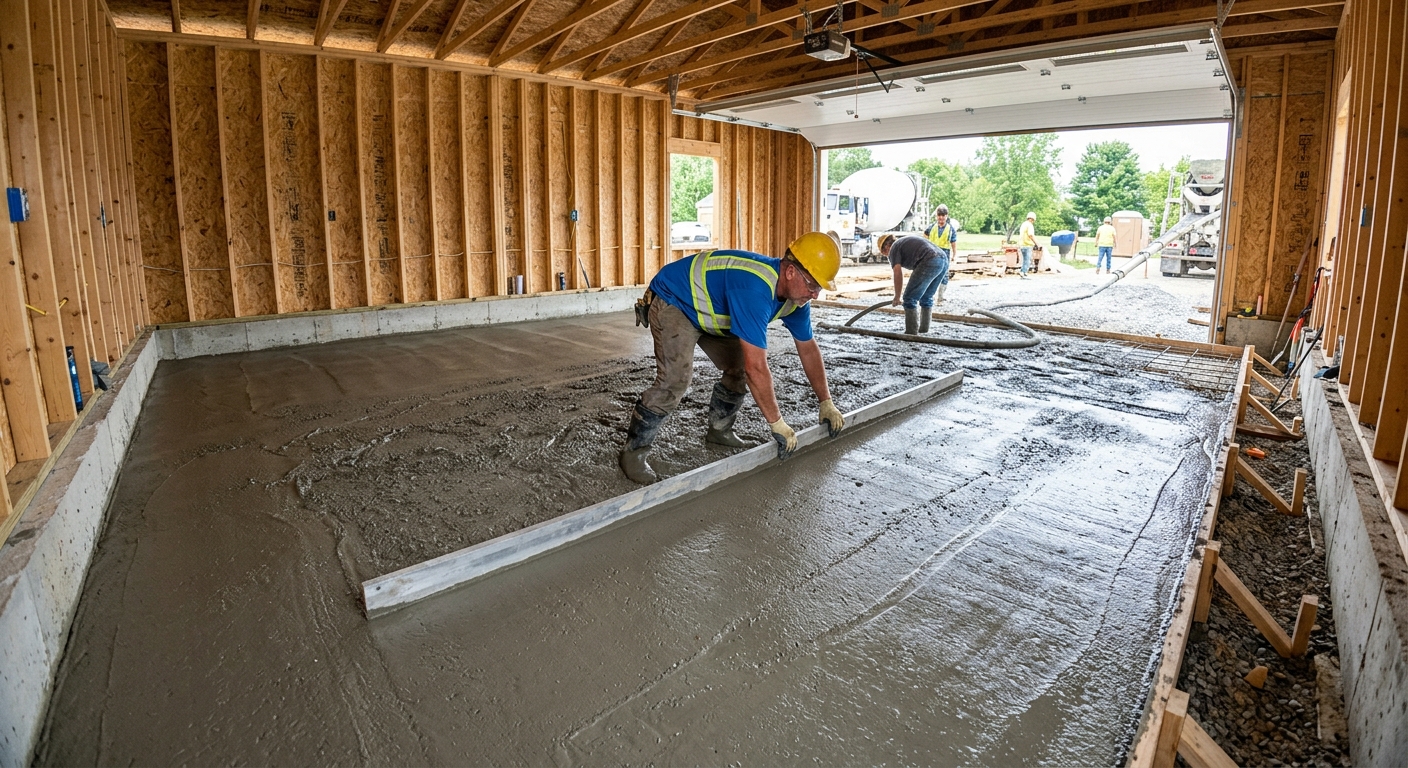
Concrete work options and costs in Maplewood
Maplewood homeowners usually start with a simple question—what kind of concrete do I need and what will it cost? Maplewood has a population of 1,090 (Statistics Canada, 2021 Census), and like many Lower Mainland–Southwest communities, it’s a market where driveways, patios, and walkways are high-visibility upgrades for single-family homes. In the wider Lower Mainland–Southwest region, the demand for concrete flatwork is strongly shaped by housing age and lot servicing needs, with many projects focused on repairs, expansions, and new exterior slabs. (Statistics Canada, 2021 Census)
In this region, mild winters can fool people, but the freeze–thaw pattern plus coastal rainfall still affects how we design and price concrete. Local practice typically assumes a frost depth around 450 mm / 18", so we place footings, piers, and thickened edges below that to reduce freeze heave. Even with a shallow frost line, saturated soils and drainage details drive base prep scope, and air-entrained mixes plus properly planned control joints help manage cracking and scaling. Weather also matters: cool nights and frequent rain mean we often use curing blankets, sealers timed for the right conditions, and longer cure schedules to reliably reach design strength.
In Maplewood, contractor availability and pricing are especially busy in the north/rail-adjacent residential areas where lots tend to have tighter access for trucks and more frequent drainage issues. Once you’ve chosen the right option—standard broom, exposed aggregate, stamped, or structural—we can line up realistic price bands in the table below.
| Application |
Typical Size |
Key Spec |
Finish Option |
Price Range |
| Concrete driveway (standard broom finish) |
300–500 sq. ft. (e.g., 10'×30' to 15'×35') |
4" slab, compacted granular base, air-entrained concrete, control joints |
Broomed surface |
$18,000 – $28,000 |
| Exposed aggregate driveway |
300–450 sq. ft. |
Exposed-aggregate mix design, proper base and drainage, air-entrained concrete |
Exposed stone / wash finish |
$22,500 – $34,000 |
| Stamped concrete driveway or patio |
250–400 sq. ft. |
Integral/toned mix, air-entrained concrete, joints aligned to pattern |
Stamped pattern with seal coat |
$24,000 – $42,000 |
| Plain concrete patio or walkway |
200–350 sq. ft. |
4" slab typical, compacted base, air-entrained concrete, edges protected |
Float-and-broom or light broom finish |
$3,200 – $9,100 |
| Garage floor (interior slab) |
400–600 sq. ft. |
Slab thickness per use, vapour considerations, reinforcement as required |
Broom finish or trowel-finish option |
$6,800 – $15,500 |
| Foundation footings (structural, below frost) |
Varies by design; typically per linear metre |
Excavation to below design frost, rebar, engineered profile |
Structural concrete finish (not decorative) |
$1,800 – $3,500 |
Prices are estimates only and vary by project scope, site access and material selection.
What affects the price of concrete work in Maplewood
In Maplewood and across the Lower Mainland–Southwest, two quotes for the same basic concrete footprint can differ by 30–50% because the “hidden” work changes: excavation, base build-up, reinforcement density, mix design, weather protection, and finishing time. That’s not unique to Maplewood—British Columbia’s coastal climate and scheduling constraints can stretch labour days even when slab thickness looks identical. In other parts of BC, the deeper cold-weather precautions and shorter pour seasons can push costs up further, and the Lower Mainland’s pricing tends to reflect how crews manage rain, cool curing nights, and truck access in a dense corridor.
Here’s the core driver: frost line depth and freeze–thaw cycles dictate every exterior spec. Footings must extend below the design frost depth (about 0.5–1.2 m in coastal BC) to prevent frost heave. Exterior slabs need air-entrained concrete to survive repeated cycles and saturated soils. When temperatures dip, cold-weather curing precautions—insulating blankets, curing protection, and sometimes temporary heating—add labour and equipment costs. Finally, de-icing salt can accelerate spalling on poorly sealed surfaces, so sealing is not just cosmetic for driveways and steps.
In Maplewood, a driveway price can land near the $18–$28 band when drainage is straightforward and truck access is easy; it often rises toward the upper end when soils are soft, forms are complex, or we need thicker edges and deeper base. Conversely, a simple walkway may stay closer to the $16–$26 patio/walkway band when the subgrade is already stable. As a ballpark example: upgrading from broom-finish to stamped can add roughly $22–$36 per sq. ft. depending on pattern complexity—worth it when you want a long-lasting, sealed finish that holds up to coastal moisture and winter traffic.
| Price Factor |
Why It Matters |
Cost Impact |
| Frost line depth — determines footing depth and form height |
Concrete must sit below design frost to prevent freeze heave |
Can add excavation/form time; major driver for foundations and thickened edges |
| Site preparation — excavation, grading, compacted granular base |
Drainage and compaction control settlement and cracking |
More haul-off, thicker base, and extra compaction passes increase cost |
| Reinforcement — rebar or wire mesh requirement |
Improves load capacity and crack control for driveways and garage slabs |
Material + install labour; needed when engineered specs require it |
| Mix design — air-entrainment and compressive strength spec |
Air content and strength manage freeze–thaw and long-term durability |
Air-entrained exterior mixes and higher-strength specs typically raise material cost |
| Finish type — broom vs. stamped vs. exposed aggregate |
Different tooling, timing, and sealing systems affect labour time |
Stamped/exposed often lands at the higher end of the $22–$36 range |
| Pour size and concrete truck access to site |
Small pours still take crews; access affects pumping or short carries |
Tighter lots can raise placement labour; larger pours can lower per-sq-ft due to efficiency |
| Cold-weather curing precautions — heating and blankets |
Reliable cure is harder during cool nights and wet spells |
Blankets, heaters, and longer protection can add significant costs in shoulder season |
| Control joint pattern and sealing cost |
Joints manage shrinkage cracking; sealing helps resist salt/moisture |
Sealing is usually a modest add; skipping it can lead to early surface deterioration |
Permits & regulations in British Columbia
In British Columbia, the permit requirements depend on the type of concrete work. Structural concrete—such as footings, foundation walls, and grade beams—typically requires a building permit, and engineered drawings are often reviewed by the municipality. Concrete flatwork (patios, walkways, and driveways) usually does not require a permit unless it affects lot grading, drainage, impervious surface coverage limits, or the municipal right-of-way (for example, work that ties into a curb, sidewalk, or modifies stormwater flow). Before breaking ground in Maplewood, confirm with the local authority having jurisdiction.
Regardless of whether a permit is required for flatwork, you should verify contractor readiness. In practice, reputable crews carry liability insurance, and they have coverage appropriate for workers (WSIB/WCB as applicable). As a homeowner, you can also ask for references on similar-scale projects—especially ones that involve exterior slabs exposed to freeze–thaw and wet winters.
Step-by-step verification you can do right away: (1) Request the contractor’s business licence information and check it through the applicable online registry or municipal listing (if available); (2) Ask for a current certificate of insurance showing general liability with suitable coverage limits and the policy active date; (3) Confirm workers’ coverage by asking for a WCB/WSIB clearance letter or account status proof; (4) Verify the scope includes engineered/permit requirements when structural work is part of the project; and (5) Keep everything in writing—your quote, start date, and any site-protection responsibilities.
Getting concrete right in Maplewood's freeze-thaw climate
Maplewood concrete has to perform through wet coastal weather, cool nights, and freeze–thaw cycles that can stress the surface and edges. Concrete fails most often when the base is underbuilt, when the mix isn’t air-entrained enough for exterior exposure, or when curing and sealing are rushed. To spec the job correctly, build from the ground up.
(1) Base preparation: excavate to the right depth for local soils and frost protection, then install a compacted granular sub-base that supports drainage. (2) Mix design: for exterior flatwork, air-entrained concrete with a target air content typically in the 5–7% range is critical, and we commonly specify minimum 32 MPa compressive strength for durability needs. (3) Control joints: plan joint spacing so cracks occur where you want them. (4) Curing: plan for at least 7 days of curing under suitable conditions; in cool, damp weather this may require curing blankets and longer protection time to reach strength reliably. (5) Sealing: apply a penetrating sealer after the concrete has cured—commonly at about 28 days—so de-icing salts and moisture don’t accelerate spalling.
The technical questions you should ask are simple: “Is the mix air-entrained and what target air content will you use for this exposure?” and “How will you protect the slab during cool, rainy periods?” This is the most common failure pathway in freeze–thaw climates—spalling caused by inadequate air content or poor curing.
On pricing: a driveway broom finish might sit around the lower end of the $18–$28 range, while switching to stamped or exposed aggregate can increase costs toward the $22–$36 band. That extra cost is justified when the goal is a tougher, more decorative finish paired with correct sealing and jointing—not when it’s used to “dress up” a weak base or skipped drainage work.
| Spec |
Why It Matters in Maplewood |
What to Ask For |
Impact if Skipped |
| Compacted granular base (depth?) |
Provides drainage and support; reduces settlement and cracking |
Granular base type and compacted depth to suit soil and frost strategy |
Uneven settlement, cracking, and faster surface failure |
| Air-entrained concrete mix (target air %?) |
Manages freeze–thaw stress and helps prevent scaling/spalling |
Target air content for exterior exposure (commonly 5–7%) |
Higher risk of spalling and scaling during winter cycles |
| Compressive strength (MPa rating) |
Strength ensures the slab reaches design performance |
Minimum 32 MPa compressive strength (as specified) |
Reduced durability and weaker surfaces under traffic |
| Control joints (spacing per ACI guidelines) |
Creates planned weak points for shrinkage control |
Joint spacing pattern and alignment with slab layout |
Random cracking across the slab and uneven appearance |
| Minimum 7-day curing period |
Cold, wet weather makes early cure critical for strength development |
How the contractor will protect and cure during cool nights/rain |
Surface weakness, higher scaling risk, and premature wear |
| Penetrating sealer (when applied after cure) |
Repels moisture and helps resist salt damage |
Penetrating sealer application timing (often ~28 days post-pour) |
Moisture penetration, early deterioration, and more maintenance |
How to choose a concrete work contractor in Maplewood
When you’re hiring a concrete contractor in Maplewood or anywhere in British Columbia, verify three things before work starts: licensing/registration (where applicable), liability insurance, and workers’ coverage (WSIB/WCB). Start by asking for a certificate of insurance (COI) that names your property owner interest if available and shows active coverage. Then request proof of workers’ coverage—often a clearance letter or account status proof—so you know you’re not exposed if someone gets hurt on site. If the contractor relies on subcontractors, confirm those subs are also covered.
Next, get 2–3 itemised written quotes, not just a single lump sum. You want a breakdown you can compare: excavation/grading, granular base, rebar/wire mesh, concrete supply, finishing, curing protection, sealing, and waste/disposal. Ask whether permits (when required) are included, and what’s excluded—common exclusions include saw-cutting after set, disposal fees, site drainage improvements, and restoration of damaged landscaping.
Warranty matters for concrete. Clarify the workmanship warranty length, what it covers (cracks, scaling, jointing), whether it’s tied to material defects, and whether any product/manufacturer warranty is transferable. Finally, payment schedule: never pay more than 10–15% upfront; hold back a portion until the slab is complete, cured, and sealed (if included). Get your timeline in writing with a start date, weather contingency notes, and an estimated completion date—cool, rainy seasons can shift cure schedules.
- Ask for proof of liability insurance with current dates on the COI.
- Confirm workers’ coverage (WSIB/WCB clearance or equivalent proof).
- Request 2–3 itemised quotes with labour and material lines.
- Ensure the quote states slab thickness, base depth, and reinforcement plan.
- Check that exterior mixes are air-entrained and meeting the exterior exposure intent.
- Confirm control joint locations and spacing are included.
- Ask how they will handle rain/cold nights and what curing blankets/sealers are planned.
- Verify disposal/haul-off is included for excavated material.
- Confirm permit scope is included if structural concrete is involved.
- Get the warranty details in writing (workmanship and any exclusions).
- Use a payment schedule with a holdback until completion and final clean-up.
- Require a written start date and realistic completion timeline.
Concrete red flags in Maplewood include: no discussion of drainage/base prep, vague statements about air-entrained mix, missing or unclear joint layout, lowball pricing that doesn’t include disposal/curing protection, and contracts that don’t mention sealing (especially when de-icing salt is expected on driveways).
Frequently asked questions — concrete work in Maplewood
How do I maintain concrete in Maplewood's freeze-thaw climate?
In Maplewood and across coastal British Columbia, the goal is to reduce moisture and salt exposure so freeze–thaw cycles don’t stress the surface. Start with simple habits: clear debris and avoid leaving standing water on driveways and walkways. If you use de-icing products, choose ones suitable for concrete and try to apply sparingly; heavy salt can accelerate surface wear. If your slab is sealed, re-check it after a couple of winters—seal performance varies with traffic and how often you clean. For maintenance, power washing should be gentle (avoid blasting the surface). If you notice hairline cracking, don’t ignore it—monitor it, and ask your contractor whether joint re-sealing is needed. Proper base prep and air-entrained exterior concrete are what make maintenance easier over time.
What causes concrete to spall in Maplewood winters?
Spalling is usually the result of freeze–thaw damage plus moisture and salts getting into the concrete near the surface. In Maplewood’s Lower Mainland–Southwest climate, the combination of coastal rainfall, saturated soils, and repeated temperature swings means that exterior slabs are exposed more often than people expect. The most common technical causes are inadequate air-entrainment in the mix, poor curing during cold or rainy weather, and weak or poorly drained base conditions that keep water near the slab edges. Sealing also matters; without a penetrating sealer applied after cure (often around 28 days), de-icing salts can speed up deterioration. If you’re comparing quotes, don’t just look at a “cheap” driveway near the $18–$28 range—ask whether the contractor specifies air content, curing protection, and sealing. Those details are what prevent spalling.
What is rebar and when is it required in British Columbia?
Rebar is steel reinforcement placed inside concrete to improve strength and control cracking under loads. In British Columbia, whether rebar is required depends on the design and the project type. For structural elements like foundations and grade beams, reinforcement is typically dictated by engineering drawings. For flatwork like driveways, reinforcement can be recommended or required based on slab thickness, soil conditions, and loading (for example, heavy vehicles). Even when engineering isn’t required for a simple patio or walkway, many contractors include reinforcement (or wire mesh) when the slab will see higher stress. The key is that your contractor should clearly describe what they will install and why, and tie it to the thickness and intended use. Don’t accept vague answers such as “we add some mesh if we feel like it.” A proper quote should name the reinforcement spec, not just the finish.
How long does a concrete project take in Maplewood?
Project duration depends on scope, access, and—most importantly in Maplewood—weather and curing conditions. For smaller exterior work like a patio or walkway, the placement day is often just one crew day, but the “calendar time” is longer because you need proper curing before you can use the surface. Many jobs plan for a minimum 7-day curing window under appropriate conditions. In cool, wet spells common in the Lower Mainland–Southwest, contractors may use curing blankets and additional protection, which can extend timelines. Driveways usually take longer because of excavation, base prep, forms, reinforcement (if required), and saw-cut/joint work. If your quote includes sealing, schedule timing for cure completion is also needed. If you’re coordinating other trades, ask for the intended start date and what happens if rain or cold nights impact curing.
What is a concrete overlay and is it suited to Maplewood?
A concrete overlay is a layer of new concrete placed over an existing slab, usually after surface preparation and sometimes with bonding agents or mechanical profiling. Overlays can be a good option when the original slab is still structurally sound, the cracking is manageable, and drainage and grades are acceptable. In Maplewood’s freeze–thaw climate, overlays can perform well when the surface is prepped thoroughly and the drainage is corrected—because trapped moisture under a poor bond can lead to separation over time. If the original slab has widespread spalling, significant settlement, or failing edges, an overlay often isn’t the best long-term fix. Cost-wise, overlays can be competitive with full replacement, but you should still compare total scope: crack repairs, prep work, bonding, thickness, joints, and sealing. For many homeowners, a properly built new slab—within the $18–$28 driveway band or $16–$26 patio/walkway band—can be more predictable long-term.
How do I seal concrete to protect it in Maplewood?
Sealing concrete in Maplewood is about protecting the surface from moisture and salt exposure. First, give the concrete time to cure properly—sealers are typically applied after the slab has cured, commonly at about 28 days post-pour for many exterior systems. Second, ensure the surface is clean and dry enough for bonding; your contractor should clean off dust and any residue from finishing. Use a penetrating sealer designed for exterior concrete, especially for driveways and walkways that may see de-icing. Ask your contractor what product they’re using, how many coats, expected coverage, and when you can traffic the surface after application. If you already have a sealed slab, maintenance depends on condition and how often it’s exposed to salt and heavy rain. Proper sealing, combined with air-entrained mix and control joints, is a practical way to reduce spalling risk in British Columbia’s winter cycles.