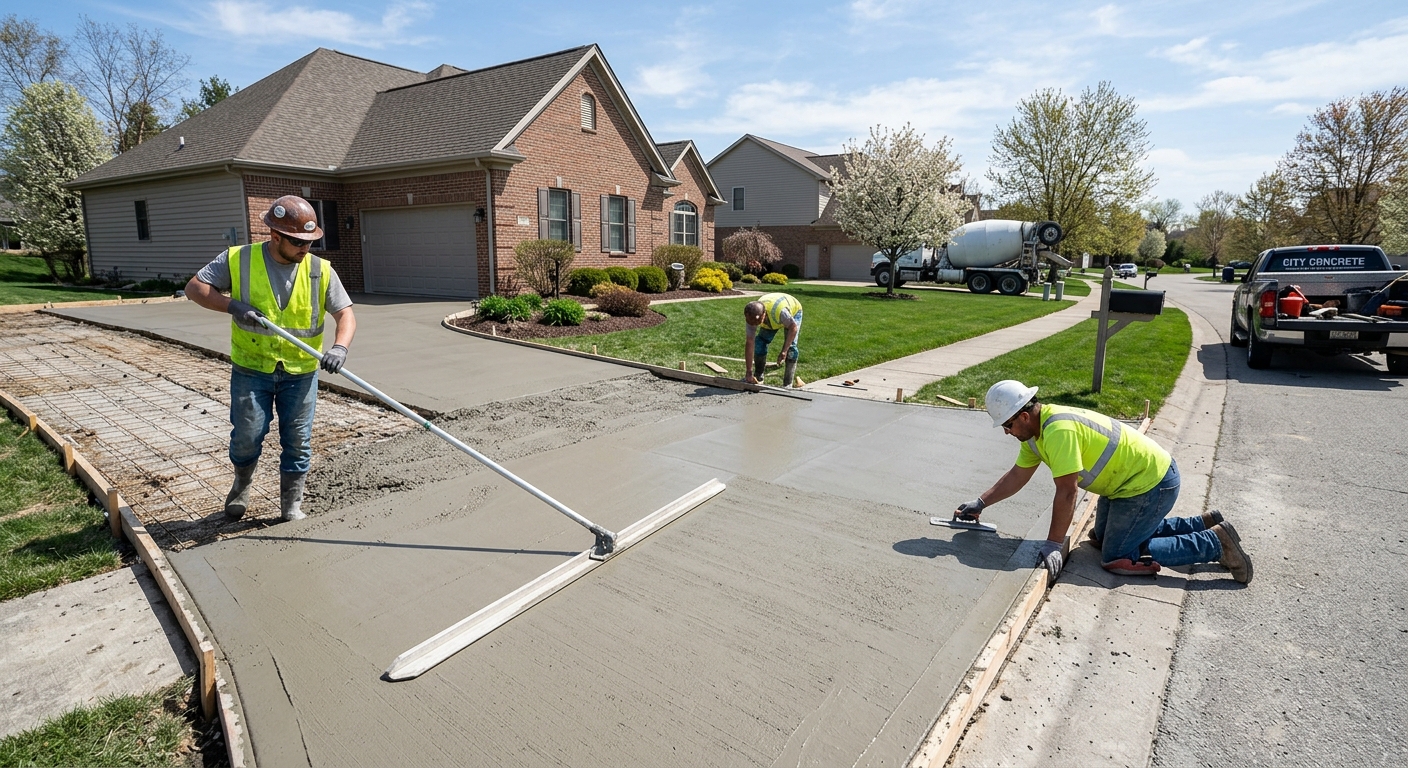
Concrete work options and costs in Edmonds
Edmonds, British Columbia is a great place for concrete flatwork, but the cost can swing depending on how we detail for the Lower Mainland–Southwest freeze–thaw climate and how busy the local trade is. With a city population of 22,318 (Statistics Canada, 2021 Census), there’s steady demand from homeowners upgrading driveways, patios, and steps—especially in the lots built with older foundations and those on busier streets near the waterfront/treed corridors. In Edmonds, concrete contractors also see a lot of work tied to the area’s predominant residential building stock, where single-detached homes are a common starting point for driveways, walkways, and backyard patios.
In the Lower Mainland–Southwest, winters are milder than interior BC, but the shallow frost depth still drives design. Local practice typically assumes a frost depth around 450 mm / 18", so footings, piers, and thickened edges are placed below that to reduce frost heave. We also plan around frequent coastal rainfall, cool nights, and high humidity—meaning longer curing times, careful base prep (compacted granular and drainage), and an air-entrained concrete mix with proper control joints to manage cracking and scaling.
If you’re in the Edmonds neighbourhoods around the Brentwood/Highgate-adjacent service area or the older residential blocks closer to commercial corridors, you’ll notice driveway work is often scheduled in spring through early fall. That seasonal planning, plus the region’s real-world labour costs in the Vancouver–Surrey–Abbotsford corridor, is why bids can differ even for similar-looking slabs. Use the table below to compare typical unit choices and see how finishes and structural depth change the budget.
| Application |
Typical Size |
Key Spec |
Finish Option |
Price Range |
| Concrete driveway (standard broom finish) |
200–300 sq. ft. |
Reinforcement as required, air-entrained exterior mix |
Broomed surface with proper control joints |
$8,000–$10,500 |
| Exposed aggregate driveway |
200–300 sq. ft. |
Air-entrained exterior mix, consistent texture/stone exposure |
Exposed aggregate finish |
$10,500–$14,500 |
| Stamped concrete driveway or patio |
200–300 sq. ft. |
Air-entrained mix; colour hardeners and sealing |
Stamped pattern with sealer |
$12,000–$18,000 |
| Plain concrete patio or walkway |
100–200 sq. ft. |
Compacted granular base; exterior air-entrained mix |
Float/steel-trowel (light broom edges) |
$2,500–$6,000 |
| Garage floor (interior slab) |
300–500 sq. ft. |
Vapour barrier and reinforcement as specified |
Smooth/steel-trowel with optional broom exterior edges |
$9,000–$18,000 |
| Foundation footings (structural, below frost) |
Per footing linear foot |
Excavate below design frost depth; engineered steel/concrete as required |
Structural concrete placement |
$2,000–$4,000 |
Prices are estimates only and vary by project scope, site access and material selection.
What affects the price of concrete work in Edmonds
Even when homeowners describe “the same” driveway or patio, two quotes in the Lower Mainland–Southwest can differ by 30–50% because the big cost drivers aren’t visible: footing depth and base build-up, drainage and excavation conditions, reinforcement requirements, and the concrete mix/curing plan needed for Edmonds’ coastal freeze–thaw cycles. Labour rates and concrete truck scheduling also matter in the Vancouver–Surrey–Abbotsford corridor, especially after rain events or when multiple crews are lined up for pour days.
Frost depth and freeze–thaw cycles dictate every exterior spec. Footings must extend below the design frost depth to prevent frost heave, and exterior slabs typically use air-entrained concrete mixes for durability. In colder regions, a shorter pour season and cold-weather curing precautions (insulating blankets and sometimes heating) can add cost; in Edmonds, it’s more about protecting the slab from cool nights and keeping curing steady during prolonged rain. De-icing salt accelerates surface deterioration, so sealing is strongly recommended on driveways and steps.
Concrete options also change the finish workflow. Standard broom-finished driveway work often lands in the concrete driveway/slab band (around $18–$28 per sq. ft.), while stamped & decorative concrete carries a premium because of colour systems, texture mats, and finishing time—closer to the stamped/decorative band (about $22–$36 per sq. ft.). In practice, an extra $3,000–$6,000 for exposed aggregate or stamping can be justified when it replaces a full re-skin of an older slab (removal, grading, and base rebuild) rather than patching over failing edges.
Local examples: if your subgrade is saturated or the soil is soft, base prep and drainage may need to increase, pushing excavation and compacted granular quantities up. If you’re replacing a driveway in a tight side yard, concrete truck access and waste haul-off can add labour and equipment charges, while wide-open back lanes can keep costs closer to the lower end of the patio/walkway band (about $16–$26 per sq. ft.).
| Price Factor |
Why It Matters |
Cost Impact |
| Frost line depth |
Determines footing depth and form height to resist frost heave |
Can shift structural excavation and concrete volume significantly (+$500 to +$3,000 depending on scope) |
| Site preparation |
Excavation, grading, and compacted granular base for load support and drainage |
Higher if soils are wet/unstable or drainage is needed (+$1,000 to +$6,000) |
| Reinforcement |
Rebar or wire mesh to control cracking and support loading |
Adds material and labour (+$300 to +$2,500) |
| Mix design |
Air-entrainment and compressive strength spec for exterior durability |
Small per-cubic-yard increase, but required for exterior longevity (+$400 to +$2,000) |
| Finish type |
Broom vs. stamped vs. exposed aggregate changes labour and curing/sealing steps |
Stamped/exposed typically adds premium (+$2,000 to +$6,500) |
| Pour size and concrete truck access to site |
Impacts crew size, pump/short-interval pours, and trucking charges |
Tight access and small pours can raise cost (+$500 to +$4,000) |
| Cold-weather curing precautions |
Heating, insulating blankets, and longer cure protection for cool/cold nights |
More during shoulder season (+$300 to +$2,500) |
| Control joint pattern and sealing cost |
Correct jointing limits random cracking; sealer reduces salt scaling and improves surface life |
Not “optional” for durability (+$200 to +$1,200) |
Permits & regulations in British Columbia
In British Columbia, structural concrete work—like footings, foundation walls, and grade beams—typically requires a building permit, often with engineered drawings reviewed through the municipality. Concrete flatwork (patios, walkways, and driveways) usually does not require a permit unless it changes lot grading, affects impervious surface coverage limits, or involves municipal right-of-way work (for example, certain boulevard ties or drainage connections). Still, the safe approach is to confirm requirements with the local authority before breaking ground.
Before you hire anyone in Edmonds, verify the contractor carries liability insurance and has the appropriate provincial worker coverage (commonly WSIB/WCB coverage, depending on their setup). Ask for references on similar-scale projects—especially exterior work where air-entrained concrete, drainage, and control joints are non-negotiable.
Step-by-step: how a homeowner can verify
- Building permit scope: Ask your contractor what permit they’ll pull (if any) for footings/foundation/structural elements and confirm it’s in your name or covered by their process.
- Contractor licence / registration: Check the provincial registry for the trade/contractor listing (where applicable) and confirm the company name matches the quote and invoice.
- Certificate of insurance: Request a current COI showing liability coverage. Ensure it lists your address as an additional insured if your contract requires it.
- Workers’ coverage: Request proof of WSIB/WCB coverage for workers who will be on site.
- Clearance letter / account status: If offered, ask for the most recent clearance documentation so you’re not left with exposure on site injuries.
If a contractor can’t show current documentation or avoids talking about permits for structural concrete, that’s a red flag—especially for foundation-related work below frost.
Getting concrete right in Edmonds's freeze-thaw climate
Concrete can fail in Edmonds when the slab doesn’t have the right base support, the mix isn’t properly air-entrained, and the curing process is rushed or interrupted during cool, wet periods. The Lower Mainland–Southwest climate brings frequent freeze–thaw cycles and coastal rainfall that can saturate soils. If water can’t drain away and the concrete isn’t detailed to resist scaling, you can see surface spalling, scaling at edges, and early cracking.
To spec the job correctly, focus on five steps. (1) Base preparation: Use compacted granular to the correct depth for local soil conditions and the design frost protection. (2) Mix design: For exterior flatwork, target 5–7% air content and specify a minimum 32 MPa compressive strength so the concrete resists freeze–thaw damage. (3) Control joints: Plan joint spacing to limit random cracking; then seal joints where appropriate to reduce water intrusion. (4) Curing: Minimum 7-day curing under proper conditions is essential—especially when cool nights slow strength gain. (5) Sealing: Apply a penetrating sealer after the cure period (commonly at 28 days) to repel de-icing salts and improve surface durability.
Here’s a practical cost example: homeowners sometimes ask why a sealed, air-entrained, properly jointed patio costs more than a “basic slab.” If your plain patio is in the $16–$26 per sq. ft. band but the sealed, upgraded spec moves you toward the middle of the range, the extra cost is often justified because sealing + correct mix reduces early scaling—so you’re not paying again for a re-surface within a few winters.
Use these questions to avoid the most common failure in Edmonds: “What’s your air-entrainment target for exterior work, and how do you verify it on pour day?” If a contractor can’t answer confidently, you’re gambling against spalling.
| Spec |
Why It Matters in Edmonds |
What to Ask For |
Impact if Skipped |
| Compacted granular base (depth?) |
Supports the slab and controls drainage so water doesn’t freeze under it |
Base depth and compaction method suited to your soil; include subdrain if needed |
Settlement, rocking, and faster cracking |
| Air-entrained concrete mix (target air %?) |
Protects against scaling and freeze–thaw deterioration in exterior Edmonds conditions |
Target air content for exterior flatwork (typically 5–7%); confirm mix design |
Spalling and surface scaling within a few winters |
| Compressive strength (MPa rating) |
Ensures durability and adequate strength gain for service conditions |
Minimum 32 MPa specified |
Lower performance and brittle, damage-prone surface |
| Control joints (spacing per ACI guidelines) |
Creates planned crack locations during shrinkage |
Joint layout drawings/spacing for your slab dimensions |
Random cracking across the slab |
| Minimum 7-day curing period |
Cold nights and coastal humidity slow strength development |
Cure plan for weather: blankets/sealer timing if required |
Weak surface, reduced durability, higher cracking risk |
| Penetrating sealer (when applied after cure) |
Repels moisture and salt exposure at the surface and edges |
Penetrating sealer applied after full cure (commonly after 28 days) |
Accelerated scaling and staining |
How to choose a concrete work contractor in Edmonds
Choosing the right concrete contractor in Edmonds is mostly about proof: proof of coverage, proof of experience with exterior freeze–thaw detailing, and proof that your scope is clear. In British Columbia, confirm licensing/registration where applicable, and ask for a current certificate of insurance showing liability coverage. If workers will be on site, request WSIB/WCB coverage documentation (and a clearance letter or account status if provided). Don’t accept “we’re covered” without paperwork—site injuries and damage are expensive, and documentation protects both you and the crew.
Get 2–3 itemised written quotes and insist they break costs into labour and materials components (excavation/base, concrete supply, reinforcement, finishing, sealing, disposal). Avoid vague “turnkey” pricing that lumps everything together; you want line items you can compare. Read exclusions carefully: is permit pulling included where required? Is disposal of concrete debris included? Is there a cut-off saw for existing slabs? Are forms, control joints, and drainage addressed? Also ask about reinforcement: wire mesh isn’t always a substitute for rebar in the areas that see heavier loading.
Warranty matters: ask for a workmanship warranty length, whether it covers surface scaling/spalling issues linked to mix/air entrainment, and if there’s a separate product/manufacturer warranty. Ask if any warranty is transferable to the next homeowner.
For payment, never pay more than 10–15% upfront. Hold back remaining funds until the job is complete and cleaned up. Finally, insist on a written timeline with a start date window and completion estimate—especially in Edmonds, where prolonged rain and cool nights can push cure timing.
- Provide COI (liability insurance) before scheduling your pour.
- Provide WSIB/WCB coverage proof for active workers.
- Show a written scope with base prep and drainage details.
- Confirm exterior mix is air-entrained and match the target air content.
- List reinforcement method (rebar/wire mesh) and where it’s used.
- Detail control joint pattern and sealing plan.
- Include disposal/haul-away for demolition concrete (if replacing slabs).
- State who pulls permits for structural concrete work (if applicable).
- Provide photos of similar Edmonds-area exterior projects.
- Use a schedule that protects curing in cool/wet weather (blankets/curing plan).
- Warranty: workmanship term in writing + what failures are covered.
- Payment schedule: 10–15% max upfront; holdback until completion.
Concrete red flags in Edmonds include: contractors who won’t discuss air-entrainment, quotes that omit base depth/compaction, no clear joint layout, minimal or no sealing for exterior flatwork, and pressure to pay large deposits before forms and reinforcement are confirmed.
Frequently asked questions — concrete work in Edmonds
How do I compare concrete quotes?
Start by comparing quotes the way an estimator does: not only the total, but the line items. Ask whether each quote includes excavation, compacted granular base depth, reinforcement (rebar or mesh and where it goes), and an exterior air-entrained mix—Edmonds’ freeze–thaw cycles are unforgiving when those details are skipped. Confirm joint layout and sealing too; a driveway that isn’t properly jointed and sealed can scale sooner with coastal moisture and de-icing salt exposure. Price-wise, you’ll usually see driveway pricing land around the $18–$28 per sq. ft. band for standard broom finish, while stamped/decorative work often trends higher in the $22–$36 per sq. ft. range. The “cheapest” quote is often cheapest because it short-cuts base prep or doesn’t include the right specifications.
Can concrete be poured in cold weather in Edmonds?
Yes, concrete can be poured in cold weather in Edmonds, but it must be protected so it can reach design strength and avoid early freeze damage. The key is temperature control and curing management: contractors may use insulating blankets, heating around forms, and careful scheduling so the mix isn’t placed on frozen subgrade. Cool nights and damp coastal air slow strength gain, so a pour that would be “fine” at midsummer may need extra curing attention in fall or early spring. Ask for the cold-weather curing precautions included in the quote and how they protect the slab during the first days. If your project involves foundation footings below frost, engineering and permit requirements typically dictate more conservative timing. A reputable crew will show a cure plan and won’t promise a concrete “cure in a day” outcome.
How do I maintain concrete in Edmonds's freeze-thaw climate?
Maintenance is mostly about keeping water and salt off the surface long enough for the concrete to perform. In Edmonds’ coastal-wet conditions, the best steps are: (1) seal exterior flatwork after it has cured (commonly after 28 days), (2) clean off de-icing salt residue and sand, (3) keep drainage paths clear so water doesn’t pond near edges, and (4) avoid heavy loads right after the pour when the concrete is still gaining strength. Annual visual checks help—look for early scaling at edges/corners and monitor hairline cracks at control joints. Proper control joints and sealing reduce how often you need touch-ups, while “patching” without addressing drainage and base issues can re-open failures. If your contractor originally used air-entrained mix and correct base prep, the concrete should last much longer in these freeze–thaw cycles.
What causes concrete to spall in Edmonds winters?
Spalling usually comes from freeze–thaw damage plus moisture and salt exposure. When water enters the surface and pores, expands as it freezes, and the concrete isn’t sufficiently protected, you can get scaling/spalling—especially near edges where curing and drainage are less forgiving. The most common technical cause is inadequate air-entrainment (or incorrect mix design), because air voids provide room for freezing water to expand. Other contributors are weak curing in cool, wet weather, poor drainage/base prep that keeps the slab wet, and de-icing salts that accelerate surface deterioration. To prevent this, ensure exterior concrete is specified as air-entrained and that the contractor includes a proper control joint pattern and a penetrating sealer after cure. If your bids are close, the detailed spec differences—not just the price—often explain why one slab lasts far longer.
What is rebar and when is it required in British Columbia?
Rebar (reinforcing steel bars) is used to increase the slab’s ability to control cracking and handle tension forces. In British Columbia, whether you need rebar depends on the structural design and the loading conditions—not just the homeowner’s preference. For exterior driveways and patios, many projects use reinforcement based on slab thickness, soil support, and the expected loads (like a heavier garage door or vehicle parking pattern). For foundation footings and structural elements below frost, reinforcement is commonly required and tied to engineered drawings and permit requirements. When comparing quotes in Edmonds, ask exactly where rebar is placed (bottom mat, tied to supports, at thickened edges, etc.) or if wire mesh is proposed instead. A reputable contractor should explain the design basis, not just say “we use mesh” without specifying placement and context.
How long does a concrete project take in Edmonds?
Timelines vary with scope, site access, and weather, but you can estimate the schedule in phases. For flatwork like a driveway or patio, demo/excavation and base prep may take 1–3 days depending on soil conditions and removal needs. The actual pour day is usually a few hours, but finishing and edge work can extend into the evening. Curing time is the real constraint: concrete needs at least 7 days under proper conditions to reach early strength, and many exterior durability steps (like sealing) are commonly done after the concrete has cured (often around 28 days). In Edmonds, rain and cool nights can extend the timeline if weather protection is required. For a rough budget lens, homeowners sometimes choose upgrades—like stamped concrete—in part because finishing steps add time, but the quality and surface durability payoff can be worth it when the pour conditions are planned correctly.