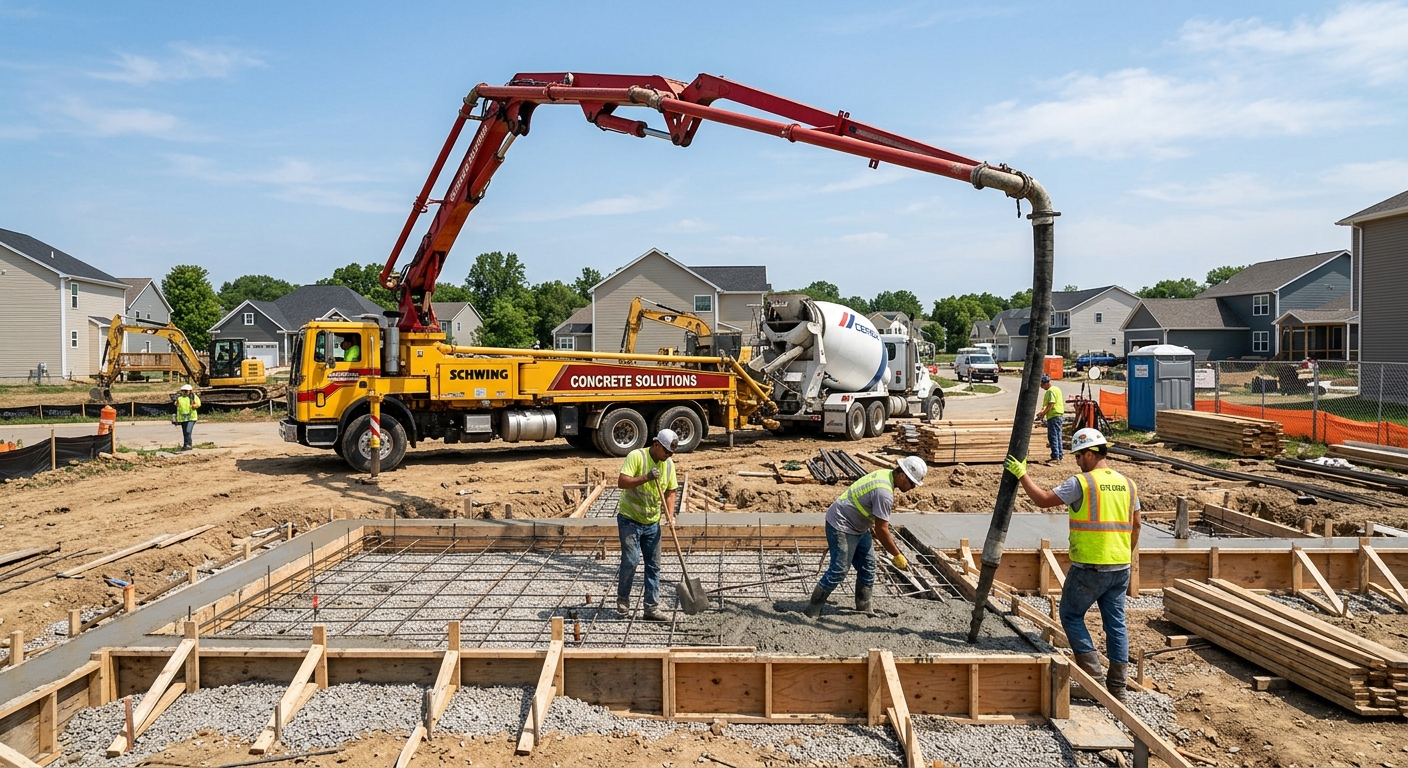
Concrete work options and costs in Upper West Lynn
Concrete in Upper West Lynn serves a lot of small-footprint homes and flatwork projects that need to look good for decades in our coastal-wet, freeze–thaw rhythm. With a population of 1,355 (Statistics Canada, 2021 Census), this is the kind of neighbourhood where word-of-mouth matters—so demand often clusters around the same streets and staging areas, especially when homeowners plan new driveways and backyard patios together. In the Lower Mainland–Southwest, pricing is shaped by mild winters and a shallow design frost depth (commonly assumed around 450 mm / 18"), but we still have to protect exterior slabs and foundations from freeze–thaw damage and saturated soils. That means properly excavated and compacted granular base, drainage attention, air-entrained mixes, and longer curing practices when we get prolonged rain, cool nights, and high humidity. Contractors also manage scheduling around weather windows, and that can affect your final cost even if your design is “simple.”
In practice, concrete flatwork tends to be especially in demand along the busier connector roads in the Upper West Lynn area where access for a pump or ready-mix truck is easiest. If you’re comparing options—standard broom concrete versus exposed aggregate or stamped work—your best reference is the scope and materials choices that directly connect to durability and finish complexity. Next, use the comparison table below to anchor realistic expectations for typical sizes and finishes before you start requesting itemised quotes.
| Application |
Typical Size |
Key Spec |
Finish Option |
Price Range |
| Concrete driveway (standard broom finish) |
300–400 sq. ft. (about 10' x 30' to 12' x 34') |
Air-entrained exterior mix, compacted granular base, control joints |
Broom finish, rounded edges, optional sealer |
$7,000–$11,000 |
| Exposed aggregate driveway |
300–400 sq. ft. (similar footprint) |
Air-entrained mix, wash/expose process, curing plan for coastal humidity |
Exposed aggregate with non-slip texture |
$9,000–$14,000 |
| Stamped concrete driveway or patio |
200–350 sq. ft. (about 10' x 20' to 18' x 20') |
Air-entrained exterior mix, color hardener, proper jointing to reduce cracking |
Stamp + stain/colour with seal coat |
$9,000–$18,000 |
| Plain concrete patio or walkway |
150–250 sq. ft. (about 10' x 15' to 20' x 12') |
Air-entrained mix, compacted base, expansion allowance at edges |
Broom or light trowel texture |
$3,000–$6,500 |
| Garage floor (interior slab) |
400–600 sq. ft. (about 20' x 20' to 22' x 27') |
Vapour considerations if required, proper sub-base and reinforcement as specified |
Broom finish |
$7,500–$14,000 |
| Foundation footings (structural, below frost) |
Typical house runs vary (priced per linear footage in most quotes) |
Excavate below design frost depth, engineered rebar placement, air/water control |
Structural concrete only (no decorative finish) |
$8,000–$20,000 |
Prices are estimates only and vary by project scope, site access and material selection.
What affects the price of concrete work in Upper West Lynn
In the Lower Mainland–Southwest, you can see the same concrete project swing 30–50% between quotes, even when the finished look seems identical. The main reason is that “concrete” is not one product—your quote is really a bundle of specifications: how deep the excavation goes, whether drainage is engineered into the base, what air content and strength the mix is designed for, how much rebar is included, and how the contractor plans curing during coastal rain and cool nights. In British Columbia, contractors also price risk into the job: a narrow pour schedule or limited truck access can add labour and equipment even if your measurements don’t change.
Frost line depth and freeze–thaw cycling dictate every key spec. Footings must extend below the design frost depth (around 0.5–1.2 m in coastal BC depending on design and soil), and every exterior slab needs an air-entrained mix to survive repeated wetting, cooling, and freeze–thaw. Colder regions have shorter pour seasons and often require additional cold-weather curing steps (heating, insulated blankets), but even in Upper West Lynn we still pay for timing and protection because extended rain and high humidity can delay finishing and affect surface durability. De-icing salt use also accelerates surface spalling if the mix and sealing aren’t right—so sealing is often a cost-effective add-on.
Two examples from Upper West Lynn: (1) a broom-finished driveway might land near the $18–$28 per sq. ft. backbone range when base prep is straightforward; but if the contractor needs extra drainage and deeper granular undercut for saturated soils, the total can climb toward the high end. (2) Stamped work carries higher labour and materials—often justified when you’re comparing $22–$36 per sq. ft. decorative pricing against upgrading elsewhere (like replacing pavers). Housing age matters, too: older lots with under-performing drainage or settled subgrades may require additional excavation, which can add thousands even when the slab size stays the same.
| Price Factor |
Why It Matters |
Cost Impact |
| Frost line depth — determines footing depth and form height |
Footings and thickened edges must sit below design frost to prevent frost heave in freeze–thaw conditions |
Higher excavation and forming can add several thousand dollars on foundations |
| Site preparation — excavation, grading, compacted granular base |
Saturated soils need proper undercut and drainage so the slab doesn’t pump or settle |
Unclear scope here is a common driver of 30–50% quote differences |
| Reinforcement — rebar or wire mesh requirement |
Controls cracking in slabs and supports structural requirements below grade |
Adding reinforcement typically increases labour and material costs |
| Mix design — air-entrainment and compressive strength spec |
Air-entrainment is essential for exterior freeze–thaw durability |
Higher-spec mixes cost more but reduce scaling and spalling risk |
| Finish type — broom vs. stamped vs. exposed aggregate |
Finishes change finishing time, specialty materials, and rework sensitivity |
Stamped/exposed generally add both labour and material premiums |
| Pour size and concrete truck access to site |
Smaller access routes may require pumps or multiple deliveries |
Pump calls, waiting time, and logistics can add hundreds to thousands |
| Cold-weather curing precautions — heating and blankets |
Concrete must reach safe early strength and resist damage during cold snaps |
Blankets/heaters add equipment and labour; scheduling shifts can add cost |
| Control joint pattern and sealing cost |
Jointing limits random cracking; sealing helps repel salts and moisture |
Good jointing/sealer is a small line item that protects the slab |
Permits & regulations in British Columbia
In British Columbia, structural concrete work typically requires a building permit, and municipal review often expects engineered details—especially for footings, foundation walls, and grade beams where loads and rebar layouts must match the design. Concrete flatwork (driveways, patios, walkways) usually does not require a permit unless it impacts lot grading, drainage requirements, impervious surface coverage limits, or the municipal right-of-way. Even when a permit isn’t normally required, you should still confirm with the local authority before breaking ground, particularly in neighbourhoods where drainage and surface runoff are sensitive.
For your protection in Upper West Lynn, start by verifying the contractor carries liability insurance (a certificate of insurance naming you/your property is ideal for larger jobs) and has the correct workplace coverage (WSIB/WCB depending on the employer’s setup). Then, ask for recent references on similar-scale flatwork or foundation work.
Step-by-step: (1) find the contractor’s business name and check their licensing/standing through the appropriate provincial registry; (2) request a current certificate of insurance and ensure the coverage dates are active for the full project duration; (3) ask for proof of clearance or current account status for workplace coverage (often provided as a clearance letter or equivalent documentation); (4) confirm they have a permit-ready scope if your project involves structural concrete. If you’re unsure whether your scope is “flatwork” or “structural,” send the proposal to the municipality before work starts—this avoids costly stop-work later.
Getting concrete right in Upper West Lynn's freeze-thaw climate
Concrete fails in Upper West Lynn mainly when moisture gets in, freezes, and expands—especially when drainage is poor, the slab wasn’t built on a correctly compacted base, or the mix wasn’t designed for freeze–thaw exposure. The result is often scaling, surface spalling near edges, and random cracking that shows up faster after winters with repeated wet/cool cycles. The way to spec the job correctly is to treat the system as a whole: base, mix, joints, curing, and surface protection.
First, base preparation: excavate to the right depth for your local soil and frost considerations, place compacted granular (not just “fill”), and get proper subgrade drainage so water doesn’t sit under the slab. Second, mix design: exterior flatwork should use air-entrained concrete—commonly 5–7% air content—and a minimum 32 MPa compressive strength to help reach durability targets. Third, control joints: install a planned joint pattern so cracks occur where you expect rather than randomly across the slab. Fourth, curing: plan for at least 7 days of proper curing conditions; in cool, humid stretches, you often need protection so the surface doesn’t dry too early or freeze before it gains strength. Fifth, sealing: for driveway/patio durability and salt resistance, a penetrating sealer applied after cure (often around 28 days) helps repel de-icing salts and moisture intrusion.
On the money side, the “cheap” version of a driveway can be false economy. For example, a basic broom-finished driveway in the $18–$28 per sq. ft. band might look attractive, but if a quote cuts air-entrainment, skimping on base prep, or delays curing protection, you may end up paying again for patching. Spending a bit more on a proper spec and sealer is often justified versus rework.
| Spec |
Why It Matters in Upper West Lynn |
What to Ask For |
Impact if Skipped |
| Compacted granular base (depth?) |
Prevents settlement and water pooling that drives freeze–thaw damage |
Granular undercut depth, compaction testing/QA method, drainage plan |
Early cracking, uneven slab, pumping or voids beneath concrete |
| Air-entrained concrete mix (target air %?) |
Helps concrete resist scaling and spalling in freeze–thaw cycles |
Air content target (commonly 5–7% for exterior flatwork) and exposure class intent |
Surface scaling/spalling after a few winters |
| Compressive strength (MPa rating) |
Affects long-term durability and performance under moisture and traffic |
Minimum 32 MPa compressive strength and timing to reach strength |
Soft or vulnerable concrete; higher wear and reduced lifespan |
| Control joints (spacing per ACI guidelines) |
Directs cracking to controlled locations rather than random breaks |
Joint spacing, saw-cut timing, and edge/expansion details at borders |
Wider random cracks and cosmetic failure that can allow water ingress |
| Minimum 7-day curing period |
Concrete must reach early strength and maintain curing conditions |
How they cure in rain/cool nights; curing method and protection plan |
Lower strength development, scaling, and increased early surface defects |
| Penetrating sealer (when applied after cure) |
Repels moisture and reduces de-icing salt impact |
Sealer type and application timing (commonly around 28 days post-pour) |
Faster deterioration at the surface and edges |
How to choose a concrete work contractor in Upper West Lynn
Choosing the right concrete contractor in Upper West Lynn comes down to proof, not promises. In British Columbia, you should verify licensing/registration for the contractor’s business activity, ask for a current liability insurance certificate (active coverage that matches your project dates), and confirm the employer has appropriate workplace coverage (WSIB/WCB status) with documentation such as a clearance letter or equivalent proof. If they won’t provide documentation quickly, that’s a major red flag—especially for jobs involving excavation, saw-cutting, or forming.
Get 2–3 itemised written quotes rather than one lump sum. The best quotes separate labour and materials (concrete supply, rebar/wire mesh, granular base, forms, joints, curing aids, sealing, and disposal). Read scope carefully: what’s excluded (old concrete removal, hauling, tree roots, subgrade repairs, drainage upgrades)? Is the permit pull included if it’s required for your foundation or grade-change scope? Disposal matters too—some “cheap” quotes exclude dump fees.
Warranty should be explicit: workmanship duration, what’s covered (cracks, spalling, settlement), and whether any manufacturer/product warranty applies separately. Ask if warranties are transferable to future owners. Payment schedule should be conservative: never pay more than 10–15% upfront, and hold back a portion until the job is complete and cleaned. Finally, insist on timeline details in writing—start date, concrete delivery window, and completion estimate—because weather in the Lower Mainland can shift pour and finishing schedules.
- Request proof of liability insurance with dates covering the full schedule.
- Confirm workplace coverage (WSIB/WCB) and ask for clearance documentation.
- Ask for at least 3 references on projects similar in size and finish (driveway vs. foundation).
- Get itemised quotes separating labour, concrete, base prep, reinforcement, and disposal.
- Confirm whether permits are included or required for your specific scope.
- Clarify what happens if excavation reveals unsuitable subgrade or saturated soils.
- Ask who supplies and places air-entrained mix and how they verify air content.
- Verify the joint plan (spacing and timing of saw-cut) is included in the scope.
- Ask about curing protection for rain/cool nights and minimum curing period.
- Confirm sealing is included (and timing after cure) if salt exposure is expected.
- Check equipment/logistics: truck access, staging, and whether a pump is included.
- Set a payment schedule: 10–15% maximum upfront; holdback until completion and cleanup.
Concrete contractor red flags in Upper West Lynn: they quote “one price per square foot” without discussing base depth or drainage; they skip air-entrainment or won’t specify the target air content; they offer sealing “later” or “if needed” without a defined schedule; they avoid discussing joint spacing/control cuts; and they demand large upfront payments (more than 10–15%) before any base prep or forming is done.
Frequently asked questions — concrete work in Upper West Lynn
How do I compare concrete quotes?
Start by comparing like-for-like scope, not just the total price. In Upper West Lynn and the Lower Mainland–Southwest, quotes vary widely because base prep, drainage attention, and mix design details change durability and labour time. Ask each contractor to itemise labour and materials: excavation/undercut, compacted granular base depth, rebar or mesh inclusion, concrete spec (air-entrained mix and minimum strength), control joints, curing protection, and whether a sealers is included. Also confirm access and equipment: pump calls, disposal fees, and saw-cutting time can make a big difference. If one quote lands in the driveway range (for example, around the $18–$28 per sq. ft. band) but omits key durability items, it may be “cheaper” only on paper. Finally, ensure start dates and protection steps are clearly stated so you’re not betting on weather.
Can concrete be poured in cold weather in Upper West Lynn?
Yes, concrete can be poured in cold weather in Upper West Lynn, but it has to be planned correctly. Even though coastal BC has milder winters, freeze–thaw conditions and cool night temperatures can slow strength gain, and poor curing can reduce durability. A competent contractor will use cold-weather curing precautions—often insulating blankets and, when needed, temporary heating—so the mix reaches early strength safely before temperatures drop. The contractor should also protect formwork, prevent surface freezing, and adjust finishing timing. Ask how they’ll manage rain and humidity too, because prolonged coastal moisture can affect finishing and curing even when temperatures aren’t extreme. If your quote doesn’t mention curing protection, ask direct questions. For exterior slabs, durability specs still matter: air-entrained concrete and proper joints are essential to resist scaling and spalling later.
How do I maintain concrete in Upper West Lynn's freeze-thaw climate?
Maintenance is mostly about keeping water and de-icing salts from attacking the surface, especially through freeze–thaw cycles common in the Lower Mainland–Southwest. In Upper West Lynn, start with sealing: a penetrating sealer applied after proper cure (often around 28 days post-pour) helps repel moisture. Reapply according to the product’s instructions, particularly on driveways where salt and vehicle traffic are frequent. Clean debris and leaf matter so it doesn’t hold moisture against the slab. If you see small surface chips or minor spalling, address them early with patch materials designed for exterior use to prevent water pathways. Avoid using harsh chemicals that can degrade sealers. Lastly, keep an eye on joint edges—if joints are failing or filler is missing, water can infiltrate and widen cracking.
What causes concrete to spall in Upper West Lynn winters?
Spalling in Upper West Lynn is usually tied to moisture intrusion plus freeze–thaw action, and it often comes from a weak link in the concrete system. The most common cause is inadequate air-entrainment or the wrong mix spec for exterior exposure—without sufficient air void structure, freeze–thaw cycling can break down the surface and cause scaling that progresses to spalling. Poor base preparation can also trap water near the surface or at slab edges, increasing the freeze–thaw stress. Another contributor is insufficient curing protection, especially when cool nights and coastal damp delay strength gain. Finally, de-icing salts can accelerate surface deterioration if the concrete isn’t sealed appropriately. When contractors explain their air-entrained mix approach and curing plan, it’s a good sign their quote is designed for our conditions—not just the form and pour day.
What is rebar and when is it required in British Columbia?
Rebar is steel reinforcement placed inside concrete to help the slab or structural element resist tension forces and control cracking. In British Columbia, whether rebar is required depends on the engineered design, soil conditions, and the structural function of the concrete element. For many structural components—like footings, foundation walls, and grade beams—rebar placement is typically required and follows the engineered drawings reviewed through the permit process. For flatwork like patios and driveways, some projects include wire mesh or rebar depending on thickness, subgrade support, intended loads, and local design criteria. In Upper West Lynn, exterior durability also depends on the whole spec: even with reinforcement, the mix still needs air-entrainment for freeze–thaw resistance. When you request quotes, ask whether reinforcement is included, what type (rebar vs. mesh), the spacing, and how it’s supported so it sits in the correct position within the slab.
How long does a concrete project take in Upper West Lynn?
Project duration in Upper West Lynn depends on site access, base prep complexity, weather windows, and finish level. A small plain patio or walkway may take just a few working days on site, with curing time limiting “walk-on” and “drive-on” availability. Decorative work like stamped concrete takes longer mainly due to placement, stamping, and curing/finishing coordination. Driveways also depend heavily on demolition/removal and base preparation for proper drainage and compaction. Even when the crew finishes pouring within a day, you should plan for curing and protection—often minimum 7 days for handling, and longer before full vehicle loads, depending on mix and conditions. If you’re comparing prices, remember that a premium finish (for example, stamped work in the $22–$36 band) usually includes extra labour time and tighter finishing steps, not just different materials. A good contractor will give a written start date and a completion estimate that accounts for rain and cool nights.