Concrete work options and costs in Brocklehurst
Brocklehurst, British Columbia is a place where homeowners rely on durable concrete because winter weather can turn quickly—rain and cool nights are common, and freeze-thaw cycling can still stress exterior slabs. The community is also shaped by its housing stock: in the Brocklehurst area, single-detached homes make up a large portion of the market that drives demand for driveways, patios, walkways, and basement foundations (Statistics Canada, 2021 Census). With a population of 16,713 in the wider local area (Statistics Canada, 2021 Census), trades are busy during the short stretch of workable conditions, which affects scheduling and pricing.
In the Lower Mainland–Southwest, pricing is strongly influenced by a shallow-but-still-important frost depth—local practice commonly assumes about 450 mm (18")—so exterior footings, thickened edges, and piers are set below frost to reduce heave risk. Even when the frost line is not as deep as interior or northern BC, saturated soils and heavy rainfall mean base preparation, drainage detailing, and air-entrained mixes are non-negotiable. Contractors also plan around prolonged rain and humidity by using curing blankets, sealers, and longer cure times to reliably reach design strength and surface durability.
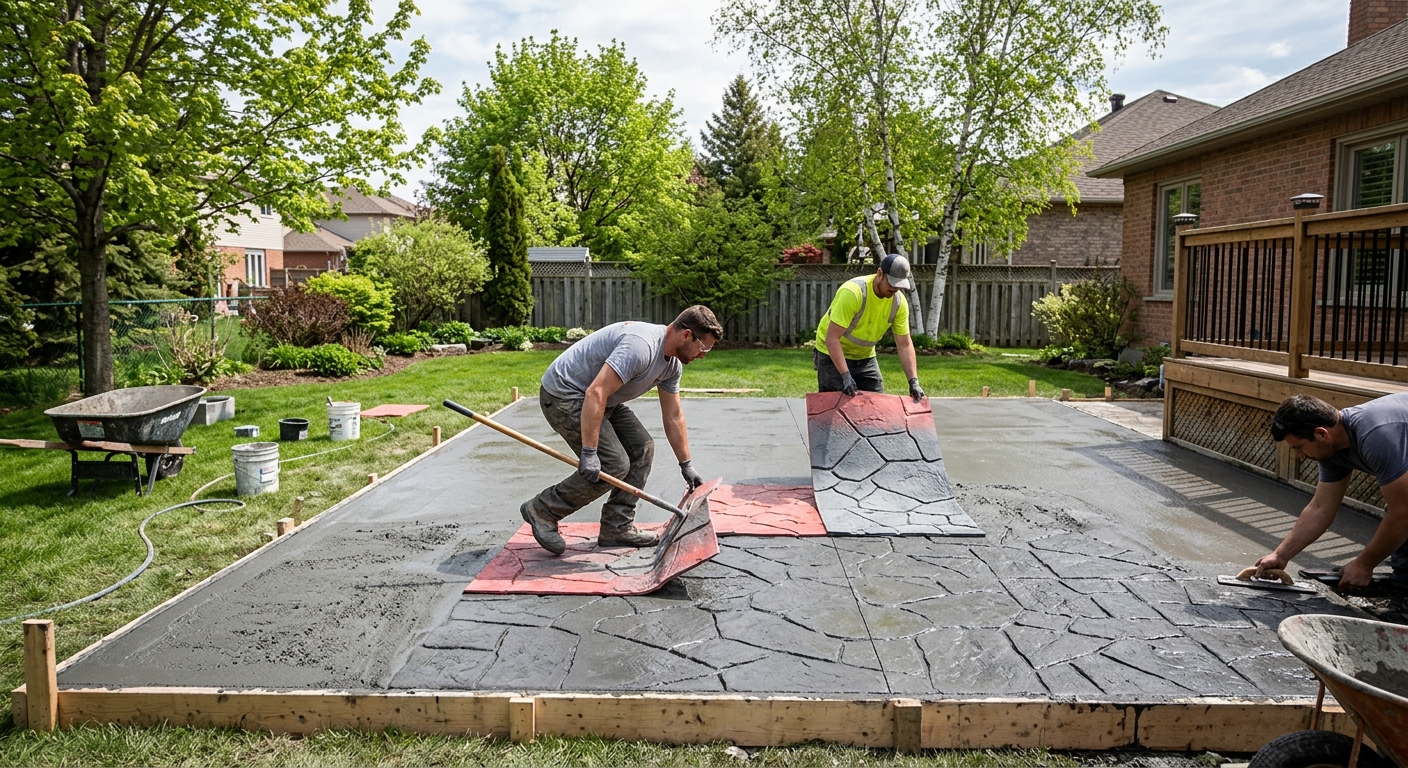
Because of this, two “similar” driveway projects can land far apart in cost depending on excavation depth, base thickness, reinforcement needs, and whether you choose standard broom finish versus exposed aggregate or stamped work. For quick budgeting, compare the typical options below—then we can match the right spec to your site conditions in Brocklehurst (especially around areas like the Valleyview and interlake corridors where flatwork upgrades are common) and your finish goals.
| Application |
Typical Size |
Key Spec |
Finish Option |
Price Range |
| Concrete driveway (standard broom finish) |
400–600 sq. ft. |
Air-entrained mix; compacted granular base; control joints |
Broom finish, sealer recommended |
$18,000–$28,000 |
| Exposed aggregate driveway |
400–600 sq. ft. |
Air-entrained mix; proper curing and wash exposure timing |
Exposed aggregate with slip-resistant surface |
$22,000–$34,000 |
| Stamped concrete driveway or patio |
250–500 sq. ft. |
Air-entrained mix; adequate sub-base and jointing |
Stamp mats + release powder; texture depth tuned |
$22,000–$36,000 |
| Plain concrete patio or walkway |
200–400 sq. ft. |
Air-entrained mix; compacted granular base |
Broom or trowel-skim look; light stamping optional |
$16,000–$26,000 |
| Garage floor (interior slab) |
300–500 sq. ft. |
Vapour barrier and reinforcing as required |
Float finish or light trowel; optional sealer |
$12,000–$22,000 |
| Foundation footings (structural, below frost) |
Per project (typically multiple piers/footings) |
Engineered dimensions; below-frost excavation; rebar per design |
Structural concrete only (no decorative finish) |
$8,500–$16,000 |
Prices are estimates only and vary by project scope, site access and material selection.
What affects the price of concrete work in Brocklehurst
In the Lower Mainland–Southwest, it’s common to see quotes for the “same” concrete job vary by 30–50% because concrete pricing isn’t just the slab. It’s excavation, disposal, base thickness, reinforcement details, mix design (including air-entrainment), and how long we can safely cure in damp, cool weather. Across British Columbia, contractors also face different frost requirements and scheduling constraints, which changes labour hours and material logistics. For example, in colder regions, deeper excavation and cold-weather curing precautions can add cost fast; in the Lower Mainland, we still need freeze-thaw durability specs, but the main cost swings come from drainage/base work and how complex the pour scheduling is when rain windows are tight.
Every exterior slab in Brocklehurst is affected by frost and freeze-thaw cycling. Footings and thickened edges must extend below the design frost depth (local practice often assumes around 450 mm / 18" as a baseline), and the concrete must be air-entrained to resist scaling and surface damage. When colder nights arrive during the pour season, crews may add curing blankets and temperature protection—small choices that protect the slab but do increase labour and equipment time. Also remember de-icing salts: they can accelerate spalling on poorly designed or poorly cured surfaces, so sealing at the right time is part of durability, not an add-on.
Two examples from Brocklehurst: (1) if your driveway needs thicker compacted granular base to reach stable subgrade, you may pay closer to the higher end of the driveway band (for instance, moving toward $18,000–$28,000) because excavation and granular supply rise; (2) if you choose stamped or exposed aggregate, the extra finishing time and material handling can justify the jump into the decorative range like $22,000–$36,000 when the design also includes proper jointing and drainage.
| Price Factor |
Why It Matters |
Cost Impact |
| Frost line depth — determines footing depth and form height |
Footings and thickened edges must sit below frost to prevent heave |
Higher excavation and forming if frost depth requirements increase |
| Site preparation — excavation, grading, compacted granular base |
Unsuitable soils and poor drainage lead to settlement and cracking |
More labour and material when regrading or hauling is needed |
| Reinforcement — rebar or wire mesh requirement |
Controls cracking and improves performance under loads |
Extra materials and placement time where required |
| Mix design — air-entrainment and compressive strength spec |
Air-entrainment is essential for freeze-thaw durability |
Cost increases with specified performance mixes and QA checks |
| Finish type — broom vs. stamped vs. exposed aggregate |
Texture and exposure techniques add time and careful curing |
Decorative finishes typically cost more than standard broom |
| Pour size and concrete truck access to site |
Access constraints affect pumping, labour, and staging |
Pumping/setup and longer crew time can increase price |
| Cold-weather curing precautions — heating and blankets |
Temperature management protects strength gain and surface integrity |
Added equipment and labour during cool, damp periods |
| Control joint pattern and sealing cost |
Jointing limits random cracking; sealing improves resistance to salts |
More detailing and products, but reduces early deterioration |
Permits & regulations in British Columbia
In British Columbia, the rule of thumb is: if the concrete is part of a structural system, you’ll almost certainly need a permit. Structural concrete work—such as footings, foundation walls, grade beams, and other load-bearing elements—typically requires a building permit and, in many cases, engineered drawings reviewed by the municipality. For concrete flatwork (patios, walkways, and driveways), permits are often not required unless the work affects lot grading, drainage, or impervious surface coverage limits, or if it impacts municipal right-of-way areas (like curb ties, boulevard work, or sidewalk/approach modifications). Always confirm with your local authority before breaking ground.
For Brocklehurst homeowners, also treat contractor credentials as part of “permits,” even when your specific scope doesn’t trigger an application. Step-by-step, here’s how to verify a contractor in BC:
- Check the contractor’s business licensing status through the province’s online contractor registry resources (and confirm the exact company name on the quote).
- Ask for a Certificate of Insurance and verify liability coverage is active and matches the job size.
- Confirm workers’ compensation coverage (WCB) for employees—request proof before work starts.
- Request references for similar-size pours in your region (Lower Mainland–Southwest crews should understand frost protection, base prep, and curing in wet coastal conditions).
If you can’t get clear paperwork or the contractor pressures you to start before documentation is provided, pause. In concrete, the cost of rework can dwarf the savings from “quick-start” agreements.
Getting concrete right in Brocklehurst's freeze-thaw climate
Concrete fails in Brocklehurst when water gets in, freezes, and expands—especially when base preparation is weak or the mix isn’t designed for freeze-thaw exposure. The Lower Mainland–Southwest may have a relatively shallow frost line, but homeowners still see scaling, minor spalling, and cracking if crews shortcut air-entrainment, joint spacing, or curing practices. The fix is not just “better concrete”—it’s a full-spec system: (1) base preparation, (2) mix design, (3) control joints, (4) curing, and (5) sealing.
Start with base preparation. Use compacted granular sub-base to the correct depth for your local soil conditions and frost protection needs; saturated or poorly compacted ground leads to settlement cracks and pump-outs. Next, specify air-entrained concrete—targeted at about 5–7% air content for exterior flatwork—and a minimum 32 MPa compressive strength so the slab gains strength reliably. Then control cracking: place control joints to limit random cracks to manageable locations, not where they look worst. Finally, curing matters most in cool, damp periods: plan for at least 7 days of proper curing conditions, using blankets or seal-and-protect methods when temperatures drop.
Sealing is the last defence against de-icing salts and rain-driven water ingress. A penetrating sealer applied after full cure—commonly around 28 days post-pour—helps repel moisture at the surface.
Ask technical questions like: “What is your air-entrainment target?” and “Who is responsible for temperature and curing conditions?” That’s how you avoid the most common failure: spalling from inadequate air-entrainment or rushed curing. As a dollar example, you might pay several thousand more for a correctly air-entrained exterior mix and proper curing measures, but it’s usually cheaper than repeating a driveway due to early scaling—often far beyond the standard driveway band of $18,000–$28,000 when removal, disposal, and re-pour are included.
| Spec |
Why It Matters in Brocklehurst |
What to Ask For |
Impact if Skipped |
| Compacted granular base (depth?) |
Proper thickness and compaction resist settlement and water pooling under slabs |
Minimum granular depth for your subgrade + compaction test/assurance |
Uneven settlement, cracking, and premature surface deterioration |
| Air-entrained concrete mix (target air %?) |
Freeze-thaw durability depends on protected microscopic air voids |
Confirm air content target (typically 5–7% for exterior flatwork) |
Scaling and spalling, especially during wet/cold cycles |
| Compressive strength (MPa rating) |
Strength gain supports performance under traffic and freeze-thaw stress |
Minimum 32 MPa and how strength is protected during cool weather |
Surface weakness, increased cracking risk |
| Control joints (spacing per ACI guidelines) |
Jointing directs shrinkage cracking to predictable locations |
Joint spacing and layout plan before the pour |
Random cracks that can widen and admit water |
| Minimum 7-day curing period |
Cool, damp conditions can slow curing unless protected |
How curing blankets/sealer curing method will be used in forecasted cool nights |
Weaker slab surface and poor long-term durability |
| Penetrating sealer (when applied after cure) |
Helps repel moisture and reduces de-icing salt damage risk |
Timing (commonly around 28 days post-pour) and sealer type |
Higher water absorption, faster deterioration of exposed surfaces |
How to choose a concrete work contractor in Brocklehurst
Start by verifying credentials the same way you’d verify a structural contractor—because concrete is unforgiving. In British Columbia, confirm the contractor’s licensing/business registration (so the quote is tied to a real, accountable entity), and request a Certificate of Insurance showing active general liability coverage. If the contractor employs workers, ask for proof of WCB coverage (workers’ compensation) before any excavation begins. Also ask for recent references from similar Lower Mainland–Southwest projects—driveways and patios in wet, freeze-thaw conditions should show consistent jointing and base prep details.
Get 2–3 itemised written quotes rather than one lump sum. A strong quote breaks down: excavation and disposal, granular base thickness, reinforcement (if required), concrete mix spec (air-entrained), labour, finishing method, jointing plan, and curing approach. Look for what’s included and what’s excluded: permit pull responsibility, protection of landscaping, concrete truck access/pumping, and whether saw-cut joints and sealing are part of the scope.
Warranty should be spelled out in writing. Ask for workmanship warranty length, whether it covers cracking related to proper jointing and curing, and whether any product/manufacturer warranties apply. For payment, don’t pay more than 10–15% upfront—hold back a portion until the slab is complete and cleaned up, with final walkthrough notes addressed. Finally, lock in a timeline: request a stated start date and completion estimate in writing, tied to weather conditions typical for Brocklehurst.
- Verify WCB coverage and liability insurance before signing.
- Ask for insurance dates to ensure they match the project timeframe.
- Demand itemised line items (base, mesh/rebar, mix, joints, sealing).
- Confirm air-entrained mix and minimum compressive strength in the quote.
- Require a joint layout plan (locations and spacing).
- Ask how they handle rain/cool nights during curing.
- Confirm whether saw-cut joints are included (not just scored lines).
- Check excavation scope and disposal inclusion.
- Clarify truck access: whether pumping is included or an extra charge.
- Ask if the quote includes protection/restoration of sod, fences, and walkways.
- Review warranty terms: workmanship vs materials, and exclusions.
- Use a payment schedule with a holdback until final acceptance.
Concrete red flags in Brocklehurst include: no mention of air-entrainment, refusal to discuss joint spacing, vague curing statements (“we’ll cure it”), skipping granular base thickness details, and a quote that won’t clearly state what’s included for disposal, sealing, or access constraints.
Frequently asked questions — concrete work in Brocklehurst
When is the best time to pour concrete in Brocklehurst?
In Brocklehurst and the broader Lower Mainland–Southwest, the best pours are typically late spring through early fall, when the ground is workable and crews can manage curing without heavy weather intervention. That said, “ideal” timing isn’t just temperature—it’s rain and wind too. Wet coastal conditions can slow curing and complicate finishing, so contractors often watch multi-day forecasts and plan around cooler nights by using curing blankets and protection. If you’re aiming for exterior flatwork, avoid periods of persistent rain where base drainage and surface finishing are compromised. For budgeting, planning a driveway in the main pour window can reduce schedule pressure—otherwise you may pay higher labour and equipment costs due to rushed sequencing. As a reference, standard driveway projects often target the $18,000–$28,000 band when the site conditions and timing are favourable.
How long does concrete take to cure?
Concrete reaches practical handling strength relatively quickly, but proper curing is about durability—not just “it’s hard.” For Brocklehurst exterior work, we typically plan for at least 7 days of curing under suitable conditions (protected from drying too fast and protected during cool nights). Full design strength is generally closer to 28 days, which is why many homeowners wait for that timeframe before applying penetrating sealers. In the Lower Mainland–Southwest, humidity and rain can make curing slower or more variable, so a good contractor actively manages conditions rather than assuming the weather will cooperate. If it’s cold and damp, crews may add blankets or other curing precautions to support strength gain. Skipping proper curing is one reason you can see early surface issues like scaling in freeze-thaw cycles, especially on driveways exposed to winter moisture and de-icing salts.
Do I need a permit for concrete work in British Columbia?
In British Columbia, it depends on what the concrete is doing. Structural concrete—such as footings, foundation walls, and grade beams—usually requires a building permit and often engineered drawings that are reviewed through the municipal process. For concrete flatwork like patios, walkways, and most driveway pours, permits are often not required unless the work affects lot grading, drainage, or impervious surface limits, or touches municipal right-of-way areas (like boulevard/approach changes). In Brocklehurst, the practical step is to confirm with your local authority before the first shovel goes in, particularly if you’re changing drainage patterns, lowering/raising grade, or modifying edges near the property line. Separately, you should verify your contractor carries proper liability insurance and has workers’ compensation coverage (WCB) before work starts—credentials matter even if a permit isn’t triggered for your specific scope.
Concrete vs pavers for a patio in Brocklehurst?
Both can work well in Brocklehurst, but the climate and your maintenance preferences usually decide. Concrete patios can be cost-effective for larger, simpler layouts, and with the right air-entrained mix, curing, and jointing they handle freeze-thaw durability expectations better than some lower-spec installations. Concrete also gives you a smooth surface that’s easier to clean, and you can match aesthetics with stamped work. Pavers can be excellent if you want easy spot repairs or prefer individual unit replacement if one area settles. The trade-off is that paver systems depend heavily on base prep, compaction, and jointing sand—if those are off, weed growth and uneven surfaces can develop. In pricing terms, plain concrete patios commonly fall within the $16,000–$26,000 band for typical residential sizes, while stamped options typically move you toward decorative ranges like $22,000–$36,000 depending on pattern and surface finish requirements.
How long does a concrete driveway last?
With correct specifications and maintenance, a concrete driveway in Brocklehurst can last decades. The durability drivers in the Lower Mainland–Southwest are base stability, air-entrainment for freeze-thaw exposure, proper control jointing, and curing. Driveways also suffer from water management issues—if drainage directs runoff into the slab edges, you’ll see spalling risk increase over time. Sealing at the right point (after full cure, commonly around 28 days) helps repel moisture and reduces de-icing salt damage. Concrete finish choice matters too: broom-finished driveways are straightforward and durable, while exposed aggregate and stamped surfaces add texture benefits and aesthetic value, but they still rely on proper mix and curing. If your contractor cuts corners on air-entrainment or curing, it’s not unusual to see early surface scaling within the first few winters, long before what you’d expect from a correctly built driveway.
What is air-entrained concrete and why does it matter here?
Air-entrained concrete is mixed with tiny, evenly distributed air voids designed to give freezing water a place to expand without damaging the paste. In Brocklehurst and the Lower Mainland–Southwest, freeze-thaw cycles and wet coastal conditions can expose exterior slabs and driveways to repeated saturation and cooling, which is exactly when non-air-entrained concrete becomes vulnerable to scaling and spalling. That’s why a reputable contractor specifies an air-entrained mix for exterior flatwork and often targets an air content in the neighbourhood of 5–7% for typical exterior driveways and patios. It also ties into your protection plan: correct base preparation, control joints, and adequate curing duration all influence how much water the slab holds and how cracks are controlled. When a quote doesn’t clearly mention air-entrainment, it’s a major technical gap—especially if you want your driveway in the $18,000–$28,000 range to perform through multiple winters, not just one.