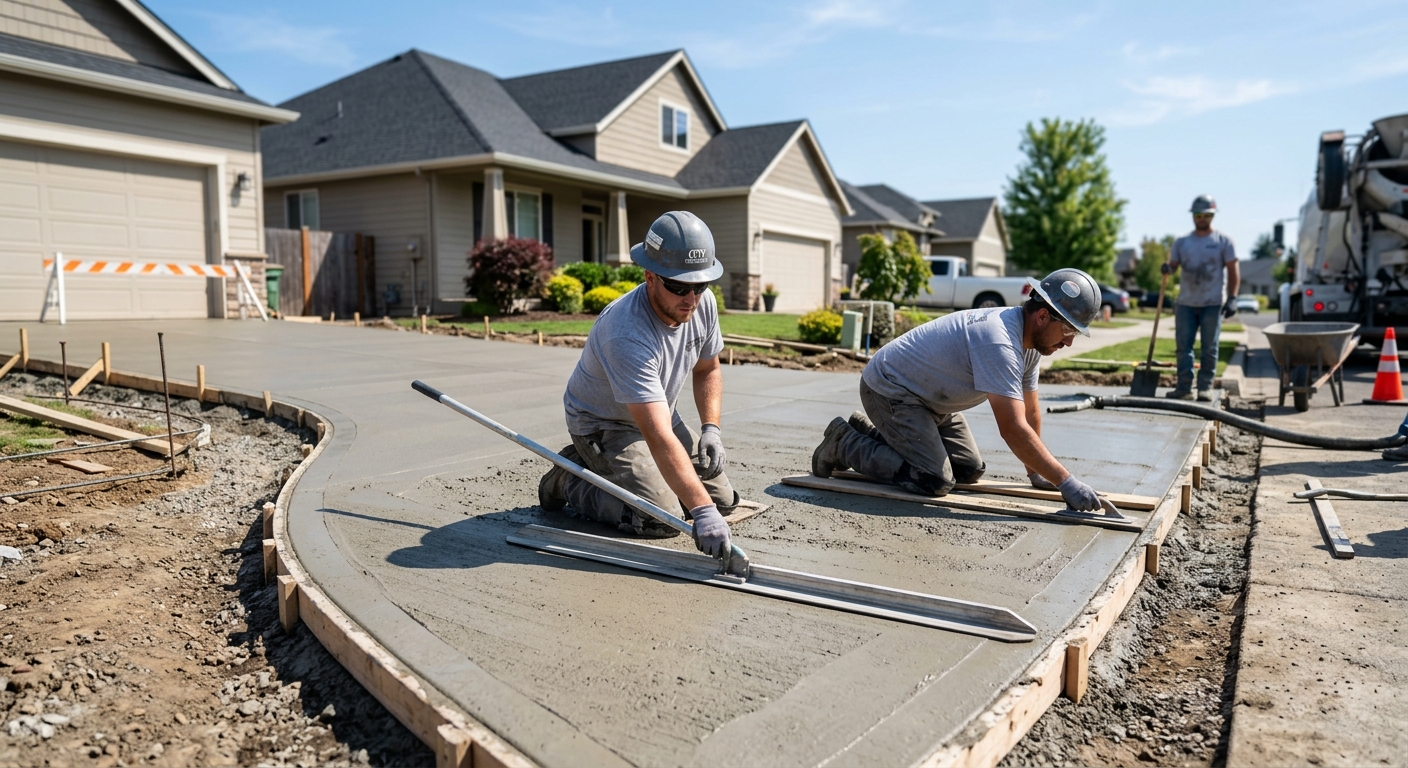
Concrete work options and costs in Rosedale
Concrete work in Rosedale is usually driven by the type of flatwork you’re building—driveways, patios, walkways, garage slabs—and the site conditions underneath them. Rosedale is a smaller community (population 5,700 in 2021), and most concrete demand clusters around owner-built and renovation activity in well-established residential pockets like the Cedar Grove area, where driveways and backyard pads are commonly upgraded.
Locally, lower prices aren’t the whole story. In the Lower Mainland–Southwest, mild winters and a shallow frost line can keep some foundation excavation lighter, but the coast-wet weather still creates a hard testing ground for slabs: freeze–thaw cycles, saturated soils, and frequent rain mean base prep, drainage, and air-entrained concrete aren’t optional. Even though our frost depth is typically treated around 450 mm / 18" for design assumptions, exterior slabs and footings still must be protected below frost to prevent heave and cracking.
Contractors in this corridor also work against schedule constraints: cool nights, high humidity, and rain delays can extend curing time and impact crew availability. That’s why one contractor’s “standard” broom-finish driveway price can differ noticeably from a decorative option that needs careful jointing, mix selection, and extra labour for forms and finishing.
Below is a practical comparison of common concrete options you’ll see in Rosedale, with typical sizes and key specs to help you align quotes before you sign.
| Application |
Typical Size |
Key Spec |
Finish Option |
Price Range |
| Concrete driveway (standard broom finish) |
400–500 sq. ft. |
Air-entrained exterior mix; compacted granular base; control joints |
Broom finish |
$7,200 – $13,900 |
| Exposed aggregate driveway |
400–500 sq. ft. |
Air-entrained exterior mix; textured stone exposure; edge protection |
Exposed aggregate |
$9,000 – $16,700 |
| Stamped concrete driveway or patio |
300–450 sq. ft. |
Air-entrained exterior mix; coloured hardener; release agent; proper joints |
Stamped patterns |
$6,900 – $16,200 |
| Plain concrete patio or walkway |
200–350 sq. ft. |
Air-entrained mix; granular base; dowels where required |
Plain float/finish |
$3,200 – $9,100 |
| Garage floor (interior slab) |
300–600 sq. ft. |
Vapour barrier (when specified); wire mesh or fibres; minimum structural flatness |
Broomed or smooth finish |
$5,400 – $15,300 |
| Foundation footings (structural, below frost) |
Varies by foundation design |
Concrete placed below design frost; rebar per engineering; proper formwork |
Structural concrete finish (not decorative) |
$18,000 – $38,000 |
Prices are estimates only and vary by project scope, site access and material selection.
What affects the price of concrete work in Rosedale
In the Lower Mainland–Southwest, it’s common to see quotes for the “same” concrete job swing by 30–50%. On paper, a driveway might look like 400 sq. ft. of concrete, but the real cost drivers are usually beneath the surface: excavation depth, base thickness, drainage, reinforcement, and the concrete mix spec required to survive Rosedale’s wet winters and freeze–thaw cycles.
Footing and slab design is dictated by frost protection. In colder regions, builders go deeper and pay more for excavation, forming and schedule protection. While coastal BC often uses a design frost depth around 0.5–1.2 m, the Lower Mainland still plans around a typical frost depth of about 450 mm / 18"—meaning exterior work and thickened edges are placed to avoid frost heave. For exterior slabs, air-entrained concrete is essential to manage freeze–thaw damage and scaling. When cold weather arrives, cold-weather curing precautions (blankets, site heating, longer turnaround to meet strength targets) can add labour and material costs even if the pour itself is quick.
In Rosedale, drainage and subgrade saturation are also big-ticket items because wet soils require more careful base prep to prevent settlement. A driveway that needs additional granular import and tighter compaction typically lands closer to the upper end of the $18–$28 per sq. ft. backbone band for driveways. Meanwhile, a patio or walkway that’s well-prepped and square to access might stay nearer $16–$26 per sq. ft., especially for plain finishes.
Decorative work is where pricing can jump for reasons you can actually see. Stamped and decorative concrete can carry a $22–$36 per sq. ft. selection range because the labour is heavier (forms, stamp workflow, colouring, and stricter timing). The right spec and curing plan can also prevent early surface damage that would otherwise force costly repairs a few seasons later.
| Price Factor |
Why It Matters |
Cost Impact |
| Frost line depth |
Determines footing depth and form height to prevent frost heave |
Higher excavation and concrete volume; can add several thousand dollars per foundation footprint |
| Site preparation |
Excavation, grading, and compacted granular base for stability and drainage |
Most variable item; poor access or saturated soils can push costs up quickly |
| Reinforcement |
Rebar or wire mesh controls cracking and supports loads |
Material + placement labour; often a mid-range add |
| Mix design |
Air-entrainment and compressive strength spec for freeze–thaw durability |
Can raise concrete unit costs and requires strict placement practices |
| Finish type |
Broom vs. stamped vs. exposed aggregate affects labour time and materials |
Stamped/exposed typically costs more due to colour/stamping workflow |
| Pour size and concrete truck access to site |
Large pours need efficient staging; access affects hose lengths and time |
Poor access adds labour and limits pour efficiency |
| Cold-weather curing precautions |
Heating/blankets help achieve strength targets and protect the slab |
Added setup, fuel, and time can increase total price |
| Control joint pattern and sealing cost |
Correct joints reduce random cracking; sealing helps repel salt/moisture |
Small individual costs but can materially affect lifecycle performance |
Permits & regulations in British Columbia
In British Columbia, whether you need a permit depends on what concrete work you’re doing. Structural concrete such as footings, foundation walls, grade beams, and other load-bearing elements typically requires a building permit and often engineered drawings reviewed by the municipality. Concrete flatwork like patios, walkways, and many driveways usually does not require a permit by itself—however, it may require review if it changes lot grading, impacts impervious surface coverage limits, or involves work near municipal right-of-way lines (for example, driveway approaches or drainage tie-ins). Always confirm with the local authority before breaking ground, especially if you’re modifying drainage, raising elevations, or connecting to existing footing/foundation elements.
To protect yourself in Rosedale, verify the contractor carries liability insurance and the required workplace coverage (WSIB/WCB—depending on their setup). Ask for proof before signing: certificates of insurance should name you as the certificate holder when appropriate. Then check their references for similar-scale pours in the Lower Mainland–Southwest.
Step-by-step, here’s how a homeowner typically verifies legitimacy:
- Ask for the contractor’s licensing details and any concrete-related registrations they hold (if applicable to their business structure).
- Request an active certificate of liability insurance, and confirm limits are appropriate for the scope.
- Request WSIB/WCB clearance or proof of coverage (and confirm it’s current).
- Verify they list their business name consistently across quotes, invoices, and insurance documents.
- Contact references and ask specifically about scheduling, curing practices, and whether the finish held up through wet seasons.
Getting concrete right in Rosedale's freeze-thaw climate
Concrete doesn’t fail because it “wasn’t poured on time”—it fails when the base, mix, joints, and curing don’t match Rosedale’s wet coastal climate and freeze–thaw behaviour. The biggest trigger for early deterioration is spalling, often caused by insufficient air-entrainment or poor consolidation/finishing that traps water at the surface. In a driveway or patio, you also have to manage saturation and drainage so water doesn’t sit under or on top of the slab during rainy stretches.
To spec the job correctly, focus on five fundamentals. First, base preparation: a compacted granular sub-base to the right depth for local soil and frost protection, with drainage attention so water can’t linger. Second, mix design: use air-entrained concrete with typical exterior target air content in the 5–7% range and minimum 32 MPa compressive strength (per the project spec). Third, control joints: place joints on a spacing plan that reduces random cracking; don’t “wing it” based on where it looks good. Fourth, curing: aim for at least 7 days under proper conditions—cool, rainy weather often needs blankets or sealers/curing protection to reach strength and protect the surface. Fifth, sealing: plan for a penetrating sealer applied after curing (commonly around 28 days) to help repel de-icing salts and reduce water penetration.
If you’re comparing options, you can see real value. For example, a stamped driveway often costs more than a broom-finish because of colouring and labour. But paying for the right exterior mix spec and curing plan can be justified either way—if a cheaper quote skips air-entrainment or shortens curing time, you’re essentially spending later.
| Spec |
Why It Matters in Rosedale |
What to Ask For |
Impact if Skipped |
| Compacted granular base (depth?) |
Stabilizes the slab and supports drainage against saturated soils |
Confirm base thickness and compaction method for your subgrade |
Settlement and premature cracking; uneven surface during freeze–thaw |
| Air-entrained concrete mix (target air %?) |
Helps concrete resist freeze–thaw scaling and spalling |
Confirm air content target (commonly 5–7% for exterior flatwork) |
Higher risk of surface scaling/spalling after salty, wet winters |
| Compressive strength (MPa rating) |
Ensures durability and surface performance in exterior conditions |
Minimum 32 MPa (or higher per design) |
Weaker surface leading to faster abrasion and damage |
| Control joints (spacing per ACI guidelines) |
Controls where cracking happens when the slab shrinks/moves |
Joint spacing plan based on slab size and configuration |
Random cracking that can open paths for water infiltration |
| Minimum 7-day curing period |
Critical in cool, rainy coastal weather to reach strength |
Confirm curing method and protection in cold snaps |
Surface scaling, dusting, and weaker long-term performance |
| Penetrating sealer (when applied after cure) |
Repels water and helps with de-icing salt exposure |
Schedule sealer at proper cure time (often around 28 days) |
More moisture uptake and faster deterioration of the surface |
How to choose a concrete work contractor in Rosedale
Choosing a concrete contractor in Rosedale is mainly about verification and clarity. In British Columbia, ask for proof of liability insurance and workplace coverage (WSIB/WCB). How you check is straightforward: request certificate(s) of insurance with current effective dates and appropriate coverage limits. If they provide WSIB/WCB documentation or a clearance letter, confirm it matches their business name and is current—don’t accept screenshots without dates. For licensing or registrations, ask directly what applies to their specific work category, and confirm any listed credentials before work begins.
Next, get 2–3 written, itemised quotes—not lump sums. You want line items that show labour and materials separately for excavation/base prep, concrete supply, reinforcement, forms, finishing, joints, curing protection, and sealing (if included). Scope clarity prevents surprises like “disposal not included” or “no sealant unless requested.” Also confirm whether a permit pull is included—structural work usually involves permits, while most flatwork may not unless grading/coverage/right-of-way issues apply.
Review warranty terms carefully. A workmanship warranty should state length and what it covers (cracking, spalling, joint performance, surface delamination) and whether it’s transferable if you sell the property. Finally, manage payment: never pay more than 10–15% upfront. Use a holdback until the work is complete and the finish has passed the agreed acceptance criteria.
Timeline matters in the Lower Mainland–Southwest: ask for a start date and completion estimate in writing, and ask how they handle rain delays and curing protection.
- Confirm proof of liability insurance (active dates, matching business name).
- Confirm WSIB/WCB clearance or coverage proof is current.
- Ask for at least two references on similar Rosedale/Large Lower Mainland pours.
- Get itemised labour + materials, including base prep, reinforcement, and curing/blankets if needed.
- Ensure the quote states air-entrainment and minimum compressive strength (MPa), not just “exterior mix.”
- Check that jointing is included: spacing, saw-cut timing, and how joints are finished.
- Ask whether disposal and hauling are included in excavation pricing.
- Verify permit responsibility: included/required/excluded for your specific scope.
- Confirm concrete truck access plan (pump/hose allowances if access is tight).
- Review curing and protection plan for cool nights and rainy spells.
- Confirm sealing is included or clearly excluded (and when it will be applied).
- Agree on payment schedule and keep a holdback until final acceptance.
Concrete red flags in Rosedale include: quoting “standard mix” without air-entrainment details, skipping a base drainage/compaction description, offering a long promise with no curing plan for wet/cool weather, vague joint spacing (or “we’ll see when we pour”), and pushing large upfront deposits without a written scope and timeline.
Frequently asked questions — concrete work in Rosedale
How do I prepare the base for a concrete slab?
Base prep is where most quality is decided in Rosedale and across the Lower Mainland–Southwest. The contractor should excavate to the design depth, remove organic material, and then place a compacted granular sub-base (often engineered for your soil and frost protection needs). The goal is a stable, well-drained layer so saturated soils don’t create settlement or water pathways that worsen freeze–thaw effects. Ask how they confirm compaction and whether they include proper drainage/grading details. For exterior slabs, insist on an air-entrained mix and control joints, but remember base prep is equally critical—skimping here can make even a good mix crack early. For budgeting, a plain patio or walkway can land in the $16–$26 per sq. ft. range when base prep is done properly.
How do I compare concrete quotes?
Comparing concrete quotes in British Columbia is about like-for-like specs. When you see different totals for the same driveway size, look past the headline price and compare base thickness and compaction, reinforcement type, and whether the mix is truly air-entrained. Confirm compressive strength (often minimum 32 MPa for many exterior specs) and ask about control joint pattern and sealing. Also check what’s included: excavation spoils disposal, truck access costs, and whether curing blankets or extra protection are planned for cool nights and wet weather. Decorative jobs should be compared by their actual finishing scope—stamped and decorative work can run in a $22–$36 per sq. ft. selection range, but a broom-finish driveway often sits closer to the $18–$28 per sq. ft. band. If one quote is much lower, it’s usually missing something essential, not simply “less overhead.”
Can concrete be poured in cold weather in Rosedale?
Yes, concrete can be poured in cold weather in Rosedale, but only if the contractor uses cold-weather curing precautions and follows a plan to protect the pour. Lower Mainland winters can still include cool nights and periods of rain, and even when we don’t get the same deep frost as interior/northern BC, you still need proper curing to reach design strength. Ask how they will protect the slab during the first 7 days: insulating blankets, heating of the workspace (if needed), and protection from wind and precipitation. A reliable contractor will explain how they manage the concrete temperature and curing conditions rather than simply saying “we’ll pour anyway.” If the weather is too hostile for quality, a good crew will schedule around it to protect durability—especially important for exterior slabs that face freeze–thaw and de-icing salt exposure.
How do I maintain concrete in Rosedale's freeze-thaw climate?
Maintenance in Rosedale is mainly about limiting water intrusion and keeping the surface protected. Start with a good initial build: correct air-entrainment, correct joints, and curing (minimum 7 days under good conditions). After cure, a penetrating sealer applied at the proper time (often around 28 days) helps repel moisture and reduces harm from de-icing salts. For day-to-day care, clean off grit and salt residue when possible, and avoid over-salting—salt accelerates surface deterioration and can contribute to spalling if the surface isn’t protected. If you see small joint cracks, keep them clean and don’t ignore joint edges; joint care is typically cheaper than replacing sections. A well-built driveway in the $18–$28 per sq. ft. range or a higher-end decorative surface can still last long, but only if moisture control is part of the plan.
What causes concrete to spall in Rosedale winters?
Spalling in Rosedale is usually caused by a combination of moisture, freeze–thaw cycling, and surface weakness. The #1 technical reason I see in problematic slabs is inadequate air-entrainment or incorrect mix handling—without proper air voids, water in the concrete can expand during freezing and break the surface layer. Coastal-wet conditions worsen it because the slab spends more time saturated during rainy stretches before temperatures swing. Poor curing can also leave the surface less durable. Finally, control joints that are incorrect or improperly sealed can let water migrate into micro-cracks, accelerating deterioration. If you’re comparing options, remember that exterior mixes need air-entrainment even if the finish is decorative. That’s why stamped/concrete work pricing may differ, but the durability spec should not be negotiable.
What is rebar and when is it required in British Columbia?
Rebar is reinforcing steel used to help concrete carry tensile stresses and control cracking in slabs and structural elements. In British Columbia, whether rebar is required depends on the engineering design for the foundation or the structural loading for your slab, not just on “what’s typical.” For structural concrete like footings and grade beams, reinforcement is commonly specified on engineered drawings and is a must for load-bearing performance. For exterior flatwork (driveways, patios), rebar or wire mesh may be specified based on slab thickness, soil conditions, expected loads (for example, heavy vehicle use), and the contractor’s design approach. In Rosedale, saturated soils and freeze–thaw mean you still need a stable base, but reinforcement can also help manage cracking patterns when paired with correctly spaced control joints. Always ask your contractor to state what reinforcement is included, where it sits in the slab (coverage), and what spec supports it.