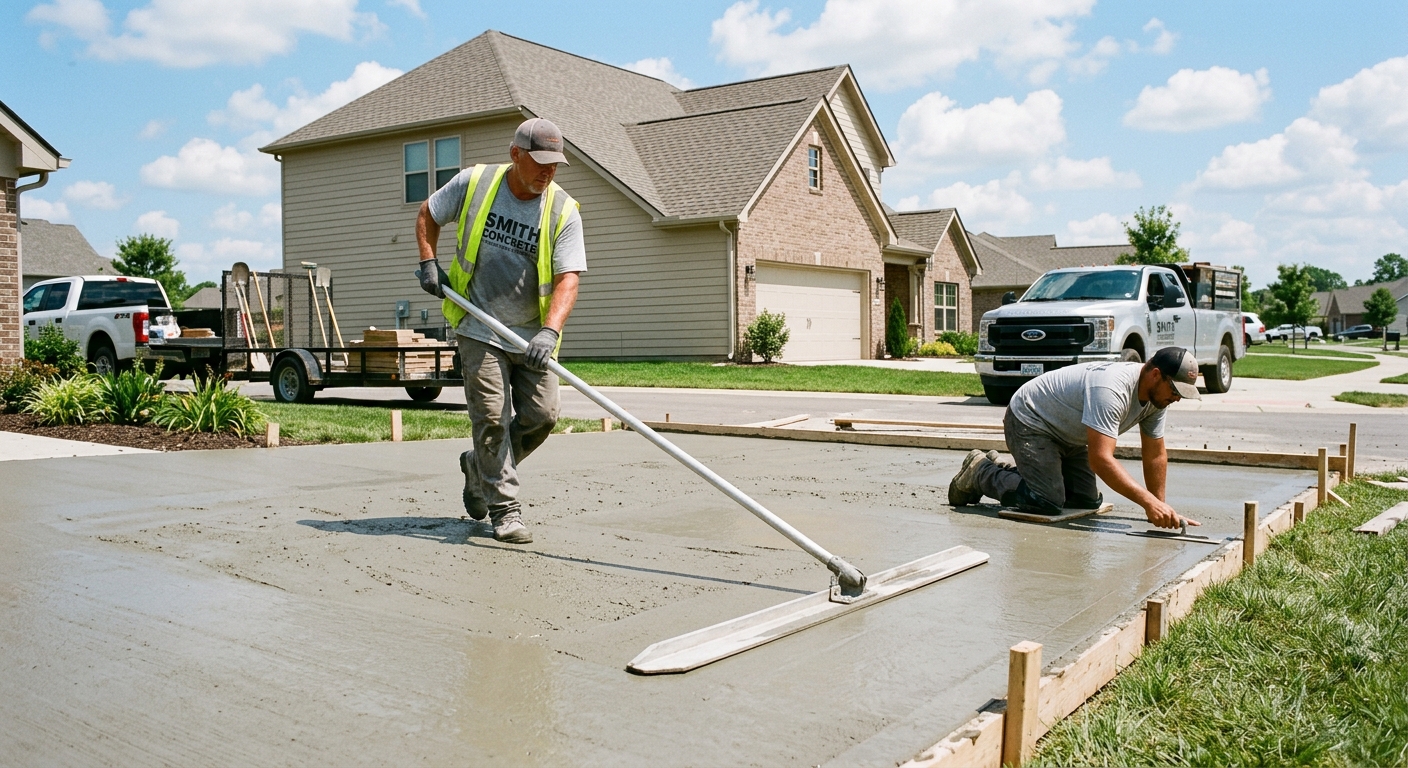
Concrete work options and costs in North Vancouver
North Vancouver homeowners typically look at concrete first because the flatwork around most houses—driveways, patios, walkways, and garage slabs—takes a lot of daily wear in a coastal-wet climate. With 10.7% of local dwellings being single-detached homes (Statistics Canada, 2021 Census), there’s a steady demand for practical concrete surfaces that can handle frequent dampness, winter freeze–thaw cycling, and heavy rainfall drainage. Homeownership is also relatively common, with 14,535 homeowner households (53.3% of households own) (Statistics Canada, 2021 Census), so many projects are owner-driven upgrades rather than bulk developer work.
In the Lower Mainland–Southwest, costs are shaped by more than just concrete volume. Even with a relatively shallow frost depth (often assumed around 450 mm / 18" in practice), we still specify foundations and thickened edges below frost to reduce freeze–thaw damage. Coastal humidity and cool nights also extend curing time and can require curing blankets or surface protection on wetter schedules. That’s why pricing can swing by jobsite conditions (access from Larson Road/Capilano Corridor areas versus back lanes, soil moisture, and how much drainage work is needed).
Trade availability can also tighten in peak pour windows around North Vancouver neighbourhoods such as Lynn Valley, where access can be more constrained and crew scheduling depends heavily on weather.
Below is a practical side-by-side of common concrete options and what they usually cost in North Vancouver, so you can compare apples-to-apples before you request detailed quotes.
| Application |
Typical Size |
Key Spec |
Finish Option |
Price Range |
| Concrete driveway (standard broom finish) |
400–600 sq. ft. |
Compacted granular base; air-entrained exterior mix; control joints |
Broom finish, saw-cut joints, cure & protect |
$18,000–$28,000 |
| Exposed aggregate driveway |
400–600 sq. ft. |
Compacted base; air-entrained mix; proper timing for wash/expose |
Exposed aggregate with consistent texture |
$22,000–$34,000 |
| Stamped concrete driveway or patio |
300–600 sq. ft. |
Reinforcement as needed; air-entrained mix; integral colour |
Stamping + release + sealer-ready finish |
$24,000–$42,000 |
| Plain concrete patio or walkway |
200–400 sq. ft. |
Compacted base; air-entrained mix; slope & drainage |
Float + light broom/smooth trowel edges |
$8,000–$18,000 |
| Garage floor (interior slab) |
300–500 sq. ft. |
Vapour barrier (as applicable), proper sub-base, reinforcement |
Power-trowel or broom finish |
$14,000–$26,000 |
| Foundation footings (structural, below frost) |
Typical house bearing line lengths |
Excavate below design frost; rebar cages; concrete grade per engineer |
Below-grade structural concrete |
$9,000–$18,000 |
Prices are estimates only and vary by project scope, site access and material selection.
What affects the price of concrete work in North Vancouver
In the Lower Mainland–Southwest, it’s common to see quotes for the “same” concrete project come back 30–50% apart—especially when one contractor includes the real foundation/drainage prep and another assumes ideal conditions. That difference is mostly driven by how each crew handles the soil and drainage, whether they price an air-entrained exterior mix properly, and how they plan for North Vancouver’s weather-driven curing needs (rain, cool nights, and saturated ground).
Frost line depth and freeze–thaw cycles affect nearly every spec here. Even when the commonly referenced frost depth is shallow (around 450 mm / 18" in coastal BC practice), we still protect exterior elements by placing footings and thickened edges below the design frost line to reduce frost heave. Exterior slabs also typically require air-entrained concrete to survive freeze–thaw cycles without scaling. If a contractor doesn’t plan for cold-weather curing precautions, you can end up with weaker early-age strength and a surface that’s more vulnerable to spalling.
Two examples from North Vancouver homeowners show the pricing reality. First, a broom-finish patio might land in the lower band when the site is already well-drained, but if we uncover saturated subgrade and need more granular base and drainage adjustments, the same square footage can move toward the upper end of the patio band (roughly $16–$26 per sq. ft. market range). Second, a stamped driveway is often justified by labour intensity—forms, finishing, texture, and colour work push it above a basic driveway—so it’s normal for stamped options to sit toward the higher driveway costs (often compared against the $18–$28 driveway slab range).
Housing age matters too. With 44.0% of homes built before 1981 (Statistics Canada, 2021 Census), older lots often have older drainage patterns or service conflicts, which can add excavation time and disposal. Even a few extra hours of excavation and regrading can move a project by thousands.
| Price Factor |
Why It Matters |
Cost Impact |
| Frost line depth — determines footing depth and form height |
Footings must be placed below design frost to limit frost heave. |
Major cost driver; deeper excavation and formwork can add thousands. |
| Site preparation — excavation, grading, compacted granular base |
Coastal-wet soils need correct base thickness and compaction. |
Medium to major swing depending on wet subgrade and rework. |
| Reinforcement — rebar or wire mesh requirement |
Controls cracking and supports loads (especially driveways). |
Medium impact; material + labour for placement and chairs. |
| Mix design — air-entrainment and compressive strength spec |
Exterior freeze–thaw resistance depends on air content and strength. |
Low to medium per yard, but can change durability outcomes. |
| Finish type — broom vs. stamped vs. exposed aggregate |
Labour and process steps differ significantly. |
Medium to major; stamped commonly adds cost versus broom. |
| Pour size and concrete truck access to site |
Narrow lanes and steep grades affect placement time and equipment. |
Medium; can increase labour and require pump/access solutions. |
| Cold-weather curing precautions — heating and blankets |
Early strength gain is critical when nights get cool. |
Medium; blankets/heaters add material and crew time. |
| Control joint pattern and sealing cost |
Joints manage shrinkage cracking; sealing helps with de-icing salt exposure. |
Low to medium; often small cost versus risk of early surface failure. |
Permits & regulations in British Columbia
In British Columbia, structural concrete work generally needs a building permit, and it often requires engineered drawings reviewed by the municipality. This includes footings, foundation walls, grade beams, and other structural elements that affect load paths. Concrete flatwork such as patios, walkways, and driveways typically does not require a permit on its own—unless your project changes lot grading in a way that affects drainage, or it triggers impervious surface coverage limits, or it involves work in a municipal right-of-way.
For a North Vancouver homeowner, the practical approach is: confirm what you need before demolition or excavation. Start with the City’s requirements for your specific address, then ask the contractor to clearly indicate whether permits and inspections are part of their scope. A reputable crew will also carry liability insurance and provide proof of coverage for their workers.
Step-by-step, here’s how to verify a concrete contractor in BC:
- Licence/registration: check the contractor’s public listing via the relevant online registry for BC (look for business/company details matching the quote).
- Liability insurance: request an up-to-date certificate of insurance naming you as “additional insured” if required; verify expiry dates.
- Worker coverage (WCB): confirm the contractor’s Workers’ Compensation coverage (commonly referenced as WCB in BC) and request proof.
- Clearance letter (if applicable): ask whether they can provide a current clearance/coverage letter for your project documentation.
- References: ask for 2–3 similar North Shore jobs (driveways/patios/foundations) and confirm dates, scope, and warranty handling.
Getting concrete right in North Vancouver's freeze-thaw climate
Concrete fails in North Vancouver when water gets under the surface and the slab cycles through freezing and thawing. That leads to spalling, scaling, and cracking—often where drainage is poor or where the mix and joints aren’t built for exterior exposure. To spec the job correctly in this Lower Mainland–Southwest climate, start with the foundation of the system: base preparation, mix design, and joints work together.
First, base prep: we excavate to a stable, well-draining level and place a compacted granular sub-base to the correct depth for local soil and frost protection needs. Second, mix design: for exterior flatwork, specify air-entrainment (commonly 5–7% air content for durable freeze–thaw resistance) and a minimum 32 MPa compressive strength. Third, control joints: the joint pattern needs to limit random cracking, with spacing planned around slab dimensions and restraint. Fourth, curing: target at least 7 days of proper curing conditions; if it’s cold or damp, crews should use curing blankets or other cold-weather precautions so strength develops as specified. Fifth, sealing: apply a penetrating sealer after the slab has cured (often around 28 days post-pour) to help repel de-icing salts and reduce moisture uptake.
A real-world way to understand value: if a broom-finish patio is quoted near the lower band (for example, roughly $16–$18 per sq. ft. for straightforward sites), but the higher quote includes proper granular base thickness, air-entrained mix verification, and a control joint plan, that added spec work can be the difference between a patio that looks good for years and one that starts scaling sooner. In North Vancouver, sealing is also more than “cosmetic”—it’s practical protection against road/entryway salts and moisture exposure.
If you’re comparing proposals, ask the technical questions that expose the durability plan—especially whether they’ll use an air-entrained exterior mix and how they’ll manage curing. Inadequate air-entrainment is one of the fastest routes to spalling in this region.
| Spec |
Why It Matters in North Vancouver |
What to Ask For |
Impact if Skipped |
| Compacted granular base (depth?) |
Stable base reduces settlement and keeps water from migrating under the slab. |
Confirmed base thickness and compaction standard; drainage notes for your soil. |
Uneven cracking, voids, and faster surface breakdown. |
| Air-entrained concrete mix (target air %?) |
Air bubbles protect against freeze–thaw scaling and spalling. |
Documented air-entrainment target (commonly 5–7% for exterior flatwork). |
Higher risk of scaling/spalling after winters. |
| Compressive strength (MPa rating) |
Strength governs durability and resistance to early wear. |
Minimum 32 MPa specified for exterior exposure as required. |
Surface can weaken and wear prematurely under traffic and moisture. |
| Control joints (spacing per ACI guidelines) |
Joints control where shrinkage cracks occur and reduce random cracking. |
Planned joint layout with spacing tied to slab dimensions and restraint. |
Random cracking that can let water penetrate and worsen deterioration. |
| Minimum 7-day curing period |
Proper curing builds strength and reduces shrinkage-related problems. |
How curing will be maintained in cool/wet weather (blankets/cover plan). |
Weaker early-age concrete and higher risk of surface defects. |
| Penetrating sealer (when applied after cure) |
Repels moisture and helps manage de-icing salt exposure on exterior slabs. |
Sealer timing (often around 28 days post-pour) and product type. |
More moisture uptake, faster staining, and reduced surface durability. |
How to choose a concrete work contractor in North Vancouver
Choosing a concrete contractor in North Vancouver is about more than price. Start by verifying British Columbia licensing and then confirming they carry the right coverage for your project. Request proof of liability insurance (with coverage limits and expiry dates), and ask for confirmation of worker coverage under the province’s workers’ compensation system (WCB). For added peace of mind, ask if they can provide a current clearance letter where applicable. A good contractor won’t resent documentation requests—because it protects both sides.
Next, collect 2–3 itemised written quotes. You want a breakdown of labour and materials (excavation, base prep/compaction, reinforcement, concrete supply, finishing, saw-cut joints, disposal, and sealing/cure protection if included). Be especially careful about exclusions: Is disposal included? Is the permit (if required) part of the job? Are there assumptions about truck access, removal of existing concrete, or any drainage work needed due to wet subgrade?
Warranty should be specific: workmanship warranty length, and whether product/manufacturer warranty applies to colour/sealer/related products. Clarify whether warranties transfer if you sell the home.
On payment schedule, avoid paying large deposits. A common best practice is no more than 10–15% upfront, with a holdback until completion and touch-ups. Finally, get the timeline in writing—start date, weather contingencies, and a realistic completion estimate, particularly in a coastal-wet season when rain can affect curing.
- Provide proof of current insurance and worker coverage (BC).
- Confirm their quote includes air-entrained mix for exterior work.
- Ask for base depth and compaction plan—don’t accept “standard base” language.
- Request reinforcement details (mesh vs rebar) tied to use and slab thickness.
- Verify control joint layout (spacing, saw-cut timing) is included.
- Confirm curing method and whether blankets/curing compound are part of scope when needed.
- Ask whether sealing is included (and when it will be applied, e.g., after curing).
- Check disposal and dump fees for excavated material—these can add up.
- Clarify scope for removal and hauling of existing concrete (if applicable).
- Ensure truck access and staging plan is addressed (especially in tighter North Shore lots).
- Get a written start date and completion window, with weather contingencies.
- Use a payment schedule with a holdback until you approve the finished surface.
Concrete red flags in North Vancouver include: (1) quotes that omit drainage/base prep and just price “concrete only,” (2) promising sealing immediately after pour regardless of cure time, (3) no mention of air-entrainment for exterior slabs in freeze–thaw conditions, (4) refusing to put key specs (thickness, base depth, reinforcement, joints) in writing, and (5) demanding large upfront payments before any work begins.
Frequently asked questions — concrete work in North Vancouver
What is the difference between concrete and cement?
Concrete is the full mixture you pour: cement, sand, gravel (or crushed stone), water, and sometimes admixtures like air-entrainment. Cement is one ingredient inside concrete—it’s the powder that reacts with water to bind everything together. In North Vancouver, the key durability issue is the concrete mix design for exterior exposure: that means air-entrainment for freeze–thaw resistance and the right compressive strength target. Two driveways can look similar at day one, but if one contractor uses a mix without proper air content, you’re more likely to see scaling or spalling after winter cycles. When comparing quotes in British Columbia, ask the contractor to state the air-entrainment target and the minimum MPa requirement, not just the total price.
How much does concrete work cost in North Vancouver?
Concrete costs in North Vancouver depend on the application, site prep, and finish level. For example, a plain concrete patio or walkway is commonly priced around the local market band (roughly $16–$26 per sq. ft.), while standard broom-finish driveway work is often aligned to the driveway band (roughly $18–$28 per sq. ft.). Stamped and decorative concrete typically runs higher (often $22–$36 per sq. ft. depending on how detailed the stamping and finishing are). Bigger cost swings usually come from excavation/disposal, reinforcement, truck access, and how wet or contaminated the subgrade is after heavy coastal rainfall. If you’re getting two quotes close in square footage but one includes improved granular base, proper air-entrained mix, and curing protection, that’s usually why the price difference shows up.
How deep must footings be for North Vancouver's frost line?
In coastal BC practice, the frost depth is often assumed around 450 mm / 18", but structural footings are still placed below the design frost depth to reduce the risk of frost heave and freeze–thaw damage. The exact depth should follow the engineered foundation requirements for your property and soil conditions. As a homeowner, the best approach is to ask whether your project will have footings located below the applicable frost protection depth and whether an engineer’s details are being followed. This matters because saturated soils plus freeze–thaw cycles can heave poorly founded elements. If you compare contractors, watch for proposals that talk only about “shallow” excavation without confirming the engineered spec and below-frost placement for your foundation footprint.
Why does concrete crack in North Vancouver and how is it prevented?
Concrete cracks mainly due to shrinkage, temperature changes, and movement at joints—then water exposure can make those cracks more noticeable over time. In North Vancouver, the freeze–thaw climate makes proper jointing and drainage even more important, because water that enters cracks can expand when it freezes. Prevention starts with correct base preparation (so the slab doesn’t move), a properly specified exterior mix (including air-entrainment), and a control joint pattern designed to limit where cracking occurs. Crews must also follow timing for saw-cut joints and plan reinforcement where required for load and restraint. Good curing reduces early-age problems, and sealing later helps reduce moisture uptake. If a quote skips air-entrainment or control joints, cracking risk increases—along with the chance of spalling in later winters.
Stamped vs broom-finish concrete — cost difference?
Stamped concrete costs more because it adds integral colouring options, stamp mats, release agent workflows, and more detailed finishing and timing to achieve consistent texture. Broom-finish concrete is typically a simpler process: place, screed, finish, and broom texture with saw-cut control joints. In North Vancouver, driveway costs generally sit around the $18–$28 per sq. ft. band for standard driveway work, while stamped/decorative concrete is commonly higher—often around the $22–$36 per sq. ft. range depending on area size, reinforcement needs, and how complex the stamping pattern is. The best way to justify the price difference is to compare included specs: both options should use exterior air-entrained concrete and appropriate joints, but stamped jobs also require extra labour and materials for the pattern and finish durability.
When is the best time to pour concrete in North Vancouver?
The best time to pour in North Vancouver is when you can maintain curing conditions and avoid prolonged rain or very cold nights that slow strength gain. The Lower Mainland–Southwest sees mild winters compared with inland BC, but the combination of cool temperatures, high humidity, and coastal rainfall means schedule and protection matter. A contractor should plan for weather contingencies: curing blankets when nights are cool, surface protection during wet stretches, and longer cure times when humidity stays high. Ask how they manage cold-weather curing precautions because early-age strength affects long-term durability—especially for exterior slabs exposed to freeze–thaw cycles. If your project is a driveway or patio, timing also affects access scheduling; crews may prioritize streets/areas with easier truck access when rain delays pours.