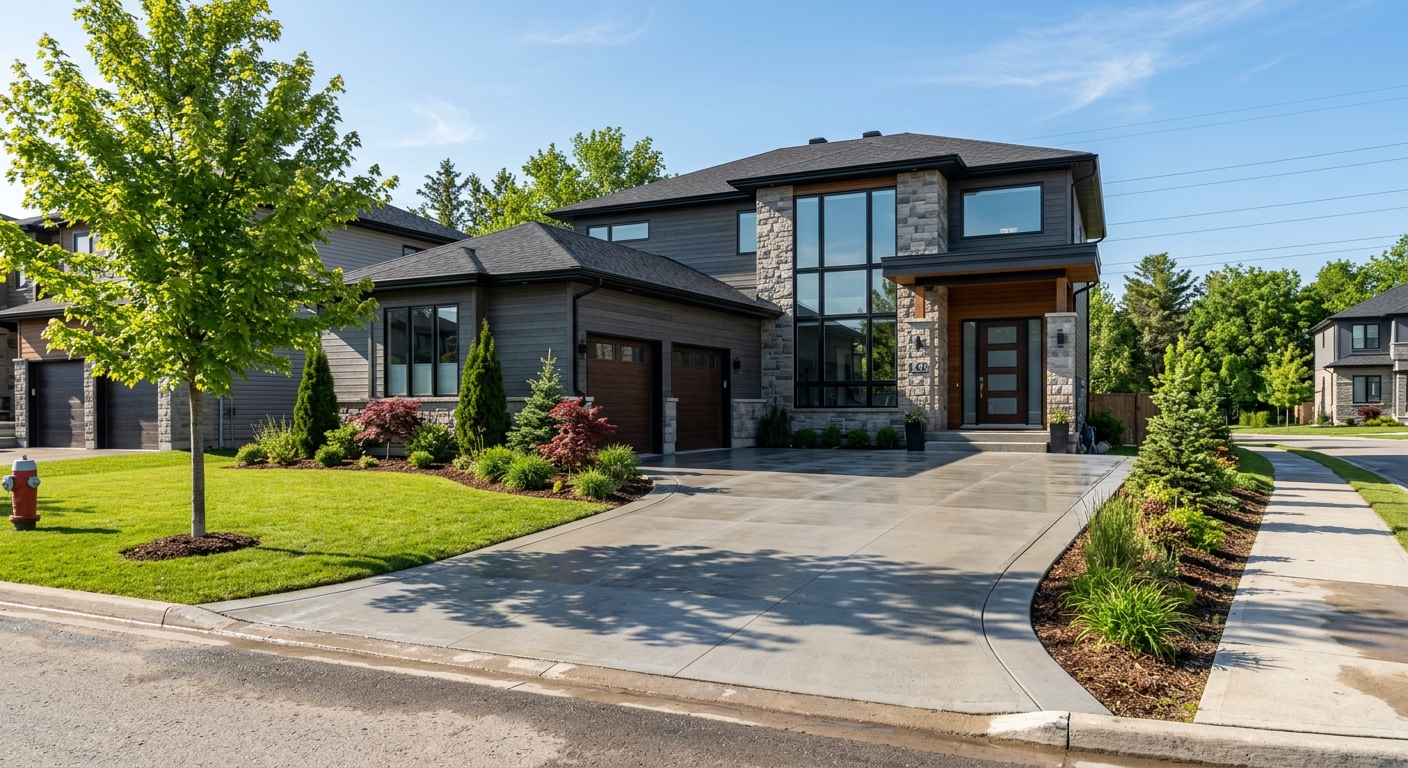
Concrete work options and costs in Downtown
Concrete work in Downtown, British Columbia is shaped by a tight, wet urban site reality and by the Lower Mainland–Southwest climate. With 62,030 people in the area (Statistics Canada, 2021 Census), demand is steady for durable exterior surfaces on compact lots—especially where older housing stock is being updated. Downtown projects most often include driveways, patios and walkways for detached and semi-detached homes, alongside interior slabs in remodels and additions. You’ll also see frequent upgrades in core neighbourhoods where property access is limited and crews need to stage material and pump concrete efficiently.
Pricing varies because the region’s shallow design frost depth is still enough to demand careful detailing. In practice, contractors commonly design around roughly 450 mm (18") of frost depth, then place footings and thickened edges below that to reduce freeze–thaw heave risk. Add frequent wet weather, saturated soils, and cool curing nights, and you get higher base prep and curing attention than many homeowners expect. That’s also why labour availability can tighten near Vancouver–Surrey–Abbotsford peak season: longer curing and rain scheduling can stretch timelines and change labour production rates.
Below are typical options and realistic unit costs you can use to sanity-check quotes, then we’ll break down what drives the biggest differences in Section 2.
| Application |
Typical Size |
Key Spec |
Finish Option |
Price Range |
| Concrete driveway (standard broom finish) |
300–500 sq ft |
Compacted granular base, air-entrained mix, control joints |
Broom finish, light colour, standard edging |
$6,000–$13,000 |
| Exposed aggregate driveway |
300–500 sq ft |
Thickened base where required, air-entrained mix, consistent curing |
Exposed stone finish |
$8,500–$16,000 |
| Stamped concrete driveway or patio |
200–400 sq ft |
Proper jointing for pattern retention, sealer schedule |
Stamp + colour integral, release agent, finishing trowel control |
$7,500–$18,000 |
| Plain concrete patio or walkway |
120–250 sq ft |
Site grading, compacted base, control joints |
Light broom or smooth trowel, simple edging |
$3,500–$7,000 |
| Garage floor (interior slab) |
400–600 sq ft |
Vapour considerations, base prep, reinforcement as required |
Standard float + broom, optionally densifier/coat |
$8,000–$15,000 |
| Foundation footings (structural, below frost) |
Varies by plan |
Excavation, formwork, rebar, pour below design frost depth |
Structural concrete (no decorative finish) |
$10,000–$25,000 |
Prices are estimates only and vary by project scope, site access and material selection.
What affects the price of concrete work in Downtown
In Downtown, British Columbia, you can see the same “driveway size” quoted 30–50% apart across the Lower Mainland–Southwest and the rest of BC because concrete pricing isn’t just about pour volume. It’s the whole system: excavation to a frost-safe depth, base prep and drainage, air-entrainment requirements, reinforcement, finish complexity, and curing conditions under coastal-wet weather. When a contractor can’t achieve production targets due to rain scheduling, cool nights, or truck access limitations, labour and crane/pump time can jump quickly—especially in dense neighbourhood pockets where material staging is tight.
Frost depth and freeze–thaw cycles dictate every spec. Footings and thickened edges must extend below the design frost depth (region practice often assumes about 450 mm / 18"), and exterior slabs require air-entrained mixes to survive repeated wetting, freezing, and thawing that lead to scaling and spalling. When you move into colder timing windows, crews need cold-weather curing precautions—insulating blankets and longer protection time—to reach required strength, which adds cost. De-icing salts also matter: without the right surface sealing plan, homeowners see premature deterioration sooner, which drives replacement costs.
Two common examples in Downtown: (1) a stamped driveway quote may look high versus a broom-finished job, but the pattern work, additional finishing time, and sealer schedule can justify the difference; (2) if your existing base is weak or drainage is poor, base rebuild and thicker gravel can push cost closer to higher patio/walkway bands (like the $16–$26 per sq ft regional expectation for many flatwork scopes). If you’re updating an older lot in the city core, the added utility adjustments and uneven subgrade can also change excavation quantities—sometimes by thousands of dollars—compared with a newer, uniform site.
| Price Factor |
Why It Matters |
Cost Impact |
| Frost line depth |
Determines footing depth and form height |
More excavation and deeper formwork; increases concrete volume and labour |
| Site preparation |
Excavation, grading, compacted granular base |
Weak subgrade or poor drainage can add thousands in base and disposal |
| Reinforcement |
Rebar or wire mesh requirement |
Material and placement time; affects slab thickness and performance |
| Mix design |
Air-entrainment and compressive strength spec |
Higher-quality mix and tighter batching; reduces freeze–thaw failures |
| Finish type |
Broom vs. stamped vs. exposed aggregate |
More finishing time, tools, and labour coordination for decorative work |
| Pour size and concrete truck access to site |
Distances, pump needs, and staging limitations |
More mobilization cost; pump or smaller truck trips can raise labour costs |
| Cold-weather curing precautions |
Heating and blankets to protect strength gain |
Extra labour, materials, and longer site time |
| Control joint pattern and sealing cost |
Jointing limits random cracking and sealing protects the surface |
More layout/finishing and product cost; reduces early spalling risk |
Permits & regulations in British Columbia
In British Columbia, structural concrete work—such as footings, foundation walls, grade beams, and other load-bearing elements—typically requires a building permit and, in many cases, engineered drawings that the municipality reviews. Concrete flatwork (like patios, walkways, and driveways) usually does not require a permit on its own unless it affects lot grading, interferes with impervious surface coverage limits, or impacts municipal right-of-way requirements (for example, certain curb tie-ins or work near boulevards). Always confirm in advance with the local authority before you break ground, because rules can change based on the site and drainage situation.
From a homeowner standpoint in Downtown, British Columbia, verify contractor compliance before work begins. Step one: ask for a certificate of insurance and confirm the liability coverage amount matches the risk of your scope. Step two: request proof of coverage for workers through the proper provincial system (commonly referred to as WCB coverage). Step three: confirm they’re properly licensed/registered for the type of construction they’re doing, then check online registry listings for the company name and contractor status.
Step four: ask for a clear written quote that notes whether permits (when required) are included, and who is responsible for site protection, disposal, and any inspections. Finally, get at least two references from projects at a similar scale—flatwork in the Lower Mainland’s wet climate has specific performance details that matter.
Getting concrete right in Downtown's freeze-thaw climate
Concrete failure in Downtown, British Columbia is most often about the details that manage moisture and temperature. In our Lower Mainland–Southwest conditions, freeze–thaw cycles and frequent saturation mean the slab can “pump” water through weak base conditions or through a surface that isn’t properly protected. The biggest performance risk I see is spalling from inadequate air-entrainment or poor curing, where freeze–thaw pressure dislodges surface paste. The fix is not “just use more concrete”; it’s base prep, correct mix, proper jointing, and a curing/sealer plan that matches coastal wet weather.
To spec the job correctly: (1) prepare the base with compacted granular to the right depth for local soils and a frost-safe design; follow the common practice of placing exterior footings and thickened edges below the design frost depth (often around 450 mm / 18"). (2) Use air-entrained concrete for exterior flatwork with an air content typically in the 5–7% range and meet a minimum compressive strength requirement (often 32 MPa for many exterior applications). (3) Install control joints at appropriate spacing so cracks, if they occur, form predictably. (4) Cure for at least 7 days under proper conditions—this is critical when cool nights or rain threaten early strength gain. (5) Seal with a penetrating sealer after cure (commonly around the 28-day mark) to help repel de-icing salts and reduce moisture ingress.
Here’s where price differences make sense: stamped concrete might cost in the $22–$36 per sq ft band for decorative work, while a plain patio/walkway typically lands closer to $16–$26 per sq ft. You’re paying for stamp tools, colour finishing, and extra labour control—so the “premium” is justified when the base, air content, joints, and curing are still done properly. If those specs are missing, the cheapest quote will usually become the most expensive repair.
| Spec |
Why It Matters in Downtown |
What to Ask For |
Impact if Skipped |
| Compacted granular base (depth?) |
Controls water movement and supports the slab through frost and rain |
Confirm excavation depth, granular type, and compaction requirements |
Settlement, cracking, and faster deterioration from trapped moisture |
| Air-entrained concrete mix (target air %?) |
Helps resist freeze–thaw scaling and surface spalling |
Request air content target (typically 5–7% for exterior flatwork) |
Higher risk of spalling and scaling in wet/cold cycling |
| Compressive strength (MPa rating) |
Ensures durability and reduces early-age damage |
Confirm minimum rating (commonly 32 MPa where specified) |
Lower performance and increased cracking/abrasion |
| Control joints (spacing per ACI guidelines) |
Controls where cracks occur under seasonal movement |
Ask for joint layout and saw-cut timing |
Random cracking and unsightly repairs |
| Minimum 7-day curing period |
Strength gain must complete before heavy exposure |
Confirm curing method and protection plan for cool nights/rain |
Reduced strength, surface weakness, and early failure |
| Penetrating sealer (when applied after cure) |
Repels water and de-icing salt to limit moisture intrusion |
Ask about product type and application timing (often after ~28 days) |
Faster surface wear and more frequent re-sealing needs |
How to choose a concrete work contractor in Downtown
Choosing a concrete contractor in Downtown, British Columbia starts with verifying compliance and ensuring they can perform in a wet, freeze–thaw environment. First, confirm British Columbia licensing/registration for the type of work they’re doing, then verify liability insurance with your address listed as the insured jobsite. Next, ask for proof of WCB coverage for workers (or equivalent provincial coverage documentation). If a contractor can’t provide clear paperwork immediately, that’s a major risk.
Then get 2–3 itemised written quotes—not just a lump sum. You want a breakdown that separates excavation and disposal, granular base, reinforcement, concrete supply (including air-entrainment and strength spec), finishing, joints, curing protection, and sealing. Check whether permits are included when structural work requires them, and whether traffic control, protection of landscaping, and concrete truck access costs are included or excluded.
Warranty matters: ask for workmanship warranty length, what it covers (cracks vs. spalling vs. surface delamination), and whether product/manufacturer warranties are transferable to you. Payment schedules should protect you: never pay more than 10–15% upfront, and hold back a portion until completion details—clean-up, sealing (if included), and final joint review—are done. Finally, request a start date and completion estimate in writing, with rain/cold weather contingency notes common to the Lower Mainland–Southwest.
- Confirm BC registration/licensing for the specific concrete scope (flatwork vs. structural)
- Verify liability insurance and ensure the project is covered (ask for certificate)
- Provide proof of provincial workers coverage (WCB documentation)
- Request 2–3 itemised quotes with line items for base, reinforcement, and concrete mix spec
- Ask whether disposal of excess soil and old concrete is included
- Confirm concrete mix includes air-entrainment for exterior slabs
- Ask for joint layout and saw-cut timing to control cracking
- Confirm curing plan for cool nights and prolonged rain (blankets/sealer schedule)
- Specify seal type and timing if you’re in a de-icing salt area
- Clarify who protects landscaping and how they handle overspray/clean-up
- Review timeline: crew days on site, truck access requirements, and rain delay handling
- Ask about warranty specifics: duration, exclusions, and process for claim resolution
Red flags in Downtown: contractors who quote decorative concrete without discussing joints and curing; crews who can’t show air-entrainment or mix specs; vague “we’ll seal it later” promises with no product/timing; a payment request above 10–15% upfront; and missing insurance/WCB paperwork or refusal to provide references for similar Lower Mainland projects.
Frequently asked questions — concrete work in Downtown
How long does a concrete project take in Downtown?
In Downtown, British Columbia, typical timelines depend on access, weather, and base prep. A standard broom-finished driveway on a straightforward site often takes about 1–3 days of active work (excavation through finishing), but total calendar time can be longer because of curing protection and scheduling around rain. A patio or walkway can be similar—often a couple of days on-site—with more time if regrading or drainage upgrades are needed. Decorative work like stamped concrete may require tighter coordination for finishing and pattern steps. Because Lower Mainland–Southwest schedules often account for cool nights and high humidity, contractors may protect the slab longer to reach design strength. If your quote includes sealing, that’s usually after the initial cure period (commonly around 28 days), which affects when you can realistically use the area safely.
What is a concrete overlay and is it suited to Downtown?
A concrete overlay is a new concrete layer placed over an existing slab, usually after surface preparation and crack repair. In Downtown, British Columbia, overlays can work when the existing concrete is structurally sound—no major settlement, no widespread base failure, and no severe ongoing water infiltration. Overlays are less suitable if the original slab is failing due to drainage problems, inadequate base, or repeated freeze–thaw moisture movement; in those cases, the overlay can simply “hide” problems until they reappear. Overlays also need a good bond and proper thickness planning, and they may not be ideal if you need significant elevation changes. If you’re comparing options, a new broom-finished driveway commonly aligns with the region’s $18–$28 per sq ft flatwork pricing, while overlays are often evaluated on a per-project basis depending on prep and bonding requirements.
How do I seal concrete to protect it in Downtown?
To protect concrete in Downtown, British Columbia, focus on timing and the right sealer. Usually, you should wait until the slab has cured properly—often about 28 days—before applying a penetrating sealer. Penetrating sealers help reduce water and de-icing salt penetration, which matters in the Lower Mainland–Southwest because surface saturation and coastal wet conditions accelerate deterioration during temperature swings. Preparation is also critical: the surface should be clean, dry, and free of curing compounds or contaminants that prevent bond. Ask your contractor what product they plan to use, whether it’s breathable, and whether it’s suitable for exterior exposure. A common mistake is sealing too early or skipping joint/edge cleaning, which can lead to patchy absorption and uneven appearance.
What is the difference between concrete and cement?
Concrete is the final building material you see and walk on; cement is one ingredient inside concrete. In simple terms, cement acts like a binder that reacts with water and helps hold the mix together. Concrete typically includes cement, water, sand, and coarse aggregate (and sometimes chemical admixtures for air-entrainment, workability, and curing performance). In Downtown, British Columbia, air-entrainment is especially important for exterior slabs because the Lower Mainland–Southwest climate involves wetting and freeze–thaw cycles that can cause scaling and spalling if the mix isn’t designed correctly. That’s why reputable contractors specify the concrete mix performance (for example, air content and minimum compressive strength), not just the word “cement.” If your quote mentions only cement and not air-entrainment or strength, that’s a technical gap you should question.
How much does concrete work cost in Downtown?
Concrete work in Downtown, British Columbia typically falls within regional bands that reflect base prep, mix design, and curing requirements. For example, a concrete driveway usually prices around $18–$28 per sq ft, while a plain patio or walkway commonly lands around $16–$26 per sq ft. If you’re considering decorative work, stamped & decorative concrete often runs about $22–$36 per sq ft depending on pattern complexity and finish time. Foundation/footings are quoted differently (structural pricing varies), but a realistic planning approach is to expect a wide range due to excavation below frost depth and formwork needs. Your exact cost can change by 30–50% if access is difficult, drainage upgrades are needed, or the contractor must increase granular thickness, reinforcement, or curing protection because of cool, wet timing. A good quote will explain those line items rather than only quoting a single number.
How deep must footings be for Downtown's frost line?
For Downtown, British Columbia, the key is that footings must be placed below the design frost depth to reduce frost heave risk. In Lower Mainland–Southwest practice, contractors typically design around a frost depth of about 450 mm (18"), then place footings and thickened edges below that value so the base doesn’t cycle through freezing conditions. Exact depth depends on your engineered drawings, soil conditions, and project-specific requirements. Even though coastal BC generally has a shallower frost line than many parts of Canada, freeze–thaw cycling and saturated soils still demand careful drainage and base preparation. Ask your contractor for the specific footing depth and show how it aligns with the drawings for your lot. If you’re seeing standing water or drainage issues, address those early—because even correctly placed footings can suffer if water pathways aren’t managed.