Concrete work options and costs in Valemount
Valemount is where concrete has to perform through real winter, not just “cold snaps.” With 63.7% of dwellings being single-detached homes (Statistics Canada, 2021 Census), the most common requests are driveways, patios, walkways and garage slabs. In practical terms, the Cariboo market you’re hiring from is shaped by freeze-thaw cycles, deep frost concerns, and a short pour season—so the price you’re quoted is tied closely to schedule, site prep, and how the contractor protects curing.
In Valemount (and around the Robson Valley access routes), excavation and forming costs can be higher when soil conditions require more granular base and rebar placement to keep footings and exterior slabs stable below frost. Exterior flatwork also needs air-entrained concrete to help prevent scaling and spalling, and contractors often budget extra time for insulated curing blankets when temperatures dip. That’s why you may see a 30–50% spread for “similar” projects across the Cariboo region and broader British Columbia—mobilization, materials specification, and protected curing make a noticeable difference.
Concrete services tend to be especially in demand in established neighbourhoods along main access corridors, where homeowners are upgrading aging exterior slabs on older homes—57.3% of homes were built before 1981 (Statistics Canada, 2021 Census), so you’ll often find settlement-related repairs mixed in with new pours. Use the table below to compare common options and what each typically includes, then we’ll break down how those specs drive your final price.
| Application |
Typical Size |
Key Spec |
Finish Option |
Price Range |
| Concrete driveway (standard broom finish) |
400 sq. ft. (about 20' x 20') |
Air-entrained mix, compacted granular base, control joints |
Broom finish + edges/expansion detailing |
$6,400–$10,000 |
| Exposed aggregate driveway |
400 sq. ft. |
Air-entrained mix, consistent surface retarder/wash process |
Exposed aggregate (cooler wet look, higher slip resistance) |
$8,400–$13,000 |
| Stamped concrete driveway or patio |
300 sq. ft. (about 15' x 20') |
Air-entrained mix, integral colour + release system |
Stamp pattern (custom border/scale) |
$7,800–$12,000 |
| Plain concrete patio or walkway |
200 sq. ft. (about 10' x 20') |
Air-entrained mix, compacted base, joints |
Smooth trowel or broom finish (exterior grade) |
$2,800–$4,400 |
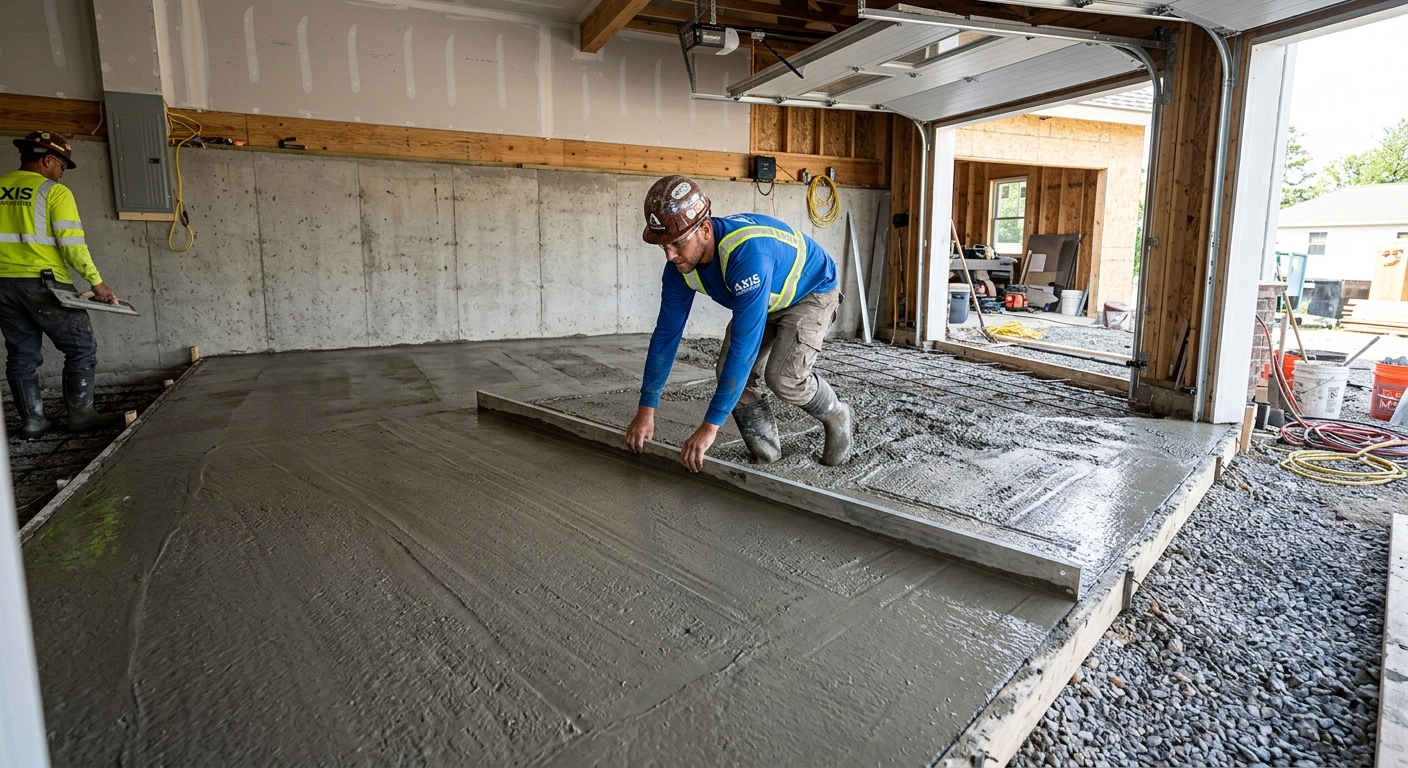
| Garage floor (interior slab) |
420 sq. ft. (about 21' x 20') |
Vapour barrier, fibres or mesh, proper base grading |
Broom or light trowel finish |
$4,800–$8,400 |
| Foundation footings (structural, below frost) |
Approx. 80 linear ft. |
Engineered footing size/rebar, pour below frost line |
Structural concrete (no decorative finish) |
$7,200–$12,800 |
Prices are estimates only and vary by project scope, site access and material selection.
What affects the price of concrete work in Valemount
In Valemount, it’s common to see quotes for the “same” driveway or patio vary by 30–50% because the differences hide in specs and logistics—not just the final look. A contractor can price a broom-finish slab near the region’s typical $16–$25 per sq. ft. for standard exterior work, but once you account for deeper excavation, rebar/wire mesh requirements, higher-spec air content, or cold-weather curing (blankets, insulation, and added labour time), the budget often climbs quickly. Mobilization also matters in a smaller market: when a crew is already booked, the next available pour date can shift to colder hours, which increases curing costs.
The Cariboo climate drives most of the variation. Frost depth and freeze-thaw cycles dictate every footing and exterior slab decision; footings must extend below local design frost depth to prevent frost heave and cracking. Exterior slabs also require air-entrained concrete to survive repeated freeze-thaw cycles, especially during shoulder-season thaws and re-freezes. When temperatures are too low, cold-weather curing precautions (heating, insulated blankets, longer protected curing) slow strength gain and extend the time concrete has to be kept warm—adding cost.
Here are a few realistic Valemount examples that move pricing up or down. First, replacing a settled older driveway on a pre-1981 home often requires extra base removal and regrading; that can move you from a lower-end patio-style unit price into a higher-end driveway budget. Second, a stamped or exposed-aggregate finish (typically $26–$40 per sq. ft. in the region for decorative work) is usually worth it when you’re covering a larger area and want a uniform, durable surface—otherwise a simpler broom finish may deliver better value with less formwork complexity. Third, driveways with limited truck access (narrow lanes or soft ground) can add labour for staging and sometimes raise costs even when the concrete quantity is the same.
| Price Factor |
Why It Matters |
Cost Impact |
| Frost line depth — determines footing depth and form height |
Helps prevent frost heave and cracking by placing concrete below design frost |
Higher excavation/formwork can add thousands on foundations/footings |
| Site preparation — excavation, grading, compacted granular base |
Correct base depth and compaction reduce settlement and pumping under slabs |
More hauling and granular supply increases cost; good soil can lower it |
| Reinforcement — rebar or wire mesh requirement |
Improves crack control and structural capacity, especially exterior flatwork |
Steel pricing + labour tying can add 10–25% depending on scope |
| Mix design — air-entrainment and compressive strength spec |
Air entrainment reduces surface scaling/spalling in freeze-thaw conditions |
Higher-spec mix can add cost but reduces long-term failure risk |
| Finish type — broom vs. stamped vs. exposed aggregate |
Labour intensity and material steps differ significantly |
Stamped/exposed typically cost more than broom finishes |
| Pour size and concrete truck access to site |
Access affects placement time, pump needs, and labour |
Limited access can increase placement labour and equipment fees |
| Cold-weather curing precautions — heating and blankets |
Protects strength gain and reduces thermal cracking when it’s cold |
Extends crew time and adds materials; biggest driver in shoulder season |
| Control joint pattern and sealing cost |
Joints manage shrinkage; sealing reduces water and de-icer damage |
Proper layout and sealing add line items but protect the slab surface |
Permits & regulations in British Columbia
In British Columbia, structural concrete work—things that affect the building’s structure such as footings, foundation walls, and grade beams—usually requires a building permit and often engineered drawings reviewed by the municipality. For example, if you’re building or replacing foundations/footings, you should expect municipal review before the pour.
Concrete flatwork (patios, walkways, and driveways) typically does not need a permit by default, unless the work changes lot grading, affects required drainage, increases impervious surface coverage beyond what’s allowed, or impacts municipal right-of-way conditions. Even when a permit isn’t required, confirming requirements before you break ground can save you from rework.
As a homeowner in Valemount, the best step-by-step process is:
- Confirm what you’re building: ask the contractor whether it’s “structural concrete” (permit likely) or “flatwork only” (often no permit).
- Request the contractor’s liability insurance certificate and verify it matches the correct legal name and address.
- Verify they have the correct WCB coverage (or required clearance) for workers on site.
- Ask for proof of credentials relevant to the work (and ensure the crew who will pour is covered).
- Look for references on similar projects in your area and ask how they handled cold-weather curing.
If you want the quickest confirmation, contact the local authority directly with a short description and site sketch, then compare that answer to what’s written in the quote.
Getting concrete right in Valemount's freeze-thaw climate
Concrete can fail quickly in Valemount when the base isn’t built for local soils and frost, or when the mix and curing aren’t matched to freezing temperatures. Most homeowner complaints—scaling, surface spalling, and random cracking—often come back to two avoidable issues: poor drainage/compaction and inadequate air-entrainment for exterior exposure. With freeze-thaw cycles, moisture gets into micro-spaces; without the right air system and sealed joints, the freeze expansion chips away at the surface.
To spec the job correctly, focus on five things. (1) Base preparation: build a compacted granular sub-base to the right depth for frost stability, with proper slopes away from the house so water doesn’t pool. (2) Mix design: exterior flatwork should use air-entrained concrete with about 5%–7% air content, and you should request a minimum 32 MPa compressive strength spec for typical residential flatwork. (3) Control joints: plan joint spacing so cracking happens where you want it, not randomly through the slab. (4) Curing: plan for at least 7 days of protected curing; in cold weather, that means insulated blankets or heating so the slab reaches strength reliably. (5) Sealing: apply a penetrating sealer about 28 days after the pour to help repel de-icing salts and reduce water absorption.
When you ask technical questions, you’re protecting your investment. For instance, a standard broom-finish driveway might fall around the region’s typical $16–$25 per sq. ft., while stamped options often run closer to the $26–$40 range. That price difference can be justified when you want decorative impact and a consistent finish—but only if the contractor still delivers the freeze-thaw protection details (air, joints, curing, drainage). Skipping one of those “under-the-surface” steps negates the value of the decorative finish.
| Spec |
Why It Matters in Valemount |
What to Ask For |
Impact if Skipped |
| Compacted granular base (depth?) |
Reduces settlement and helps manage frost-related movement |
State granular base depth and compaction method |
Uneven settling, cracking, and premature surface failure |
| Air-entrained concrete mix (target air %?) |
Improves resistance to freeze-thaw scaling/spalling in exterior exposure |
Confirm 5%–7% air content for exterior flatwork |
Higher risk of scaling/spalling during winter cycles |
| Compressive strength (MPa rating) |
Ensures the slab reaches durability strength under cold-weather conditions |
Minimum 32 MPa specified on the quote |
Lower strength gain and increased cracking/weak surface |
| Control joints (spacing per ACI guidelines) |
Controls where shrinkage cracks appear |
Joint spacing/strategy and saw-cut timing plan |
Random cracking that can open under freeze-thaw |
| Minimum 7-day curing period |
Cold temperatures slow strength gain and increase thermal stress |
What curing protection is used if temperatures drop |
Weak surface and higher long-term cracking risk |
| Penetrating sealer (when applied after cure) |
Helps limit water and de-icer salt penetration through the surface |
Sealer after cure (around day 28), plus surface prep |
Faster salt/water damage and reduced slab lifespan |
How to choose a concrete work contractor in Valemount
Choosing the right concrete contractor in Valemount is mostly about verifying coverage, understanding the technical scope, and confirming they can actually execute in cold conditions. Start with British Columbia requirements and proof: request their certificate of liability insurance and ensure it’s current. For worker coverage, verify WCB/clearance documentation so you’re not left responsible for injuries on your property. Then ask how the crew will handle cold-weather curing—this is where “lowest bid” often breaks down in the Cariboo.
Next, get 2–3 itemised written quotes. You want the labour and materials line items separated: excavation/site prep, granular base, forms, reinforcement, concrete supply, finishing, saw-cut joints, curing protection, and sealing (if included). Avoid lump-sum quotes that don’t say what finish you’re getting (broom vs trowel vs stamped) or what mix spec is used. Also clarify inclusions: is permit pulling included where required, and is disposal/haul-off included if the job needs it?
Pay attention to warranty terms. A workmanship warranty should state the duration and what’s covered. Product/manufacturer warranties for sealers or admixtures (if used) should be explained, including whether they’re transferable if you sell the home. For payment schedule, never send more than about 10%–15% upfront; hold back a portion until the job is complete and walkable-quality items are satisfied.
Finally, insist on a written timeline: proposed start date, pour date range (weather-dependent), and completion estimate. In Valemount, schedule matters as much as design because curing conditions can change week to week.
- Confirm the contractor’s liability insurance certificate is current and matches their legal business name.
- Verify WCB/worker coverage clearance so workers are properly covered.
- Ask for references on driveways/patios built for freeze-thaw climates similar to Valemount.
- Get itemised pricing (prep, base, steel, concrete, finishing, joints, curing, sealer).
- Ensure the quote includes air-entrained mix and a minimum compressive strength.
- Require the curing plan for cold weather (blankets/heating) if temperatures are near-freezing.
- Clarify reinforcement: mesh vs rebar, and where it’s placed (not just “included”).
- Confirm control joint spacing and when saw cuts are done.
- Ask whether slope away from the building is engineered, especially at garage entries.
- Confirm disposal and hauling of excess material is included or listed as a separate line.
- Verify finish type match: broom finish for slip resistance; stamped/exposed includes colour and release system.
- Use a payment schedule with a holdback; don’t exceed 10–15% upfront.
Red flags in Valemount include quotes that don’t mention air entrainment or curing protection, contractors who dismiss joint layout (“cracks are normal”), promises to pour in freezing conditions without blankets/heating, missing proof of liability/WCB coverage, and vague scope language that omits base depth, reinforcement, or sealing.
Frequently asked questions — concrete work in Valemount
Why does concrete crack in Valemount and how is it prevented?
In Valemount and the wider Cariboo region, concrete cracking usually comes from shrinkage, thermal movement, and freeze-thaw pressure on surfaces that aren’t built for moisture control. Older homes are common here—57.3% were built before 1981 (Statistics Canada, 2021 Census)—and that often means existing drainage or base conditions aren’t as stable as newer standards. Prevention starts with correct base preparation and compaction, proper air-entrained mix for exterior exposure, and a control joint pattern that directs cracking where it’s least visible and easiest to manage. Curing matters too: in cold weather, protected curing helps the slab reach strength before it’s exposed to freeze risks. Finally, sealing helps reduce water and de-icer penetration that can widen micro-cracks over time.
Stamped vs broom-finish concrete — cost difference?
Stamped concrete costs more than a standard broom-finished driveway because it adds integral colour, stamp mats, release powder, and additional labour time to achieve consistent patterning and edges. In Valemount, a simple broom-finished driveway often aligns with the region’s typical $16–$25 per sq. ft. pricing for concrete flatwork, while stamped decorative work more often lands in the $26–$40 per sq. ft. range depending on complexity and area. The price difference is justified when you want decorative curb appeal, but it should never come at the expense of freeze-thaw durability specs—air entrainment, joint timing, curing blankets/heating, and proper drainage are still essential. A good contractor will show you both the decorative steps and the structural/durability steps in the same scope.
When is the best time to pour concrete in Valemount?
The best time is typically late spring through early fall when daytime temperatures are more stable and curing is easier. In Valemount, the “shoulder seasons” can still work, but you’ll pay more if the contractor must add heating or insulated blankets to keep concrete in the right temperature band during curing. The challenge is that cold slows strength gain, and if the slab is exposed to freezing too early, durability and crack resistance can suffer. If you’re planning a driveway or patio, ask about the pour date window and what weather triggers them to reschedule. Good contractors plan for cure protection even when nights drop, especially for exterior slabs where air entrainment and curing time directly affect how the surface handles winter de-icing and freeze-thaw cycling.
How long does concrete take to cure?
For typical residential concrete work in British Columbia, you should plan for at least 7 days of protected curing to reach key strength, with durability improving as the slab continues to gain strength over time. In cold weather in the Cariboo region, curing can’t be rushed—strength gain slows, so contractors often use insulated blankets and careful temperature management. For sealing, many homeowners don’t realize timing matters: a penetrating sealer is usually applied around 28 days after the pour (once the slab has cured adequately) so the product can properly penetrate and help resist de-icer salts. If someone tells you concrete “dries” in a day or two, that’s not the full story for freeze-thaw performance.
Do I need a permit for concrete work in British Columbia?
It depends what you’re building. In British Columbia, structural concrete work—like footings, foundation walls, and grade beams—typically requires a building permit and often engineered drawings reviewed by the municipality. Concrete flatwork such as patios, walkways, and driveways usually doesn’t require a permit unless it affects lot grading, drainage, impervious surface coverage limits, or municipal right-of-way conditions. Because rules can depend on how your project impacts the site, the safest approach in Valemount is to ask the contractor whether the scope is “structural” or “flatwork,” then confirm with the local authority before breaking ground. Also verify the contractor has liability insurance and proper WCB coverage so the project is handled professionally.
Concrete vs pavers for a patio in Valemount?
Concrete and pavers can both work well in Valemount, but they behave differently under freeze-thaw. Pavers give flexibility and are visually adjustable if a section shifts, but they depend heavily on base construction and drainage—if the bedding and compaction aren’t right, you can still get uneven movement. Concrete patios are often simpler to maintain and can be more durable when the slab is built with an air-entrained mix, good base prep, control joints, and proper curing. Pricing varies: a plain concrete patio or walkway commonly sits around the regional $14–$22 per sq. ft. band, while stamped decorative concrete is higher (often $26–$40 per sq. ft.). If you’re choosing for longevity in winter, ask both options about joints/drainage details and how they’ll protect the surface from de-icing salts.