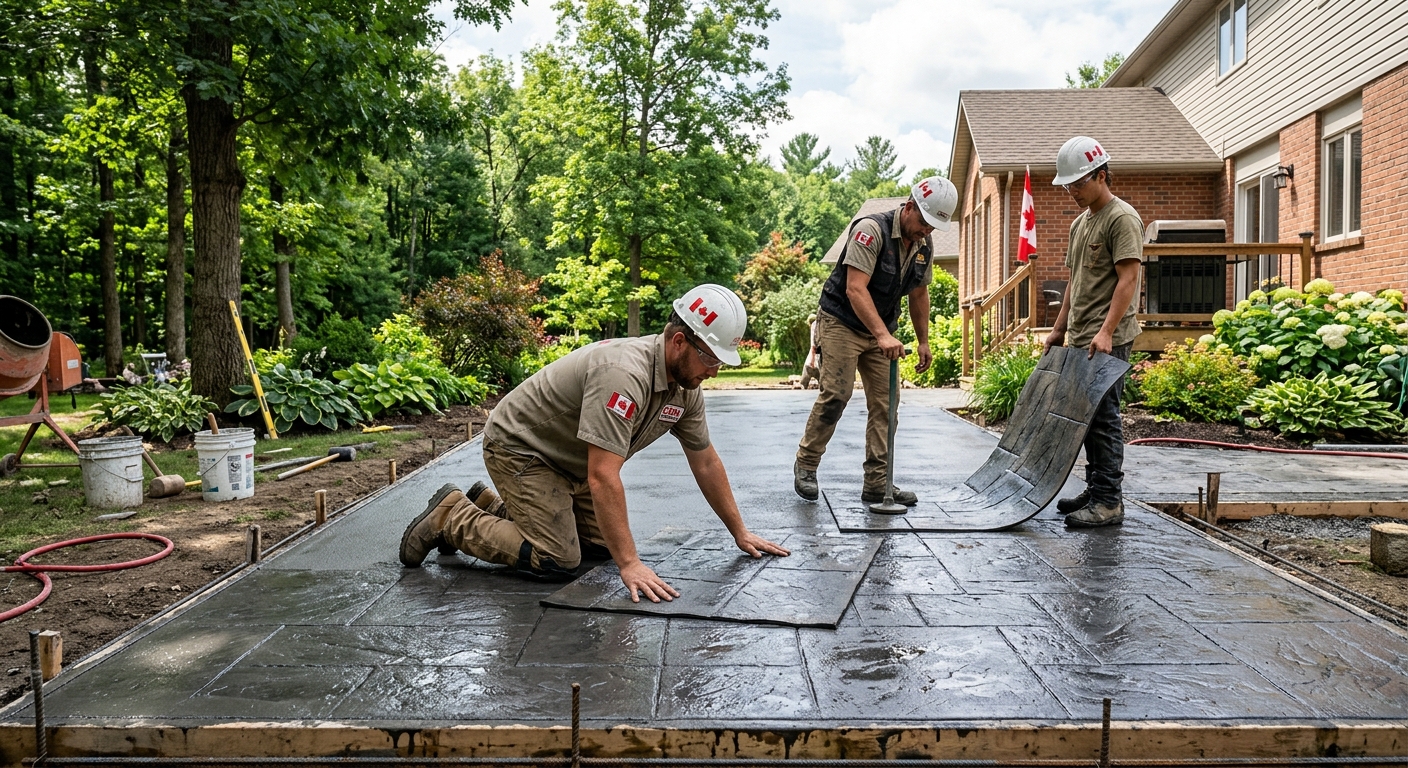
Concrete work options and costs in Colwood
Concrete work is a big part of property upgrades in Colwood, especially because most homeowners here build around long, wet shoulder seasons and then face freeze–thaw nights that punish poorly detailed slabs. In Colwood’s housing stock, single-detached houses make up about 49.2% of dwellings, so driveways, patios and walkways are constant demand items—along with interior garage slabs for renos. Homeownership is also high (73.5% of households own), which typically means more residents opt for longer-lasting exterior surfaces rather than cheaper, short-lived patches. (Statistics Canada, 2021 Census)
On Vancouver Island and the Coast, concrete pricing is shaped by a relatively shallow frost line but frequent wetting and freezing. That combination pushes contractors to use air-entrained mixes, proper granular base preparation, and a clean control-joint plan. Rain can also slow excavation and base compaction, while cooler snaps can extend curing protection time (blankets, sealers, drainage) to reach required strength and surface durability. Contractor availability can tighten during peak spring-to-early-summer scheduling, so waiting for “best weather” may not always lower cost.
In Colwood’s Glen Lake and Royal Bay areas, we commonly see repeat orders for driveway replacements and backyard patio upgrades tied to landscaping regrades and drainage improvements. Below is a practical comparison of typical sizes and specs contractors price for Colwood projects, so you can sanity-check quote numbers before you shop finishes.
| Application |
Typical Size |
Key Spec |
Finish Option |
Price Range |
| Concrete driveway (standard broom finish) |
400 sq. ft. (e.g., 10' x 40') |
Air-entrained mix, compacted base, wire mesh where required |
Broomed, simple edge forms |
$6,400 – $10,000 |
| Exposed aggregate driveway |
400 sq. ft. (e.g., 10' x 40') |
Engineered base + proper curing to support wash/exposure |
Exposed aggregate (wash or retarder method) |
$9,000 – $14,000 |
| Stamped concrete driveway or patio |
250 sq. ft. (e.g., 12' x 20') |
Air-entrained mix, rebar/wire per design, consistent jointing |
Stamp + integral colour (or stain/colour system) |
$8,000 – $14,000 |
| Plain concrete patio or walkway |
200 sq. ft. (e.g., 10' x 20') |
Exterior slab with control joints and air-entrainment |
Float and broom (or light broom on walkways) |
$2,800 – $4,400 |
| Garage floor (interior slab) |
400 sq. ft. (e.g., 20' x 20') |
Vapour strategy as needed, reinforcement, proper curing |
Standard smooth/steel trowel, light broom edges |
$6,500 – $11,500 |
| Foundation footings (structural, below frost) |
Per linear foot (e.g., 8'–12' wide walls, typical rebar cages) |
Excavate to design frost depth, granular base, engineered rebar |
Structural formwork + concrete grade per spec |
$7,000 – $13,000 |
Prices are estimates only and vary by project scope, site access and material selection.
What affects the price of concrete work in Colwood
In Colwood and across Vancouver Island and the Coast, two contractors can quote the “same” concrete project and still end up 30–50% apart. The gap usually isn’t the slab—it’s the site prep, base quality, reinforcement decisions, and how the contractor manages Vancouver Island weather during the pour and curing window. Your quote also reflects how much risk the contractor is willing to carry when rain and cold snaps disrupt grading, compaction and curing.
The biggest driver is frost and freeze–thaw detailing. Local design expectations assume footings sit below frost to prevent heave and cracking; in coastal BC, that frost depth is commonly in the 0.5–1.2 m band, but the exact depth is driven by soil conditions and local assumptions. Exterior slabs also need air-entrained concrete mixes to survive repeated wetting/freezing. When we do cold-weather curing, the contractor may need insulation blankets or controlled heating to protect the slab while strength develops—small changes that can add real labour and consumables. Even surface finishing and de-icing salt exposure matter: if you plan on using salt on driveways, sealing and durable mix choices become more important to reduce scaling and spalling.
In Colwood, we often see cost rise when the existing base is soft or saturated after winter storms—excavation and hauling can add thousands. Costs can also drop if your access is straightforward (no steep pulls, limited tree clearing, easy truck access) and your subgrade is already competent. The finish choice shows up clearly: a standard broom driveway is typically in the $16–$25/sq. ft. backbone range, while decorative options like stamped or exposed aggregate move up into the higher band. With many homes built before 1981 (42.2% in Colwood), renovations sometimes include drainage regrades and old base removal, which can push a plain slab closer to decorative pricing once site work is added. (Statistics Canada, 2021 Census)
| Price Factor |
Why It Matters |
Cost Impact |
| Frost line depth — determines footing depth and form height |
Footings must sit below local design frost to reduce heave risk |
Excavation depth can add substantial labour and disposal |
| Site preparation — excavation, grading, compacted granular base |
Unstable subgrade causes settlement and early cracking |
Soft or saturated soils increase haul-off and rebase costs |
| Reinforcement — rebar or wire mesh requirement |
Reinforcement controls cracking and improves slab performance |
Material and labour time vary by engineer/design |
| Mix design — air-entrainment and compressive strength spec |
Exterior freeze–thaw durability depends on correct air content |
Spec’d mixes may cost more, but failures cost more |
| Finish type — broom vs. stamped vs. exposed aggregate |
Finish systems require different placement/curing and extra labour |
Stamped/exposed typically adds forming, stamp time, and materials |
| Pour size and concrete truck access to site |
Smaller pours or tight access may require more staging/hosing |
Access constraints can increase labour and equipment costs |
| Cold-weather curing precautions — heating and blankets |
Strength gain slows in cool, damp conditions |
Blankets/heating may add line items during shoulder-season pours |
| Control joint pattern and sealing cost |
Joints direct cracking; sealing helps defend surface from salts |
Proper jointing and sealers add cost but reduce long-term damage |
Permits & regulations in British Columbia
In British Columbia, structural concrete work usually needs a building permit and often engineered drawings reviewed by the municipality. That includes concrete footings, foundation walls, grade beams, and other structural elements that support a building. For concrete flatwork—patios, walkways and driveways—the work often does not require a permit unless it affects lot grading, alters drainage in a way that impacts neighbouring runoff, or triggers local requirements related to impervious surface coverage or right-of-way considerations. Because rules can vary by site context, confirm with the City/municipality before breaking ground.
Regardless of permit need, always verify the contractor is properly insured and able to legally work. In Colwood, you should request proof of liability insurance and workers’ compensation coverage (WSIB/WCB) before any excavation begins. Then ask for recent references on similar-scale residential concrete jobs (driveways, patios, and—if relevant—footing work).
Step-by-step homeowner checklist to verify status in BC: (1) find the contractor’s licensing/registration information through the province’s online listings (search the contractor’s legal business name); (2) ask for a current certificate of insurance and check that the policy is active and the coverage amount makes sense for concrete excavation and traffic risk; (3) request proof of WSIB/WCB clearance/coverage, and confirm dates cover your planned pour period; (4) get copies attached to your quote or in your contract package; and (5) confirm the permit responsibility in writing (who pulls it, if required).
Getting concrete right in Colwood's freeze-thaw climate
Concrete failure in Colwood typically looks like surface scaling, spalling at edges, and random cracking after freeze–thaw cycles. Even if the concrete “looks fine” at pour-out, poor base prep, wrong air content, and weak or rushed curing create a slow failure that shows up the next winter. Specifying the right details for Vancouver Island and the Coast is how you avoid callbacks and patching.
1) Base preparation: start with a properly graded and compacted granular sub-base to the depth required for your soil and local frost expectations. If the base is too thin or not compacted, settlement and cracking follow—especially where water collects. 2) Mix design: exterior flatwork should use air-entrained concrete, typically targeting 5–7% air content for freeze–thaw durability, along with a minimum 32 MPa compressive strength. 3) Control joints: you need a joint layout that limits random cracking to predictable lines; joints are cheaper than replacing slabs. 4) Curing: plan for at least 7 days of proper curing conditions. Cool, damp weather can slow strength gain, so contractors may need curing protection during short cold snaps. 5) Sealing: use a penetrating sealer after the slab has cured (commonly after 28 days) to help repel de-icing salts and reduce surface deterioration.
Here’s where pricing choices can be justified: in Colwood, a stamped patio can be roughly $22–$35/sq. ft. equivalent when you factor labour, colour/stamp labour and extra finishing time. If you’re paying that premium, don’t cut corners on base or air-entrainment—those specs drive durability more than the pattern does. A cheaper “plain broom” option at the lower end of the patio range may actually outperform a decorative job if the decorative contractor shorted the mix or rushed curing. Ask for the mix and joint plan in writing—especially for driveways and walkways that get salt.
| Spec |
Why It Matters in Colwood |
What to Ask For |
Impact if Skipped |
| Compacted granular base (depth?) |
Proper thickness and compaction prevent settlement and edge cracking |
Base depth for your soil and frost detail; compaction method and granular type |
Uneven support leads to cracking and premature failure |
| Air-entrained concrete mix (target air %?) |
Freeze–thaw cycles require protected paste to resist scaling |
Air target (commonly 5–7%) and exterior exposure class if provided |
Spalling and surface pop-outs after winter |
| Compressive strength (MPa rating) |
Ensures durability and adequate strength gain in cool weather |
Minimum 32 MPa specification for exterior work |
Higher risk of surface damage and joint deterioration |
| Control joints (spacing per ACI guidelines) |
Directs cracking to joints instead of random locations |
Joint spacing plan and saw-cut or tooled timing |
Random cracking and cosmetic failures |
| Minimum 7-day curing period |
Cool, wet conditions slow strength development |
Curing method (blankets/cover) and protection timeline |
Weak surface layers that scale under salt and freeze–thaw |
| Penetrating sealer (when applied after cure) |
Helps repel de-icing salts and reduces water/ion penetration |
Type of penetrating sealer and application date after cure (commonly 28 days) |
Faster scaling and spalling at treated areas |
How to choose a concrete work contractor in Colwood
Choosing the right concrete contractor in Colwood comes down to proof, details, and a realistic schedule—not just the lowest line item. Start by confirming British Columbia licensing/registration where applicable, then verify liability insurance and WSIB/WCB coverage. How to check: (1) ask for their certificate of insurance (make sure it’s current and covers the scope, including excavation and any work near driveways/sidewalks); (2) request WSIB/WCB clearance or proof of coverage that matches your project dates; and (3) confirm the contractor’s legal business name and registration match the quote documents. If they can’t provide these quickly, treat that as a serious warning sign.
Next, get 2–3 itemised written quotes, not a lump-sum. The quote should break out labour, materials, excavation/disposal, base/granular, reinforcement (if required), concrete supply, finish work, and any curing/sealing provisions. Also read the exclusions carefully: is disposal included, is the haul-off cost separate, and who handles rough carpentry removal/landscaping protection? For permits, clarify whether the contractor pulls them (when structural work requires it) or if you’re responsible.
Warranty matters in concrete because failure often shows up after a winter. Ask for the workmanship warranty length (and what it covers), plus any product/manufacturer warranty terms. Clarify whether warranties are transferable if you sell. Payment should be conservative: never pay more than 10–15% upfront; hold back a reasonable portion until completion and any final sealer/joint finishing tasks are done. Finally, require a start date and completion estimate in writing—shoulder-season rain and curing time can affect timelines.
- Provide BC registration/licensing details and match them to the quote paperwork.
- Show current liability insurance certificate before work starts.
- Provide WSIB/WCB proof/clearance with project coverage dates.
- Use an itemised quote (labour, materials, base prep, reinforcement, finish).
- State who is responsible for permits (structural vs. flatwork situations).
- List what’s included for excavation, haul-off and disposal.
- Confirm mix type includes air-entrainment for exterior freeze–thaw exposure.
- Provide a control joint plan (spacing/timing for saw cutting or tooling).
- Specify base thickness and granular compaction method.
- Describe curing protection if temperatures drop during the pour/first days.
- Include sealing plan for driveways/walkways where salt exposure is expected.
- Define warranty coverage, start date, and what qualifies for remediation.
Concrete contractor red flags in Colwood: (1) no mention of air-entrainment or “we always use the same mix” for exterior slabs; (2) vague jointing plans (“we’ll see how it looks”); (3) minimal base work or no granular compaction details; (4) asking for large upfront payments or refusing to hold back until completion; and (5) missing or outdated insurance/WSIB/WCB proof.
Frequently asked questions — concrete work in Colwood
What is the difference between concrete and cement?
In everyday language, people say “cement” when they mean the finished material. Cement is actually one ingredient—typically Portland cement—that’s blended with sand, gravel (aggregate) and water to make concrete. In exterior projects around Colwood, the concrete mix design is the part that matters for durability in freeze–thaw conditions: it includes air-entrainment and the specified strength (commonly minimum 32 MPa for exterior work). When contractors quote driveways or patios, ask what air content and strength they’re using, not just what brand of cement they purchase. On Vancouver Island and the Coast, the correct air system and proper curing are what help the slab resist scaling and spalling during winter wetting/freezing cycles.
How much does concrete work cost in Colwood?
Concrete pricing in Colwood generally follows the regional backbone ranges, but your actual total depends heavily on site prep, access and finish. For example, a concrete driveway is commonly priced around $16–$25 per sq. ft. before you add decorative upgrades. Plain patios and walkways often land around $14–$22 per sq. ft. for typical exterior work. If you’re considering stamped concrete, expect higher labour and materials; stamped & decorative concrete often falls in the $22–$35 per sq. ft. band. If your project includes footing work (below frost), foundation/footings are typically much higher per job because excavation and engineered reinforcement drive the scope. (Statistics Canada, 2021 Census)
How deep must footings be for Colwood's frost line?
For Colwood and the Vancouver Island and Coast climate band, footings are typically designed to sit below the local frost depth, which is commonly around 0.5–1.2 m in coastal BC conditions—exact depth depends on soil and design assumptions. The key takeaway for homeowners is that you shouldn’t guess: footing depth should follow the design requirements shown on engineered drawings or the applicable structural spec. This is especially important for homes where older foundations were poured before modern details; Colwood’s housing stock includes many homes built before 1981, so soils and drainage details can vary. (Statistics Canada, 2021 Census) For any structural work, confirm the footing elevation and frost depth note in the permit/engineer documents before excavation starts.
Why does concrete crack in Colwood and how is it prevented?
Concrete cracks in Colwood mostly due to shrinkage and movement, plus freeze–thaw stresses when the slab isn’t detailed for exterior exposure. Two big culprits are inadequate base support and weak or improperly mixed exterior concrete. Prevention is all about the spec: compacted granular base to the correct thickness, air-entrained mix to resist freeze–thaw scaling, and a control joint layout that creates predictable cracking lines. Contractors should also follow curing and protection practices so strength gain isn’t compromised by cool, damp weather. On Vancouver Island, random cracking often shows up where joints were delayed, where too few joints were used, or where slabs were poured on unstable or saturated subgrade. Ask your contractor for their joint spacing plan and the air-entrainment/strength they will place.
Stamped vs broom-finish concrete — cost difference?
Stamped concrete costs more than broom-finish because it requires additional labour and materials—integral colour or surface colouring, stamping tools, and extra careful timing of finishing. For homeowners in Colwood, the broom-finish driveway or walkway is usually the lowest-cost “durable exterior” option. As a reference, concrete driveways commonly price around $16–$25 per sq. ft. for standard broom finishing. Stamped and decorative concrete often falls higher, commonly in the $22–$35 per sq. ft. band because of increased preparation and finishing steps. The important part: don’t pay for stamping while skipping durability fundamentals like air-entrainment, proper base compaction, and control joints—those decide whether your investment survives winter.
When is the best time to pour concrete in Colwood?
The best time to pour concrete in Colwood is when temperatures stay consistently above freezing and weather allows proper finishing and curing protection. While winters are milder than interior BC, Vancouver Island’s frequent wetting and occasional cold snaps still affect cure times and surface durability. Plan pours for late spring through early summer if you can, because rain delays excavation, grading and base compaction, and cool temperatures slow strength gain. A good contractor schedules around forecast windows and builds curing protection into the plan when shoulder-season temps dip. If the weather turns cold, heating blankets and careful curing may be needed to avoid surface weakness that can later scale. If you’re comparing quotes, ask whether each contractor includes cold-weather curing precautions in the scope.