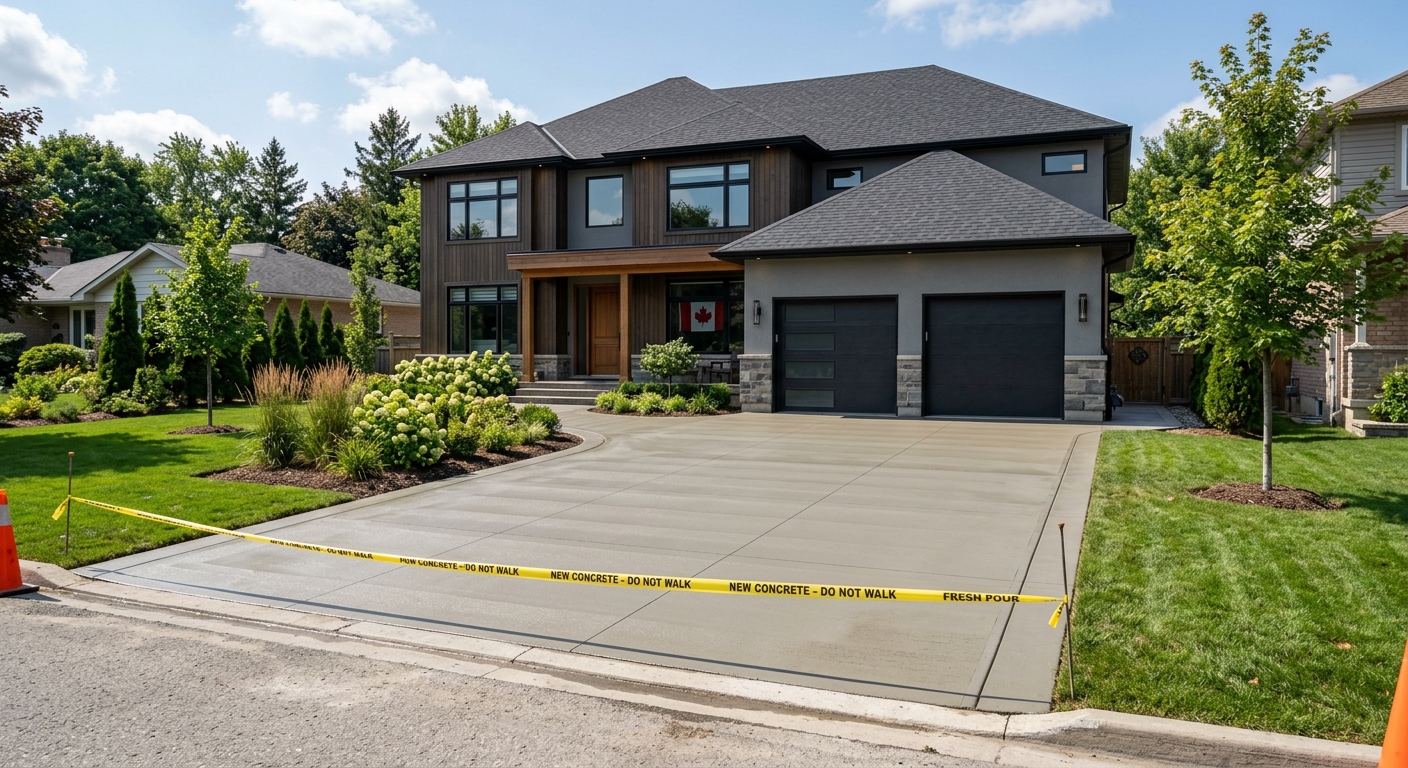
Concrete work options and costs in Capitol Hill
Concrete in Capitol Hill is a practical upgrade for homeowners who want durable driveways, patios, and foundation improvements that hold up to Lower Mainland–Southwest weather. In a city of 6,330 people (Statistics Canada, 2021 Census), this neighbourhood mix includes plenty of residential lots where concrete flatwork is in constant demand—especially around family homes that rely on long-lived surfaces for everyday use.
Pricing here is shaped by a shallow but unforgiving frost depth in coastal British Columbia. Local practice typically assumes frost protection around 450 mm / 18", so footings and thickened edges are placed below that level to reduce the risk of freeze–thaw heave. Even when winters feel “mild,” the cycle of saturation from heavy rainfall and the subsequent freeze–thaw cycles can drive up costs for drainage work, granular base prep, and air-entrained concrete design.
Contractor availability and scheduling also affect your quote. Because rain, cool nights, and high humidity can slow curing, contractors often add labour planning for curing blankets/sealers and longer cure times to reach design strength before surface exposure. In Capitol Hill, this trade is especially busy in the Capitol Hill / McKenzie neighbourhood corridor where older homes frequently need driveway and walkway replacement as landscaping and drainage are refreshed.
Below is a realistic comparison of common concrete options and typical price ranges so you can match specs—not just totals—before you request your quote.
| Application |
Typical Size |
Key Spec |
Finish Option |
Price Range |
| Concrete driveway (standard broom finish) |
320 sq. ft. (approx. 16’ x 20’) |
Air-entrained mix; compacted granular base; control joints |
Broom finish |
$5,760–$8,960 |
| Exposed aggregate driveway |
320 sq. ft. (approx. 16’ x 20’) |
Air-entrained mix; proper cure timing for wash/exposure |
Exposed aggregate |
$7,200–$11,520 |
| Stamped concrete driveway or patio |
240 sq. ft. (approx. 12’ x 20’) |
Air-entrained mix; integral colour; rebar/wire per design |
Stamped + release + light sealer |
$5,280–$8,640 |
| Plain concrete patio or walkway |
180 sq. ft. (approx. 9’ x 20’) |
Compacted base; air-entrained mix; control joints |
Smooth trowel or light broom |
$2,880–$4,680 |
| Garage floor (interior slab) |
440 sq. ft. (approx. 22’ x 20’) |
Minimum thickness plan; jointing; base prep |
Steel trowel + seal (optional) |
$8,800–$12,320 |
| Foundation footings (structural, below frost) |
Per project; allowance for typical small foundation pad |
Below frost depth; engineered rebar placement |
Structural concrete |
$1,200–$2,800 |
Prices are estimates only and vary by project scope, site access and material selection.
What affects the price of concrete work in Capitol Hill
In Capitol Hill and across the Lower Mainland–Southwest, the same “driveway replacement” can land 30–50% apart between quotes because concrete work is spec-driven: thickness, base build-up, drainage detailing, reinforcement, and curing plan all change the labour and material requirements. A small increase in driveway thickness, for example, isn’t just extra concrete—it can trigger more excavation, more granular supply, and more rebar/wire placement. In wetter coastal conditions, contractors also have to account for weather windows and curing labour, which can add cost even if the visible surface looks similar.
Frost depth and freeze–thaw cycles dictate every exterior spec. In practice, footings must extend below the design frost depth (in coastal BC this is commonly around 0.5–1.2 m depending on conditions) to prevent frost heave. Exterior slabs require air-entrained mixes with proper control joints to manage cracking and scaling. Compared with interior/northern climates, our frost line is shallower than many parts of Canada, but our saturated soils and frequent wet/cool swings make drainage and air-entrainment non-negotiable.
Lower Mainland–Southwest projects can cost more when the pour season is constrained by rain and when colder curing precautions are needed (insulating blankets, staging, and longer timelines). De-icing salt use by residents also increases spalling risk on unsealed surfaces, which is why many contractors recommend penetrating sealer after cure—adding materials and scheduling. On a typical 320 sq. ft. driveway, moving from a standard broom finish to exposed aggregate can justify the price difference (commonly $7,200–$11,520 versus standard $5,760–$8,960) when the base, mix, and timing are properly managed. Conversely, upselling decorative finishes without addressing drainage and base prep often wastes money.
Housing age plays a role too: older Capitol Hill properties may have older compacted bases, poor downspout discharge, or deteriorating subgrades that drive excavation and disposal beyond what’s shown on day one.
| Price Factor |
Why It Matters |
Cost Impact |
| Frost line depth — determines footing depth and form height |
Footings must be built below frost protection levels to limit heave |
More excavation and forming can add significant labour and material cost |
| Site preparation — excavation, grading, compacted granular base |
Controls settlement and prevents pumping/surface failure under freeze–thaw |
Unexpected poor subgrade can increase disposal and granular supply |
| Reinforcement — rebar or wire mesh requirement |
Helps control cracking in slabs and supports structural loads |
Material and labour time increases when reinforcement is required |
| Mix design — air-entrainment and compressive strength spec |
Exterior air-entrainment protects against scaling from freeze–thaw |
Higher-spec mix and test requirements can raise per-cubic-yard costs |
| Finish type — broom vs. stamped vs. exposed aggregate |
Decorative finishes add steps (colour, stamps, exposure/wash) |
Often increases labour time and materials; can shift quotes substantially |
| Pour size and concrete truck access to site |
Access affects pumping/placement speed and how much crew time is needed |
Limited access may require pumping fees and extra labour |
| Cold-weather curing precautions — heating and blankets |
Ensures concrete reaches required strength despite cool nights |
Blanket/heating time and staging can increase labour and equipment cost |
| Control joint pattern and sealing cost |
Controls where cracks form and protects against salt/scaling |
Proper jointing and sealer add cost but reduce long-term failure risk |
Permits & regulations in British Columbia
In British Columbia, structural concrete work—such as footings, foundation walls, and grade beams—generally requires a building permit and often engineered drawings that get reviewed by the municipality. For concrete flatwork like patios, walkways, and driveways, permits typically are not required unless the work affects lot grading, changes drainage patterns, or conflicts with municipal limits for impervious surface coverage and any right-of-way considerations. Even if your flatwork “usually doesn’t need a permit,” you should still confirm with the local authority before breaking ground, especially if you’re re-grading or working close to drainage infrastructure.
Here’s how a Capitol Hill homeowner can verify a contractor before hiring: (1) confirm the contractor’s business information and standing using the appropriate online registry resources available to you in BC (your contractor should provide their legal business details); (2) request a certificate of liability insurance—it should match the work scope and show current coverage limits; and (3) verify WSIB/WCB coverage (or the applicable BC coverage confirmation your contractor uses for worker protection). Ask for the COI and clearance documentation directly, and ensure the start/end dates align with your project timeline. Finally, request references on similar-scale projects (driveway/patio or small foundations) so you can see how they’ve handled Lower Mainland curing and drainage.
Getting concrete right in Capitol Hill's freeze-thaw climate
Concrete fails in Capitol Hill’s climate mostly when water and temperature swings find weak points in the system: inadequate base preparation, poor drainage, low air-entrainment, or incorrect curing. In our Lower Mainland–Southwest environment, exterior slabs are exposed to heavy rainfall, saturated soils, and freeze–thaw cycles that can drive cracking and spalling (surface flaking). The best way to “spec it right” is to treat the job as a full assembly: base, mix, joints, curing, and surface protection—rather than just picking a finish.
1) Base preparation: contractors should build a compacted granular sub-base to the depth needed for local soil conditions and frost protection. 2) Mix design: for exterior flatwork, use air-entrained concrete with typical target air content around 5–7% and a minimum compressive strength of 32 MPa. 3) Control joints: place joints to limit random cracking; follow standard spacing rules for slab thickness and exposure. 4) Curing: plan for at least 7 days of proper curing conditions—longer when nights are cool or humidity is high—using blankets or controlled curing when needed. 5) Sealing: apply a penetrating sealer after cure (often around 28 days post-pour) to help repel de-icing salt and reduce scaling risk.
A common pricing justification: the difference between plain broom-finished concrete and stamped options is real (for example, stamped driveways/patios often land in the $5,280–$8,640 band versus plain patio/walkways around $2,880–$4,680), but you should only pay for decoration after the protective system is correct. If the contractor can’t clearly explain air-entrainment and jointing, the cheaper option with correct specs is the better value.
Ask the contractor specifically how they prevent spalling from inadequate air-entrainment—because in Capitol Hill, that’s what typically separates “fine for a year” from “still solid after winters.”
| Spec |
Why It Matters in Capitol Hill |
What to Ask For |
Impact if Skipped |
| Compacted granular base (depth?) |
Prevents settlement and helps manage moisture under freeze–thaw |
Compacted granular sub-base depth and compaction method for your site |
Cracking, uneven slabs, and premature surface failure |
| Air-entrained concrete mix (target air %?) |
Air voids protect against scaling/spalling in wet winter cycling |
Confirm air-entrainment target around 5–7% for exterior flatwork |
Spalling and scaling within a short service life |
| Compressive strength (MPa rating) |
Strength ensures the slab resists loading and early deterioration |
Minimum 32 MPa compressive strength |
Surface damage, reduced durability, and higher maintenance |
| Control joints (spacing per ACI guidelines) |
Controls where shrinkage cracks form when slabs move |
Joint spacing and layout matched to slab thickness and exposure |
Random cracking and easier water intrusion |
| Minimum 7-day curing period |
Durable strength development depends on curing conditions |
Minimum 7 days curing; plan for blankets/sealer when cool/rainy |
Weak surface, dusting, and early scaling |
| Penetrating sealer (when applied after cure) |
Helps repel moisture and de-icing salt, reducing freeze–thaw damage |
Penetrating sealer applied about 28 days after pour (after cure) |
Salt-driven spalling and faster deterioration of the top layer |
How to choose a concrete work contractor in Capitol Hill
Choosing the right contractor in Capitol Hill means checking credentials and matching the quote to the technical specs that matter locally. In British Columbia, start by verifying the contractor’s current business status and request proof of liability insurance for the work—your COI should list the correct insured party and coverage dates. Next, ask how they handle worker protection and coverage for their crews; confirm WSIB/WCB coverage status by requesting documentation or clearance information they can provide for the project dates. Don’t accept “we’re covered” verbally—ask for the certificate and keep a copy with your contract.
Then get 2–3 itemised written quotes that show labour and materials (concrete supply, rebar/wire, granular base, forms, finish labour, sealing, disposal), not one lump sum. Read exclusions: is site disposal included? Is permit pull included (if it applies)? Who supplies curing blankets or sealing? Confirm measurement methods: sq. ft. for flatwork and how thickness is specified. Warranty matters too—ask for the workmanship warranty length, whether it covers cracking, spalling, and settlement, and whether any product/manufacturer warranty is transferable to you.
For payment, never pay more than 10–15% upfront, and hold back a portion until completion and site cleanup. Finally, insist on a start date and completion estimate in writing, because rain delays and curing time are real cost drivers in the Lower Mainland.
- Request proof of liability insurance (certificate of insurance with current dates).
- Confirm worker coverage documentation (WSIB/WCB or applicable clearance for the job).
- Ask whether the quote includes drainage adjustments and proper granular base build-up.
- Verify the mix spec: air-entrainment and minimum compressive strength (MPa).
- Ask who installs reinforcement and what’s used (rebar vs wire mesh) and where.
- Confirm control joint layout and spacing based on slab thickness and exposure.
- Ask how they handle curing in cool/wet conditions (blankets/sealer timing).
- Get a written plan for sealing: penetrating sealer after the required cure time.
- Ensure disposal and site protection (tarps/rails) are included if needed.
- Require itemised breakdown: labour, concrete supply, forms, base materials, finishing, sealers.
- Check warranty length and exactly what it covers (and what it doesn’t).
- Keep payment schedule conservative: 10–15% max upfront; holdback until final inspection.
Red flags in Capitol Hill concrete contracting: a contractor who refuses to discuss air-entrainment and jointing; quotes that omit base thickness/compaction and only “quote the surface”; vague timelines with no curing plan for rainy/cool weeks; no written warranty or a warranty that excludes cracking/spalling; and insisting on large upfront payments or skipping site protection and disposal.
Frequently asked questions — concrete work in Capitol Hill
Can concrete be poured in cold weather in Capitol Hill?
Yes, concrete can be poured in cold weather in British Columbia, but it depends on conditions and the contractor’s cold-weather curing plan. In Capitol Hill, cool nights and wet spells can slow strength gain, and freeze–thaw cycles can damage immature concrete if it’s not protected. A reputable crew monitors temperatures and plans curing with insulating blankets and/or temporary heating so the slab reaches required early strength before exposure. Ask how they protect the pour overnight, whether they adjust the mix and placement timing, and how they’ll maintain moisture for curing. If a job is priced as if it were summertime-only, you may see savings disappear later as contractors add labour for protection and extended cure. For budgeting, many homeowners compare driveway options (often around $5,760–$8,960 for standard broom work) but should treat cold-weather curing as a real factor in scope, not a “small detail.”
How do I maintain concrete in Capitol Hill's freeze-thaw climate?
Maintenance in Capitol Hill is mainly about keeping water and salts away from the surface and managing minor wear before it becomes a failure. After your pour fully cures, many contractors recommend a penetrating sealer (commonly after about 28 days) to reduce moisture and de-icing salt penetration. During winters, use de-icing products carefully—too much salt or sharp scraping can accelerate surface spalling if the air-entrainment and curing weren’t perfect. For everyday care, sweep debris, address standing water near edges, and keep downspouts and grading directing runoff away from slab surfaces. If you notice small cracks, don’t ignore them: sealing or targeted repair can prevent water from migrating under the surface. In a coastal climate where soils saturate from heavy rainfall, drainage details around walkways and driveways matter just as much as cleaning.
What causes concrete to spall in Capitol Hill winters?
Spalling in Capitol Hill winters is usually caused by a combination of water getting into concrete and damage during freeze–thaw cycling. The most common root cause is insufficient air-entrainment for exterior exposure. Without the right air void system, water inside the cement paste expands when it freezes, breaking down the surface layer—especially when de-icing salt is used. Poor curing also contributes: if concrete doesn’t reach adequate strength before it’s exposed to cool, damp conditions, the surface is less resistant. Another contributor is inadequate base prep or drainage, which keeps the slab wetter for longer. That’s why a correct exterior specification isn’t optional here—quotes should include air-entrained mix, control joints, and a curing/sealer plan. If you’re comparing options, remember that decorative finishes won’t fix technical issues; a broom-finished driveway with correct mix and drainage can outlast a decorative slab that was rushed or improperly cured.
What is rebar and when is it required in British Columbia?
Rebar is steel reinforcement bars embedded in concrete to increase tensile capacity and control cracking, particularly in structural elements like foundation walls, grade beams, and many engineered slabs. In British Columbia, whether rebar is “required” depends on the design loads, slab thickness, soil conditions, and structural details—so it’s usually specified by an engineer or by the contractor’s structural design scope. For exterior flatwork like driveways and patios, reinforcement is often used when spans, thickness, or soil conditions warrant it, or when the design calls for it. Ask your contractor to state what’s being used (rebar or wire mesh), where it’s placed (at mid-depth vs near the surface), and how it’s supported. A good quote will tie reinforcement to slab thickness and jointing strategy. In Capitol Hill’s freeze–thaw climate, proper reinforcement can help reduce uncontrolled cracking, but it doesn’t replace critical specs like air-entrainment and base drainage.
How long does a concrete project take in Capitol Hill?
Project duration in Capitol Hill typically includes scheduling for excavation/forming, concrete placement, finishing, curing, and site cleanup—plus weather buffers due to cool nights and rain in the Lower Mainland–Southwest. For standard driveway replacements, the active work (excavate, base prep, forms, pour, finish) is often done in about 1–3 days, but the total timeline depends on curing conditions and when the slab can be loaded or sealed. Decorated work like stamped concrete can add time for colour application, stamping, and careful curing. If cold-weather curing precautions are needed (blankets/heating), the crew may extend calendar days even if labour hours are similar. Sealing adds another scheduling checkpoint because many penetrating sealers are applied after cure (often around 28 days). For many homeowners, the easiest planning benchmark is to treat concrete like a “stay-off schedule” for at least the curing period rather than assuming the work is complete the moment the surface dries.
What is a concrete overlay and is it suited to Capitol Hill?
A concrete overlay is a topping layer placed over an existing concrete slab to improve appearance or add a new surface. It can be suited to Capitol Hill in cases where the original slab is still structurally sound (minimal movement, not heavily spalled or deteriorated underneath) and where the surface preparation can be done correctly. Overlays require excellent surface cleaning and bonding methods; otherwise, moisture can trap under the topping and accelerate failures through freeze–thaw cycling. In a coastal-wet climate, drainage and any existing cracking become key—if water is already causing deterioration, an overlay may only delay the inevitable unless the underlying problem is addressed. Overlays are often chosen to reduce demolition disruption, but they aren’t a substitute for repairing settlement, correcting drainage, or rebuilding a failed base. If you’re comparing costs, overlays can look attractive versus full replacement, yet for long-term durability your contractor should explain whether your slab qualifies and how air-entrainment and curing specs will be handled.