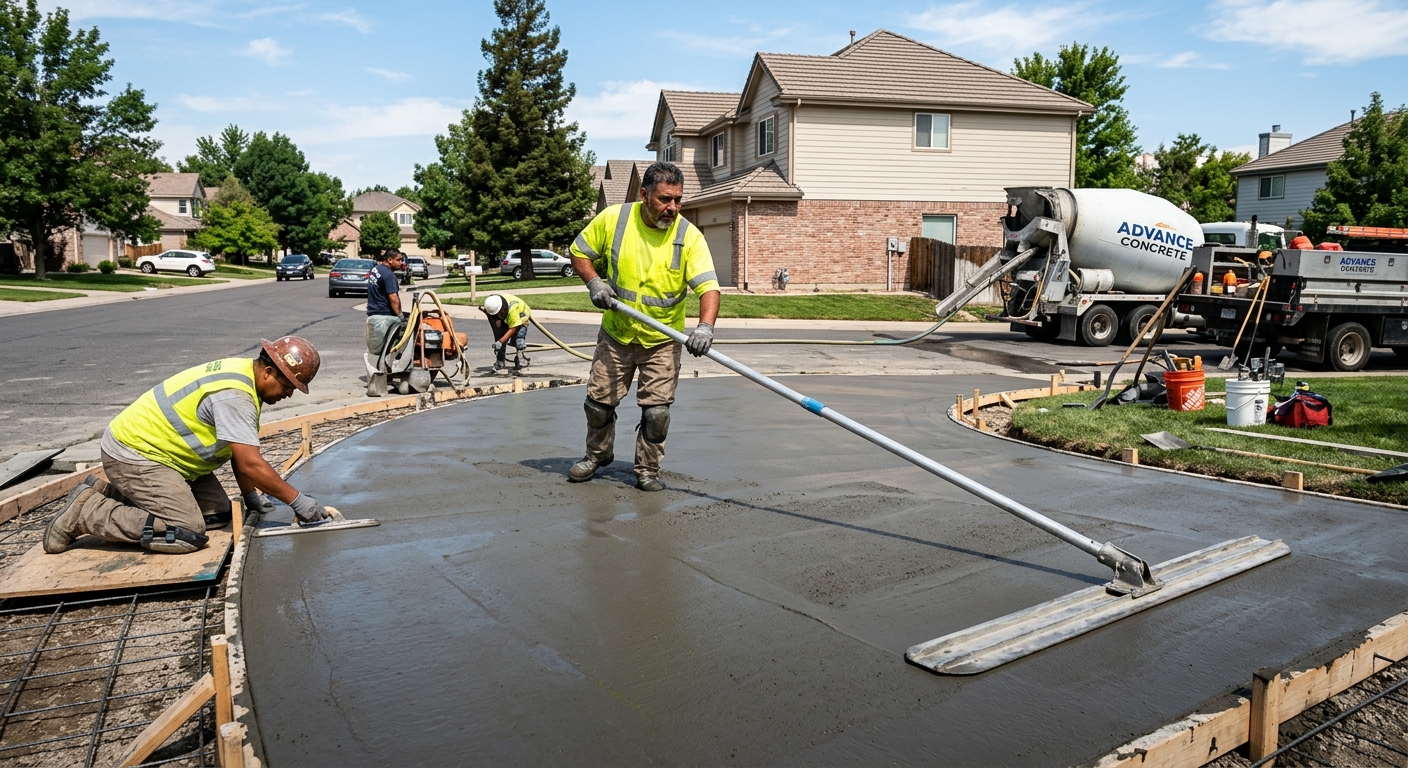
Concrete work options and costs in Logan Lake
In Logan Lake, concrete work is all about building for freeze–thaw. With about 890 homeowner households (83.6% of households own) and single-detached homes making up 63.4% of dwellings, most concrete flatwork demand is driven by driveways, patios, walkways, and garage slabs that need to stay solid through interior BC winter cycles (Statistics Canada, 2021 Census). In the Thompson–Okanagan, contractors typically design for frost depth—usually in the 45–60 cm range—and they don’t rely on “minimum thickness” rules that can underperform. That matters because frequent cold snaps and thawing can stress weak subgrades and unprotected edges, pushing costs up versus warmer parts of the province.
We also see the market tighten around pour season. Excavation, forming, and cold-weather protection (insulation blankets, curing compounds, careful timing) can add labour even when the concrete volume looks modest. Demand is especially high around areas with older home stock—logically, many homes built before 1981 still get driveway and walkway replacements as families update drainage and upgrade curb appeal. In Logan Lake, that often shows up near the core residential streets where access is manageable for equipment but grading and tie-ins are required. Next, compare common concrete options and realistic price bands in the table below.
| Application |
Typical Size |
Key Spec |
Finish Option |
Price Range |
| Concrete driveway (standard broom finish) |
400–600 sq. ft. |
Frost-appropriate base + air-entrained concrete, control joints |
Broom finish |
$18,000–$28,000 |
| Exposed aggregate driveway |
400–600 sq. ft. |
Frost-appropriate base + air-entrained concrete, proper curing |
Exposed aggregate |
$22,000–$34,000 |
| Stamped concrete driveway or patio |
300–500 sq. ft. |
Air-entrained mix, release agent, stamped finish with joint control |
Stamped (concrete with texture and colour) |
$24,000–$38,000 |
| Plain concrete patio or walkway |
150–300 sq. ft. |
Compacted granular base + air-entrained concrete, edging |
Float & broom (light texture) |
$14,000–$24,000 |
| Garage floor (interior slab) |
500–700 sq. ft. |
Vapour barrier (as needed) + compacted base, reinforcement if required |
Broom finish or light trowel |
$12,000–$22,000 |
| Foundation footings (structural, below frost) |
Varies by design |
Below-frost excavation, reinforcement, engineered spec |
Structural concrete |
$220,000–$350,000 |
Prices are estimates only and vary by project scope, site access and material selection.
What affects the price of concrete work in Logan Lake
Concrete quotes for the “same size” project can swing by 30–50% across Thompson–Okanagan and other parts of BC because the spec changes with climate and site conditions. In Logan Lake, the design frost depth and freeze–thaw cycles dictate how deep and how well-supported the system needs to be. Contractors build footings and foundation elements to sit below the design frost depth (not just a shallow minimum), and exterior slabs typically use air-entrained concrete so water exposure and repeated temperature cycling don’t translate into freeze heave or scaling. In colder interior pockets, the practical pour season is shorter, so there’s more labour devoted to excavation scheduling, temperature protection, and curing control—especially around shoulder months. You’ll also hear different approaches to joints and sealing because de-icing salts can accelerate surface spalling when the finish and moisture management aren’t right.
Two examples from Logan Lake that commonly push costs upward: (1) a driveway replacement where the old base is soft or poorly drained—extra excavation and granular re-build can add substantial labour; and (2) a stamped patio or exposed finish where formwork, release prep, and finish labour are higher than a plain broom surface. Conversely, costs can drop when site access is straightforward and the subgrade is stable—then you can keep reinforcement and base prep to what’s truly required. A standard broom-finished driveway typically tracks the $18,000–$28,000 band, while stamped options often move into the $24,000–$38,000 range because of finish labour and tighter control needs during the pour.
| Price Factor |
Why It Matters |
Cost Impact |
| Frost line depth |
Determines footing depth and form height |
More excavation and rebar placement; higher foundation/footing pricing |
| Site preparation |
Excavation, grading, compacted granular base |
Soft subgrade or poor drainage can add days of work |
| Reinforcement |
Rebar or wire mesh requirement |
Material cost + labour for placement/chairs/ties |
| Mix design |
Air-entrainment and compressive strength spec |
Higher material spec, better durability; prevents premature scaling |
| Finish type |
Broom vs. stamped vs. exposed aggregate |
Stamped/exposed requires more steps and crew time |
| Pour size and concrete truck access to site |
Speeds up the pour and reduces labour hours |
Long carries, steep grades, or limited access can raise labour |
| Cold-weather curing precautions |
Heating and blankets to protect strength gain |
Extra supplies and supervision in cool/wet conditions |
| Control joint pattern and sealing cost |
Limits random cracking and manages moisture at the surface |
Joint cutting + sealing can add cost but reduces future patching |
Permits & regulations in British Columbia
In British Columbia, structural concrete work usually needs a building permit and often requires engineered drawings reviewed as part of the municipal building permit process. That typically includes footings, foundation walls, and grade beams—anything that supports the structure or is part of the load-bearing system. Concrete flatwork like patios, walkways, and many driveways usually does not require a permit by itself, unless it changes lot grading, impacts drainage, affects impervious surface coverage limits, or encroaches into a municipal right-of-way. Because rules can be project-specific, confirm with the local authority before breaking ground.
For Logan Lake homeowners, verifying a contractor is practical and repeatable:
- Licence/registration: check the contractor’s business details through the appropriate BC registry sources and any publicly listed trade registration info they provide in their proposal package.
- Liability insurance: request a current Certificate of Insurance (COI) showing adequate general liability limits for concrete work and naming you/your property as required (some contracts specify an additional insured endorsement).
- WSBC coverage (WCB/WSIB equivalent): ask for proof of clearance/coverage documents showing the contractor is registered and insured for their workers.
- References: get contact info for similar-scale Logan Lake projects, ideally ones poured in comparable freeze–thaw conditions (interior BC winters).
Before you sign, also confirm who pulls the permit (if required) and what is included in the scope for inspections and documentation.
Getting concrete right in Logan Lake's freeze-thaw climate
Concrete in Logan Lake most often fails when the system can’t handle repeated expansion and contraction. The usual culprits are inadequate base prep, lack of air-entrainment, weak joint planning, and curing that doesn’t let the concrete reach strength before it gets exposed to cold or rapid drying. For the Thompson–Okanagan, the right specs are straightforward: build a compacted granular base to the frost-appropriate depth for your soil and footing conditions; place air-entrained concrete (commonly 5–7% air content for exterior flatwork) so freeze–thaw water doesn’t disrupt the paste; and include control joints at the right spacing to limit random cracking. Equally important is curing—aim for at least 7 days under proper conditions (and add insulation blankets or heat if the forecast drops cold), then allow a full cure before applying sealers.
Finally, sealing matters locally. A penetrating sealer applied after the cure period helps repel water and reduces the way de-icing salts sit on and penetrate the surface during winter. If you skip sealing, you may see early surface roughening or spalling around edges sooner than you expected—especially on driveways where the salt exposure is constant.
A common cost decision: choosing a plain patio versus stamped. If a contractor quotes a plain patio at the $14,000–$24,000 band, and stamped comes in closer to $24,000–$38,000, the price difference is justified when you’re paying for extra finish labour and a controlled pour schedule. If the base prep and joint plan aren’t strong either way, the look won’t last—so ask for the technical details, not just the style.
| Spec |
Why It Matters in Logan Lake |
What to Ask For |
Impact if Skipped |
| Compacted granular base (depth?) |
Supports the slab through frost movement and drainage |
Granular depth to frost-appropriate design + compaction method |
Settlement and cracking; edge heave in freeze–thaw |
| Air-entrained concrete mix (target air %?) |
Prevents freeze–thaw scaling and spalling in exterior exposure |
Air content target (typically 5–7% for exterior flatwork) |
Surface deterioration and premature pitting/scaling |
| Compressive strength (MPa rating) |
Strength gain must be adequate for traffic and seasonal stress |
Minimum 32 MPa spec (or as engineered) |
Lower durability and higher risk of surface damage |
| Control joints (spacing per ACI guidelines) |
Directs cracking to planned locations |
Joint spacing and type (saw-cut timing) appropriate to thickness |
Random cracking; widened joints; moisture intrusion |
| Minimum 7-day curing period |
Ensures strength development before cold exposure and water contact |
Cure conditions and protection plan if temperatures drop |
Reduced strength and increased cracking risk |
| Penetrating sealer (when applied after cure) |
Helps manage water and salt exposure |
Sealer type and timing (commonly after full cure, around 28 days) |
Faster wear, spalling risk, and more staining |
How to choose a concrete work contractor in Logan Lake
Choosing a concrete contractor in Logan Lake comes down to checking three things: capability, proof, and clarity. First, verify British Columbia coverage and financial responsibility. Ask for a Certificate of Insurance for general liability that is current and appropriate for concrete work (including general site risk). Next, request proof of WSBC/WCB coverage for their workers—have it match the period of the project and confirm it’s active. For licensing/registration, confirm their business details and ensure they can document credentials relevant to the work they’re bidding.
Then lock in quality with quotes. Get 2–3 itemised written quotes, ideally with separate line items for excavation, forms, base preparation (granular depth and compaction), reinforcement, concrete supply/mix spec, finish labour, saw-cutting joints, curing/protection, and sealing (if included). Don’t accept a vague “we’ll pour concrete” scope—ask what’s excluded (disposal of excess soil, trenching for drainage, saw-cut timing, traffic control, permit pull if required). For warranties, confirm the workmanship warranty length and whether it’s tied to the finishing system (for example, sealing timing). If there’s a product warranty, ask who provides it, what defects it covers, and whether it’s transferable if you sell the home.
Keep the payment schedule fair: never pay more than 10–15% upfront for mobilization, and hold back a portion until the job is complete and cleaned. Require a timeline in writing with a start date and estimated completion date, especially around cold snaps—frozen ground and short days can derail schedules.
- Ask for their proposed footing/foundation approach below frost depth (where applicable).
- Confirm the concrete mix is air-entrained for exterior flatwork.
- Require granular base depth and compaction method in writing.
- Get reinforcement details: mesh vs. rebar, spacing, and placement elevation.
- Clarify joint layout, saw-cut timing, and whether joints are sealed.
- Ask what happens if the forecast turns cold (blankets, heat, curing compound).
- Confirm cleanup and waste/disposal are included or explicitly excluded.
- Check the quote includes edging, dowels/tie-ins, and transitions to existing slabs.
- Require a detailed finish description (broom type, stamp system, exposed aggregate process).
- Ensure the crew and equipment are scheduled for one continuous pour (when applicable).
- Verify insurance COI and WSBC/WCB proof are valid before work begins.
- Get warranty terms in writing, including what you must do to maintain it.
Concrete red flags in Logan Lake include: vague mix specs (no air-entrainment or strength number), no plan for curing protection when nights get cold, missing joint layout details, no mention of base depth/compaction, and quotes that treat sealing as “optional” for exterior slabs that see de-icing salt.
Frequently asked questions — concrete work in Logan Lake
Concrete vs pavers for a patio in Logan Lake?
In Logan Lake’s freeze–thaw climate, both concrete and pavers can perform well, but they manage moisture differently. Concrete patios usually come out simpler: a properly compacted granular base, air-entrained concrete, control joints, and curing are the big success factors. Pavers can look great and are easier to repair one section at a time, but they depend heavily on correct bedding sand and drainage to avoid shifting during seasonal freeze cycles. For pricing, a plain concrete patio typically falls in the $14,000–$24,000 band depending on size and prep, while textured finishes cost more. If your patio is close to a driveway where salt spray is heavy, ask either installer how they’ll handle water and joint detailing to reduce spalling or movement.
How long does a concrete driveway last?
A well-built driveway in British Columbia often lasts 20 to 30 years, and sometimes longer, but lifespan is driven by the details. In Logan Lake, the freeze–thaw cycle makes proper base preparation and air-entrained concrete essential. If the contractor designs footings/base below the frost-appropriate zone, uses control joints correctly, and cures the slab properly, you reduce cracking and scaling. Sealing also helps because de-icing salt can accelerate surface wear. The cost difference between a basic broom finish and a decorative driveway reflects labour and finish complexity, not just appearance—so a higher bid can be justified when it includes the right mix spec and joint/seal plan. If you’re shopping quotes, look for line items on base, air content, joints, and curing rather than only the “per square foot” number.
What is air-entrained concrete and why does it matter here?
Air-entrained concrete has tiny microscopic air bubbles built into the mix. In Logan Lake, those bubbles give water somewhere to expand when it freezes, which significantly reduces cracking and surface scaling. Without air-entrainment, exterior slabs are much more likely to spall—especially where the slab sees repeated wetting from snow melt and de-icing salt. That’s why Thompson–Okanagan interior practice typically specifies air-entrained mixes for driveways and walkways. Ask your contractor to provide the air content target (commonly 5–7% for exterior flatwork) and the compressive strength requirement (often a minimum 32 MPa for the slab type). This is one of the clearest technical differences between low-cost and durable concrete bids.
How do I prepare the base for a concrete slab?
Base preparation is where durability is won or lost in Logan Lake. Start with excavation to the design depth, then grade for proper drainage, and install a compacted granular sub-base to the frost-appropriate requirements for your soil and slab thickness. Contractors should compact in lifts and verify the base is firm before forms and rebar go in. Drainage details matter because trapped water accelerates freeze–thaw stress. A good contractor will also confirm how they’ll handle transitions—like connecting to an existing driveway—so the slab doesn’t break at the edges. If you’re comparing quotes, insist on seeing granular depth and compaction expectations in the scope. That’s often a major reason interior BC pricing sits above generic “BC averages.”
How do I compare concrete quotes?
To compare concrete quotes in Logan Lake, don’t rely on a single total. Ask for itemised pricing that breaks out excavation, granular base prep (including depth/compaction), reinforcement (mesh vs. rebar and placement), concrete mix spec (air content and strength), finish labour, joints (type and saw-cut timing), and curing/protection. Clarify what’s included for disposal of excess soil and whether site access or traffic control adds cost. Also compare finish options: a broom-finished driveway might land around the $18,000–$28,000 band, while stamped concrete often moves closer to the $24,000–$38,000 band because of additional labour and process control. Finally, confirm warranty length and any sealing requirements.
Can concrete be poured in cold weather in Logan Lake?
Yes, concrete can be poured in cold weather in Logan Lake, but it must be done with the right protection plan. The Thompson–Okanagan freeze–thaw environment means the concrete needs time to reach strength before freezing damages early hydration. Contractors typically use methods like heated enclosures, insulating blankets, and temperature monitoring, and they may adjust the schedule to avoid pouring when the risk of freezing the fresh mix is too high. Ask your contractor for their cold-weather curing procedure, including how they’ll keep the slab safe for at least the initial curing period. If a quote doesn’t mention curing protection, it’s a warning sign. For exterior slabs, also ensure the mix is air-entrained and designed for the exposure so durability matches the climate reality.