Concrete work options and costs in Dunbar-Southlands
Dunbar-Southlands homeowners typically choose concrete because it holds up well to Vancouver’s wet swings and the Lower Mainland–Southwest freeze–thaw rhythm. With a population of 21,245 in the broader area (Statistics Canada, 2021 Census), there’s a steady market for driveway and patio work around established residential pockets, especially in the flatter streets near portions of West Boulevard and around Dunbar Village. You’ll also notice a lot of single-detached homes here, which is the primary driver of concrete flatwork demand—think driveways, walkways, and garden patios that see daily use.
In this region, pricing isn’t just “thicker concrete.” Our local practice is based on a design frost depth of roughly 450 mm / 18", so exterior footings and thickened edges must sit below that line to reduce frost heave risk. Even though winter is mild compared with interior BC, coastal-wet conditions mean saturated soils, drainage detail, and longer curing windows often become the difference between a quick pour and a durable slab. Contractors also plan around rain, cool nights, and high humidity, which can extend the schedule and increase labour for protection (curing blankets, sealers, and careful finishing).
That’s why two quotes for the “same driveway” can land in different price bands—finish type, base build-up, and reinforcement details can shift the total. Use the table below to compare common options for Dunbar-Southlands and then match the spec to your site conditions.
| Application |
Typical Size |
Key Spec |
Finish Option |
Price Range |
| Concrete driveway (standard broom finish) |
300–450 sq ft |
Compacted granular base, air-entrained mix for exterior, control joints |
Broom finish, optional light sealer |
$18,000–$28,000 |
| Exposed aggregate driveway |
300–450 sq ft |
Compacted base, air-entrained mix, controlled surface retardation |
Exposed aggregate (surface stones revealed) |
$22,000–$34,000 |
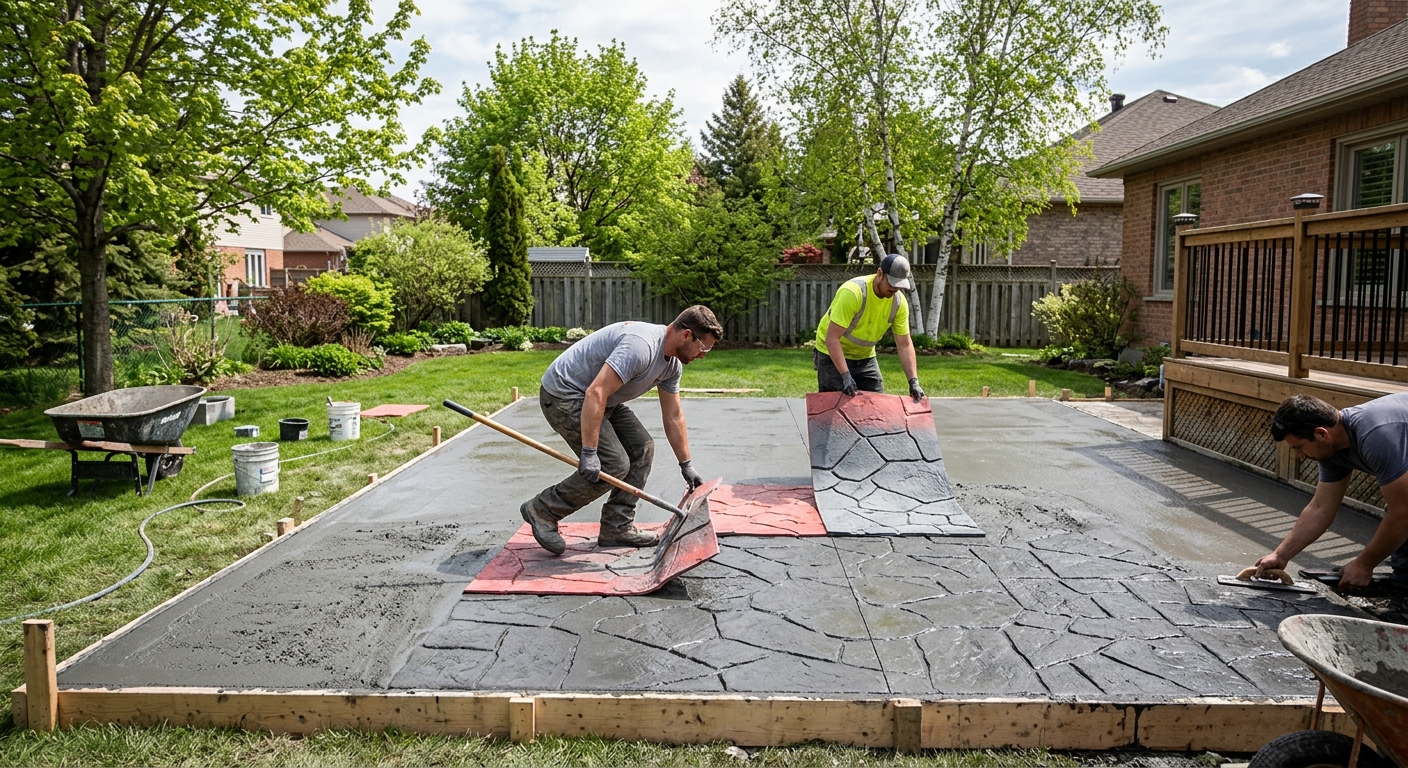
| Stamped concrete driveway or patio |
300–500 sq ft |
Compacted base, air-entrained mix, properly planned joints |
Stamped patterns with release and colour |
$26,000–$40,000 |
| Plain concrete patio or walkway |
150–300 sq ft |
Compacted granular base, air-entrained exterior mix |
Broom or smooth trowel (non-slip texturing as needed) |
$16,000–$26,000 |
| Garage floor (interior slab) |
400–600 sq ft |
Vapour barrier where appropriate, standard mix, saw cuts |
Floated finish with densifier/sealer optional |
$14,000–$22,000 |
| Foundation footings (structural, below frost) |
Per lineal metre (varies) |
Reinforced concrete, below design frost depth, engineered as required |
Structural finish (not decorative) |
$200–$350 |
Prices are estimates only and vary by project scope, site access and material selection.
What affects the price of concrete work in Dunbar-Southlands
If you’re getting quotes in Dunbar-Southlands, it’s common to see the same concrete scope spread by 30–50% across the Lower Mainland–Southwest and the broader British Columbia market. The biggest reason isn’t contractor “pricing style”—it’s the spec required to survive our wet coastal winters and freeze–thaw cycles. Here, the design frost depth we work around is approximately 450 mm / 18", so exterior footings and thickened edges are typically placed below that depth. When excavation, rebar placement, and base preparation are done properly, the slab performs; when they’re trimmed to hit a low number, you often pay later in scaling, spalling, and expensive repairs.
Quoting differences also come from scheduling and curing. Because Vancouver-area winters run cool and humid, contractors frequently use curing blankets, sealers, and longer cure timelines to reach strength and durability. That adds labour compared to regions with longer warm pour seasons. Cold-weather precautions can push costs up quickly. De-icing salt accelerates surface breakdown when surfaces aren’t sealed or when the mix lacks adequate air-entrainment.
Two examples you’ll feel in Dunbar-Southlands: first, a backyard patio on soft or poorly drained soil may require deeper granular base and improved drainage—raising the job above the $16–$26 per-sq-ft patio band you might see for straightforward sites. Second, a “decorative but simple” stamped driveway may still need the full engineered base and correct joint strategy; the price jump toward the $22–$36 stamped & decorative band is often justified if the contractor also includes proper joint layout and sealing. On older homes with existing walkways and garden edging, demolition and haul-off can also swing the final total by hundreds to thousands.
| Price Factor |
Why It Matters |
Cost Impact |
| Frost line depth — determines footing depth and form height |
Footings and thickened edges must sit below the design frost depth to limit frost heave. |
Higher excavation and forming; can raise the job materially for foundations. |
| Site preparation — excavation, grading, compacted granular base |
Concrete performance depends on a stable subgrade and properly compacted base. |
Loose soils or drainage corrections increase labour and granular material. |
| Reinforcement — rebar or wire mesh requirement |
Controls cracking under load and supports structural requirements. |
Adds material and placement time; may be essential for exterior slabs. |
| Mix design — air-entrainment and compressive strength spec |
Air entrainment helps concrete resist freeze–thaw scaling and spalling. |
Better durability usually costs more than basic mixes. |
| Finish type — broom vs. stamped vs. exposed aggregate |
Decorative finishes require more labour, timing control, and material handling. |
Stamped/exposed typically adds significant cost versus broom finish. |
| Pour size and concrete truck access to site |
Access affects how crews place, consolidate, and finish without delays. |
Limited access can increase labour hours and pump/placement charges. |
| Cold-weather curing precautions — heating and blankets |
Cool nights and humidity slow strength gain and increase risk if not protected. |
Warmer-protection materials and extra labour add to the total. |
| Control joint pattern and sealing cost |
Joints and sealing manage cracking and protect against water and de-icing salts. |
Skipping or rushing can reduce upfront cost but increases repair risk. |
Permits & regulations in British Columbia
In British Columbia, structural concrete work such as footings, foundation walls, and grade beams generally requires a building permit, and engineered drawings are often reviewed as part of that process. For concrete flatwork—driveways, patios, and walkways—a permit is often not required, but it can be required when the work affects lot grading, drainage, or impervious surface coverage limits, or when changes impact municipal right-of-way elements (for example, certain curb tie-ins or sidewalk/driveway approaches). Before breaking ground in Dunbar-Southlands, confirm details with the local authority.
No matter which permit path applies, you should verify the contractor is properly insured and set up for the job. Ask for a current certificate of insurance showing liability coverage (and confirm it’s active for the project dates). Also confirm they have the appropriate worker coverage—commonly WCB coverage in BC—so you’re not stuck with unexpected liability if there’s an on-site incident.
To verify compliance step-by-step as a homeowner: (1) check the contractor’s licence/registration through the BC government contractor registry/online listings where applicable; (2) request a certificate of insurance and confirm project address coverage; (3) ask for proof of WCB clearance (a clearance letter or equivalent proof); and (4) ask for references from similar-scope jobs in the Vancouver–Surrey–Abbotsford area so you know they’ve handled our drainage and curing conditions.
Getting concrete right in Dunbar-Southlands's freeze-thaw climate
In Dunbar-Southlands, the most common concrete failures are tied to how water moves through the slab system during freeze–thaw cycles. When the base isn’t built correctly (insufficient compacted granular, weak subdrainage, or incorrect grading), water saturates the soil under the concrete. As temperatures drop and ice forms, the slab can crack and then scale or spall at the surface—especially on driveways and walkways where de-icing salts are used. That’s why the job spec matters more than the concrete “brand” on the ticket.
To spec the system correctly, start with base preparation: a well-compacted granular sub-base to the right depth for the soil and local frost considerations, with drainage addressed so water doesn’t pool under the slab. Next, specify the mix: for exterior flatwork in a coastal-freeze region, ask for air-entrainment (typically around 5–7% air content) and a minimum 32 MPa compressive strength for durability. Control joints should be placed to limit random cracking, and the curing plan must be realistic for our cool, humid conditions—plan for minimum 7 days under proper conditions, using curing blankets when needed. Finally, sealing should be done with a penetrating sealer applied after the cure (commonly around 28 days post-pour) to help repel moisture and de-icing salt intrusion.
When homeowners skip one spec, the savings can be short-lived. For example, choosing a plain broom-finish patio may land near the $16–$26 pricing range, but swapping to a stamped or exposed aggregate finish can be worth the cost (and not just “for looks”) if the contractor also keeps the same proper base, air-entrained mix, and joint/sealing plan—otherwise the decorative surface may show deterioration just like a basic slab.
| Spec |
Why It Matters in Dunbar-Southlands |
What to Ask For |
Impact if Skipped |
| Compacted granular base (depth?) |
Reduces pumping and keeps the slab stable as wet soils freeze and thaw. |
Base depth tied to your site conditions; confirm granular type and compaction requirements. |
Settlement, cracking, and faster deterioration from trapped moisture. |
| Air-entrained concrete mix (target air %?) |
Provides freeze–thaw resistance to limit surface scaling and spalling. |
Request air-entrainment details (typically 5–7% for exterior flatwork) and confirm exterior-grade mix. |
Increased risk of spalling in BC winters, especially with de-icing salts. |
| Compressive strength (MPa rating) |
Ensures the slab achieves design strength for service conditions. |
Ask for minimum 32 MPa and whether strength testing/cure conditions are documented. |
Lower strength can lead to surface wear and premature cracking. |
| Control joints (spacing per ACI guidelines) |
Controls where cracks happen so they don’t become random and damaging. |
Request joint layout and spacing plan based on slab dimensions and thickness. |
Random cracking and higher water penetration risk. |
| Minimum 7-day curing period |
Cool nights and humidity slow hydration if curing isn’t protected. |
Confirm cure protection plan (blankets/insulation when required) and cure timeline in writing. |
Surface damage, reduced durability, and weaker long-term performance. |
| Penetrating sealer (when applied after cure) |
Reduces moisture and chloride intrusion from rain and de-icing salts. |
Penetrating sealer after cure (commonly around 28 days post-pour) and confirm product type. |
Faster scaling/spalling and higher maintenance costs. |
How to choose a concrete work contractor in Dunbar-Southlands
Choosing the right contractor in Dunbar-Southlands comes down to verification, clarity, and a spec-minded approach to our wet-freeze climate. First, confirm British Columbia compliance: ask for the contractor’s current licence/registration (where applicable), their liability insurance, and proof of WCB coverage. To check each, you can (1) search online for their contractor registration/licence status using BC’s contractor registry tools; (2) review the certificate of insurance and confirm the project address and coverage dates match your timeline; and (3) request a WCB clearance letter or proof of coverage—don’t rely on verbal assurances.
Next, get 2–3 itemised written quotes rather than lump sums. You want line items for excavation/site prep, formwork, reinforcement, concrete supply, placing, finishing, curing/protection, disposal/haul-off, and sealing (if included). Read the scope carefully: what’s excluded (for example, saw-cutting existing slabs, regrading, or permits)? Is disposal included? Will they haul concrete and debris away, and where will they dispose it? Also ask about permitting responsibility if grading changes or right-of-way impacts apply.
For warranty and payment, insist on a workmanship warranty length and whether it covers surface defects and cracking within normal design expectations. Payment should not exceed 10–15% upfront; hold back a portion until the job is complete and cleaned up. Finally, get your start date and completion estimate in writing so you aren’t caught by rain delays without a plan.
- Request licence/registration details and confirm they match the company name on the quote.
- Verify liability insurance certificate (active dates, coverage limits, project/address).
- Ask for WCB proof/clearance letter before work begins.
- Get itemised pricing: demo, excavation, base, rebar/mesh, concrete, finishing, curing, sealing, disposal.
- Confirm air-entrained exterior mix and minimum 32 MPa compressive strength.
- Confirm control joint spacing and a joint layout sketch tied to slab dimensions.
- Ask how they protect curing in cool, humid, or rainy forecasts (blankets/curing plan).
- Verify reinforcement plan (where mesh/rebar is used, tie plans, and slab support).
- Check whether they include sealing and when (after cure, commonly about 28 days).
- Require a disposal/haul-off line item if demolition is involved.
- Keep payment staged: max 10–15% upfront; hold back until final clean-up and walkthrough.
- Get a written schedule with a weather/rain contingency plan.
Concrete contractor red flags in Dunbar-Southlands: they can’t explain their air-entrainment and joint plan; they quote “standard concrete” without confirming exterior durability specs; they demand full payment upfront; they avoid discussing curing protection for cool/wet periods; or they provide only a vague lump sum with no line items for base prep, drainage, and disposal.
Frequently asked questions — concrete work in Dunbar-Southlands
Can concrete be poured in cold weather in Dunbar-Southlands?
Yes, concrete can be poured in cold weather in Dunbar-Southlands, but it requires the right protection and scheduling. In the Lower Mainland–Southwest, winters are generally milder than interior BC, yet we still get cool nights and occasional freeze conditions that can slow hydration. A good contractor will plan for a proper curing approach—often including curing blankets, insulation, and attention to concrete temperature—so the slab reaches design strength. For exterior flatwork and foundations that must survive freeze–thaw cycles, the mix spec (including air-entrainment) matters just as much as temperature control.
Price-wise, the same driveway can cost more in cold-season conditions due to protection labour and extended cure time, even if your finish choice (for example, a broom driveway in the $18–$28 band) stays the same. Always ask how they’ll protect the pour and what the expected cure timeline is.
How do I maintain concrete in Dunbar-Southlands's freeze-thaw climate?
Maintenance in Dunbar-Southlands is about keeping water and de-icing salts from attacking the surface. Start with sealing: if your contractor includes a penetrating sealer, it’s typically applied after cure (often around 28 days post-pour). This helps reduce moisture and chloride intrusion from rain and winter use. Sweep debris regularly so sand and grit don’t grind the surface. If you notice early scaling, fix it promptly—small defects expand faster during wet winters and repeated freeze–thaw cycles.
For snow removal, use plastic shovels where possible and avoid aggressive scraping that damages the top surface. When salting, use a limited amount of de-icer and avoid repeated heavy applications; salt accelerates spalling on poorly protected or non-air-entrained surfaces. If you’re comparing options, a plain patio in the $16–$26 range with the right curing and sealing can outlast a cheaper slab that skipped proper durability specs.
What causes concrete to spall in Dunbar-Southlands winters?
Spalling—flaking or popping of the concrete surface—usually comes from water getting into the slab and then freezing. In Dunbar-Southlands and the Lower Mainland–Southwest, coastal rainfall and saturated soils increase the chance of water penetration, and freeze–thaw cycles drive expansion stresses. A common root cause is inadequate air-entrainment in the exterior mix. Air-entrainment creates microscopic space for freezing water to expand without fracturing the paste.
Other contributors include poor base prep that lets the slab move, weak drainage that allows water to pool, and skipping control joint planning so cracks open where they shouldn’t. De-icing salts compound the problem by introducing chlorides that speed deterioration. If a contractor only promises “good concrete” without specifying exterior air content and durability steps, spalling risk climbs—regardless of whether the project is a driveway or walkway that sits in the $18–$28 or $16–$26 pricing bands.
What is rebar and when is it required in British Columbia?
Rebar is steel reinforcement bars embedded in concrete to carry tensile stresses and control cracking. In British Columbia, whether rebar is required depends on the engineered design and the structural role of the concrete element. For structural work like footings, foundation walls, and grade beams, reinforcement is commonly required and is typically driven by engineered drawings reviewed through the building permit process. For exterior flatwork, rebar or wire mesh may be used based on slab thickness, soil support, anticipated loads (vehicles on a driveway), and the contractor’s design method.
Because Dunbar-Southlands has a shallow design frost depth (around 450 mm / 18") and relies on proper base prep to reduce freeze–thaw movement, the right reinforcement placement works with the full system—base, joints, and air-entrained mix. Ask your contractor to show the reinforcement plan in writing (bar size, spacing, and where it sits in the slab) rather than assuming “mesh is mesh.”
How long does a concrete project take in Dunbar-Southlands?
Typical timing in Dunbar-Southlands depends on the scope, site access, weather, and curing. A driveway or patio often involves demolition (if needed), excavation and base compaction, forming, reinforcement placement (if included), concrete delivery and finishing, and then curing and protection. The pour day itself is usually only a portion of the total schedule, especially in the Lower Mainland–Southwest where cool nights and rain can affect finishing and curing.
As a practical guide, many flatwork projects finish in about 1–3 days of active work, but the schedule extends because you should plan for curing time before you can drive or load the slab and before applying sealing. Many contractors keep a minimum 7-day curing approach before heavier use, and penetrating sealers are often applied after full cure (commonly around 28 days). If you’re budgeting, timing can influence cost; seasonal conditions can push quotes upward even for finishes that normally land in the $18–$28 driveway or $22–$36 stamped bands.
What is a concrete overlay and is it suited to Dunbar-Southlands?
A concrete overlay is a new concrete layer placed over an existing slab (after surface preparation, usually grinding and patching). It can be a cost-effective option when the original concrete is still structurally sound, but the surface is worn, cracked cosmetically, or uneven. In Dunbar-Southlands, overlay can be suited to your home if the base is stable, drainage is corrected, and preparation is thorough—because any hidden weakness in the old slab can telegraph through and create cracking or early deterioration.
Overlays also depend heavily on freeze–thaw performance. Exterior durability still requires the right mix design and air-entrainment; otherwise, moisture trapped between layers can worsen scaling or spalling. If your existing driveway has major joint failure or recurring water pooling, replacement is often the better long-term fix. If you’re deciding between overlay and new concrete, compare quotes item-by-item—overlay jobs should still include prep, bonding steps, and curing/sealing plans, not just “pour overtop.”