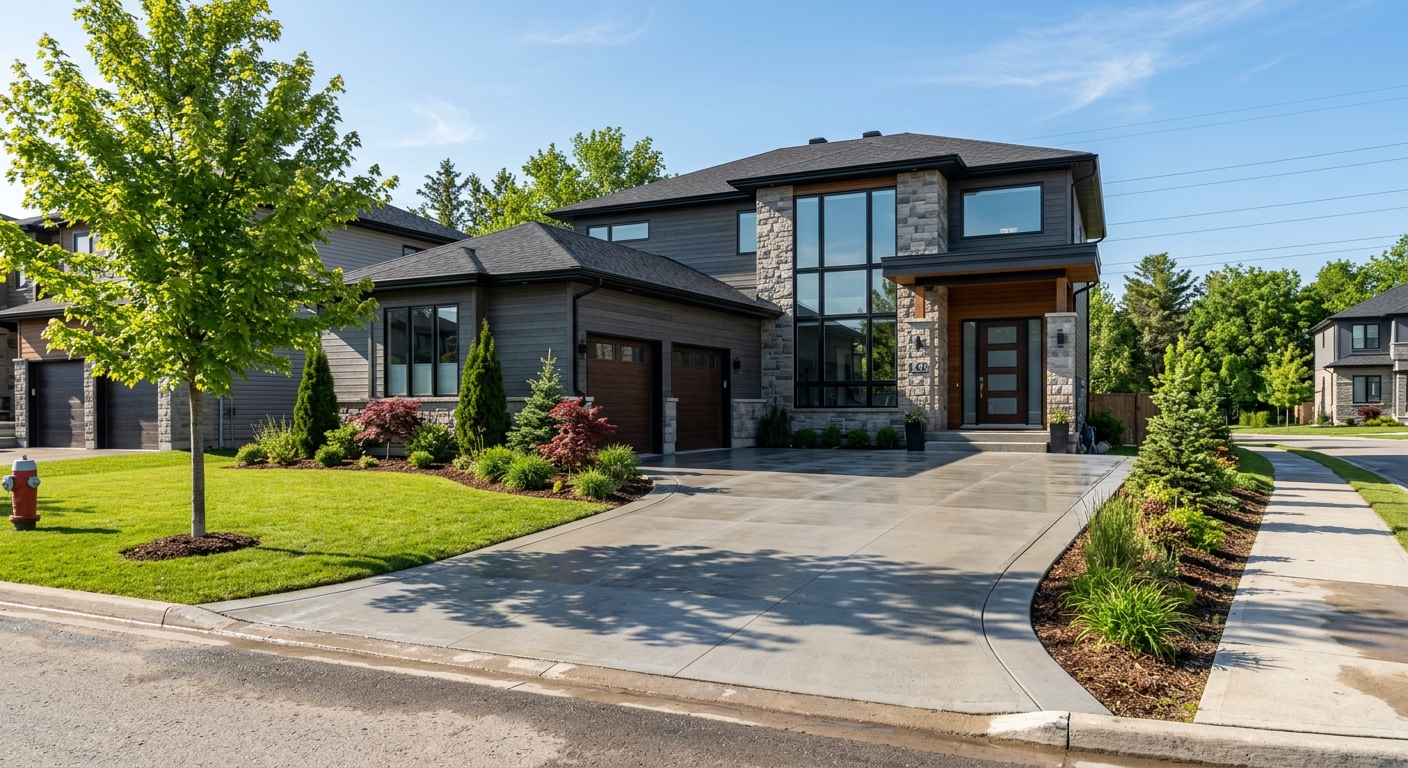
Concrete work options and costs in Merritt
Merritt homeowners typically choose concrete flatwork for driveways, patios and walkways because it handles daily wear better than many alternatives—especially in an interior BC climate that cycles between freezing nights and warmer daytime thaw. With 65.0% of local dwellings being single-detached homes (Statistics Canada, 2021 Census), there’s steady demand for exterior work like driveway replacement and new front entries. Concrete also shows up often in older neighbourhoods: 59.3% of homes were built before 1981 (Statistics Canada, 2021 Census), which means more retrofit opportunities where drainage and slab performance are already being tested.
In the Thompson–Okanagan, concrete pricing is shaped by frost depth and freeze–thaw cycles. We design footings and foundation elements to sit below frost (commonly around the 45–60 cm range as a practical basis for layout, with deeper excavation when soil conditions require), not just the shallow “minimum” people hear online. Frequent winter freeze–thaw means contractors build up the granular base properly for drainage, specify air‑entrained concrete for exterior slabs, and plan control joints to manage shrinkage and thermal movement. That translates into higher labour and material discipline than generic “southern BC” pricing.
In Merritt, trades are especially busy around commercial-to-residential corridors and established areas like the Nicola Valley Highway (commonly referred to by locals as the Hwy 5 corridor), where replacement and small upgrades happen in quick succession during the short pour season. Below is a practical comparison of common options so you can budget and then align the quote with the right specs.
| Application |
Typical Size |
Key Spec |
Finish Option |
Price Range |
| Concrete driveway (standard broom finish) |
24 ft × 10 ft (240 sq ft) |
Air-entrained exterior mix; compacted granular base; control joints |
Broom finish; straight or simple expansion detailing |
$4,300 – $6,700 |
| Exposed aggregate driveway |
24 ft × 10 ft (240 sq ft) |
Proper curing + wash/retard system timing; sealer for salt resistance |
Exposed aggregate with clean, even texture |
$5,100 – $8,400 |
| Stamped concrete driveway or patio |
200 sq ft |
Integral colour or two-step colour; air-entrained mix for freeze–thaw |
Stamped patterns (e.g., slate/stone look) with release and colouring |
$6,000 – $9,600 |
| Plain concrete patio or walkway |
12 ft × 12 ft (144 sq ft) |
Exterior mix; compacted base; slight slope to drainage |
Float/steel trowel then light broom for traction |
$2,000 – $3,600 |
| Garage floor (interior slab) |
20 ft × 20 ft (400 sq ft) |
Interior mix; vapour barrier if required by site; saw-cut joints |
Steel-trowel finish (often with light broom at edges) |
$7,200 – $12,200 |
| Foundation footings (structural, below frost) |
Varies by home; common estimate per linear metre |
Excavation to design grade; rebar per engineering; concrete below frost |
Structural formwork finish (not decorative) |
$220 – $350 |
Prices are estimates only and vary by project scope, site access and material selection.
What affects the price of concrete work in Merritt
In Merritt and across the Thompson–Okanagan, quotes for what looks like the “same” concrete job can swing by 30–50%. The big reason is that exterior concrete specifications aren’t optional here—frost depth, freeze–thaw cycling, drainage and curing all drive material selection and crew time. A driveway poured with the wrong base build-up or without air‑entrainment may look fine at first, but it’s much more likely to scale or crack when temperatures repeatedly cross the freezing point.
Every spec starts with frost and movement control. Exterior footings must extend below the design frost depth so the ground doesn’t heave under the slab; the Thompson–Okanagan’s interior conditions mean formwork and excavation are often more substantial than people expect. All exterior slabs should use air‑entrained concrete mixes to survive repeated freeze–thaw cycles. Colder interior pockets also have a shorter practical pour season and can require cold-weather curing precautions—insulating blankets and, in some cases, temporary heating—so contractors charge for protection and slower scheduling. Finally, de-icing salts accelerate surface wear and spalling in freeze–thaw climates, which is why sealing and finishing quality matter.
Two practical cost examples in Merritt: (1) upgrading a standard broom driveway ($18–$28 per sq ft backbone band) to an exposed aggregate driveway typically costs more because of the wash/retard process and stricter finishing and curing timing; the texture is worth it when you want better salt-resistance and grip. (2) If a patio quote is “plain concrete” ($14–$24 band), the cost can still rise when the contractor must rebuild drainage or adjust base depth for frost-safe performance.
Home age matters, too. With 59.3% of homes built before 1981 (Statistics Canada, 2021 Census), many sites have older grading patterns that trap water—adding excavation and base replacement can shift pricing by thousands even before you discuss finish.
| Price Factor |
Why It Matters |
Cost Impact |
| Frost line depth |
Determines footing depth and form height |
Higher excavation and formwork can add significant labour and concrete volume |
| Site preparation |
Excavation, grading, compacted granular base |
Poor ground prep increases failure risk and usually increases rebuild time later |
| Reinforcement |
Rebar or wire mesh requirement |
Material + tying/install time; may be essential for driveways and larger slabs |
| Mix design |
Air-entrainment and compressive strength spec |
Exterior air content and strength requirements often raise material cost |
| Finish type |
Broom vs. stamped vs. exposed aggregate |
Stamped and exposed work adds colour, tools, timing and labour intensity |
| Pour size and concrete truck access to site |
Large pours need scheduling; tight access can require pumping |
Access limitations can add equipment and crew time |
| Cold-weather curing precautions |
Heating and blankets |
Winter protection increases labour hours and fuel/blanket costs |
| Control joint pattern and sealing cost |
Movement control and surface protection from salts |
More joints (done correctly) plus proper sealing is extra work but improves durability |
Permits & regulations in British Columbia
In British Columbia, structural concrete work generally needs municipal approval and is often tied to engineered drawings. This includes things like foundation walls, grade beams, footings, and other structural elements that support a building’s load path. For Merritt homeowners, the practical takeaway is: if the concrete is part of the structure (not just a surface), plan on permits and engineered specs reviewed by the local authority.
Concrete flatwork—patios, walkways, and typical driveways—usually does not require a building permit on its own. However, a permit may be required if the work changes lot grading, involves an alteration that affects stormwater drainage, increases impervious surface coverage beyond municipal limits, or encroaches near a municipal right-of-way. Always confirm with the local authority before you break ground.
To verify a contractor in Merritt (BC), do it step-by-step: (1) ask for their business licence/contractor registration details and confirm standing using the relevant online registry tools available for the trade, (2) request a current Certificate of Insurance showing liability coverage, and confirm the policy is active for the project dates and includes concrete work, and (3) confirm they carry required workers’ compensation coverage (WSIB/WCB equivalent coverage applies in BC). Then ask for references on similar-scale jobs in the Thompson–Okanagan, ideally with photos of finished surfaces and any repaired areas after a winter.
Getting concrete right in Merritt's freeze-thaw climate
Merritt’s freeze–thaw climate punishes shortcuts. Concrete fails here when water gets into the slab or subgrade and then expands during freezing, creating pressure that leads to cracking, scaling and—worst cases—spalling. The correct approach is to spec the job so it resists movement, sheds water, and cures properly in cooler interior conditions.
Start with base preparation: use a compacted granular sub-base to the correct depth for the site and frost requirements, and make sure drainage is right so the slab doesn’t sit in saturated soil. Next, mix design matters. For exterior flatwork, specify air‑entrainment targeting 5–7% air for freeze–thaw durability, and don’t accept a mix without the minimum strength requirement—commonly 32 MPa for many exterior applications depending on project specs. Then plan control joints: joints should be cut (or formed) at appropriate spacing so cracking happens where you intended, not randomly. Curing is another common problem: aim for at least 7 days of curing under proper conditions, and in cold shoulder periods use insulating blankets or curing protection rather than forcing early drying. Finally, sealing helps with de-icing salts: plan on a penetrating sealer applied about 28 days post-pour (after the concrete has cured) to repel salt-water intrusion.
When comparing options, ask a concrete-minded question: “If you’re charging for stamped or exposed aggregate, what are you doing differently for durability?” For example, stamped concrete may cost you closer to the $24–$38 backbone band, but you’re not just paying for aesthetics—you should still be getting air-entrained exterior mix, correct joints and proper curing.
| Spec |
Why It Matters in Merritt |
What to Ask For |
Impact if Skipped |
| Compacted granular base (depth?) |
Helps drainage and supports slab through frost movement |
State granular base depth and compaction method (e.g., type of base and compaction) |
Settlement, pumping, and faster cracking |
| Air-entrained concrete mix (target air %?) |
Protects concrete from freeze–thaw scaling and spalling |
Confirm air content target (typically 5–7% for exterior) |
Surface scaling and spalling within winters |
| Compressive strength (MPa rating) |
Ensures design strength for load and durability |
Minimum 32 MPa (or the spec required by your scope/engineering) |
Weaker concrete and reduced service life |
| Control joints (spacing per ACI guidelines) |
Controls where shrinkage cracks form |
Proposed joint spacing and cutting timing |
Random cracking and water pathways |
| Minimum 7-day curing period |
Builds strength without damaging moisture loss or freezing |
How curing is handled in cold weather (blankets/heaters if needed) |
Lower strength and increased cracking risk |
| Penetrating sealer (when applied after cure) |
Reduces salt-water intrusion and surface deterioration |
When sealer is applied (about 28 days post-pour) and product type |
Faster staining, scaling and salt-related surface breakdown |
How to choose a concrete work contractor in Merritt
Choosing the right contractor is mostly about verifying capability and reducing spec ambiguity. In Merritt and across BC, confirm the contractor’s trade standing through the appropriate provincial registry tools, then ask for documentation. Request a current Certificate of Insurance (liability) and confirm it covers concrete work for your project dates. Next, verify they carry workers’ compensation coverage (the BC equivalent of WCB). If they can’t provide proof or their certificates are expired, that’s a major warning sign.
Then get 2–3 itemised written quotes. You want a breakdown that includes labour and materials separately (concrete supply, rebar/mesh, base materials, forms, finishing and sealing). Avoid quotes that are pure lump sum with vague language like “proper base” or “standard mix.” Ask if permit pull (where required) is included, and whether disposal of excavated material, compacting, and any saw-cutting and joint layout are included.
Warranty is another differentiator: ask for the workmanship warranty length and what’s covered (and not covered). Also ask whether the product/manufacturer warranty applies to any sealers, admixtures or specialty concrete items, and whether it’s transferable to you as the homeowner. Finally, payment schedule matters—never pay more than about 10–15% upfront. Hold back a portion until the job is complete and inspected.
Timeline should be in writing too: request a proposed start date and completion estimate. In the Thompson–Okanagan, shoulder-season conditions can compress scheduling, so clarity helps avoid rushed curing.
- Ask for a written mix design spec: air content target and compressive strength.
- Confirm footing/foundation depth or slab base build-up is designed for frost-safe performance.
- Ensure they detail the control joint plan (spacing and timing of cutting).
- Ask how they handle cold weather curing (blankets, curing compound, or temporary heat).
- Request what reinforcements are included for your application.
- Verify whether they include excavation, grading, and hauling/disposal.
- Check if they will apply penetrating sealer and when (about 28 days post-pour).
- Confirm finishing sequence (broom/trowel timing, texture uniformity, edge treatment).
- Get a site access/pouring method plan (truck reach vs. pump, if needed).
- Ask about protection of fresh concrete from rapid drying or freezing.
- Confirm the warranty is in writing and clearly states duration and scope.
- Make sure the quote reflects your preferred drainage slope away from the building.
Concrete red flags in Merritt: (1) they won’t commit to air-entrainment for exterior work, (2) they skip or reduce base preparation without explaining the frost-depth logic, (3) they cut corners on joints and say “we’ll just keep it solid,” (4) they rush curing in shoulder season, and (5) their quotes are not itemised or don’t mention sealing/when it’s applied.
Frequently asked questions — concrete work in Merritt
How do I prepare the base for a concrete slab?
In Merritt, base prep is the difference between a slab that lasts and one that cracks in a few winters. The contractor should excavate to the designed depth, shape proper grades (so water drains away), then place well-graded granular base and compact it in lifts to reduce voids. For freeze–thaw performance in the Thompson–Okanagan, the key is drainage and stability—frozen wet subgrade moves, and concrete follows. Ask what granular material they use, how deep it goes for your soil, and what compaction method they follow. If you’re budgeting for flatwork in the $18–$28 driveway backbone band, the “extra” you pay for proper base prep is what protects that price from turning into future repairs.
How do I compare concrete quotes?
Start by comparing apples to apples: ask each contractor for an itemised quote showing base materials, reinforcement (if required), concrete mix spec, finishing, joints, and sealing where applicable. In British Columbia, exterior durability in the Thompson–Okanagan depends on air-entrainment and proper curing—so your quotes should explicitly mention these, not just “standard concrete.” Look for details like joint spacing, whether disposal is included, and whether they protect the pour in cold conditions. If one quote is cheaper, ask exactly what it’s omitting—often it’s granular depth/compaction, air content, or curing protection. When stamped or exposed aggregate is involved, confirm the difference in process; stamped can align closer to the $24–$38 band, but it still needs freeze–thaw specs to be worth the premium.
Can concrete be poured in cold weather in Merritt?
Yes, but it must be done correctly. In Merritt, cold shoulder-season temperatures can slow strength gain or freeze surface moisture before concrete reaches adequate maturity. That’s why contractors use cold-weather curing precautions: insulating blankets, curing compound (when appropriate), and sometimes temporary heating to keep the slab within a safe temperature range during the critical early curing window. Ask your contractor what the plan is if temperatures drop overnight, and how they’ll protect the concrete after the pour. A properly planned cold-weather pour supports the minimum 7-day curing expectation (longer may be required depending on conditions). If a contractor suggests pouring without protection just to “hit a date,” that’s a serious risk to surface durability and long-term crack resistance.
How do I maintain concrete in Merritt's freeze-thaw climate?
Maintenance in British Columbia’s interior climate is mostly about keeping water and salt off the surface. Use de-icing products that are less harsh where possible, and avoid piling snow directly on edges and joints for long periods. After installation, plan on penetrating sealer applied about 28 days after the pour (after proper cure). Sealing helps repel salt-water and reduces the chance of scaling. Inspect annually for small cracks around joints and edges; early attention prevents water from getting under the slab where freeze–thaw can worsen the damage. Keep drainage clear—gutters and downspouts should not direct water onto the slab area. Given Merritt’s winter cycles, even a few skipped steps can increase the pace of wear, especially on broom-finish driveways versus more textured finishes.
What causes concrete to spall in Merritt winters?
Spalling is usually tied to freeze–thaw damage and salt intrusion. When concrete lacks sufficient air-entrainment or has the wrong mix design, water that enters the surface and pores expands during freezing, breaking off the outer layer. In Merritt, de-icing salts accelerate chemical and moisture effects, especially if joints let water in or if the slab edges are not well sealed. Poor base preparation and inadequate drainage also raise risk because the subgrade stays wet longer, keeping the slab colder and more vulnerable to repeated cycles. The fix is preventative: specify air-entrained exterior concrete (target typically 5–7%), build the base correctly, plan control joints and sealing, and cure properly. A small premium on correct mix and curing is often far cheaper than resurfacing after spalling begins.
What is rebar and when is it required in British Columbia?
Rebar (reinforcement steel) is used to control cracking and increase structural capacity in concrete elements like slabs-on-grade in certain conditions, driveways with heavy loads, and structural foundation components such as footings and foundation walls. In BC, whether rebar is required depends on the design loads, slab thickness, subgrade conditions, and—where applicable—engineering requirements. For foundation work (footings, foundation walls, grade beams), rebar requirements are typically driven by engineering drawings and the structural code approach. For flatwork, some projects use welded wire mesh or rebar depending on slab size, intended loads (like vehicles), and local ground conditions. Ask your contractor to state exactly what reinforcement they include in your quote and why, and whether it matches the intended use—this should be clear in itemised pricing rather than assumed.