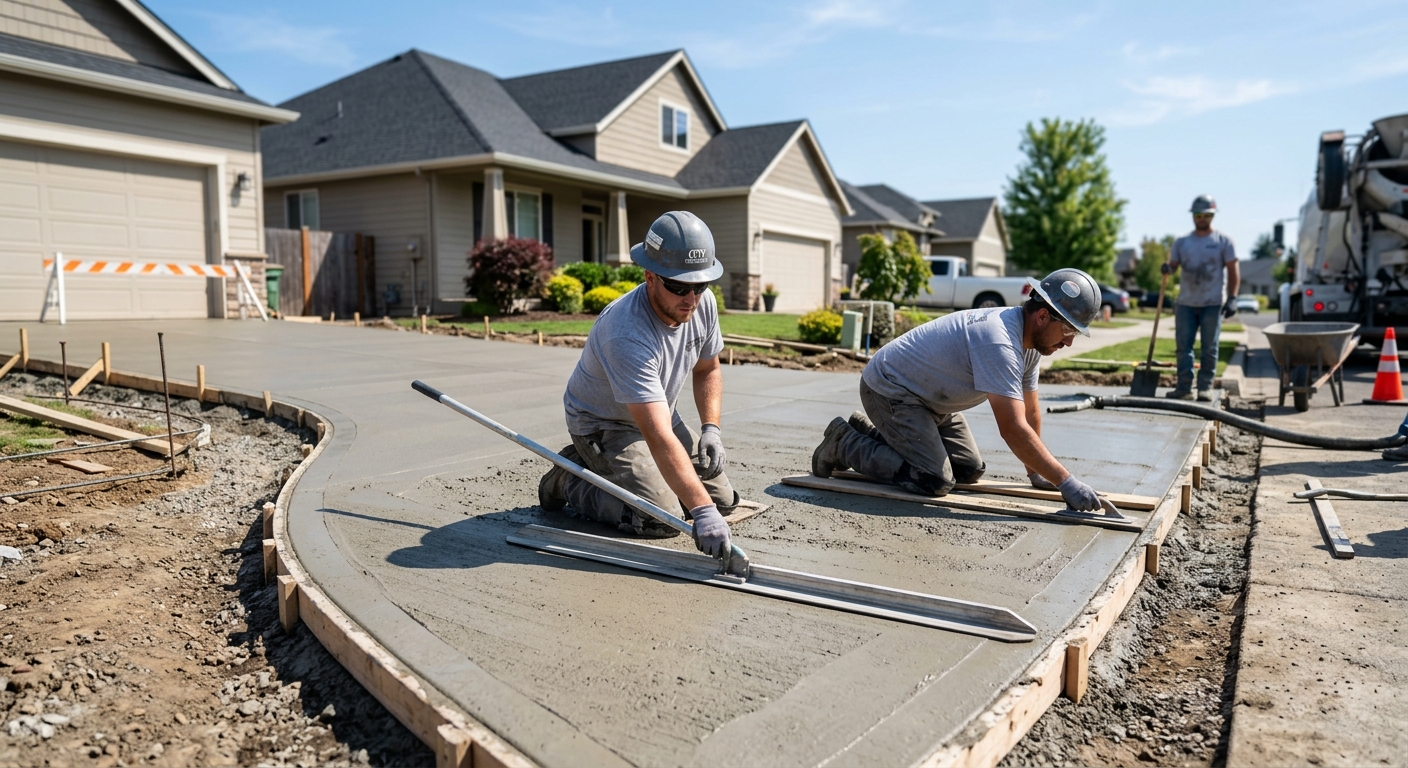
Concrete work options and costs in Nanoose Bay
Nanoose Bay homeowners usually start with three common concrete projects: driveways, patios/walkways, and foundation-related work. With a population of 6,540 (Statistics Canada, 2021 Census), the local housing market is small enough that scheduling and crew availability can swing by season, especially when rain weeks push curing timelines. While I can’t give exact housing-type shares for Nanoose Bay from the data provided, this community is shaped by detached homes and recurring rebuild/renovation cycles—exactly the kind of homes that lead to new flatwork around garages, side yards, and entry paths.
In the Lower Mainland–Southwest, mild winters and a shallow frost line (locally planned around ~450 mm / 18") reduce extreme frost excavation compared with interior BC, but freeze–thaw cycles and coastal-wet conditions still control every design decision. For exterior slabs and driveways, contractors typically use air-entrained concrete, proper drainage, and control joints to manage scaling and cracking. Rain, cool nights, and high humidity also mean longer cure windows and more attention to curing blankets and surface protection, which affects labour time and material handling.
In Nanoose Bay, trade demand is especially noticeable around the mid-island commuter corridor and higher-renovation pockets near the central neighbourhoods where homeowners upgrade curb appeal and drainage along drive and entry routes. As a result, you’ll often see that a “standard” broom-finish pour is the budget baseline, while decorative options—stamped or exposed aggregate—are priced for extra finishing labour and material selection. Use the table below to compare typical scope and realistic cost ranges before you request quotes.
| Application |
Typical Size |
Key Spec |
Finish Option |
Price Range |
| Concrete driveway (standard broom finish) |
320–500 sq. ft. |
Compacted granular base, air-entrained exterior mix, control joints |
Broom finish |
$18,000–$28,000 |
| Exposed aggregate driveway |
320–500 sq. ft. |
Compacted base, air-entrained mix, aggregate choice and wash timing |
Exposed aggregate |
$22,000–$34,000 |
| Stamped concrete driveway or patio |
200–450 sq. ft. |
Air-entrained exterior mix, hardened release system, seal-ready finish |
Stamped pattern |
$22,000–$36,000 |
| Plain concrete patio or walkway |
120–300 sq. ft. |
Proper grading, compacted granular base, control joints |
Float + broom/steel trowel |
$16,000–$26,000 |
| Garage floor (interior slab) |
300–600 sq. ft. |
Vapour barrier (if needed), reinforcement, drying/curing approach |
Plain finish |
$14,000–$28,000 |
| Foundation footings (structural, below frost) |
Per project (often 20–60 ft. of thickened edge/footing) |
Excavate below design frost, rebar cage, engineered uplift/wall specs |
Structural concrete placement |
$25,000–$42,000 |
Prices are estimates only and vary by project scope, site access and material selection.
What affects the price of concrete work in Nanoose Bay
In the Lower Mainland–Southwest, quotes for what looks like the “same” concrete job can land 30–50% apart because contractors may be pricing different base specifications, reinforcement decisions, and curing protection. Even when the finish is broom-clean and the colour looks similar, the real cost drivers are usually below the surface: excavation depth, granular base thickness, drainage details, mix design (especially air-entrainment), and how long the crew has to protect the pour from cool nights and coastal humidity.
Frost line depth and freeze–thaw cycles dictate every exterior specification here. In coastal BC, design practices commonly treat frost depth as shallow (often planned around ~450 mm / 18"), but footings and thickened edges still must extend below the design frost depth to reduce frost heave risk in saturated soils. That means exterior slabs and foundation work need correctly detailed base prep and—critically—air-entrained concrete mixes so the slab survives repeated wetting/freezing cycles. Colder regions elsewhere in BC typically require deeper excavations and more cold-weather precautions (heating/blankets), which is one reason costs can jump relative to the Lower Mainland. In Nanoose Bay, the season may be milder than interior BC, but persistent moisture and cool nights still add time: more curing labour and sometimes additional surface protection and sealing coordination.
Two common examples from Nanoose Bay: replacing a driveway that has failed from scaling usually costs more when we remove poor base material and re-build with compacted granular and drainage rather than “patching.” On the flip side, choosing a plain patio finish instead of stamped can keep you closer to a $16–$26 per sq. ft.-type band, while stamped typically justifies the premium (often aligning with $22–$36 per sq. ft.-type selections) when you’re aiming for a decorative look that also needs proper reinforcement and sealing.
| Price Factor |
Why It Matters |
Cost Impact |
| Frost line depth — determines footing depth and form height |
Exterior and foundation elements must be placed below design frost to limit heave |
Higher excavation and forming labour if deeper than expected |
| Site preparation — excavation, grading, compacted granular base |
Stability and drainage reduce settlement and cracking |
Can add major cost if the soil is saturated or base is underspecified |
| Reinforcement — rebar or wire mesh requirement |
Controls cracking and improves load capacity |
Material + labour increases, especially for driveways and garage slabs |
| Mix design — air-entrainment and compressive strength spec |
Air-entrainment helps manage freeze–thaw durability outdoors |
More expensive mix if specified correctly; often prevents future failures |
| Finish type — broom vs. stamped vs. exposed aggregate |
Decorative systems require more labour and strict timing |
Premium for stamping/release products or exposed-aggregate wash steps |
| Pour size and concrete truck access to site |
Small pours or tight access increases labour and time |
Extra handling costs if pumping/long placement distances are needed |
| Cold-weather curing precautions — heating and blankets |
Protects early strength development in cool, damp conditions |
Blankets/heaters can materially increase labour and equipment costs |
| Control joint pattern and sealing cost |
Reduces random cracking and extends surface life with freeze–thaw salts |
Added materials and labour; usually worth it for exterior slabs |
Permits & regulations in British Columbia
In British Columbia, structural concrete work typically requires a building permit. That includes footings, foundation walls, grade beams, and any other elements that support the building structure. In many cases, engineered drawings are reviewed by the municipality before construction can proceed. Concrete flatwork like patios, walkways, and driveways usually does not require a permit on its own, but you should confirm because permits can be triggered by lot grading changes, drainage modifications, or compliance with impervious surface coverage/municipal right-of-way requirements.
For Nanoose Bay homeowners, the safest approach is to treat the “structural vs. surface” distinction as your first check. If you’re pouring footings or a foundation, expect a permit and engineering involvement. If you’re adding or replacing a driveway or patio, you may not need a permit, but alterations that redirect water, change drainage patterns, or impact property lines may still require municipal review.
Before you hire anyone, verify the contractor carries liability insurance and the appropriate coverage for jobsite workers (commonly WSBC/WCB coverage). Then ask for certificates and clearance letters rather than relying on verbal assurance. Step-by-step: (1) request their certificate of insurance; (2) confirm current status of coverage for workers; (3) verify they’re licensed/eligible for the work in BC through the appropriate online registry; (4) ask for 2–3 references on similar-size concrete flatwork or foundation-related projects.
Getting concrete right in Nanoose Bay's freeze-thaw climate
Concrete failures in Nanoose Bay are usually not a “mystery mix” problem—they’re often specification and execution problems that show up under our coastal-wet freeze–thaw cycles. The slab or footing can look fine for a season, then develop scaling, spalling, or random cracking because moisture gets into the concrete and repeats freezing. To spec the job correctly, start from the ground up.
(1) Base preparation: use compacted granular sub-base to the correct thickness and to local soil conditions, with drainage attention. (2) Mix design: for exterior flatwork, use air-entrainment—commonly targeted around 5–7% air content—and minimum 32 MPa compressive strength so the concrete reaches durability requirements. (3) Control joints: create a planned crack path so shrinkage and thermal movement don’t split the slab randomly. (4) Curing: plan for a minimum 7-day curing period under proper protection; when pours land on cool, damp weeks, curing blankets or equivalent measures are often needed to reach adequate early strength. (5) Sealing: apply a penetrating sealer after the concrete cure window (often at 28 days post-pour) to help repel de-icing salts and reduce moisture ingress.
The right technical questions prevent the most common failure in this climate—spalling caused by inadequate air-entrainment. If someone is pricing “plain” mix without discussing air content, that’s a red flag. As a dollar example, upgrading from a basic broom-finish driveway to a properly detailed exposed-aggregate or stamped system can add roughly $4,000–$8,000 depending on size and prep, but that premium is only justified when the contractor also builds the same drainage and air-entrainment durability you’d expect in any exterior slab. A pretty finish over a weak base will still fail.
| Spec |
Why It Matters in Nanoose Bay |
What to Ask For |
Impact if Skipped |
| Compacted granular base (depth?) |
Reduces settlement and helps manage moisture under freeze–thaw cycles |
Granular depth and compaction method, plus drainage details |
Settlement, rocking joints, and early cracking |
| Air-entrained concrete mix (target air %?) |
Improves freeze–thaw durability in coastal-wet conditions |
Target 5–7% air content for exterior flatwork |
Scaling and spalling from freeze–thaw damage |
| Compressive strength (MPa rating) |
Ensures the concrete achieves the performance needed for drive/traffic |
Minimum 32 MPa compressive strength |
Surface wear, dusting, and reduced long-term durability |
| Control joints (spacing per ACI guidelines) |
Controls where cracking happens under temperature movement |
Joint layout plan and spacing for your slab dimensions |
Random cracking and more difficult repairs |
| Minimum 7-day curing period |
Early strength development is critical when nights are cool or damp |
Protection plan (covers/blankets) if temperatures dip |
Weakened surface and poor durability |
| Penetrating sealer (when applied after cure) |
Helps repel moisture and de-icing salts in driveway season |
Confirm sealer application around the 28-day mark (after full cure) |
Higher water absorption and faster surface deterioration |
How to choose a concrete work contractor in Nanoose Bay
When you’re hiring a concrete contractor in British Columbia for Nanoose Bay projects, start with proof—not promises. Verify their coverage: request a current certificate of liability insurance and confirm they carry the proper worker coverage (WSBC/WCB) for anyone working on your site. Then verify licensing/eligibility through the correct BC online registry (the contractor’s own invoice or website isn’t enough). If they can’t provide documents quickly, that’s usually a sign they’re not prepared to stand behind their work.
Next, get 2–3 written quotes that are itemised. You want a breakdown showing labour and materials (concrete supply, base prep/granular, reinforcement, forms, joints, finishing, curing protection, and sealing). Avoid “lump sum” quotes that don’t explain what’s included. Ask whether permit pull (if required), haul/disposal, and surface restoration are included—then ensure the scope matches your expectations. For example, ask whether the quote includes drainage grading and compacted granular base, not just “concrete thickness.”
Warranty matters too: ask for a workmanship warranty length and whether any product/manufacturer warranty is included and transferable. Finally, use a sensible payment schedule: never pay more than 10–15% upfront, and hold back a portion until the job is complete and cleaned up.
Get the schedule in writing with a start date and completion estimate. In the Lower Mainland–Southwest, rain and cool nights can shift curing windows, so a contractor who plans for curing protection is usually more reliable.
- Ask for proof of liability insurance and BC worker coverage (WSBC/WCB) before work starts
- Verify eligibility/licensing via the correct BC registry
- Use itemised quotes (labour + materials), not just a single lump sum
- Confirm included scope: excavation, disposal, compacted granular base, reinforcement, joints, curing, and sealing
- Check whether control joints and their spacing are specified in writing
- Require exterior mix durability: air-entrainment and a minimum strength spec (e.g., 32 MPa)
- Ask how they protect the pour from rain/cool nights during curing
- Request a drainage plan (slopes, tie-ins to existing grades, and runoff control)
- Confirm finishing method: broom vs. stamped vs. exposed aggregate, and what seal system is included
- Get warranty details in writing (workmanship and any product/manufacturer warranty)
- Agree on payment schedule: 10–15% max upfront; holdback until completion
- Get start date and completion estimate in the contract, including curing/seasonal contingency
Red flags in Nanoose Bay: (1) they won’t discuss air-entrainment or joint layout; (2) they quote “quick pours” without curing protection plans for cool/wet weeks; (3) they avoid itemising base prep and drainage; (4) they ask for large upfront payments; and (5) they can’t provide insurance/BC coverage documentation or recent references for similar driveway/patio work.
Frequently asked questions — concrete work in Nanoose Bay
Stamped vs broom-finish concrete — cost difference?
In Nanoose Bay and the wider Lower Mainland–Southwest, stamped concrete usually costs more than broom-finish because it requires more labour time, release agents, and careful timing for stamping and finishing. As a practical reference, broom-finish driveway work often lines up with the lower end of the local concrete driveway band (about $18–$28), while stamped decorative concrete tends to fall in the $22–$36 range for driveways and patios. The real cost isn’t the stamp alone—it’s also ensuring the same durability specs below the surface: correct granular base, air-entrained exterior mix for freeze–thaw resilience, and proper control joints. If the quote for stamped work doesn’t clearly state those inclusions, the “savings” on the broom-finish baseline will usually come back as cracking or surface scaling.
When is the best time to pour concrete in Nanoose Bay?
The best time is when temperatures stay consistently above typical cold-weather thresholds so the concrete can develop early strength without excessive heating. In coastal BC, you may still pour during milder winter windows, but rain, cool nights, and high humidity increase the need for curing blankets and protective measures. In practice, late spring through summer is when scheduling is easiest and finishing quality is more predictable, particularly for decorative work like stamping or exposed aggregate. Even in the shoulder season, a reliable contractor will plan around weather—covering the pour, protecting from direct rain splash, and extending cure/handling time if conditions are cool. For homeowners, it also helps to schedule base prep and reinforcement placement so the crew isn’t rushing through vulnerable steps.
How long does concrete take to cure?
Concrete curing has a few stages. You can generally handle normal construction activities after about 24–48 hours depending on mix design and temperature, but that doesn’t mean the concrete is fully ready for long-term exposure. For durability in Nanoose Bay’s freeze–thaw climate, a minimum 7-day curing period under proper protection is a common baseline for exterior flatwork. Full strength development continues beyond that; many contractors plan for surface sealing around the 28-day mark, once curing is complete enough to receive a penetrating sealer. If curing is shortened—especially in cool, damp weather—surface quality can suffer and you may see early scaling or joint-related cracks. Ask your contractor what curing protection they’ll use and whether they’ll commit to the minimum cure period in the written scope.
Do I need a permit for concrete work in British Columbia?
In British Columbia, structural concrete work such as footings, foundation walls, and grade beams typically requires a building permit and often engineered drawings. Concrete flatwork like patios, walkways, and driveways usually does not require a permit by default, unless the work affects lot grading, drainage, impervious surface coverage rules, or municipal right-of-way considerations. Since Nanoose Bay falls under BC municipal processes, it’s smart to confirm with the local authority before you pour—especially if you’re changing slopes for drainage or altering access in a way that impacts municipal boundaries. When you request quotes, ask whether the contractor will handle any required permit process and include that step in the scope if applicable. A reputable contractor will tell you clearly what requires approval and what typically doesn’t.
Concrete vs pavers for a patio in Nanoose Bay?
Concrete is often the better choice when you want a consistent surface, fewer joint lines, and predictable maintenance—especially if the contractor can deliver strong drainage and proper control jointing. In Nanoose Bay, plain patios and walkways often land in the $16–$26 band, while decorative concrete (like stamped patterns) can rise into the $22–$36 range depending on the look and preparation. Pavers can be great for flexible design and easier partial repairs, but they still depend heavily on base preparation and drainage; otherwise you’ll see shifting or uneven settling over time. With coastal moisture and freeze–thaw cycles, both systems need good base and drainage. If your main goal is a clean, modern finish with fewer individual elements to move, concrete usually simplifies long-term maintenance.
How long does a concrete driveway last?
A well-built driveway in Nanoose Bay commonly lasts many years—often a couple of decades or more—when the base is compacted correctly, the exterior mix is air-entrained for freeze–thaw durability, and joints and curing are done properly. Driveways fail early most often when drainage is poor (water sits under or beside the slab), air-entrainment wasn’t adequate, or curing was rushed during cool/wet periods. Sealing after cure (commonly around 28 days) can help resist moisture and de-icing salt exposure. Price doesn’t guarantee longevity, but it’s a clue: a low-end concrete driveway quote within the $18–$28 range can still be durable if the specs are right, while decorative concrete in the $22–$36 range should only be considered if it includes the same durability details, not just better appearance.