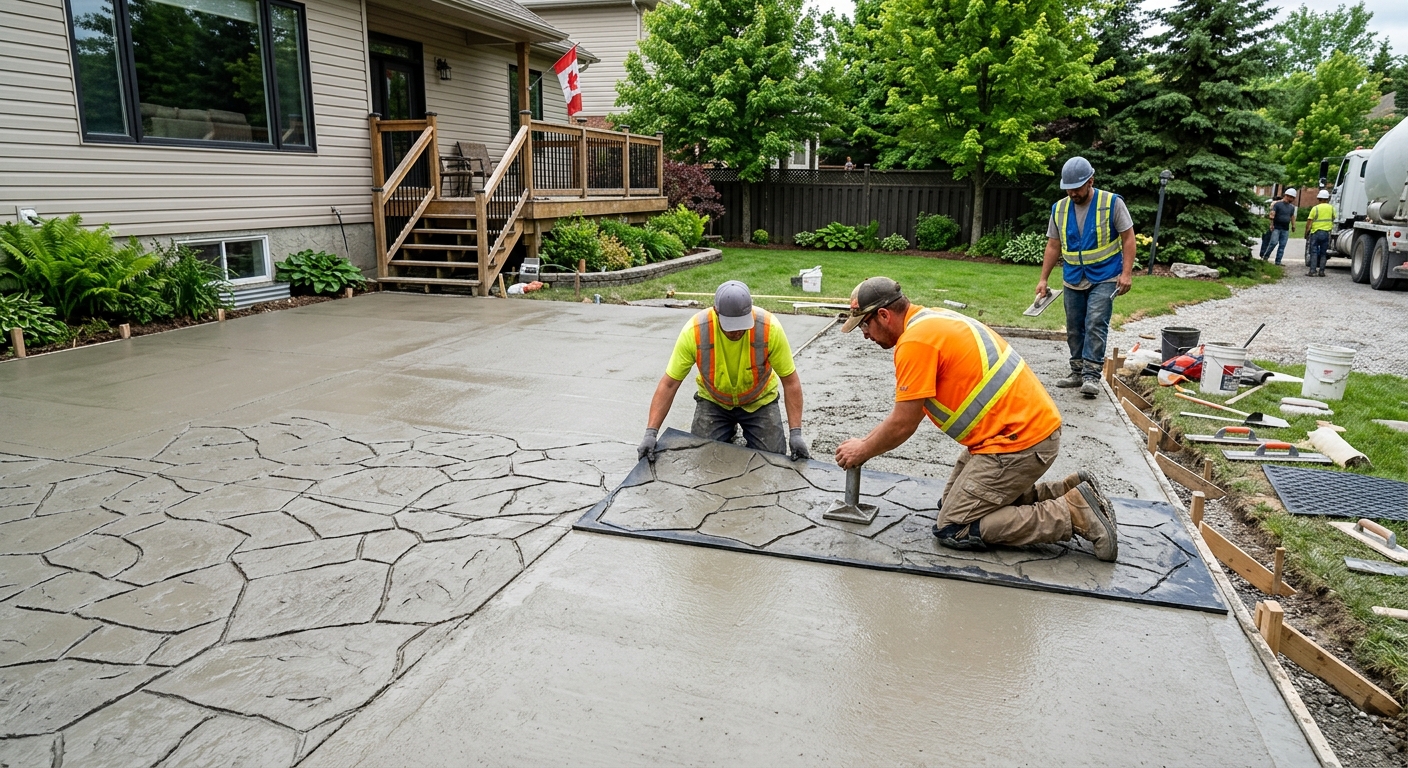
Concrete work options and costs in Kits Point
Kits Point, British Columbia is a small, coastal neighbourhood where concrete flatwork is a daily practical upgrade—driveways, patios, and walkways need to handle moisture, cool nights, and frequent freeze–thaw activity. With a 2021 population of 2,639 (Statistics Canada, 2021 Census), you’ll typically see a limited pool of crews, and lead times can be tight when multiple homeowners are scheduling exterior work after spring thaw. The housing mix also matters: Kits Point has a strong base of single-detached homes (a common starting point for new driveways and backyard patios), and that drives steady demand for durable, good-looking concrete in the Vancouver–Surrey–Abbotsford corridor.
In the Lower Mainland–Southwest, contractors commonly design for a shallow but meaningful frost depth of about 450 mm / 18". Footings and thickened edges are still placed below that to reduce frost heave risk, and exterior slabs are usually specified with air-entrained concrete to manage scaling during wet winters. At the same time, coastal rainfall means rain planning and curing protection (blankets, sealers, longer cure windows) are cost drivers just as much as the concrete itself. If your site is in a higher-access area or closer to local roads with truck access, pricing can stay in the lower end; restricted access, hauling, and extra base work push costs up.
Below are typical price bands for common projects in Kits Point, followed by the key specs that make each option perform in our climate.
| Application |
Typical Size |
Key Spec |
Finish Option |
Price Range |
| Concrete driveway (standard broom finish) |
300–450 sq ft |
Compacted granular base, air-entrained mix, control joints |
Broom finish, saw-cut joints |
$10,000–$16,000 |
| Exposed aggregate driveway |
300–450 sq ft |
Compacted base, air-entrained mix, retarder/cleaning process |
Exposed aggregate, sealed surface |
$12,500–$20,000 |
| Stamped concrete driveway or patio |
250–400 sq ft |
Compacted base, air-entrained mix, integral colour |
Stamp + release + seal coat |
$11,000–$22,000 |
| Plain concrete patio or walkway |
200–350 sq ft |
Compacted base, air-entrained mix, edge restraint |
Broom or trowel/light broom |
$3,500–$9,000 |
| Garage floor (interior slab) |
400–600 sq ft |
Vapour barrier (where required), base compaction, reinforced slab |
Light broom or trowel finish |
$8,500–$16,500 |
| Foundation footings (structural, below frost) |
Varies by design |
Excavate/form/pour below design frost, rebar as engineered |
Structural concrete (not decorative) |
$6,500–$14,000 |
Prices are estimates only and vary by project scope, site access and material selection.
What affects the price of concrete work in Kits Point
In the Lower Mainland–Southwest, it’s not unusual to see the same concrete scope price differently by 30–50% across British Columbia, even when the “square footage” looks similar. The biggest reasons are how each contractor handles site conditions (excavation and drainage), how they specify concrete (air content and strength), and how they protect the pour in damp, cool weather. In colder parts of BC, contractors also add cost for deeper excavations and cold-weather curing; in our Kits Point conditions, the frost depth is shallower than Ontario-style designs, but the freeze–thaw cycles and heavy coastal rainfall are still enough to drive proper base prep, air-entrained mixes, and longer cure planning.
For pricing, think in layers. First, frost depth and freeze–thaw cycles dictate specs: footings must extend below the design frost depth (about 0.5–1.2 m in coastal BC to manage heave risk). Second, every exterior slab should be air-entrained to resist surface scaling during wet winter swings. Third, cold-weather precautions—blankets and scheduling when nights are cool—add labour and materials, especially for driveways and patios. Finally, de-icing salt (common on entrances) accelerates spalling if the concrete isn’t correctly air-entrained and properly sealed.
In Kits Point, costs can rise if your soil needs additional granular base and if drainage is weak—there’s often extra work to slope and daylight water away from the slab edges. Costs can also drop when truck access is good and the grade is already near final, which reduces form height and excavation. As a practical anchor: a plain patio might land closer to the lower band (for example, $16–$26 per sq ft for patios/walkways), while stamped or exposed options (often $22–$36 per sq ft for decorative work) justify the added labour only if the base, curing, and finishing are done properly.
| Price Factor |
Why It Matters |
Cost Impact |
| Frost line depth — determines footing depth and form height |
Footings and thickened edges must sit below design frost to prevent heave |
Higher excavation/formwork; can add substantial labour |
| Site preparation — excavation, grading, compacted granular base |
Drainage and compaction control settlement and cracking |
Extra haul-away and granular material increase cost |
| Reinforcement — rebar or wire mesh requirement |
Reduces shrinkage cracking and improves slab performance |
Material and placement labour; depends on engineered needs |
| Mix design — air-entrainment and compressive strength spec |
Air-entrainment helps manage freeze–thaw and scaling resistance |
Impacts material cost and QA/testing requirements |
| Finish type — broom vs. stamped vs. exposed aggregate |
Complex finishes require extra labour time and steps |
Stamped/exposed typically add the most labour per sq ft |
| Pour size and concrete truck access to site |
Access affects pumping needs, cut-off delays, and scheduling |
Pumping, waiting time, and haul distances raise costs |
| Cold-weather curing precautions — heating and blankets |
Cool nights slow strength gain and increase surface risk |
May add labour, blankets, and temperature monitoring |
| Control joint pattern and sealing cost |
Joints control where cracks happen; sealing protects against salts |
Extra saw-cut and sealer add cost, but reduce callbacks |
Permits & regulations in British Columbia
In British Columbia, structural concrete work typically requires a building permit, and municipalities often want engineered drawings reviewed before concrete is placed. That means foundation walls, grade beams, footings for structural support, and other load-bearing elements usually fall under the “permit required” category. Concrete flatwork—driveways, patios, and walkways—usually does not require a permit by itself, unless it changes lot grading, affects stormwater drainage plans, increases impervious surface beyond allowed limits, or impacts municipal right-of-way conditions.
For a homeowner in Kits Point, the safest approach is to verify in writing with the local authority before demo day. Next, check contractor coverage: a legitimate concrete contractor should carry liability insurance and the required workplace coverage (WSIB/WCB depending on the contractor’s status). Ask for certificates and a clearance letter if applicable, and keep copies with your contract.
Here’s a practical step-by-step way to verify before you sign:
- Confirm contractor identity and trade status via the provincial/online business registry listings they provide.
- Request a Certificate of Insurance (COI) showing liability limits and effective dates.
- Ask for WSIB/WCB clearance or proof of coverage and match it to the company name on the quote.
- Request references for similar-scale Kits Point driveways/patios with photos of joints and sealing.
- Ensure the written scope clearly states who pulls permits (if needed) and what is excluded.
Getting concrete right in Kits Point's freeze-thaw climate
Concrete failures in Kits Point are usually predictable: weak base support, inadequate drainage, incorrect air content, and poor curing in cool damp weather. When the soil stays saturated and water migrates under a slab, freeze–thaw cycles expand the stress. If the concrete isn’t properly air-entrained and finished with a correct joint pattern, you can see scaling and spalling around edges and wheel paths. The fix starts at the specification stage and continues through curing and sealing.
First, base preparation: specify a compacted granular sub-base to the correct depth for local soil and frost considerations, with proper grading to drain away from the slab. Second, mix design: for exterior flatwork, air-entrainment is typically in the 5–7% range, and you want a minimum compressive strength around 32 MPa. Third, control joints: plan joint spacing to limit random cracking. Fourth, curing: plan for a minimum 7-day curing period under proper conditions—if the forecast stays cool or wet, the contractor may need curing blankets or other cold-weather controls to reach strength safely. Fifth, sealing: apply a penetrating sealer after the cure (commonly around 28 days post-pour) to help repel de-icing salts and moisture intrusion.
When you ask the right questions, you reduce the most common failure driver here: inadequate air-entrainment leading to surface deterioration. As a dollar example, a broom-finish driveway might be in the standard concrete band (commonly around $18–$28 per sq ft), while a decorative option like stamped concrete might push higher (often $22–$36 per sq ft). If you’re paying the premium, don’t trade away the base, air content, joints, and curing just to “save a bit” on the spec—those are the items that protect the finish from the weather.
| Spec |
Why It Matters in Kits Point |
What to Ask For |
Impact if Skipped |
| Compacted granular base (depth?) |
Supports the slab and manages drainage so water doesn’t freeze under it |
Confirm granular depth, compaction method, and drainage slope |
Settlement, cracking, and faster freeze–thaw damage |
| Air-entrained concrete mix (target air %?) |
Air bubbles reduce freeze–thaw scaling risk in coastal-wet weather |
Ask for air content target (commonly 5–7% for exterior flatwork) |
Spalling and surface scaling, especially with de-icing salts |
| Compressive strength (MPa rating) |
Strength gain affects durability and resistance to early wear |
Minimum 32 MPa specified for exterior slabs |
Surface wear, scaling, and reduced long-term durability |
| Control joints (spacing per ACI guidelines) |
Controls where cracks form during shrinkage and temperature swings |
Joint layout and spacing consistent with the slab thickness |
Random cracking through decorative finishes or slab panels |
| Minimum 7-day curing period |
Cold nights and rain slow strength development |
Plan curing protections and confirm protection duration |
Low strength at early age and higher likelihood of cracking |
| Penetrating sealer (when applied after cure) |
Repels moisture and helps protect against salt attack |
Confirm penetrating sealer and typical timing (often ~28 days) |
More water/salt migration and accelerated deterioration |
How to choose a concrete work contractor in Kits Point
Choosing the right contractor in Kits Point is mostly about verification and scope clarity. In British Columbia, you should confirm the contractor’s credentials, then independently verify insurance and coverage before any work starts. Start by requesting their Certificate of Insurance (liability) with the correct legal entity name and policy dates. Next, ask for WSIB/WCB clearance or proof of coverage (the documents should match the company name on your contract). If they hesitate or provide generic documents, that’s a red flag for both safety and workmanship accountability.
Then get 2–3 itemised written quotes—not just one lump sum. You want the breakdown to show labour and materials (concrete supply, base/gravel, rebar/mesh, formwork, finishing, sealing, saw cutting, and any disposal/haul-away). Read the exclusions carefully: for example, is removal of old concrete included, is pumping included if access is tight, and is permit pulling included where required (typically structural items)? A clear scope helps you compare quotes fairly.
Warranty and schedule matter too. Ask how long the workmanship warranty lasts, whether it covers the specific risks for exterior concrete (cracking at joints vs. workmanship defects), and whether product/manufacturer warranties are included and transferable. For payment, never pay more than 10–15% upfront; keep a holdback until completion and final cleanup. Get your start date and estimated completion in writing so your project doesn’t stall mid-pour during wet/cool periods.
- Verify liability insurance COI with correct company name and policy dates.
- Confirm WSIB/WCB coverage or clearance letter matching the contractor entity.
- Ask for 2–3 local references with photos of sealed exterior slabs.
- Request a detailed, itemised quote (labour + materials line items).
- Confirm who supplies and installs reinforcement (rebar/mesh) and why.
- Ask for the air-entrainment and concrete strength specification details.
- Confirm base depth, granular type, and compaction method.
- Ensure control joint spacing and layout are included in writing.
- Ask how they manage rain and cool nights (blankets, curing plan).
- Clarify disposal, saw-cutting, and removal of existing concrete.
- Confirm sealing product type and when it will be applied after cure.
- Set a payment schedule with a holdback until final walkthrough.
Concrete contractor red flags in Kits Point: quoting without discussing base/drainage or air-entrainment; proposing decorative finishes without confirming curing/sealing steps; giving only a “per sq ft” number with no joint, reinforcement, or removal details; asking for large deposits (beyond 10–15%); and avoiding written schedules or warranty terms.
Frequently asked questions — concrete work in Kits Point
What is rebar and when is it required in British Columbia?
Rebar (reinforcing steel bars) is used to control cracking and improve slab and foundation performance by helping the concrete carry stresses it cannot handle well on its own. In British Columbia, whether rebar is required depends on the structural design (engineered foundations/footings) and slab use (for example, heavier loads in a garage floor may require reinforcement). Exterior flatwork may use wire mesh or rebar depending on the thickness, subgrade, and engineered requirements. If you’re building or changing a foundation system in Kits Point, the engineered drawings typically govern rebar placement, cover, and bar sizes. For non-structural patios and walkways, many projects still include reinforcement when the slab is thicker or when the subgrade is weaker. Always ask for the specific reinforcement callouts in writing—“reinforced” should not be vague.
How long does a concrete project take in Kits Point?
The total timeline depends on access, excavation, curing protection, and finish type. For many Kits Point driveways and patios, the “active work” (demo, excavation, base prep, forms, pour, and finishing) can happen within 1–3 days, but the project isn’t truly done until curing and protection are completed. Practical scheduling often looks like this: base prep and forms first day; pour and finishing day two (sometimes day one if site is ready); curing and protection ongoing. If weather is cool or rainy, the contractor may use curing blankets and extend protective measures. Even after the 7-day curing milestone, many homeowners plan around the full durability timeline before heavy traffic or sealing. Sealing is commonly done around 28 days after the pour, so if you want the full protective system, build that into your plan. Decorative work like stamped concrete may require a stricter finish and protection routine to avoid surface defects.
What is a concrete overlay and is it suited to Kits Point?
A concrete overlay is a bonded layer placed over existing concrete to renew the surface without fully demolishing and replacing the slab. It can be suited to Kits Point when the existing slab is structurally sound—no major settlement, deep scaling, or widespread cracking—because the overlay can only perform as well as the original base. Wet coastal conditions and freeze–thaw cycles can expose weak adhesion if prep isn’t thorough, so surface preparation (grinding/profiling, cleaning, and bonding agents) is critical. Overlays may be a cost and schedule saver for some homeowners, but they’re not ideal if water has been migrating under the existing slab or if the subgrade has failed. For pricing context, overlays may fall near or between standard flatwork bands depending on prep and thickness; however, a full replacement often better addresses base drainage and control joint correction. If you’re considering an overlay, ask for a condition assessment and a written plan addressing moisture and adhesion.
How do I seal concrete to protect it in Kits Point?
Sealing concrete in Kits Point is about moisture and salt resistance—especially during our damp winters and when de-icing products are used. The most important rule is timing: don’t seal too early. In typical practice, a penetrating sealer is applied after the concrete has cured (often around 28 days post-pour), when the surface is ready to accept the sealer. Before sealing, the contractor should clean the surface and make sure there’s no film, dust, or standing water in the pores. Ask whether the sealer is penetrating (not just a surface coating) and confirm coverage rate. Sealing won’t fix poor air-entrainment or a bad base, but it can reduce water and salt intrusion that drives scaling and spalling. If you’re budgeting, sealing is usually a line item; for many homeowners, it’s money well spent compared to repair calls. As a reference, exterior projects commonly sit around the $16–$26 per sq ft band for patios/walkways and $18–$28 per sq ft for driveways, and sealing quality influences durability more than tiny price differences.
What is the difference between concrete and cement?
Concrete and cement are often mentioned together, but they’re not the same thing. Cement is one ingredient—essentially the binder—that reacts with water to create strength. Concrete is the finished building material: cement plus water plus aggregates (sand and gravel) and often admixtures (like air-entrainment agents for freeze–thaw durability, and plasticizers for workable placement). In Kits Point, the concrete mix design is the part that directly affects performance during freeze–thaw cycles—air-entrained mixes help resist scaling and surface damage when the slab repeatedly gets wet and then freezes. So when contractors talk about “cement” vs “concrete,” what you should really ask about is the concrete specification: air content target, minimum compressive strength (commonly around 32 MPa for exterior flatwork), and whether the mix is designed for our coastal conditions. A quote should specify the concrete performance requirements, not just generic product names.
How much does concrete work cost in Kits Point?
Concrete costs in Kits Point depend on the application, size, excavation needs, finish complexity, and site access. As a baseline for Lower Mainland–Southwest pricing, concrete driveway or slab projects often land around $18–$28 per sq ft, while patios and walkways are commonly $16–$26 per sq ft. Decorative work costs more because stamped and exposed aggregate surfaces require extra labour and steps—often $22–$36 per sq ft. If you’re working on foundations, structural footings are commonly priced around $200–$350 (per unit/scope basis depending on your design), and the engineered depth below frost drives excavation and forming costs. For a homeowner-friendly comparison, a standard broom-finished driveway is usually at the lower end of the driveway band, while stamped concrete climbs toward the higher range. If you share your approximate dimensions and whether there’s existing slab removal and good truck access, a contractor can narrow you to a more precise estimate.