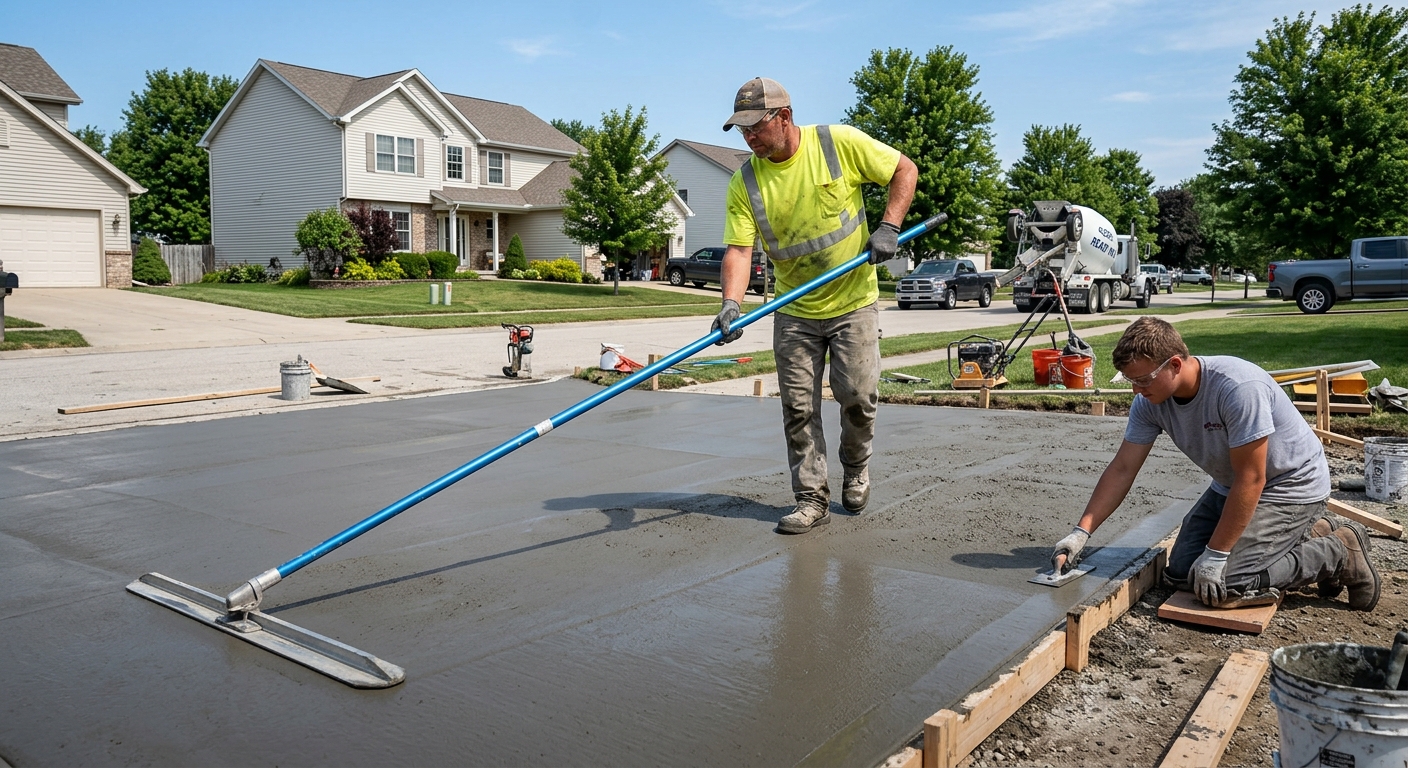
Concrete work options and costs in Haney
In Haney, British Columbia, concrete is one of the most practical ways to handle driveways, patios, walkways and the foundation work that keeps homes solid through our coastal-wet weather. With a population of 21,041 (Statistics Canada, 2021 Census), the Lower Mainland–Southwest market supports a steady pool of concrete crews—yet pricing still moves based on scheduling, rain delays and the specs required for freeze–thaw durability.
Many local projects involve single-family homes; in communities like Haney, flatwork demand tends to be driven by household-scale renovations and new builds. That matters because exterior slabs and thickened edges have to be detailed correctly for our shallow frost line concept (commonly planned around ~450 mm / 18"), while still protecting from freeze–thaw cycles and heavy coastal rainfall. In practice, contractors often place footings, piers and thickened edges below the design frost line to reduce the risk of frost heave and movement. If the weather window is tight, crews may also need longer curing plans—curing blankets, sealers and careful temperature management—which can influence the total cost.
Where crews are especially busy is around the Haney area on the east side of the Fraser corridor, where ongoing housing turnover keeps driveways and rear-yard patios in rotation. If you’re comparing options, start with the finish and structural scope—then use the table below to sanity-check what different concrete choices typically cost in this tier.
| Application |
Typical Size |
Key Spec |
Finish Option |
Price Range |
| Concrete driveway (standard broom finish) |
10' x 20' (200 sq. ft.) |
Air-entrained exterior slab; compacted granular base; control joints |
Broom finish |
$3,600–$5,600 |
| Exposed aggregate driveway |
10' x 20' (200 sq. ft.) |
Air-entrained mix; controlled wash/exposure; reinforced edges as needed |
Exposed aggregate |
$4,200–$6,700 |
| Stamped concrete driveway or patio |
10' x 20' driveway (200 sq. ft.) or 12' x 16' patio (192 sq. ft.) |
Air-entrained mix; hardened release/colour; proper curing plan |
Stamped + coloured finish |
$4,700–$8,000 |
| Plain concrete patio or walkway |
12' x 12' (144 sq. ft.) or 3' x 20' (60 sq. ft.) |
Air-entrained mix; compacted base; joints aligned for shrinkage |
Broom or trowel finish |
$1,800–$3,800 |
| Garage floor (interior slab) |
20' x 22' (440 sq. ft.) |
Vapour/under-slab prep as required; reinforcement where specified |
Light broom or steel trowel (as scoped) |
$6,500–$11,000 |
| Foundation footings (structural, below frost) |
Varies by home plan; typical small foundation perimeters |
Excavate below design frost depth; reinforced concrete; formwork |
Structural finish (not aesthetic) |
$4,500–$9,500 |
Prices are estimates only and vary by project scope, site access and material selection.
What affects the price of concrete work in Haney
In the Lower Mainland–Southwest, two quotes for what looks like the same concrete job can differ by 30–50% because the “hidden scope” changes with drainage, subgrade conditions, reinforcement requirements and seasonal constraints. The same finish price band can swing when a contractor has to redo base prep to achieve proper compaction, add reinforcement, adjust footing depth for site conditions, or protect curing during cool nights and persistent rain. Labour rates and availability also play a role: when projects stack up before a wet stretch, crews charge more to secure trucks, formwork and finishing time.
First, frost depth and freeze–thaw cycles dictate the specs. Even though Lower Mainland–Southwest is designed around a shallow frost concept (~450 mm / 18"), exterior concrete and foundations are still detailed to avoid frost heave: footings, piers and thickened edges are placed below the design frost depth, and exterior slabs use air-entrained concrete so water doesn’t break down the surface during repeated freezing and thawing. Second, colder regions require colder-weather curing precautions (heating and insulating blankets), but in Haney we still plan around cool evenings and high humidity—often using curing blankets or extended cure timelines for durability and scaling resistance.
Here are a few concrete examples that raise or lower cost in Haney: (1) a driveway on soft or poorly drained soils may need thicker compacted granular base and improved drainage, adding several thousand dollars; (2) switching from broom-finish to stamped concrete can move you from a simpler driveway band (roughly $18–$28 per sq. ft. for standard work) to the decorative band (around $22–$36 per sq. ft.), justified by added materials and labour; (3) sealing and proper jointing for exterior flatwork can prevent early deterioration and helps reduce costly rework—especially when de-icing salts are used near thresholds.
Finally, housing-stock age matters. Older properties often have older drainage patterns, perimeter backfill issues, or uneven grades, which means more excavation and regrading. In practical terms, that’s where the lower end versus upper end of a driveway estimate gets earned.
| Price Factor |
Why It Matters |
Cost Impact |
| Frost line depth — determines footing depth and form height |
Footings must extend below the design frost depth to prevent frost heave |
Can add significant excavation + formwork scope on foundations and thickened edges |
| Site preparation — excavation, grading, compacted granular base |
Subgrade and drainage control freeze–thaw movement and settlement |
More grading/haul-away pushes total cost up; good access keeps it down |
| Reinforcement — rebar or wire mesh requirement |
Controls crack width and improves slab performance under loads |
Extra material and labour; often required for driveways and thicker slabs |
| Mix design — air-entrainment and compressive strength spec |
Air-entrainment improves resistance to freeze–thaw scaling and spalling |
Upcharges for engineered mix and quality control, especially for exterior work |
| Finish type — broom vs. stamped vs. exposed aggregate |
Finish complexity changes labour time and material handling |
Decorative finishes typically cost materially more than standard broom finishes |
| Pour size and concrete truck access to site |
Truck placement affects workflow and number of finishing assists |
Limited access can add labour and sometimes pumping/extra handling |
| Cold-weather curing precautions — heating and blankets |
Temperature and humidity affect strength gain and surface durability |
Blankets/heaters and longer schedule can add costs during shoulder seasons |
| Control joint pattern and sealing cost |
Joints guide shrinkage cracking; sealing helps repel moisture and salts |
Proper jointing reduces cosmetic cracking; sealer adds a line-item but reduces risk |
Permits & regulations in British Columbia
In British Columbia, structural concrete work—such as footings, foundation walls and grade beams—typically requires a building permit, and in many cases engineered drawings are reviewed as part of the permit process. Concrete flatwork (patios, walkways, most standard driveways) usually does not require a permit, unless your project affects lot grading, changes stormwater/impervious surface coverage limits, or touches the municipal right-of-way (for example, modifying curb returns or walkways connected to boulevard areas). Before any demo or excavation, confirm with the local authority that your exact scope is in-bounds.
For contractor due diligence in Haney and across the Lower Mainland, verify three things: (1) contractor licensing/registration (where applicable for your trade scope), (2) liability insurance and (3) coverage for workers under WSIB/WCB requirements. Step-by-step, ask the contractor for a current certificate of insurance and proof of WSIB/WCB clearance or equivalent clearance documentation. Then cross-check licensing using the appropriate online registry search (based on the contractor’s legal business name). Request references on similar-scale projects—driveways and foundation work should look consistent with your site conditions and climate considerations. If the contractor refuses to provide insurance or clearance documents up front, that’s a major warning sign—especially when structural work is involved.
Getting concrete right in Haney's freeze-thaw climate
Concrete failures in Haney usually trace back to water and temperature: moisture gets into the surface or the base, then freeze–thaw cycles expand it, leading to scaling and spalling. The fix is specification and execution that matches our Lower Mainland–Southwest reality—rainy stretches, cool nights, and seasonal schedule pressure. Start with base preparation: excavate to the right depth and build a compacted granular sub-base that drains and supports the slab. Next, specify mix design: for exterior flatwork, air-entrainment is key (often targeting 5–7% air content) and the concrete should meet at least 32 MPa compressive strength for durability. Third, control joints must be placed to guide shrinkage cracking—random cracks look worse and can become leak paths. Fourth, curing: plan for at least 7 days under proper conditions, and in colder or wet spells use curing blankets or seal protection so the slab reaches strength reliably. Fifth, sealing: apply a penetrating sealer after the cure period (commonly around 28 days) so water, salts and surface contaminants repel into the concrete rather than through it.
When you ask technical questions, focus on the most common failure mode in our region: spalling from inadequate air-entrainment. A contractor who can’t clearly state air content targets and curing steps is guessing.
Dollar example: If a standard broom driveway comes in around the lower end of the concrete driveway band (roughly $18–$28 per sq. ft.), it’s often the difference between “good enough” prep and engineered durability. Investing in the right base and air-entrained mix typically costs more up front, but it’s what helps avoid the expensive cycle of surface deterioration and partial replacement after a winter or two—especially where de-icing salts get used.
| Spec |
Why It Matters in Haney |
What to Ask For |
Impact if Skipped |
| Compacted granular base (depth?) |
Proper support and drainage reduces settlement and moisture retention during rain and freeze–thaw |
“Confirm base thickness and compaction method for my soil and slab thickness.” |
Soft spots, uneven slabs, accelerated cracking and early spalling |
| Air-entrained concrete mix (target air %?) |
Air voids protect against freeze–thaw scaling on exterior slabs in coastal-wet cycles |
“What air content (5–7%) are you targeting for exterior flatwork?” |
Surface scaling/spalling, especially near edges and where salts collect |
| Compressive strength (MPa rating) |
Strength gain affects wear resistance and long-term performance in damp conditions |
“Minimum 32 MPa at specified curing conditions—please list the mix design strength.” |
Lower durability, faster wear, and reduced resistance to moisture damage |
| Control joints (spacing per ACI guidelines) |
Controls where cracks form so they don’t become random and leak-prone |
“What joint spacing are you using, and how will joints align with existing features?” |
Random cracking and water pathways that worsen freeze–thaw deterioration |
| Minimum 7-day curing period |
Ensures the slab gains strength before exposure to cold snaps and wet periods |
“How do you protect curing in cool nights and rain—blankets, timing, and drying plan?” |
Surface weakness, poor finish durability, increased cracking risk |
| Penetrating sealer (when applied after cure) |
Helps repel moisture and de-icing salts that accelerate spalling in exterior areas |
“Confirm sealer type and timing (commonly after ~28 days of cure).” |
Higher moisture ingress and faster surface breakdown |
How to choose a concrete work contractor in Haney
Choosing a concrete contractor in Haney starts with verification: in British Columbia, you should confirm the company’s credentials before you sign anything. First, verify the contractor’s licensing/registration for the scope you’re hiring them for (and make sure the business name on the quote matches the registered name). Next, request proof of liability insurance—ask for a current certificate of insurance and confirm it covers the work you’re planning. For workers’ coverage, ask for WSIB/WCB clearance or the relevant clearance letter/documentation; a reputable crew will provide this without pressure. If they can’t supply documents quickly, keep looking.
Then get 2–3 itemised written quotes instead of a single lump sum. You want a labour + materials breakdown that clearly shows what includes excavation, disposal, reinforcement, base prep, forming, finish, curing measures and sealing (if applicable). Read the scope carefully: what’s excluded (haul-away, permits, electrical sawcut disposal, driveway approach changes)? Is disposal included or billed separately? Is a permit included when it’s needed for structural concrete?
Warranty should be in writing. Ask about workmanship warranty length, whether it covers replacement versus cosmetic issues, and whether product/manufacturer warranty applies to admixtures or decorative coatings. For payment, never pay more than 10–15% upfront; hold back a portion until the job is complete and deficiencies are addressed. Finally, lock down schedule: request a start date and an estimated completion date in writing so you can plan around Haney’s rain and shoulder-season curing needs.
- Confirm credentials: licensing/registration, liability insurance and WSIB/WCB clearance.
- Ask for references on the same type of work (driveways, patios, or foundations) with similar slab thickness and access conditions.
- Require an itemised quote (labour + materials) instead of a single lump sum.
- Confirm base depth and compaction requirements for your soil and slab thickness.
- Get the mix design details: air-entrainment target and minimum compressive strength.
- Ask who controls curing (blankets/sealers) and how they handle rain delays in Haney.
- Verify reinforcement scope (mesh/rebar) and where it’s placed (slab vs edges).
- Confirm joint layout: where joints will be cut and the approximate spacing.
- Clarify finishing method and quality checks (broom vs stamped vs exposed aggregate).
- Check whether sealing is included, and when it will be applied after cure.
- Review the disposal/haul-away plan for old concrete and excavated soil.
- Set payment terms: small deposit, then staged payments; keep a holdback.
In Haney, red flags include: vague specs (no air-entrainment or curing plan stated), quotes that don’t explain base prep and reinforcement, contractors asking for full payment upfront, no written warranty, and “we’ll fix it later” promises after cracking or spalling signs appear.
Frequently asked questions — concrete work in Haney
How do I seal concrete to protect it in Haney?
Sealing in Haney is mainly about water and salt management in our coastal-wet, freeze–thaw conditions. For exterior driveways and patios, use a penetrating sealer (not just a surface film) applied after the concrete has fully cured—commonly around 28 days after the pour. Before sealing, the surface should be clean and dry; if you trap moisture, sealing won’t perform as intended. Ask your contractor to describe the prep steps (pressure wash or cleaning solution), the sealer type, and coverage rate. If you plan to use de-icing salts near entrances or edges, sealing becomes even more important because salt exposure can speed up surface spalling on inadequately detailed slabs.
What is the difference between concrete and cement?
Concrete is the finished building material you see: a mixture of cement, water, fine and coarse aggregates (sand and stone), plus admixtures like air-entrainment for freeze–thaw durability. Cement is only one component inside the concrete mix. In Haney and across the Lower Mainland–Southwest, the important part for exterior flatwork durability is the engineered concrete mix—not just the “cement” label. Air-entrainment, specified compressive strength, and proper curing are what help concrete resist scaling and spalling when temperatures swing and the slab gets wet during rain. When you get quotes, ask for the concrete mix design and air content targets rather than focusing only on cement brand or strength marketing terms.
How much does concrete work cost in Haney?
Concrete cost in Haney depends on size, excavation and base prep, reinforcement, finish type and access. For a standard broom-finished driveway, homeowners often see figures aligned with the local driveway tier of about $18–$28 per sq. ft. If you’re building a decorative option, stamped concrete typically lands in the higher band—roughly $22–$36 per sq. ft.—because it involves added labour, materials and a more complex finishing workflow. In practical quote terms, a typical 200 sq. ft. driveway may land around a few thousand dollars depending on thickness and site conditions. Because Lower Mainland–Southwest schedules can be tight with rain, costs can also increase if crews need extra protection for curing, like blankets or extended timeline measures.
How deep must footings be for Haney's frost line?
For Haney in the Lower Mainland–Southwest, local practice commonly plans for a shallow design frost depth concept around ~450 mm / 18", but footings and foundation elements are typically placed below that design depth to reduce the risk of frost heave. The exact depth can vary with your geotechnical conditions, soil type, and whether the foundation is insulated. That’s why a contractor should base footing depth on your engineered foundation plan and site conditions, not a one-size-fits-all number. If you’re comparing quotes, ask whether the engineer/contractor is designing the footings below the frost depth and how they’re handling excavation and form height. The goal is consistent performance through freeze–thaw cycles and saturated coastal rainfall.
Why does concrete crack in Haney and how is it prevented?
Concrete cracks are common in Haney because slabs naturally shrink and expand, and the freeze–thaw cycles in a wet coastal climate can intensify moisture movement through the slab and joints. The good news is that you can’t fully eliminate cracking, but you can control it. Prevention starts with correct base preparation and drainage, using air-entrained exterior mixes, and placing control joints to guide where shrinkage cracks occur. A proper joint spacing and a concrete curing plan are also essential so the slab reaches strength reliably before it’s exposed to cool nights. Sealing after cure can reduce moisture ingress, especially where salt exposure occurs. When contractors skip air-entrainment or joint planning, cracks may form randomly and worsen into spalling over time.
Stamped vs broom-finish concrete — cost difference?
Stamped concrete costs more than broom-finish primarily because it requires additional materials (colours and release) and more labour to stamp, texture, and finish while maintaining consistent timing. In Haney, broom-finished driveways typically align with the lower end of the driveway tier (about $18–$28 per sq. ft.), while stamped concrete often lands higher (about $22–$36 per sq. ft.) due to the added workflow and finishing complexity. Is it worth it? If you want enhanced curb appeal and are selecting a finish that’s paired with proper base prep, air-entrained mix and correct curing, stamped concrete can be a durable upgrade. But if the scope is underspecified—thin base, weak mix or rushed curing—the extra money won’t prevent early scaling or spalling.