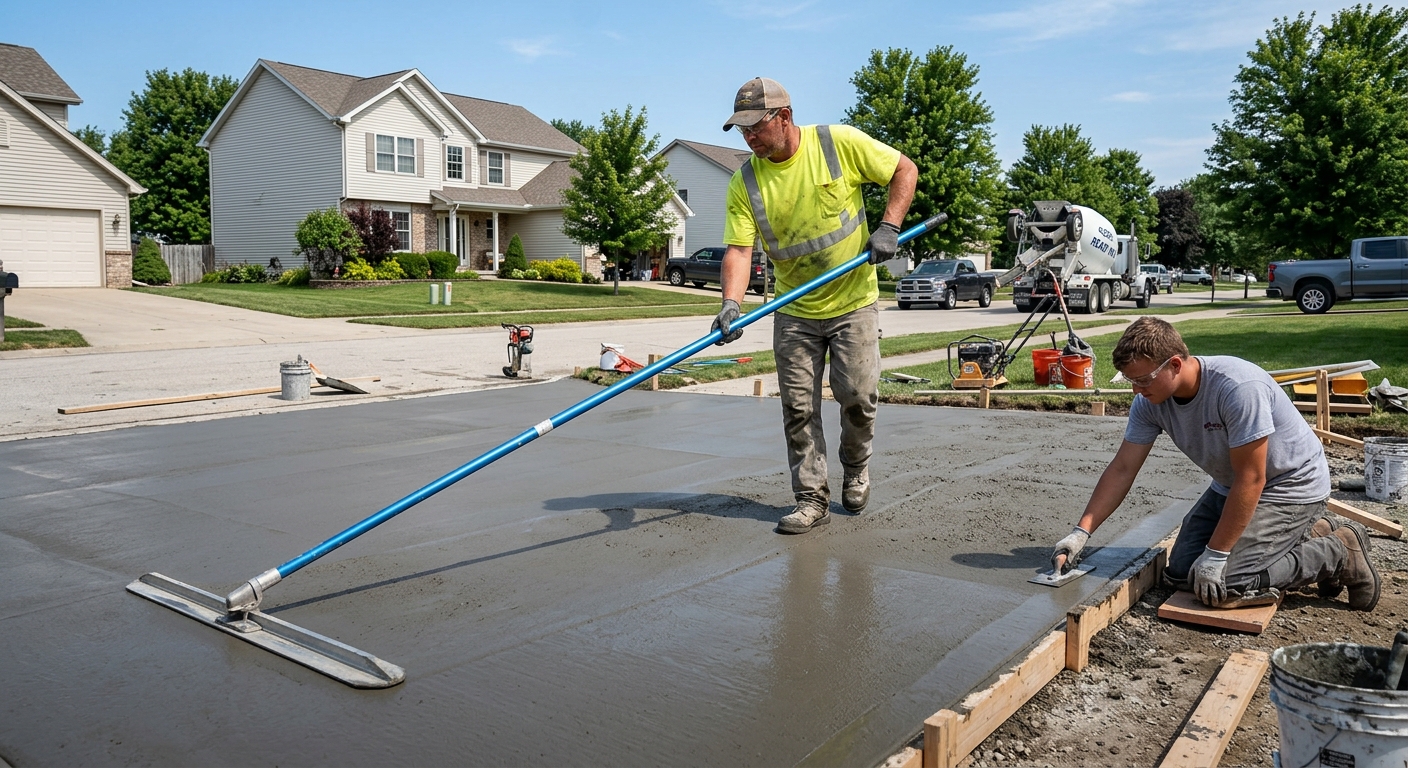
Concrete work options and costs in Marshall-McCallum
Marshall-McCallum homeowners typically choose concrete because it looks sharp, holds up well on busy driveways, and performs reliably when it’s detailed correctly. In a community of 10,055 people (Statistics Canada, 2021 Census), the flatwork market is driven largely by housing types that benefit from durable exterior slabs—especially single-detached neighbourhoods where driveways, patios, and walkways see heavy use year-round. In the Lower Mainland–Southwest, you’ll also see contractors more often in areas like Fleetwood-style suburban pockets and near older residential pockets close to town amenities, where property upgrades and landscaping tie directly into new concrete.
Pricing here is shaped by the frost depth and moisture behaviour of the coast-to-foothills soils. While Lower Mainland–Southwest frost depth is often treated around 450 mm / 18" for exterior design, the real cost comes from building the slab and foundation below the design frost line to manage freeze–thaw and saturated conditions. We routinely plan for drainage, air-entrained mixes, and longer curing windows because rain, cool nights, and high humidity can slow strength gain and affect surface durability. That seasonal schedule and the need for the “right” base (compacted granular plus proper subgrade drainage) is why you’ll see labour and forming costs cluster around certain months.
Below is a realistic pricing snapshot for the most common concrete options, so you can compare bids apples-to-apples before you ask for a site visit.
| Application |
Typical Size |
Key Spec |
Finish Option |
Price Range |
| Concrete driveway (standard broom finish) |
400–520 sq. ft. (typ. 20' x 20' to 25' x 21') |
Air-entrained exterior mix; control joints; compacted granular base |
Broomed finish + standard edging |
$6,600–$12,500 |
| Exposed aggregate driveway |
400–520 sq. ft. (typ. 20' x 20' to 25' x 21') |
Air-entrained mix; proper curing; surface retarder/cleaning process |
Exposed aggregate (light reveal) + seal |
$8,500–$16,000 |
| Stamped concrete driveway or patio |
300–450 sq. ft. (typ. 20' x 15' to 30' x 15') |
Air-entrained mix; coloured powder + release; crack control layout |
Stone/brick stamp + colour accents |
$8,000–$18,500 |
| Plain concrete patio or walkway |
180–320 sq. ft. (typ. 12' x 15' to 16' x 20') |
Air-entrained exterior mix; compacted base; jointing |
Float/trowel then light broom or broomed |
$2,900–$7,200 |
| Garage floor (interior slab) |
360–600 sq. ft. (typ. 20' x 18' to 24' x 25') |
Interior mix; vapour control considerations; proper reinforcement plan |
Standard finish, trowel or broomed |
$5,500–$14,000 |
| Foundation footings (structural, below frost) |
Per project; often 1,000–3,000 sq. ft. of footprint area total |
Engineered dimensions; excavation below frost; rebar placement |
Structural concrete only (no decorative finish) |
$18,000–$45,000 |
Prices are estimates only and vary by project scope, site access and material selection.
What affects the price of concrete work in Marshall-McCallum
In Marshall-McCallum and the wider Lower Mainland–Southwest, the same basic “driveway replacement” can land 30–50% apart between quotes because the inputs that matter most—base prep, drainage detailing, reinforcement, mix design, and curing—aren’t always priced the same way. That spread is typical across British Columbia because contractors may carry different overhead, schedule capacity, and concrete supplier mix specifications for exterior durability in a wet, coastal freeze–thaw environment. Even when the final surface looks similar, the slab can behave very differently if the subgrade and air content aren’t right.
Here, frost and freeze–thaw cycles dictate the spec. Exterior footings and structural supports must extend below the design frost depth (Lower Mainland practice often treats frost around 450 mm / 18", while colder regions require deeper excavation). In coastal BC, you still get freeze–thaw cycling on saturated soils, so exterior slabs require air-entrained concrete mixes to manage scaling risk and spalling. The Lower Mainland also has a “shorter-effective” pour window on cool, wet stretches; when temperatures drop, curing may require blankets and, in some cases, temporary heating to reach design strength. Add de-icing salt risk on driveways and steps—sealing becomes essential for surface durability.
Two local examples of cost movement: (1) If your soil is wet or soft and the base needs deeper granular replacement and improved drainage, driveway pricing can climb from the typical $18–$28 per sq. ft. band toward the high end. (2) If you’re replacing a smaller, uncomplicated patio and the old slab comes out cleanly, you can often stay nearer the $16–$26 per sq. ft. range for plain flatwork rather than stepping up to stamped & decorative pricing at about $22–$36 per sq. ft.
With housing stock across the Lower Mainland–Southwest varying in age, an older property often means more unknowns: compromised subbase, shifting grades, or hidden deterioration under existing slabs—each adds excavation and labour dollars even before concrete is poured.
| Price Factor |
Why It Matters |
Cost Impact |
| Frost line depth |
Determines footing depth and form height to prevent frost heave |
Higher excavation depth typically adds forming and labour; can swing total foundation costs by thousands |
| Site preparation |
Excavation, grading, compacted granular base, and drainage control |
Wet/soft subgrade and extra granular replacement increase cost materially |
| Reinforcement |
Rebar or wire mesh requirements depend on slab thickness, spans, and support conditions |
More steel and careful placement raise material and labour; affects cracking/settlement performance |
| Mix design |
Air-entrainment and compressive strength spec for exterior durability |
Better mix costs more per yard, but reduces scaling/spalling and callbacks |
| Finish type |
Broom vs. stamped vs. exposed aggregate changes labour time and materials |
Stamped/exposed work can add significant premium over standard broom finishes |
| Pour size and concrete truck access to site |
Long carries, tight access, and multiple loads affect placement labour and pumping needs |
Pumping or extra crew time can add thousands on driveways |
| Cold-weather curing precautions |
Heating, insulation blankets, and timing help achieve strength gain safely |
Seasonal precautions increase labour and fuel costs; also affects scheduling |
| Control joint pattern and sealing cost |
Jointing controls shrinkage cracking; sealing protects against moisture and de-icing salt |
Proper joint layout and sealer add cost, but prevent early surface deterioration |
Permits & regulations in British Columbia
In British Columbia, it’s important to separate structural concrete from decorative or site flatwork. Structural concrete work—such as footings, foundation walls, grade beams, and any engineered foundation elements—typically requires a building permit and is often supported by engineered drawings that the municipality reviews before work starts. In contrast, concrete flatwork like patios, walkways, and driveways usually does not require a permit unless it affects lot grading, impervious surface coverage limits, drainage requirements, or a municipal right-of-way (for example, work that ties into curb/sidewalk areas).
Before breaking ground in Marshall-McCallum, confirm the trigger with your local authority. Even when a permit isn’t required, the contractor should still build to code-related standards for drainage, slab thickness, and durability in our freeze–thaw conditions.
To verify your contractor in BC, follow a simple step-by-step process. First, ask for proof of liability insurance and a certificate of insurance showing coverage limits and effective dates. Next, confirm they have the required workplace coverage (WSIB/WCB coverage—depending on their registration) and request a clearance letter or proof documentation. Then, check their licensing/registration through the appropriate online registry used in BC for contractors. Finally, verify references: ask for recent photos and an explanation of how they handled base prep, air-entrainment, and curing on exterior projects in the Lower Mainland.
Getting concrete right in Marshall-McCallum's freeze-thaw climate
Concrete failures in Marshall-McCallum are usually about moisture movement, not “bad concrete.” The most common problems we see in the Lower Mainland–Southwest are scaling and spalling from repeated freeze–thaw cycles on saturated surfaces, often made worse by de-icing salt and inadequate air-entrainment. The fix is to spec the job correctly from the base up—so water can’t undermine the slab, and the concrete is protected against freeze expansion.
Start with base preparation: excavate to the proper depth for your local soil and subgrade conditions, then place and compact a granular base to support the slab and manage drainage. Next, mix design matters. For exterior flatwork, air-entrained concrete with proper air content is critical; a common target is about 5–7% air (set by the mix design), along with at least 32 MPa compressive strength at the appropriate curing stage. Third, control joints: spacing should be planned to limit random cracking, especially on driveways and patios that experience temperature cycling. Fourth, curing: aim for at least 7 days of proper curing conditions; if temperatures drop, you may need curing blankets or other cold-weather curing precautions to prevent strength gain issues. Fifth, sealing: for driveways and walkways exposed to salts, apply a penetrating sealer after the cure—often around 28 days post-pour—so the surface resists moisture uptake.
For example, if you’re choosing between a standard broom driveway and a sealed exterior slab spec, the extra sealer and correct jointing might add a smaller line item, but it can be the difference between “looks fine for a season” and a surface that resists scaling over multiple winters. A well-detailed broom-finished driveway in the typical $18–$28 per sq. ft. range can outperform a decorative option if the base and air content are compromised.
When you meet contractors, ask pointed technical questions: “What air content will your mix target?”, “How will you build and compact the granular base for drainage?”, “What joint spacing are you installing?”, and “How will you cure in cool, wet weather?” This keeps bids comparable and reduces the risk of spalling from inadequate air-entrainment.
| Spec |
Why It Matters in Marshall-McCallum |
What to Ask For |
Impact if Skipped |
| Compacted granular base (depth?) |
Supports the slab and helps control water under freeze–thaw cycling |
Specified granular depth and compaction method for your soil conditions |
Settlement, pumping, and early cracking; faster deterioration |
| Air-entrained concrete mix (target air %?) |
Resists scaling and freeze-related surface damage |
Target air content around 5–7% for exterior flatwork (per mix design) |
Higher risk of spalling and surface flaking during winters |
| Compressive strength (MPa rating) |
Ensures durability and adequate strength gain before weather exposure |
Minimum 32 MPa compressive strength (as specified) |
Weaker surface and increased risk of abrasion and scaling |
| Control joints (spacing per ACI guidelines) |
Limits random cracking from shrinkage and temperature changes |
Joint spacing plan and saw-cut timing or installation method |
Uncontrolled cracks that allow water entry and freeze damage |
| Minimum 7-day curing period |
Strength and durability depend on protected curing in humid, cool conditions |
Concrete curing plan; blankets/heating if needed |
Surface weakness leading to scaling and reduced lifespan |
| Penetrating sealer (when applied after cure) |
Repels moisture and helps protect against de-icing salt effects |
Penetrating sealer applied around 28 days post-pour (after cure) |
Faster water uptake, colour loss, and more salt-related surface breakdown |
How to choose a concrete work contractor in Marshall-McCallum
Start by confirming your contractor is properly covered for work in British Columbia. Ask for a certificate of liability insurance (showing it’s active for your project dates) and proof of workplace coverage (WSIB/WCB clearance or documentation). Then, check their contractor registration/licensing using the appropriate BC online tools—don’t rely only on a verbal assurance. A reputable crew should also carry the right concrete placement equipment for your site, including the ability to manage curing in cool, wet weather common in the Lower Mainland–Southwest.
For pricing, get 2–3 itemised written quotes—not a single lump-sum number. The best quotes break down labour, excavation and disposal, forming, reinforcement supply and placement, concrete supply (including mix design/air-entrainment), finishing, and sealing. Make sure the quote includes whether joints are saw-cut or formed, and whether permit pulls (if required) are included. Also confirm access details: if your driveway needs pumping or long wheelbarrow carries, that must be reflected in the scope.
Warranty matters in concrete because most failures are avoidable with detailing. Ask for: the workmanship warranty length, whether the product/manufacturer warranty applies to the materials used, and whether that warranty is transferable if you sell your home. Payment scheduling should protect you: never pay more than 10–15% upfront, and use a holdback until the job is complete and any cure/finishing requirements are satisfied. Finally, get a start date and completion estimate in writing, along with weather allowances.
- Request mix details: target air content for exterior work (especially in freeze–thaw conditions)
- Ask how they will build and compact the granular base and to what depth
- Confirm reinforcement plan (mesh/rebar type, placement height, and spacing)
- Ensure control joint spacing and timing are specified
- Verify curing method (blankets/heating if temperatures drop)
- Ask whether they include sealing for driveways/walkways exposed to salt
- Confirm disposal of removed concrete is included
- Clarify if permit pulls are required and whether they’re included or extra
- Check site access and concrete placement method (truck access vs pumping)
- Get an itemised breakdown of labour and materials (not “allowance” mysteries)
- Review workmanship warranty and what it covers (spalling, scaling, cracking)
- Require a written start/completion window and weather contingency plan
Concrete red flags I see in Marshall-McCallum include: vague “standard mix” wording with no air-entrainment detail, quotes that don’t discuss base prep or drainage, crews that skip control joints or seal timing, payment schedules that ask for large upfront deposits, and contractors who can’t show recent exterior flatwork in the Lower Mainland with photos of joints and curing results.
Frequently asked questions — concrete work in Marshall-McCallum
How do I prepare the base for a concrete slab?
For Marshall-McCallum concrete slabs, the base preparation is what protects your slab through Lower Mainland freeze–thaw and wet-season rain. A good contractor excavates to the design depth, then installs compacted granular material in lifts with proper compaction. They should also address drainage—especially where water collects near foundations or at the low edge of a driveway. If your soil is soft or saturated, expect deeper granular replacement rather than “pouring over” questionable subgrade. Ask what granular depth they’re using, what compaction method is planned, and how they’ll confirm the base is firm before forming. This is also where costs move: a well-prepped base is part of why a driveway replacement might land in a typical range like $18–$28 per sq. ft.
How do I compare concrete quotes?
When comparing concrete quotes in British Columbia, the biggest mistake is judging by the surface finish only (broom vs stamped) instead of comparing the build quality underneath. Compare line items: excavation and disposal, granular base depth and compaction, reinforcement (mesh/rebar type and placement), concrete supply including air-entrainment and compressive strength targets, and curing/blankets. Also compare finishing scope—joint layout, saw-cut timing, and whether sealing is included. For example, stamped work often costs more per sq. ft. than plain concrete, and you should confirm what’s included (release agent, colour, and crack control plan). If one quote is far cheaper, ask what they’re omitting. In Marshall-McCallum’s wet/cool conditions, skipping air-entrainment details is a common “hidden” trade-off that leads to early scaling.
Can concrete be poured in cold weather in Marshall-McCallum?
Yes, concrete can be poured in cold weather in Marshall-McCallum, but it has to be protected properly so it reaches strength. In the Lower Mainland–Southwest, the issue isn’t usually deep frost like in parts of the Prairies—it’s cool, damp conditions and nights that slow curing. A competent crew will watch temperatures, plan timing, and use cold-weather curing precautions such as insulated curing blankets and sometimes temporary heating, depending on conditions and mix requirements. Ask the contractor how they handle curing protection, what the minimum curing period is, and how they’ll prevent surface damage from early exposure. If the job falls into a very cold window, some contractors will schedule later to avoid added curing cost—though that added cost can be worth it for durability.
How do I maintain concrete in Marshall-McCallum's freeze-thaw climate?
Maintenance in British Columbia is mainly about water and salts. Keep an eye on drainage: don’t allow downspouts to run onto the slab, and fix grading issues so water doesn’t pond at joints or edges. For exterior slabs exposed to de-icing salts, sealing is a practical step—typically a penetrating sealer applied after the slab has cured, often around 28 days post-pour. Sealing helps repel moisture and slows down salt-related surface breakdown. Avoid aggressive de-icing that damages the surface and use gentler alternatives when possible. Also inspect annually: small joint gaps or hairline cracks should be addressed promptly (with a compatible repair/seal) before water gets underneath. Well-detailed driveways and patios—especially those built with proper air-entrainment—generally hold up much longer through the freeze–thaw cycles.
What causes concrete to spall in Marshall-McCallum winters?
Spalling is usually the result of freeze–thaw damage combined with moisture and de-icing salt, not just “age.” In Marshall-McCallum and the Lower Mainland–Southwest, saturated soils and frequent temperature swings allow water to enter the concrete. When it freezes, expansion can break the surface. If the concrete mix isn’t properly air-entrained, it loses its ability to manage freeze expansion, and scaling/spalling becomes much more likely. Poor base prep can add to the problem by leaving voids or areas where water accumulates. Jointing also matters: random cracking creates paths for water entry. If you’re comparing quotes and one doesn’t specify air-entrainment targets, curing precautions, and joint spacing, that’s a major risk factor for spalling. Durability specs are why properly built exterior work—often in the $18–$28 per sq. ft. driveway range—can significantly outperform cheaper shortcuts.
What is rebar and when is it required in British Columbia?
Rebar is steel reinforcement placed inside concrete to improve performance under tension, shrinkage, and certain load conditions. In British Columbia, the need for reinforcement depends on the design and the application. For foundation footings and structural grade beams, reinforcement is typically required based on engineering design and local soil/support conditions—especially since these elements are engineered to carry loads and resist movement below the frost line. For slabs-on-grade like patios and driveways, reinforcement requirements vary by slab thickness, subbase quality, and how the slab is supported; some projects use wire mesh or rebar, while others rely on thickened edges and design spec. Always ask your contractor to explain their reinforcement plan and show how it matches the intended thickness and drainage details. If you’re unsure, request evidence of engineering involvement where the work is structural.