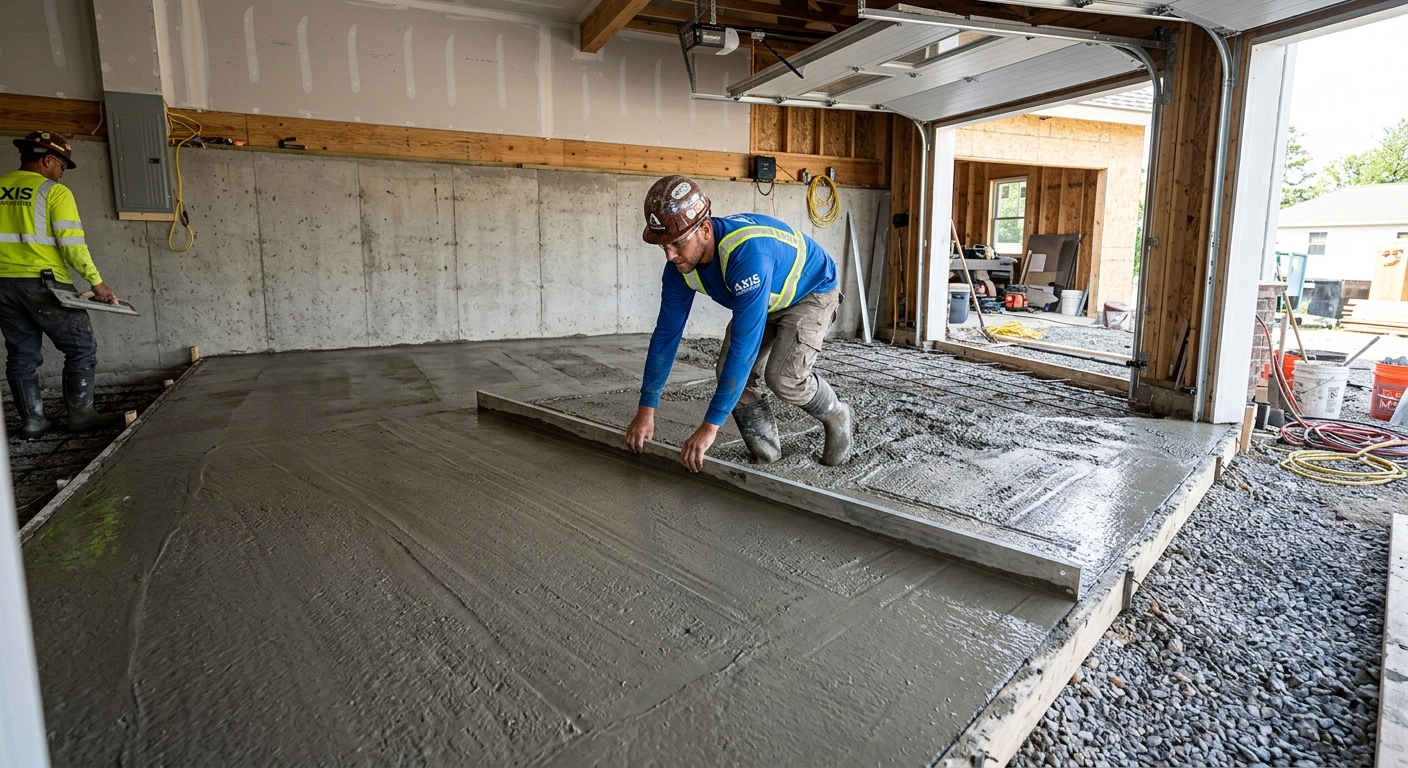
Concrete work options and costs in Clayburn
Clayburn homeowners typically choose concrete because it’s durable for driveways, patios and foundations in a Lower Mainland–Southwest climate that brings mild winters, a shallow design frost depth, and plenty of coastal-wet rainfall. Clayburn’s population is 11,755 (Statistics Canada, 2021 Census), and the housing mix here heavily features single-detached and small-lot neighbourhoods where new driveways and backyard flatwork are a regular project type. In this corridor, concrete contractors also have to manage scheduling around rain, cool nights and high humidity—so “the right mix and the right cure” directly affects labour time, material selection and, ultimately, your final price.
In practice, Lower Mainland–Southwest specs still assume a frost depth around 450 mm / 18", so footings, piers and thickened edges are placed below that to reduce freeze–thaw and frost-heave risk. Exterior slabs and garage floors also call for properly air-entrained concrete, good granular base preparation and control joints to control cracking and scaling. If a site has saturated soil, poor drainage, or limited access for a concrete truck, your cost rises because excavation, forming, and base work need more time and material.
Demand is especially strong in family-heavy areas closer to the Abbotsford corridor where homeowners are building and renovating with an “add curb appeal” mindset—think new driveways, interlock-to-concrete replacements, and backyard patios. With that context, the price ranges below will help you compare common options before you review itemised quotes.
| Application |
Typical Size |
Key Spec |
Finish Option |
Price Range |
| Concrete driveway (standard broom finish) |
16 ft x 24 ft (384 sq ft) |
Air-entrained exterior mix, compacted base, control joints |
Broom finish, sealer optional |
$6,900–$10,700 |
| Exposed aggregate driveway |
16 ft x 24 ft (384 sq ft) |
Designed aggregate blend, proper cure to lock texture |
Exposed aggregate with seal coating |
$9,000–$13,500 |
| Stamped concrete driveway or patio |
300–450 sq ft |
Air-entrained mix, release agent, saw-cut joints |
Stone/brick stamp pattern |
$8,000–$15,800 |
| Plain concrete patio or walkway |
10 ft x 16 ft (160 sq ft) |
Exterior thickness + base prep, air-entrained concrete |
Float + light broom |
$2,600–$4,200 |
| Garage floor (interior slab) |
20 ft x 22 ft (440 sq ft) |
Minimum 32 MPa mix, vapour barrier (if applicable) |
Broom finish, saw-cut joints |
$4,000–$8,200 |
| Foundation footings (structural, below frost) |
Per linear foot (typical home: 40–70 lf) |
Excavation below frost depth + rebar + concrete |
Structural concrete to spec |
$8,000–$24,500 |
Prices are estimates only and vary by project scope, site access and material selection.
What affects the price of concrete work in Clayburn
In Clayburn and across the Lower Mainland–Southwest region, two quotes for the “same size” concrete job can still differ by 30–50%. The main reason is that concrete pricing isn’t just the slab—it’s everything underneath and around it: excavation depth, soil conditions, drainage, reinforcement needs, forming complexity, truck access, and how long crews must protect curing concrete when rain and cool nights slow progress.
Frost line depth and freeze–thaw cycles dictate every spec. Even though coastal BC generally has a shallower frost design than interior provinces, exterior work still needs footings below the design frost depth to prevent frost heave. In the Lower Mainland–Southwest, the commonly used design assumption is roughly 450 mm / 18", so thickened edges and footings are placed below that. Exterior slabs should use air-entrained concrete (to resist scaling and freeze–thaw damage), plus control joints to manage cracking. In colder regions, shorter pour seasons and cold-weather curing precautions (heating, insulated blankets) can add cost; in Clayburn those costs are usually lower than northern BC, but prolonged damp weather and cool night temperatures can still require additional curing management.
In Clayburn, a saturated, poorly draining backyard can add significant excavation and granular regrading before you ever place concrete. Likewise, replacing a driveway on a tight driveway approach can raise forming and concrete truck logistics. If you’re choosing between a standard broom driveway (common backbone pricing: $18–$28 per sq ft) and stamped & decorative concrete (often $22–$36 per sq ft), the price jump is usually justified by labour-intensive form-and-stamp work and finishing time—not just the concrete itself.
House age matters, too. Older properties often have older drainage patterns or deteriorating subgrade near patios and steps, which can force deeper base prep than newer builds—sometimes turning a “simple patio” into a base-replacement job with a noticeable dollar impact.
| Price Factor |
Why It Matters |
Cost Impact |
| Frost line depth — determines footing depth and form height |
Footings must sit below design frost to prevent heave and settlement issues |
Can add major excavation/forming time on structural work |
| Site preparation — excavation, grading, compacted granular base |
Proper base prevents pumping, uneven settlement and premature cracking |
Higher for wet soils or poor drainage; lower on clean, firm sites |
| Reinforcement — rebar or wire mesh requirement |
Controls cracking and supports load in exterior slabs and structural members |
Material + labour cost increase if reinforcement is required and properly positioned |
| Mix design — air-entrainment and compressive strength spec |
Exterior freeze–thaw durability relies on air-entrained concrete |
Typically modest per-cubic-yard increase; critical for long-term performance |
| Finish type — broom vs. stamped vs. exposed aggregate |
More steps, timing control, and labour-intensive finishing for decorative work |
Stamped/exposed generally costs more than broom-finished flatwork |
| Pour size and concrete truck access to site |
Small access issues increase labour and may require smaller loads or extra equipment |
Can add truck logistics and extra labour hours |
| Cold-weather curing precautions — heating and blankets |
Concrete needs controlled curing to reach target strength and durability |
Usually seasonal; more common when nights are consistently cool |
| Control joint pattern and sealing cost |
Joints limit random cracking; sealing helps resist moisture and de-icing-related wear |
Not optional on long-term performance; adds material and crew time |
Permits & regulations in British Columbia
In British Columbia, concrete work splits into “structural” and “non-structural flatwork,” and that’s where permits usually differ. Structural concrete—such as footings, foundation walls, grade beams, and other load-bearing concrete components—typically requires a building permit, and it often needs engineered drawings reviewed through the municipality’s process. Concrete flatwork (patios, walkways and many driveways) usually does not require a permit by default, unless the work affects lot grading, changes drainage patterns, impacts impervious surface coverage limits, or touches municipal right-of-way or access constraints. Because rules and thresholds can vary by site conditions, confirm with the local authority before breaking ground.
Before you hire a contractor in Clayburn, verify three things: the licence/registration appropriate for the contractor’s scope, liability insurance, and coverage for workers. Step-by-step: (1) check the contractor’s business listing/online registry details to confirm it is active and aligned with the trade scope they claim; (2) request a current certificate of insurance (COI) showing general liability and the correct insured parties; (3) ask for confirmation of worker coverage (WSIB/WCB) for the company. Ask for a “clearance letter” or coverage document number and confirm dates. Then request references on similar projects in the Lower Mainland–Southwest where drainage and freeze–thaw durability were part of the scope.
Getting concrete right in Clayburn's freeze-thaw climate
Clayburn concrete jobs fail for predictable reasons: weak base preparation, missing air-entrainment, poor control-joint layout, and curing that’s rushed or compromised by rain and cool nights. To spec the job correctly, start from the ground up. (1) Base preparation: excavate to the right depth and build a compacted granular sub-base sized for your soil and local frost considerations, then ensure positive drainage so water can’t sit under the slab. (2) Mix design: require air-entrained concrete with typical exterior air content around 5–7% for durable freeze–thaw performance, and specify a minimum 32 MPa compressive strength for the concrete used in exterior flatwork and structural pours as appropriate. (3) Control joints: plan joint spacing so shrinkage cracking happens where it’s least noticeable and easiest to seal. (4) Curing: plan for at least 7 days of curing under proper conditions; in cold or damp weather, crews may need curing blankets and careful temperature control to reach strength. (5) Sealing: apply a penetrating sealer after the concrete has cured—commonly around 28 days post-pour—so moisture and de-icing salts don’t accelerate surface wear.
This is where you can avoid wasting money. For example, a homeowner might compare a plain broom patio versus a stamped patio. If the contractor cuts corners on the base or omits correct air-entrainment, the cheaper option won’t last. If both options are properly spec’d, stamped concrete typically costs more (often in the $22–$36 per sq ft decorative band), and that premium is justified by additional labour for stamping, timing and finishing—not by skipping durability essentials.
When you review quotes, ask specific technical questions about air-entrainment, joint spacing, curing method, and sealing timing—because spalling from inadequate air content is one of the most common “looks fine at first, fails later” problems in coastal-wet freeze–thaw environments like ours.
| Spec |
Why It Matters in Clayburn |
What to Ask For |
Impact if Skipped |
| Compacted granular base (depth?) |
Correct base depth and compaction reduce settlement and help drainage in wet soils |
“What thickness of compacted granular base will you place and how will you verify compaction?” |
Uneven settling, cracking, and early edge deterioration |
| Air-entrained concrete mix (target air %?) |
Freeze–thaw durability depends on entrained air and proper concrete quality |
“What’s the target air content for exterior exposure (typ. 5–7%) and how is it controlled?” |
Higher risk of scaling and spalling during freeze–thaw cycles |
| Compressive strength (MPa rating) |
Adequate strength supports durability and finishing schedule under cool damp conditions |
“Minimum 32 MPa—confirm mix design and testing approach.” |
Surface wear, reduced longevity and increased cracking potential |
| Control joints (spacing per ACI guidelines) |
Joints manage shrinkage cracking to predictable locations |
“What joint spacing will you use for my slab size, and will you saw-cut as required?” |
Random cracking and wider repair patches |
| Minimum 7-day curing period |
Proper curing helps the slab reach strength before it’s exposed to wet/cold swings |
“How long will you keep it curing and what happens if nights are cool/rainy?” |
Surface weakness, dusting and moisture-related deterioration |
| Penetrating sealer (when applied after cure) |
Helps repel moisture and reduces salt/chemical impact on exterior surfaces |
“Will you apply penetrating sealer around 28 days after pour, and what product is used?” |
Faster staining, moisture ingress and surface breakdown |
How to choose a concrete work contractor in Clayburn
Start by verifying the contractor’s ability to legally and safely perform the work in British Columbia. Ask for their current business registration details (and any required trade-specific authorization for the scope they’re selling), then request a certificate of insurance showing general liability. For worker coverage, ask for proof of WSIB/WCB coverage (or clearance documentation) and confirm the dates match your job timeline. Don’t accept verbal confirmation—ask for the paperwork and keep copies for your records.
Next, get 2–3 itemised written quotes. You want a breakdown that clearly separates excavation/grading, compacted granular base, reinforcement, concrete supply/mix, forming, finishing, joints, curing protection, sealing (if included), and any disposal costs. Avoid lump sums that don’t explain what’s excluded: for instance, whether demo and hauling are included, whether permit handling is included (for structural work), and whether the contractor is responsible for protecting nearby landscaping during prolonged rain days.
Warranty matters for flatwork. Ask for the workmanship warranty length and what it covers (cracks, spalling, settlement, joint seal failure), plus whether product/manufacturer warranties apply and if they’re transferable to you. For payment, keep it sensible: don’t pay more than about 10–15% upfront, and hold back a portion until the job is complete and broom-to-sealer details are done as promised. Finally, insist on a written timeline with a start date window and an estimated completion date.
- Ask who will place and finish the concrete on-site (crew name/lead), not just who signs the quote.
- Confirm excavation depth and compacted base thickness in writing.
- Require a stated air-entrained mix spec for exterior exposure.
- Check joint layout: spacing, saw-cut timing, and whether joints will be sealed.
- Ask how they handle rain/cool nights (curing blankets, moisture protection, scheduling).
- Ensure reinforcement requirements are listed (wire mesh vs rebar, placement height).
- Verify sealing scope and exact timing (typ. after curing, commonly around 28 days).
- Review truck access plan and concrete placement method for your driveway width/turning radius.
- Confirm disposal: haul-away for demo and whether off-site dumping is included.
- Ask for sample colours/patterns for stamped/exposed work and who owns the final layout decision.
- Request a copy of insurance COI and WSIB/WCB coverage documentation before scheduling.
- Get a clear warranty form in writing and ask what “excluded” conditions mean.
Red flags in Clayburn include: quotes that don’t mention air-entrainment for exterior slabs, missing details on base prep/compaction, pressure for large upfront payments, no written curing/sealer timeline, and vague warranty language that excludes cracking without referencing joint design and expected shrinkage.
Frequently asked questions — concrete work in Clayburn
What is a concrete overlay and is it suited to Clayburn?
A concrete overlay is a bonded layer of new concrete (often thin) placed over existing slab concrete after surface prep. In Clayburn and across British Columbia’s Lower Mainland–Southwest, overlays can work when the original slab is structurally sound: minimal lifting, no widespread settlement, and cracks that are stable (not actively moving). The key is preparation—surface profiling, cleaning, moisture conditions, and correct bonding method. Overlays also still need proper control joints and correct exterior durability specs, because freeze–thaw cycles and wet conditions can punish weak edges. Cost-wise, an overlay is sometimes attractive versus full removal, but if the base is already failing, the “savings” can disappear. If your driveway is already rough or moving, full replacement is usually a better long-term bet than a thin repair.
How do I seal concrete to protect it in Clayburn?
To protect concrete in Clayburn, use a penetrating sealer designed for exterior exposure and let the slab fully cure first. A good rule of thumb is applying penetrating sealer around 28 days after the pour, assuming weather conditions allow curing to reach the target strength and surface condition. The contractor should clean the surface and repair minor defects (like spalls at edges) before sealing. Sealing helps repel moisture from rain and reduces how de-icing salts can attack the surface during cold spells. It does not replace proper air-entrained mix, correct joints, or good drainage—those are the durability foundation. If your contractor offers sealing immediately after finishing, without cure time, that’s a concern. Confirm the product type and coverage rate in the written scope.
What is the difference between concrete and cement?
Cement is one ingredient; concrete is the full mixture. Cement (typically Portland cement) is the binder that reacts chemically to harden. Concrete also includes water, sand, gravel (or other aggregates), and admixtures like air-entraining agents for freeze–thaw durability. In Clayburn’s exterior work, the difference matters because “using the right concrete” is what protects your driveway or patio over wet winters and freeze–thaw cycles. For example, an exterior mix should be air-entrained and meet minimum compressive strength (commonly a 32 MPa spec for flatwork in many residential scopes). A contractor should be able to explain their air content and mix design, not just mention “cement is strong.” If the quote only discusses cement type and not the full concrete mix, it’s missing critical durability details.
How much does concrete work cost in Clayburn?
In Clayburn, typical pricing depends on finish level and site conditions, but most homeowners can budget within the regional bands. For example, a concrete driveway in the $18–$28 per sq ft range is common for standard broom-finished flatwork, while stamped & decorative concrete often lands in the $22–$36 per sq ft band due to additional labour for patterning and finishing. A plain patio or walkway often sits in the $16–$26 per sq ft range. Foundation footings are priced differently because excavation and reinforcing are involved—often reflected as a per-project total within a $200–$350 per linear foot backbone, depending on scope. If your site is tight, wet, or requires extra base prep for drainage, the price can move toward the high end. The most reliable way to know your number is an itemised quote that lists base prep, reinforcement, mix, joints, curing, and sealing (if included).
How deep must footings be for Clayburn's frost line?
For Clayburn and the Lower Mainland–Southwest, contractors typically design around an assumed frost depth of about 450 mm / 18". Footings, piers, and thickened edges are placed below that design depth to reduce the risk of frost heave during freeze–thaw cycles. That said, the exact footing depth for your home depends on engineered requirements, soil conditions, and the structural design—so you shouldn’t rely on a single number from a quote. When you’re dealing with foundation work, ask your contractor whether the excavation is planned to meet below-frost design and whether the engineer’s foundation plan is being followed. If the site has saturated or poor-draining soils, the contractor may also adjust base/subgrade treatment and drainage features to protect the foundation system.
Why does concrete crack in Clayburn and how is it prevented?
Concrete cracks mainly because it shrinks as it cures, then experiences temperature and moisture changes. In Clayburn, freeze–thaw cycles and wet conditions can worsen the appearance and severity if the slab doesn’t have the right durability specs. Prevention comes from combining proper base prep (stable, compacted granular), a durable air-entrained exterior mix, correctly spaced control joints, and good curing. Control joints give the concrete a planned “release point,” so shrinkage and movement happen where you expect them rather than randomly. For exterior slabs, properly air-entraining the mix (typical exterior targets around 5–7% air content) is critical to reduce freeze–thaw scaling and spalling. Sealing after curing helps protect the surface from moisture and salt exposure. If a contractor offers no joint plan or won’t discuss air content and curing, you’re taking a durability risk.