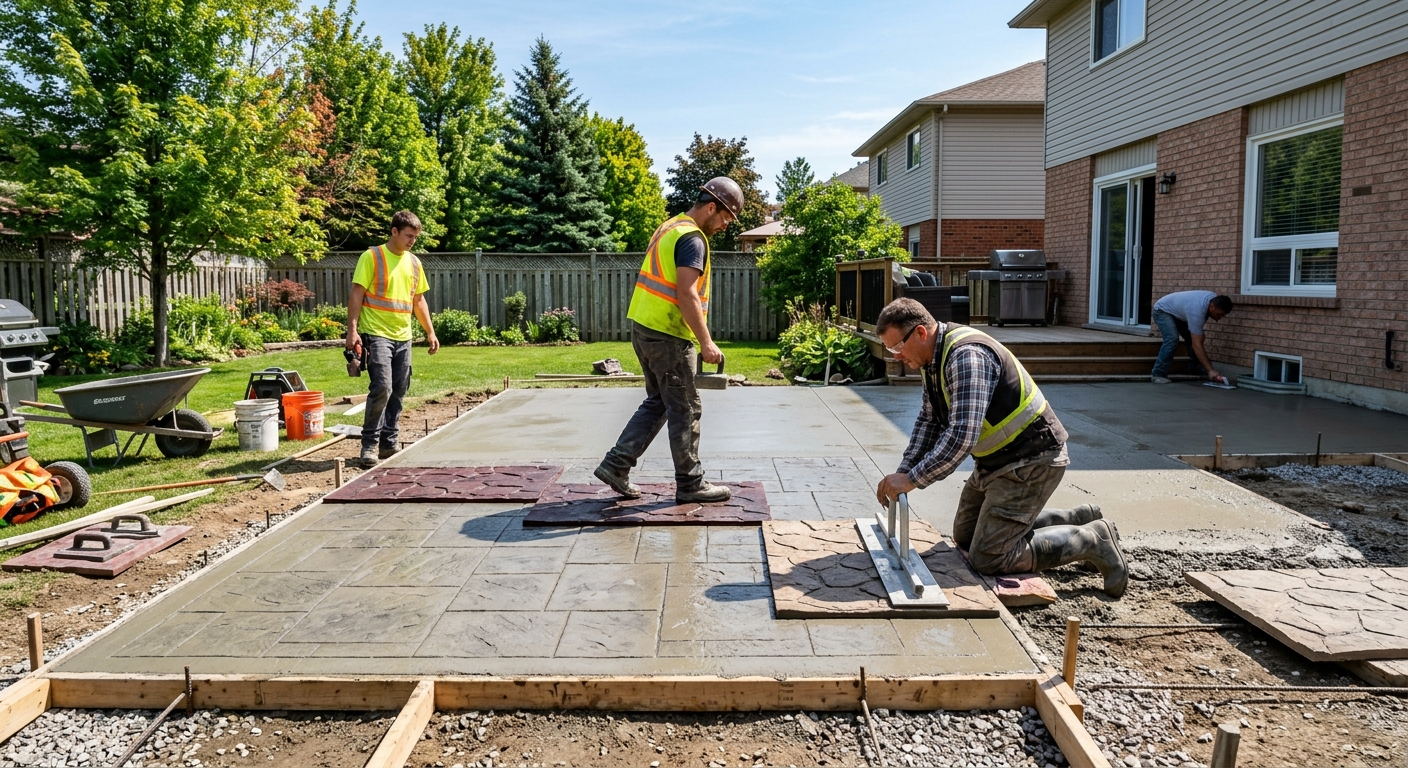
Concrete work options and costs in West Cambie
Concrete work in West Cambie is a practical choice for homeowners who want durable flatwork in a coastal, wet climate—especially when the ground cycles between moisture-heavy periods and colder nights. West Cambie is home to a mix of family housing; in the wider Lower Mainland–Southwest area, single-detached neighbourhoods and townhouse pockets drive steady demand for driveways, patios, sidewalks, and foundation upgrades. In 2021, West Cambie’s population was 12,255 (Statistics Canada, 2021 Census), and that stable growth supports reliable local scheduling—though crews still have to plan carefully around rain and high humidity.
Lower Mainland–Southwest concrete pricing is shaped by shallow-but-real frost depth (commonly ~450 mm / 18" in design practice) and frequent freeze–thaw cycles. Even when winters feel mild, saturated soils and cool nights can damage poorly prepared bases, and exterior slabs need air-entrained mixes plus proper control joints to control cracking and reduce scaling. That climate reality also affects contractor availability: when it rains for days, excavation and base prep slow down, and curing takes longer, which can narrow the window for “same-week” pours.
If you’re looking at projects around areas like the West Cambie neighbourhood near Bridgeport/Langley-side commuting routes, driveway and backyard patio work is especially in demand because many homes sit on tighter lots where access, grading, and drainage details must be handled carefully. Below is a straightforward comparison of common options and realistic price bands for this tier, so you can align expectations before you request quotes.
| Application |
Typical Size |
Key Spec |
Finish Option |
Price Range |
| Concrete driveway (standard broom finish) |
300–500 sq. ft. |
Air-entrained exterior mix, compacted granular base, control joints |
Broom finish + basic edging |
$4,800–$10,000 |
| Exposed aggregate driveway |
300–450 sq. ft. |
Air-entrained mix, sealed aggregate, trowel/float control |
Exposed aggregate with sealer-ready surface |
$7,000–$14,000 |
| Stamped concrete driveway or patio |
250–450 sq. ft. |
Air-entrained mix, integral color, proper joints |
Stamp pattern + release + seal coat |
$6,000–$16,000 |
| Plain concrete patio or walkway |
150–300 sq. ft. |
Air-entrained exterior mix, compacted base, expansion/edge detailing |
Float/smooth or broom-light finish |
$2,400–$7,800 |
| Garage floor (interior slab) |
300–600 sq. ft. |
Vapour control considerations, fibre or mesh reinforcement as needed |
Smooth trowel finish (typically) |
$3,900–$11,500 |
| Foundation footings (structural, below frost) |
Per project: typical 8"–12" thick footing; varies by design |
Excavate below design frost depth, form/steel as engineered, drainage detail |
Structural concrete (no decorative finish) |
$9,000–$35,000 |
Prices are estimates only and vary by project scope, site access and material selection.
What affects the price of concrete work in West Cambie
In West Cambie and across the Lower Mainland–Southwest, it’s common to see quote differences of 30–50% for “the same” concrete job—because the real variables are underground and operational, not just the visible finish. Two contractors may both quote a driveway at a similar total area, but one includes the correct base depth, subgrade drainage work, and engineered reinforcement details, while the other assumes a simpler prep. In cold-weather-proofing terms, the region’s frost depth is often treated around ~450 mm / 18", yet freeze–thaw cycles and saturated soils still force exterior specs like air-entrainment, thicker edge details, and tighter control-joint layouts.
Concrete work also costs more when contractors must take extra precautions. In colder parts of BC (and in interior climates), the pour season can be shorter and heating/blankets may be required—those added labour and equipment costs don’t disappear in the Lower Mainland. Coastal-wet conditions mean curing can run longer under cool, humid weather; that affects scheduling and sometimes the need for curing blankets and surface protection.
Here are a few West Cambie examples that move the price: (1) a driveway replacement on wet or poorly drained soil may need deeper compacted granular and additional drainage, pushing you from standard broom-finish pricing (often aligned with the $18–$28/sq. ft. tier) toward the upper end; (2) stamped concrete adds colour, stamp mats, labour time, and sealing, commonly tracking closer to the $22–$36/sq. ft. decorative band; and (3) tight access for a wheelbarrow-style pour can reduce concrete truck efficiencies—raising labour even if the slab is the same area.
Finally, housing age matters. Older properties in this area may have older drainage patterns or uneven subgrades that require extra excavation and grading—turning a “refresh” into a full base rebuild. That’s why two driveways can differ sharply even when the finishing looks identical.
| Price Factor |
Why It Matters |
Cost Impact |
| Frost line depth |
Determines footing depth and how much excavation/formwork is required below exterior frost exposure |
Can add significant labour/haul cost for structural work; footing-only pricing often ranges $200–$350 per foot as a reference band |
| Site preparation |
Excavation, grading, and compacted granular base affect settlement risk and durability under freeze–thaw |
Typically the biggest variable; poor subgrade can move a “standard” slab into a higher prep bracket |
| Reinforcement |
Rebar or wire mesh depends on slab use (driveway vs walkway) and engineered design |
Adds material and labour; increases unit cost and inspection time |
| Mix design |
Air-entrainment and required strength help resist scaling and spalling in wet coastal freeze–thaw conditions |
Air-entrained exterior mixes add modest material cost but reduce failure risk and callbacks |
| Finish type |
Broom vs exposed aggregate vs stamped requires different labour time, tools, and sealing steps |
Stamped/exposed often carries a higher per-sq.-ft. premium than plain broom-finished concrete |
| Pour size and concrete truck access to site |
Sequencing and distance from truck to pour impact labour efficiency and quality |
Tight access and small pours can increase labour per square foot |
| Cold-weather curing precautions |
When nights are cold or the season is marginal, contractors may use blankets/heaters to protect early strength |
Heating blankets and monitoring add labour and equipment rental costs |
| Control joint pattern and sealing cost |
Proper joints control cracking; sealing helps repel de-icing salts and moisture penetration |
Small line item, but often the difference between “good” and “stays good” surfaces over years |
Permits & regulations in British Columbia
In British Columbia, structural concrete work typically requires a building permit, and many projects also need engineered drawings reviewed through the municipality. That usually includes foundation walls, grade beams, footings, and other structural elements. If you’re building new, underpinning, or significantly altering structural support, plan on permits and engineering as part of the process.
Concrete flatwork—like patios, walkways, and standard driveways—often does not require a building permit when it’s limited to non-structural improvements and does not change lot grading in a way that affects drainage, slope stability, or impervious surface coverage limits. However, any work that impacts lot grading, directs water toward neighbouring property, changes right-of-way conditions, or involves municipal frontage/sidewalk interfaces can trigger review requirements. Always confirm with the local authority before breaking ground, especially if your driveway ties into municipal curb/sidewalk areas.
For your contractor checks in West Cambie, start simple and document everything:
- Ask for the contractor’s business details and proof of general liability insurance (certificate of insurance).
- Confirm WCB coverage (where applicable under their structure) and ask for proof of coverage/clearance documentation.
- Verify licensing/registration status through the relevant provincial registry (and ensure their listed coverage matches the legal name on the quote).
- Request references from similar concrete flatwork or foundation jobs (similar scope, similar site access).
- Make sure the quote clearly states what is and isn’t included (permit pulling, disposal, saw-cutting, reinforcement, drainage).
Reputable contractors can provide these items quickly—because they’ve already done it for other West Cambie homeowners.
Getting concrete right in West Cambie's freeze-thaw climate
Concrete failures in West Cambie are usually preventable. The most common problems I see are surface scaling, spalling, and random cracking caused by inadequate base preparation, poor mix design, or rushed curing in cool, wet weather. Even though the frost line is relatively shallow compared with many inland or northern regions (commonly around ~450 mm / 18" in local design practice), freeze–thaw cycles and saturated subgrades still stress slabs and footings. That means the “standard” recipe needs to be tailored: you want the right base depth for your soil, air-entrained concrete for exterior exposure, properly spaced control joints, and curing/curing protection that reaches design strength.
To spec the job correctly: (1) Base prep should include compacted granular at the right depth for the local soil conditions, with drainage attention so water doesn’t sit under the slab. (2) Mix design for exterior flatwork should use air-entrainment (targeting roughly 5–7% air content) and a minimum 32 MPa compressive strength. (3) Control joints should be laid out to limit random cracking; you’re guiding where cracks occur instead of letting them choose. (4) Curing should be at least 7 days under proper conditions—this becomes critical when overnight temps are low or the forecast is cool and damp. (5) Sealing should be applied after the slab cures—typically 28 days post-pour—to improve resistance to moisture and de-icing salts.
A specific cost example: homeowners often weigh plain broom-finish concrete against stamped or exposed work. Stamped concrete can run a noticeable premium (often within the $22–$36/sq. ft. decorative band), but the higher labour for stamping and finishing is justified when you’re prioritizing appearance and sealing. If the base prep and air-entrainment are wrong, though, a cheaper broom-finish pour can fail just as quickly—so the technical specs matter more than the look.
| Spec |
Why It Matters in West Cambie |
What to Ask For |
Impact if Skipped |
| Compacted granular base (depth?) |
Provides load support and reduces pumping/surface movement during wet periods and freeze–thaw |
“What base thickness will you compact to (and what material spec)?” |
Settlement, cracking, and early surface failure |
| Air-entrained concrete mix (target air %?) |
Helps concrete tolerate freezing moisture without scaling and spalling |
“What air content are you targeting for exterior exposure?” |
Higher risk of spalling and scaling |
| Compressive strength (MPa rating) |
Ensures the mix reaches durability strength for exterior weather exposure |
“Confirm minimum 32 MPa and curing method.” |
Surface wear and reduced long-term durability |
| Control joints (spacing per ACI guidelines) |
Controls where shrinkage cracking occurs under coastal humidity and temperature changes |
“What joint spacing and layout will you use, and will you seal them?” |
Random cracking and easier water ingress |
| Minimum 7-day curing period |
Curing under cool, damp conditions is critical for early strength gain |
“How do you protect the slab in rain/cold, and for how long?” |
Weaker surface, higher cracking risk, reduced durability |
| Penetrating sealer (when applied after cure) |
Repels moisture and reduces damage from de-icing salts and coastal-wet exposure |
“What sealer type, and when exactly is it applied (after 28 days cure)?” |
Faster staining, moisture penetration, and surface deterioration |
How to choose a concrete work contractor in West Cambie
Choosing a concrete contractor in West Cambie comes down to proof, not promises. Start by verifying British Columbia coverage and standing. Ask for a certificate of insurance naming you/your property as required under the quote, and verify their liability limits are appropriate for your scope. Next, confirm WCB coverage documentation (or clearance where applicable) so you’re not exposed if a worker is injured. If their work touches structural elements, you should also confirm that any required registrations/licensing match the business name used on the contract.
Then get 2–3 itemised written quotes. You want labour and materials separated, not a single lump sum that hides exclusions. Ask specifically if the quote includes excavation, forms, reinforcement, disposal, and saw-cutting. For flatwork, confirm whether permit pulling is required for your specific situation; for any structural concrete, permit/engineering steps are typically part of the overall process in BC. Make sure the scope states whether they include drainage details at the slab edge and how they handle tie-ins to existing concrete.
Warranty should be clear: workmanship warranty length (how long and what’s covered) and whether the product/manufacturer warranty applies to additives/sealers or any other supplied system. Also ask if warranties are transferable if you sell.
For payment schedule, never accept a plan that requires more than 10–15% upfront. Hold back a portion until the job is complete and corrected. Finally, request a written start date and completion estimate—rain and curing requirements in the Lower Mainland–Southwest can affect timelines.
- Ask for proof of insurance (certificate) and keep it with your contract.
- Confirm WCB coverage/clearance documentation before work begins.
- Get the exact scope in writing (dimensions, thicknesses, reinforcement, base depth).
- Require an air-entrained exterior mix for any driveway/patio exposed to weather.
- Ask for compressive strength target (e.g., minimum 32 MPa for durability).
- Confirm control joint pattern and whether joints will be sealed.
- Check whether disposal, haul, and site cleanup are included.
- Ask who coordinates delivery timing with curing and rain forecasts.
- Verify concrete truck access method and pour sequencing for your lot.
- Require curing protection plan (especially during cool nights or extended rain).
- Review warranty terms for workmanship and finish systems (sealers).
- Ensure payment schedule is tied to milestones and final inspection.
Concrete contractor red flags in West Cambie include: vague specs (no mention of air-entrainment or base depth), refusing to itemise quotes, asking for a large upfront payment, skipping joint layout/sealing discussions, and dismissing rain/cold curing precautions as “not necessary.”
Frequently asked questions — concrete work in West Cambie
What is the difference between concrete and cement?
Concrete is the full building material: cement plus water plus aggregates (sand and gravel) and often admixtures (like air-entraining agents for exterior exposure). Cement is only one component—the binder that reacts with water to create strength. In West Cambie, the key practical difference shows up in durability specs: for driveways, patios, and other exterior slabs, contractors should use air-entrained concrete mixes to help resist freeze–thaw scaling in the Lower Mainland–Southwest’s coastal-wet conditions.
When you ask for a quote, don’t just ask for “concrete.” Ask what mix design will be delivered, including target air content and minimum compressive strength (commonly minimum 32 MPa for durability). A good contractor will also describe curing and sealing steps, because the cement can hydrate properly only if moisture/temperature conditions are managed.
How much does concrete work cost in West Cambie?
Concrete costs in West Cambie depend heavily on excavation, base prep, and how premium your finish is. For plain exterior flatwork, you’ll often land in the driveway/slab tier of about $18–$28 per square foot, and patios/walkways around $16–$26 per square foot. Stamped and decorative concrete generally runs higher—about $22–$36 per square foot—because it includes extra labour, colour materials, and sealing.
As a practical reference, a standard broom-finish driveway that’s roughly 300–500 sq. ft. commonly falls into the mid-to-upper thousands, while a stamped driveway or patio of similar size typically moves into a wider range due to labour intensity. If your site needs extra drainage or deeper granular base because of saturated soils and freeze–thaw exposure, your prep costs can push the total toward the higher end even if the finish looks simple.
How deep must footings be for West Cambie's frost line?
Footing depth is determined by frost protection requirements and engineered design—not by guesswork. In Lower Mainland–Southwest practice, the design frost depth is commonly assumed around 450 mm / 18", meaning footings and thickened edges are typically placed below that to reduce frost heave risk. The exact required depth can still vary depending on soil conditions, drainage, and the structural design requirements for your home.
That’s why foundation pricing differs: excavation and forming increase with depth, and contractors must build below the design frost exposure. If your site has higher moisture or poor drainage, you may also see added drainage detailing and base preparation to keep the soil from staying saturated. For structural concrete work in BC, you should expect permits and engineered drawings as part of the process.
Why does concrete crack in West Cambie and how is it prevented?
Concrete cracks in West Cambie mainly because shrinkage and temperature movement are normal, and exterior slabs are exposed to wet/dry cycles and freeze–thaw. In coastal BC, moisture can move in and out of the slab and base, and that movement can worsen surface deterioration if the mix isn’t properly air-entrained or if joints and curing aren’t handled correctly.
Prevention is about controlling where the cracks can happen: use a proper control joint pattern (spaced to limit random cracking), include proper base compaction, and use air-entrained exterior concrete. Curing matters too—minimum 7 days under suitable protection—especially when cool nights and rainy stretches delay strength gain. Sealing after cure helps reduce moisture and de-icing salt impacts.
Stamped vs broom-finish concrete — cost difference?
Stamped concrete typically costs more than broom-finish because it involves additional steps: integral or surface colour, stamp application and finishing, more careful joint planning so the pattern aligns, and usually a sealing system designed for decorative surfaces. In the Lower Mainland–Southwest, stamped and decorative concrete often tracks in the $22–$36 per square foot band, while standard driveway concrete commonly aligns around $18–$28 per square foot.
That cost difference can be justified when you want a specific appearance for a front driveway or a backyard patio and you’re also getting the same core durability specs: air-entrained mix, proper base prep, and correct curing. The biggest mistake I see is when homeowners pay extra for the look but the prep or mix design is compromised—then the surface still fails due to spalling or scaling from freeze–thaw moisture. Always evaluate the technical scope, not only the finish name.
When is the best time to pour concrete in West Cambie?
The best time to pour concrete in West Cambie is when weather supports consistent curing and manageable site conditions—dry days for excavation/base prep and stable temperatures for concrete strength gain. While winters are milder in the Lower Mainland–Southwest, you can still get cool nights, foggy humidity, and rain that prolong cure times. That affects scheduling and sometimes requires curing blankets or protective measures so the slab reaches design strength.
Practically, contractors plan around rain forecasts, wind, and overnight temperatures to reduce risks like surface defects and under-strength early curing. For exterior flatwork, you also want enough time for water control and curing before heavy foot or vehicle traffic. If you’re booking ahead, ask the contractor how they monitor temperature and what cold-weather precautions they use—because “mild winter” doesn’t mean “no curing risk,” especially with freeze–thaw cycles.