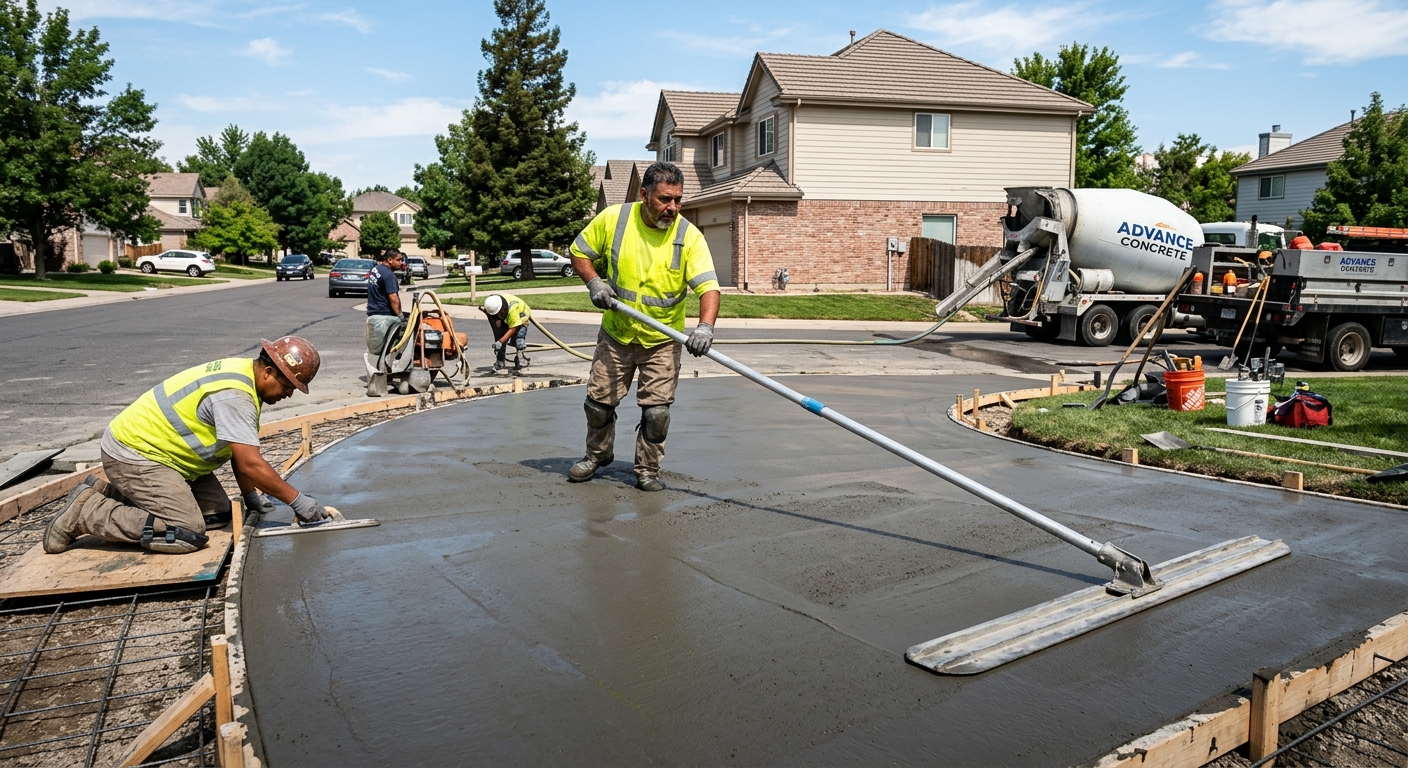
Concrete work options and costs in Murrayville
Murrayville homeowners typically choose concrete because it gives a clean, durable finish for driveways and patios—especially on properties where drainage and freeze-thaw protection matter. With a population of 11,420 (Statistics Canada, 2021 Census), the area supports a steady level of residential concrete demand, and most flatwork jobs are tied to single-family homes common in the Lower Mainland–Southwest. While the exact housing mix varies by neighbourhood, many concrete projects in Murrayville are driven by upgrades to older lots, plus new builds in and around the Murrayville/Southridge corridor where there’s ongoing driveway, walkway, and backyard patio construction.
Lower Mainland–Southwest concrete pricing is shaped by our mild winters combined with a shallow frost line, typically around 450 mm / 18". That still means footings, piers, and thickened edges need to sit below that depth to reduce frost heave risk, and exterior slabs require properly air-entrained mixes plus control joints to manage cracking and scaling. It’s also a coastal-wet market: prolonged rain, cool nights, and high humidity can slow curing and affect surface durability, so crews often use curing blankets and schedule work to avoid washout or over-wet base conditions. Availability of experienced finishers is another local driver—decorative work (stamped/exposed aggregate) takes more labour and time than standard broom finishes.
Below is a practical comparison of common options you’ll see in Murrayville. Use it as a budgeting starting point before you request itemised quotes and confirm specs like footing depth, mix design, and curing timing.
| Application |
Typical Size |
Key Spec |
Finish Option |
Price Range |
| Concrete driveway (standard broom finish) |
400–600 sq. ft. |
Air-entrained exterior mix; control joints; granular base |
Broom finish |
$7,200–$12,000 |
| Exposed aggregate driveway |
400–600 sq. ft. |
Air-entrained mix; proper curing; exposed surface prep |
Exposed aggregate (wash/retarder) |
$9,500–$15,800 |
| Stamped concrete driveway or patio |
300–500 sq. ft. |
Air-entrained mix; integral colour; released stamps; control joints |
Stamped with texture + colour |
$9,000–$18,000 |
| Plain concrete patio or walkway |
200–400 sq. ft. |
Air-entrained exterior mix; compacted base; slope to drain |
Plain trowel or light broom |
$3,200–$9,600 |
| Garage floor (interior slab) |
400–600 sq. ft. |
Minimum thickness per design; vapour/spacing as needed; control joints |
Float and broom/trowel finish |
$6,000–$12,500 |
| Foundation footings (structural, below frost) |
Per linear footing (typical 40–120 ft total) |
Excavation to below design frost depth; reinforced concrete |
Structural concrete |
$6,500–$16,800 |
Prices are estimates only and vary by project scope, site access and material selection.
What affects the price of concrete work in Murrayville
In Murrayville and across the Lower Mainland–Southwest, quotes for the “same” concrete project can swing by 30–50% because pricing follows the actual engineering and site conditions—not just the square footage. Two properties can both be “a 400 sq. ft. patio,” yet one site may need deeper base excavation, better drainage, more reinforcement, and longer curing protection due to rain exposure. Contractors also price labour differently depending on how quickly they can mobilize finishing crews and concrete trucks during the wet shoulder seasons.
Everything starts with frost protection and freeze–thaw cycles. Even though our frost depth is often assumed around 450 mm / 18", footings and thickened edges must extend below the design frost depth to prevent frost heave. Exterior slabs also need air-entrained concrete mixes to survive repeated wetting, cooling, and thawing. If the weather window is tight, colder conditions can require cold-weather curing precautions—heating equipment, insulated blankets, and additional monitoring—adding cost. After installation, de-icing salts can accelerate surface scaling if the surface isn’t protected; that’s why sealing is commonly recommended and why budgeting for “prep + curing + sealer” matters. A standard broom-finished driveway may land in the Lower Mainland–Southwest backbone range of roughly $18–$28 per sq. ft., while decorative options like stamped or exposed aggregate typically carry a higher finish premium (often aligning with the $22–$36 per sq. ft. decorative band, depending on complexity).
Concrete can get more expensive in Murrayville when soil is saturated, when we find poor bearing that needs additional granular base, or when access requires multiple handling steps (compact equipment, pump requests, or smaller pours). It can cost less when the site is already well-drained, excavation is straightforward, and you choose a simple plain patio rather than stamped work.
| Price Factor |
Why It Matters |
Cost Impact |
| Frost line depth — determines footing depth and form height |
Footings must be below design frost depth to reduce frost heave. |
High: deeper excavation and more concrete/steel can add 10–25%+. |
| Site preparation — excavation, grading, compacted granular base |
Proper drainage and base compaction protect against settlement and cracking. |
High: saturated soils or poor subgrade can add 15–30%. |
| Reinforcement — rebar or wire mesh requirement |
Reinforcement controls cracking and improves performance on exterior slabs. |
Medium: rebar mat/laps and chairing can add 5–15%. |
| Mix design — air-entrainment and compressive strength spec |
Exterior air entrainment reduces scaling/spalling risk in freeze–thaw cycles. |
Medium: proper mix and testing can add 3–8%. |
| Finish type — broom vs. stamped vs. exposed aggregate |
Decorative finishing is labour-intensive and requires specialized materials. |
High: can add 25–60% versus broom finish depending on area and pattern. |
| Pour size and concrete truck access to site |
Long pulls, tight access, or multiple loads increase labour time and risk. |
Medium to high: can add 5–20%. |
| Cold-weather curing precautions — heating and blankets |
Protects strength gain and surface quality when nights are cool. |
Medium: typically adds 2–10% but can be more in heavy protection scenarios. |
| Control joint pattern and sealing cost |
Joints manage cracking locations; sealing helps repel salts and moisture. |
Low to medium: often 1–5% for sealing; can be higher if multiple coats are needed. |
Permits & regulations in British Columbia
In British Columbia, structural concrete work generally needs a building permit. That includes the items that support the foundation system and transfer loads—such as footing pads, foundation walls, grade beams, and other structural concrete elements. For these, municipalities often require engineered drawings and reviews before construction starts. In contrast, concrete flatwork like patios, walkways, and typical driveways usually does not require a permit by default, as long as you’re not changing lot grading significantly or affecting municipal requirements around impervious surfaces and drainage discharge. In Murrayville, the practical point is to confirm whether your scope triggers lot grading changes, right-of-way impacts, or drainage alterations before you dig.
Before starting, verify your contractor carries liability insurance and the required workplace coverage (WSB/WCB). A homeowner should request documents and keep copies in your project file.
Step-by-step verification in BC:
- Ask for a current certificate of insurance: check that it’s valid and names your property (or is appropriately general) for liability coverage.
- Ask for proof of required coverage for workers (WSB/WCB).
- Confirm the contractor is eligible to perform the scope you’re buying (for example, concrete finishing vs. foundation structural work may involve different trades/subcontractors).
- Use the relevant online registries to confirm licence/registration status if applicable, and match the business name to the quote and invoice.
- Request references on similar-scale jobs in the Greater Vancouver/Surrey–Abbotsford corridor and verify the contractor’s track record in wet-season scheduling.
When in doubt, call the municipality or check their development/building process—especially if your project affects drainage routing, water management, or interfaces with existing foundation components.
Getting concrete right in Murrayville's freeze-thaw climate
Concrete fails in Murrayville most often due to water and temperature cycling—water gets under or through weak edges, then expands during freeze, pushing on surfaces and joints. The most preventable problem is spalling caused by inadequate air-entrainment or poor base drainage. To spec a successful job, start with base preparation, then move to the mix, joints, curing, and finally sealing—because each step addresses a different failure mode in our Lower Mainland–Southwest conditions.
1) Base preparation: Ensure compacted granular sub-base at the correct depth and grade for local soils. A well-drained base reduces pumping and settlement. If the site is soft or saturated, base prep becomes a larger portion of the quote because we may need more granular import and careful compaction.
2) Mix design: For exterior flatwork, require air-entrained concrete (commonly targeting 5–7% air) and a minimum compressive strength of 32 MPa for durability. This is what protects the surface through our freeze–thaw cycles and heavy rainfall exposure.
3) Control joints: Plan joints to local standards so cracking occurs where it’s intended, not randomly across the slab.
4) Curing: Arrange minimum 7-day curing under suitable conditions. In cool, damp periods, crews may use curing blankets and longer protection so strength gain proceeds properly.
5) Sealing: Apply a penetrating sealer after the slab has cured—commonly around 28 days post-pour—to reduce moisture and de-icing salt penetration.
Example of how specs affect cost: a plain patio might be in the neighbourhood of $16–$26 per sq. ft., but upgrading from broom-finished plain concrete to stamped decorative work can move you toward the $22–$36 per sq. ft. band. That price difference is justified when the job includes the correct base, air-entrained mix, and careful curing—otherwise the decorative surface may still scale or crack prematurely.
| Spec |
Why It Matters in Murrayville |
What to Ask For |
Impact if Skipped |
| Compacted granular base (depth?) |
Protects against settlement and keeps water from undermining the slab. |
Written granular depth/grade plan and compaction method. |
Higher risk of uneven cracking, edge failure, and spalling from trapped moisture. |
| Air-entrained concrete mix (target air %?) |
Reduces freeze–thaw damage and scaling on exterior surfaces. |
Confirm air content targets (commonly 5–7% for exterior flatwork) and mix spec. |
Spalling and surface scaling, especially where salts or runoff are present. |
| Compressive strength (MPa rating) |
Ensures durability and strength gain for proper performance over time. |
Require minimum 32 MPa (or project-specified higher rating). |
Lower long-term durability and increased cracking risk under freeze–thaw loads. |
| Control joints (spacing per ACI guidelines) |
Controls where shrinkage cracks occur as moisture and temperature change. |
Joint layout plan and intended spacing/routing. |
Random cracking and wider joint failures that let water in. |
| Minimum 7-day curing period |
Strength development depends on time, temperature, and moisture. |
Curing protection plan (blankets/sealer curing where needed) and minimum cure schedule. |
Surface weakness, dusting, and poor durability in wet/cool weather. |
| Penetrating sealer (when applied after cure) |
Repels moisture and helps manage de-icing salt exposure. |
Confirm product type and timing—commonly around 28 days after pour. |
More water ingress, faster scaling, and higher maintenance needs. |
How to choose a concrete work contractor in Murrayville
Choosing the right concrete contractor in Murrayville starts with verification and transparent quoting. In British Columbia, confirm the contractor’s eligibility to do the work you’re buying, and always request proof of liability insurance. Ask for documentation showing workers are covered by the required workplace coverage (WSB/WCB). Then verify it: look for a current certificate of insurance (valid dates and the correct business name), and keep the certificate number in your records. If the contractor is part of a larger build, ask who is responsible for permits and inspections for structural scope—footings and foundation elements typically need that level of approval.
Next, request 2–3 itemised written quotes. A good quote breaks labour and materials out clearly (excavation/base prep, reinforcement, concrete supply, finishing, curing protection, and any sealing), rather than only giving a lump sum. Read exclusions: ask whether permit pulling (if required), haul-away/disposal, protection of landscaping, and disposal of unsuitable soil are included. For workmanship, ask the length of the warranty and what it covers (cracks, spalling, joint performance, unevenness). Clarify whether the warranty is tied to the original owner or transferable when you sell.
Payment schedule matters: don’t pay more than 10–15% upfront. Hold back the balance until the job is complete and cleanup is done. Finally, get a written start date and completion estimate. In a wet-season region like the Lower Mainland–Southwest, scheduling delays are common, so the contract should include how weather impacts timing and what happens if rain interrupts base prep or curing.
- Provide a written scope with thickness, base depth, and reinforcement details.
- List concrete mix spec (air-entrained for exterior) and target strength.
- Confirm footing depth below design frost requirements for structural scope.
- State joint layout and sealing plan (including timing after cure).
- Include disposal/haul-away costs for unsuitable or excess soil.
- Specify truck access plan and whether pumping/extra labour is included.
- Show line items for excavation, granular base, compaction, and labour.
- Include curing protection measures for cool/wet nights.
- Provide insurance and workers coverage documentation before starting.
- Share references for similar Murrayville/Langley/Surrey-scale residential jobs.
- Use a sensible warranty: workmanship duration and what voids coverage.
- Set payment milestones tied to measurable completion steps.
Concrete contractor red flags in Murrayville: they refuse to discuss air-entrainment or joint spacing; they won’t provide itemised pricing or a written scope; they ask for large upfront payments; they dismiss drainage/base prep as “not necessary”; or they can’t show proof of insurance and workers coverage documents.
Frequently asked questions — concrete work in Murrayville
What is air-entrained concrete and why does it matter here?
Air-entrained concrete has microscopic air bubbles intentionally built into the mix so water that freezes inside the paste can expand without destroying the concrete. In Murrayville and across British Columbia’s Lower Mainland–Southwest, freeze–thaw cycles combined with coastal rainfall make exterior surfaces vulnerable to scaling and spalling if the mix isn’t designed correctly. For exterior flatwork, it’s common to target about 5–7% air content. This is why a “cheapest” quote can become expensive later—if the contractor supplies an interior-type mix instead of an air-entrained exterior mix, the surface can deteriorate prematurely, especially near edges where water collects. When budgeting, remember that protective mix design is usually a small line item compared with the cost of replacing a failed driveway or patio; broom-finished driveways often land around $18–$28 per sq. ft. depending on scope and base prep, while premium durability specs are part of why quality contractors price accordingly.
How do I prepare the base for a concrete slab?
Base preparation is the foundation of the job (even before the concrete). For a driveway, patio, or walkway in Murrayville, the contractor should excavate to the correct depth, remove unsuitable material, and install a compacted granular sub-base designed to control water and support the slab. The key is not only thickness but also drainage and compaction—especially in a wet coastal climate where saturated subgrade can pump water under a slab. Ask how deep the compacted base will be, what granular material is used, and what compaction method they use. Also ask about how they protect base from rain before the pour. If your site is already well-drained and access is simple, base prep can be straightforward; if the soil is soft or wet, expect more granular import and more labour, which is one reason quotes can differ by 30–50% across the region.
How do I compare concrete quotes?
To compare quotes fairly in Murrayville, treat every number as a spec question. Ask for an itemised quote that separates excavation/base prep, reinforcement, concrete supply, finishing, curing protection, control joints, and sealing (if included). Confirm the concrete mix is air-entrained for exterior work and the slab thickness matches your plan. If it’s a decorative driveway, confirm the plan includes integral colour, correct release methods, and appropriate curing/finishing timing—not just “stamps applied.” Also check what’s excluded: disposal/haul-away, permit support (for structural scope), protection of landscaping, and whether rain delays are handled. A rough price per sq. ft. can help you sanity-check—standard exterior flatwork frequently falls into the $16–$26 per sq. ft. band for plain patios/walkways, while decorative work trends higher (often aligning with $22–$36 per sq. ft.). If one quote is far lower, it often cuts corners on base drainage, air entrainment, joints, or curing.
Can concrete be poured in cold weather in Murrayville?
Yes, concrete can often be poured in cold weather in Murrayville, but it must be managed properly. Cool nights and damp conditions slow curing and can delay strength gain, which increases the risk of surface defects if protection isn’t used. A qualified contractor will discuss cold-weather curing precautions such as insulating blankets, controlled protection times, and monitoring concrete temperature. The pour season can be shorter in colder parts of BC compared with the Lower Mainland–Southwest, so crews plan scheduling carefully—especially for larger driveways where multiple loads and finish timing matter. Ask the contractor to explain their plan for curing and how they’ll protect the slab from rain and frost during the first days. If they can’t clearly describe cold-weather procedures, that’s a warning sign. Even if the job price seems attractive, poor curing can shorten the service life of exterior flatwork.
How do I maintain concrete in Murrayville's freeze-thaw climate?
Maintenance in Murrayville is about water control and surface protection. Start by keeping drainage paths functioning—clear debris so runoff doesn’t pond at slab edges or against foundations. For exterior surfaces, applying a penetrating sealer after the slab cures (commonly around 28 days post-pour) helps repel moisture and reduces the impact of de-icing salts that can accelerate scaling. Avoid overusing salt on new concrete; use sand or minimal salt where possible. Inspect joints and edges during seasonal temperature swings—if a joint shows gaps or erosion, re-sealing or joint repair may prevent water migration beneath the slab. Also, don’t power-wash too aggressively right after sealing or curing; you can damage the surface if applied at the wrong time. Proper initial specs—air-entrained mix, correct joints, and proper curing—are what make maintenance easier later.
What causes concrete to spall in Murrayville winters?
Spalling is the flaking or breaking off of the concrete surface, and in Murrayville it’s usually tied to moisture, salts, and freeze–thaw action. The most common causes include insufficient air entrainment (so frozen water expansion damages the paste), inadequate base drainage (so water collects and freezes under or at slab edges), and curing problems that leave the surface weaker than intended. Joints that aren’t placed correctly or that don’t allow controlled cracking can also let water enter randomly created pathways. De-icing salts can worsen the surface when moisture is present, which is why sealing is recommended after cure. If you’re comparing quotes, ask whether the exterior mix is air-entrained and whether sealing is included or offered as an add-on. A driveway might be budgeted in the rough range of $18–$28 per sq. ft., but avoiding spalling depends on the specs behind that number—not just the finish look.