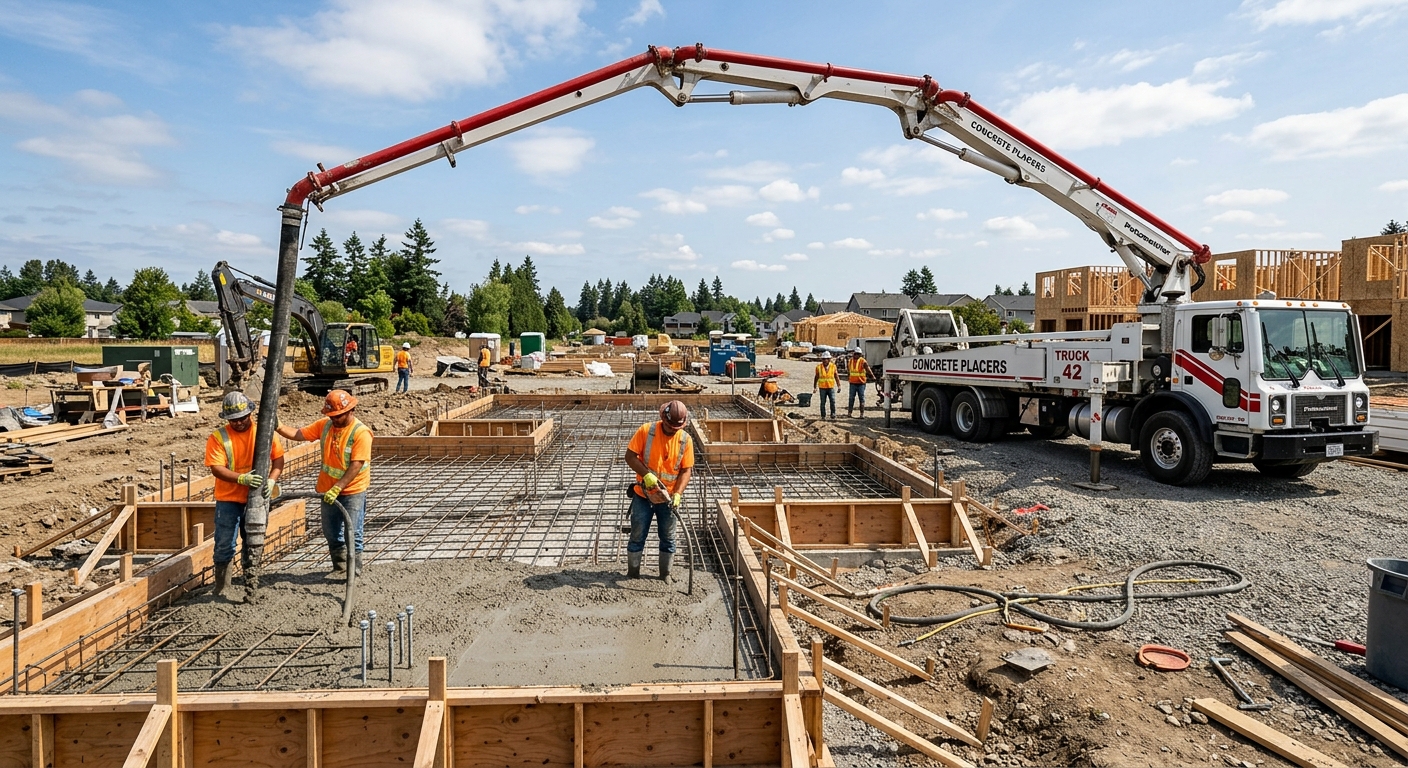
Concrete work options and costs in Cove Cliff
Cove Cliff is a small community on the Lower Mainland–Southwest side, where most homeowners are working within a coastal-wet, freeze–thaw climate that’s tough on concrete surfaces. With a population of 1,778 (Statistics Canada, 2021 Census), contractor availability can feel tighter than in larger hubs, so scheduling and mobilization can affect your final budget. This area also sees plenty of family housing—especially single-detached homes—driving strong demand for driveways and patios that sit through rain, damp winters, and coastal temperature swings.
In the Lower Mainland–Southwest, mild winters don’t eliminate risk: our shallow-but-not-zero frost depth (locally planned around ~450 mm / 18") means footings and thickened edges still need protection from freeze–thaw damage. That’s why pricing includes engineered base prep (compacted granular, drainage attention), air-entrained concrete mixes, and control joints. Coastal rainfall and high humidity also slow down curing and increase the need for blankets or sealers to protect the slab long enough to reach design strength and durability.
Here in Cove Cliff, you’ll typically see the trade especially in demand around the main residential stretches where new curb-to-drive access and backyard patios are common, and where homeowners want surfaces that look good while resisting scaling. Below is a practical cost comparison so you can match scope to expected budgets before you request quotes.
| Application |
Typical Size |
Key Spec |
Finish Option |
Price Range |
| Concrete driveway (standard broom finish) |
400–600 sq. ft. |
Air-entrained mix; compacted granular base; control joints |
Broom finish |
$18,000–$28,000 |
| Exposed aggregate driveway |
400–600 sq. ft. |
Air-entrained mix; properly cured to expose stone; jointing |
Exposed aggregate |
$22,000–$34,000 |
| Stamped concrete driveway or patio |
300–500 sq. ft. |
Air-entrained mix; base prep for crisp stamp texture |
Stamp + color hardener |
$24,000–$40,000 |
| Plain concrete patio or walkway |
200–350 sq. ft. |
Air-entrained mix; joints; compacted base |
Float/trowel with broom or light finish |
$6,000–$14,000 |
| Garage floor (interior slab) |
300–600 sq. ft. |
Vapour control considerations; reinforcing as required |
Plain broom finish |
$9,000–$18,000 |
| Foundation footings (structural, below frost) |
Typical 1–2 storey footing perimeter |
Excavation below design frost; formwork; rebar; engineered requirements |
Structural concrete |
$2,400–$5,000 |
Prices are estimates only and vary by project scope, site access and material selection.
What affects the price of concrete work in Cove Cliff
In the Lower Mainland–Southwest, it’s common to see quotes for the “same” concrete idea vary by 30–50% once you compare the details. The big reason is that concrete pricing here isn’t just about the cubic yards—it’s about what it takes to keep the slab and foundation intact through coastal rainfall and frequent freeze–thaw cycles. In colder parts of British Columbia, contractors often face longer schedule constraints and more aggressive cold-weather measures; that can push up excavation, forming and curing costs compared with the Lower Mainland corridor.
For foundation work and exterior slabs, frost depth planning drives the whole spec. Footings need to extend below the design frost depth to prevent frost heave, and exterior slabs should use air-entrained concrete mixes to survive freeze–thaw damage. When your driveway or patio is exposed to alternating wetting and drying, poor drainage or under-spec mix leads to scaling and spalling—especially when de-icing salts are used. Sealing and longer curing times become more than “nice extras” in Cove Cliff.
Concrete examples from Cove Cliff: (1) A standard broom-finish driveway can land closer to the region’s $18–$28 band, but adding exposed aggregate or stamped work often raises labour intensity (additional steps, careful curing, and finishing time). (2) Two patios of the same square footage may differ a lot if one site has saturated soils requiring thicker granular base and better drainage. (3) If a contractor plans for cool nights and prolonged rain—curing blankets, proper curing window, and protection—your schedule and labour cost rise, but your surface durability typically improves.
| Price Factor |
Why It Matters |
Cost Impact |
| Frost line depth — determines footing depth and form height |
Prevents frost heave by placing concrete below the design frost zone |
Higher excavation and form height |
| Site preparation — excavation, grading, compacted granular base |
Proper base reduces settlement and improves drainage under slabs |
More granular, labour and disposal if soils are unsuitable |
| Reinforcement — rebar or wire mesh requirement |
Supports loads and helps control cracking (especially larger slabs) |
Material and placement labour |
| Mix design — air-entrainment and compressive strength spec |
Air entrainment manages freeze–thaw cycles and scaling resistance |
Typically higher material cost and stricter batching |
| Finish type — broom vs. stamped vs. exposed aggregate |
Finishing complexity affects labour and curing/protection time |
Stamped/exposed generally higher than plain |
| Pour size and concrete truck access to site |
Access constraints can increase labour and limit pour efficiency |
Possible pump, extra labour, waiting charges |
| Cold-weather curing precautions — heating and blankets |
Protects strength gain during cool, damp conditions |
Additional materials, labour and staging time |
| Control joint pattern and sealing cost |
Joints manage cracking; sealing improves salt/rain resistance |
Extra layout time and later-stage sealer product cost |
Permits & regulations in British Columbia
In British Columbia, structural concrete work typically requires more oversight than most homeowners expect. Footings, foundation walls, and grade beams generally need a building permit and are often supported by engineered drawings that the municipality reviews as part of the structural process. If your concrete scope is connected to a new foundation, a structural alteration, or a significant basement modification, plan for permit requirements.
Concrete flatwork like patios, walkways and most driveways usually does not require a permit by itself unless it affects lot grading, stormwater management, impervious surface coverage rules, or the municipal right-of-way. Even when a permit isn’t required, contractors should still follow local requirements for drainage and setbacks, and you should confirm in writing with the local authority before breaking ground.
Here’s how a Cove Cliff homeowner can verify a contractor step-by-step:
- Request the contractor’s business information and confirm they carry current liability insurance.
- Ask for a certificate of insurance showing coverage amounts and effective dates.
- Verify WSBC/WCB coverage for workers (ask directly and keep the documentation).
- Check licensing/registry information online through provincial resources appropriate to contractor trade registration.
- Review references with photos of similar projects (driveways, patios, and foundation pours) and confirm warranty terms.
When in doubt, ask whether their plan includes inspections, engineered sign-off where needed, and how they handle drainage—BC projects live or die on that details-level compliance.
Getting concrete right in Cove Cliff's freeze-thaw climate
Concrete fails in Cove Cliff most often for predictable reasons: poor base preparation, inadequate freeze–thaw durability, and rushed curing during cool, damp weather. To spec the job correctly, start with base prep—use compacted granular to the right depth for the local soil and frost-protection approach, and make sure drainage routes water away rather than letting it saturate under the slab. Next, require an air-entrained mix (for exterior flatwork, target about 5–7% air content) and set a minimum compressive strength of 32 MPa so it can resist scaling and cracking over time.
Then focus on control joints. You want a joint spacing layout that reduces random cracking and channels shrinkage safely; a proper sealant plan is the difference between “hairline cracks” and moisture-driven deterioration. Finally, curing: plan for at least 7 days of curing under appropriate conditions. In Cove Cliff’s coastal-wet swing, cool nights and high humidity mean your protection matters—curing blankets or wind/rain shielding can be necessary to reach strength reliably. After curing, apply a penetrating sealer about 28 days post-pour to repel de-icing salts and rain-driven contaminants.
These details prevent spalling—the surface flaking that shows up when air-entrainment is inadequate. A helpful price reality check: if your options include a plain patio or walkway versus stamped concrete, stamped work may land closer to the $22–$36 per sq. ft. band in this market, while plain work often sits nearer the $16–$26 range. That added cost is usually justified by extra finishing labour and tighter curing/texture control; if the base and mix are weak, though, you pay more for a surface that won’t last.
| Spec |
Why It Matters in Cove Cliff |
What to Ask For |
Impact if Skipped |
| Compacted granular base (depth?) |
Controls settlement and manages water so freeze–thaw doesn’t lift the slab |
Specify base type and target depth for your soil and slab type |
Uneven settling, cracking, premature surface damage |
| Air-entrained concrete mix (target air %?) |
Freeze–thaw resistance in a coastal-wet climate reduces scaling and spalling |
Target about 5–7% air for exterior flatwork |
Spalling, surface scaling, faster deterioration |
| Compressive strength (MPa rating) |
Strength gain ensures durability during seasonal temperature swings |
Minimum 32 MPa and mix design details |
Weaker concrete, higher risk of scaling and cracking |
| Control joints (spacing per ACI guidelines) |
Limits random cracking from shrinkage and temperature movement |
Confirm joint pattern and spacing plan |
Wider random cracks, more water ingress |
| Minimum 7-day curing period |
Curing under damp/cool conditions is essential for strength development |
Minimum 7 days, plus protection plan when nights are cool |
Reduced strength and early surface failure |
| Penetrating sealer (when applied after cure) |
Repels moisture and helps defend against de-icing salt intrusion |
Apply after curing (around 28 days post-pour) |
More salt/rain damage and faster surface wear |
How to choose a concrete work contractor in Cove Cliff
Start by verifying British Columbia licensing/registration, then confirm insurance and worker coverage. Ask for (1) liability insurance certificate and (2) WSBC/WCB coverage documentation before any work begins. A legitimate contractor won’t hesitate to provide clear paperwork—this is especially important in Cove Cliff where smaller crews handle scheduling and mobilization across neighbourhoods.
Next, get 2–3 itemised written quotes. You want a breakdown that shows labour versus materials (concrete, rebar/mesh, formwork, granular base, sealing) and what’s included in access, excavation, and disposal. Avoid single-line lump sums without scope detail. Also confirm whether they include permit pulling (if your project is structural), whether drainage corrections are part of their base prep, and whether saw-cutting and sealing are included where required for durability.
Warranty matters. Ask for a workmanship warranty length in writing, plus product/manufacturer warranty details. Be clear on whether the warranty is transferable if you sell the home—some warranties are tied to the original owner, while others follow the property.
For payment, never allow more than about 10–15% upfront. Hold back funds until key milestones are complete (base prep check, pour date completion, and jointing/sealing items if included). Finally, lock in a timeline: get the start date and a completion estimate in writing, with a plan for rain delays and cold-weather curing needs.
- Ask for proof of liability insurance and confirm coverage dates are current.
- Confirm WSBC/WCB coverage for workers (request the documentation).
- Verify the contractor’s BC registration/licence information using the appropriate provincial lookup.
- Require itemised quotes: excavation/granular, rebar/mesh, concrete supply, finishing, joints, sealer (if included).
- Confirm drainage and subgrade handling is included (not just “we pour on dirt”).
- Ask what air-entrainment and compressive strength spec they will use for your exterior slab.
- Request a joint layout plan (spacing, saw-cut vs formed joints) and whether sealant is included.
- Verify curing protection steps for cool, wet periods (blankets, covering, protection from rain).
- Clarify truck access and whether pumping or additional labour is included.
- Ask who supplies and installs forms and reinforcement, and whether inspections are scheduled.
- Review warranty terms and whether they cover cracking/spalling due to workmanship.
- Use a payment schedule tied to milestones; keep a holdback until close-out items are done.
Concrete contractor red flags in Cove Cliff: they refuse to discuss air-entrainment or joints; they quote a driveway price without addressing base thickness/drainage; they ask for large upfront payments; they can’t provide insurance/coverage documents; and they treat curing as optional rather than critical for reaching strength in BC’s cool, coastal conditions.
Frequently asked questions — concrete work in Cove Cliff
Why does concrete crack in Cove Cliff and how is it prevented?
Concrete in Cove Cliff cracks mainly because it moves: temperature swings, moisture changes, and shrinkage after the pour. In our coastal-wet, freeze–thaw conditions, saturated base soils and poor drainage can amplify movement, especially at edges. Prevention starts below the surface: a properly compacted granular base with good drainage reduces uneven settling. On top of that, you prevent random cracking with the right control joint pattern and a finish that’s consistent across the slab. Proper air-entrainment also helps durability, because freeze–thaw scaling can widen micro-cracks over time. If you’re budgeting, a standard broom-finish driveway often falls in the $18–$28 range, but the cheapest option without joints and correct curing is where homeowners get problems first.
Stamped vs broom-finish concrete — cost difference?
Stamped concrete costs more than broom-finish because it adds materials and labour steps: moulds, release agents, colouring/hardener options, and careful timing to achieve crisp texture without compromising strength. In the Lower Mainland–Southwest, weather and curing windows matter too—wet conditions and cool nights require extra protection so the stamped surface doesn’t get damaged while it develops strength. For a homeowner in Cove Cliff, that difference is often reflected in the regional price bands: broom-finish driveways commonly land around the $18–$28 band, while stamped driveway or patio work typically runs higher—often aligning with the $22–$36 decorative band depending on square footage and how complex the design is. If your base prep and air-entrainment aren’t right, stamping won’t “hide” future cracking; you’ll just make repairs more expensive.
When is the best time to pour concrete in Cove Cliff?
The best time is when you can protect curing and avoid continuous rain or extreme cold nights. In British Columbia’s Lower Mainland–Southwest, late spring through early fall is usually ideal because temperatures are more stable and contractors can manage curing with less heating and fewer delays. Even then, coastal humidity can slow surface dry-down, so reputable crews plan around weather—covering, wind/rain shielding, and curing blankets if needed. Pour scheduling is also influenced by the shallow frost depth planning used in this region: while frost risk is lower than in colder BC areas, you still need to protect footings and exterior slabs from freeze–thaw damage. If your contractor can’t discuss curing protection and a realistic weather plan, that’s a risk sign—especially when concrete prices in the $18–$28 driveway band depend on getting the job done correctly during a workable window.
How long does concrete take to cure?
Concrete curing has two timelines: strength gain and practical readiness. For most exterior flatwork in Cove Cliff, you should plan for at least 7 days of curing under proper conditions before treating the slab as reliably finished for normal use. Full design strength takes longer—commonly 28 days—because concrete continues to hydrate gradually even when it looks “hard.” This matters for finishing and sealing: penetrating sealers are typically applied about 28 days post-pour to repel moisture and de-icing salts. In the Lower Mainland–Southwest, cool nights and persistent coastal damp can extend the time it takes to reach reliable early strength, so crews should protect the pour during adverse periods. Ask your contractor what curing method they’ll use and how they’ll handle prolonged rain so you’re not rushing traffic over a slab that hasn’t achieved adequate strength.
Do I need a permit for concrete work in British Columbia?
Often, the answer is “it depends on what concrete you’re doing.” In British Columbia, structural concrete work such as footings, foundation walls, and grade beams typically requires a building permit and may involve engineered drawings reviewed through the municipality process. Most concrete flatwork—driveways, patios and walkways—usually does not require a permit on its own unless it impacts lot grading, stormwater/drainage compliance, impervious surface limits, or involves the municipal right-of-way. For a Cove Cliff homeowner, the practical move is to confirm in writing with the local authority before work begins, especially if you’re changing drainage patterns. Also confirm your contractor has the right paperwork and coverage; the best crews will tell you exactly which parts of the job are permit-driven and which aren’t.
Concrete vs pavers for a patio in Cove Cliff?
Concrete and pavers both can look great, but they behave differently in Cove Cliff’s freeze–thaw and coastal-rain environment. Concrete patios rely on a monolithic slab with air-entrained mix, compaction, control joints and proper curing—when done right, they’re durable and often simpler to maintain. Pavers can be flexible because individual units can be replaced, but they still depend heavily on base prep and drainage; if the base is wrong, weed growth, settlement, and uneven surfaces can show up. From a cost perspective, plain concrete patio/work usually aligns with the $16–$26 band, while stamped/decorative work is higher (often within the $22–$36 decorative range). If you want a clean, uniform surface and long-term performance with fewer joints to manage, concrete is often the straightforward choice—just insist on correct air entrainment and jointing.