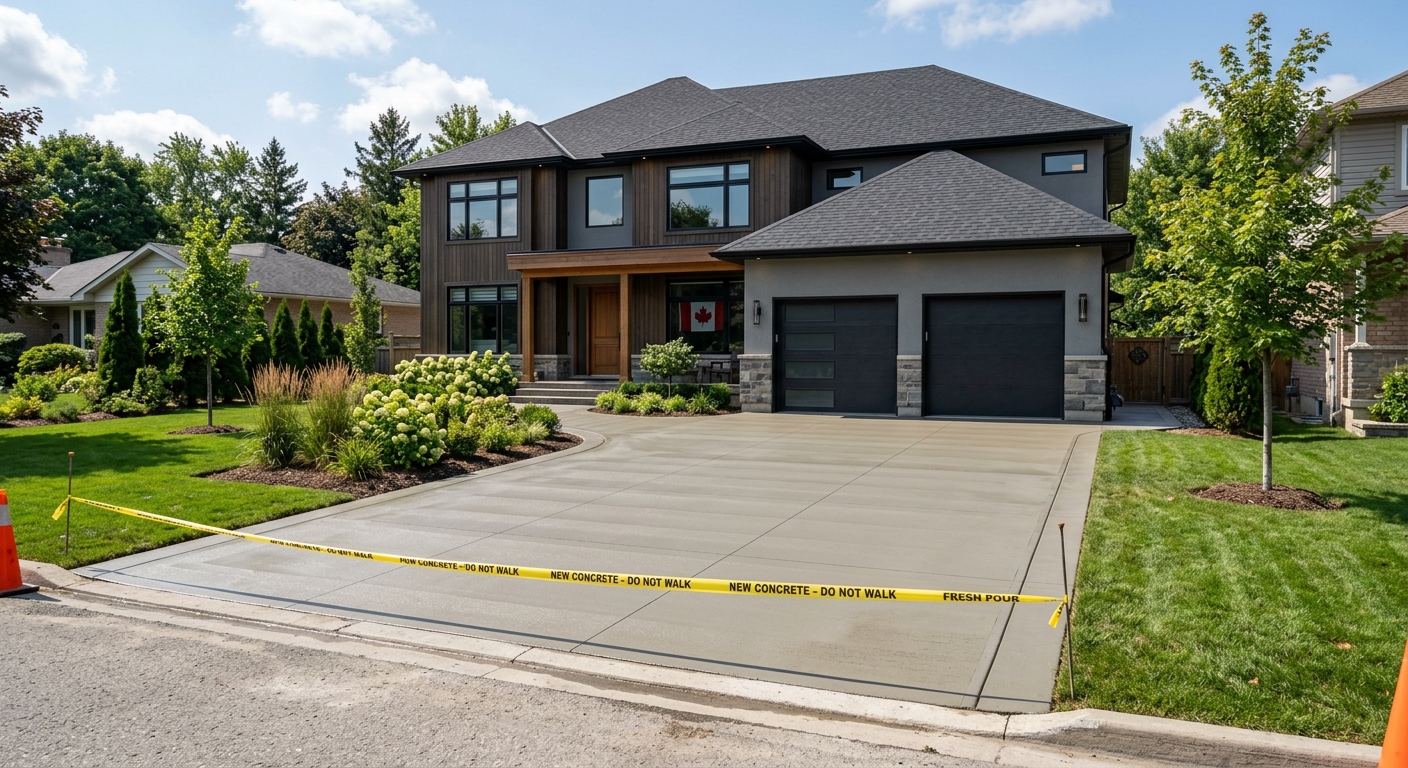
Concrete work options and costs in River Springs
In River Springs, concrete work is a practical upgrade for homeowners who want durable, low-maintenance surfaces on everything from driveways to entry patios. With a local population of 2,325 (Statistics Canada, 2021 Census), River Springs sits in a tight regional labour market where ready-mix scheduling, excavation crews, and finishers can affect both turnaround time and price. The Lower Mainland–Southwest region also has a housing mix that drives consistent demand for exterior flatwork—especially on single-detached properties common to this commuter corridor—so contractors tend to be busiest around the warmer, drier windows.
Pricing in the Lower Mainland–Southwest still reflects climate engineering. Even though we’re not dealing with deep inland frost, crews design around a frost depth of about 450 mm / 18" and place footings and thickened edges below that line to reduce freeze–thaw movement. Coastal-wet weather brings frequent saturation and rain, so base prep (compacted granular plus drainage attention), air-entrained concrete mixes, and longer, more carefully managed curing are standard on exterior work. These requirements can push quotes upward compared with “quick pour” estimates, and they also explain why availability varies by week during the spring and fall edges.
If you live around the more established residential areas near River Springs’ core and east-side neighbourhood streets, you’ll often see driveways and backyard patio replacements prioritized as people modernize access and outdoor living. With that in mind, the table below gives typical ranges you can use to compare apples-to-apples bids.
| Application |
Typical Size |
Key Spec |
Finish Option |
Price Range |
| Concrete driveway (standard broom finish) |
400–600 sq. ft. |
Air-entrained mix, compacted granular base, control joints |
Broomed |
$7,200–$13,000 |
| Exposed aggregate driveway |
400–600 sq. ft. |
Proper retarder/wash plan, air-entrained mix, sealing-ready finish |
Exposed aggregate |
$9,500–$16,000 |
| Stamped concrete driveway or patio |
300–500 sq. ft. |
Integral colour/overlay colour (as selected), air-entrained mix, joints |
Stamped (pattern + colour) |
$8,500–$18,500 |
| Plain concrete patio or walkway |
200–400 sq. ft. |
Air-entrained mix, compacted base, edge forms, joints |
Broomed or smooth steel-trowel |
$3,200–$9,000 |
| Garage floor (interior slab) |
300–600 sq. ft. |
Vapour barrier (when required), fibre or mesh reinforcement, joints |
Power-floated/steel finished |
$5,900–$14,500 |
| Foundation footings (structural, below frost) |
Per linear foot (typical builds) |
Excavation, rebar cage, concrete below design frost depth |
Structural concrete |
$200–$350 |
Prices are estimates only and vary by project scope, site access and material selection.
What affects the price of concrete work in River Springs
In the Lower Mainland–Southwest, two homeowners can receive quotes for what looks like the same concrete project and still see a 30–50% spread once the details are compared. The difference usually comes down to climate-driven specs (frost protection, air-entrainment, and curing controls), how much base prep is truly included, and how complicated the site is to access. When contractors price in other British Columbia markets, the labour and heating/blanket costs can jump in colder regions due to longer freeze periods and shorter pour windows—so the “same driveway” can cost meaningfully more outside the Lower Mainland, even before considering different excavation realities.
Locally, frost line depth and freeze–thaw cycles dictate every exterior spec. Footings and thickened edges must sit below the design frost depth (often around 450 mm / 18" in local practice), and all exterior slabs need air-entrained concrete mixes to manage scaling and cracking from repeated wetting and freezing. In River Springs, coastal rainfall also means saturated soils are common, so proper granular base and drainage attention aren’t optional—cheap base prep often shows up as settlement or surface deterioration. If pours happen around cooler nights, cold-weather curing precautions (blankets, insulation, sometimes supplementary heat) increase labour and supervision time. De-icing salts in winter accelerate surface wear, so sealing becomes part of long-term durability.
Here are a few real examples of what moves price up or down in River Springs: (1) A driveway widened to include a vehicle turnaround increases excavation and rebar labour; (2) replacing soft, wet subgrade with imported granular can add thousands; (3) choosing stamped or exposed finishes typically adds colour, texture labour, and material handling—yet a basic broom-finish driveway is often the better value if you only need safe traction and a clean profile. As a reference point, driveway pours commonly land around the $18–$28 per sq. ft. band for standard concrete flatwork, while stamped concrete generally sits higher (often aligning with the $22–$36 per sq. ft. range for decorative work).
| Price Factor |
Why It Matters |
Cost Impact |
| Frost line depth — determines footing depth and form height |
Sets how deep excavation and forms must go to prevent frost heave |
Higher excavation increases concrete volume and labour (can add substantial cost on foundations) |
| Site preparation — excavation, grading, compacted granular base |
Controls settlement and keeps water from undermining slab edges |
Soft or wet soils raise disposal/import and equipment time |
| Reinforcement — rebar or wire mesh requirement |
Improves crack control and load capacity for vehicle areas |
Material and placement time can noticeably increase pricing on larger slabs |
| Mix design — air-entrainment and compressive strength spec |
Air content and strength reduce scaling and early deterioration |
Higher-spec mix costs more and may require tighter scheduling |
| Finish type — broom vs. stamped vs. exposed aggregate |
Different tooling, colour systems, and curing/processing steps |
Stamped/exposed options add labour and materials compared with plain broom |
| Pour size and concrete truck access to site |
Long carries or limited access can change equipment and placement approach |
Restricted access often increases labour and pour-time risk |
| Cold-weather curing precautions — heating and blankets |
Ensures the concrete reaches strength and durability targets in cool conditions |
Blankets/heaters add daily labour and material rental |
| Control joint pattern and sealing cost |
Controls cracking and protects surfaces from winter salts and moisture |
Proper jointing/sealer adds line items but reduces future repairs |
Permits & regulations in British Columbia
In British Columbia, structural concrete work typically requires municipal processes before work begins. If you’re building or modifying anything that affects structure—such as footings, foundation walls, and grade beams—expect that a building permit is required and engineered drawings are often reviewed as part of permit approval. For concrete flatwork like driveways, patios, and walkways, permits are often not required by default. However, a permit or approval can be necessary if the work changes lot grading, increases impervious surface coverage beyond municipal limits, affects drainage, or ties into municipal right-of-way conditions (for example, work near curb/sidewalk lines).
Step-by-step, here’s how a River Springs homeowner can protect themselves by verifying a contractor properly: (1) Confirm the contractor is licensed/registered as required for the type of work they’re doing (start with provincial/licensing registry access through official sources); (2) Ask for a certificate of insurance showing general liability limits and the project name/address if available; (3) For work that falls under the coverage requirements, verify their WCB/WSIB-type coverage documentation (request their clearance/coverage confirmation letter as applicable); (4) Request references and photos from similar-scale local projects (driveways, exterior slabs, and foundation concrete).
Before any digging, confirm with the municipality whether your specific scope needs permit approvals. A reputable crew won’t be offended by these checks—they’ll treat them as standard due diligence.
Getting concrete right in River Springs's freeze-thaw climate
Concrete failures in River Springs usually come from one of five weak links: inadequate base preparation, poor mix design, missed air-entrainment, weak curing, or wrong joint/sealing practices. In a freeze–thaw climate with coastal rainfall, water moves through tiny voids and around edges; when temperatures swing, that moisture expands and can cause spalling (surface flaking) and accelerated scaling. To spec the job correctly, start at the ground-up level: (1) base preparation with compacted granular to the right depth for local soil and frost protection. (2) mix design: exterior slabs should use air-entrained concrete—typically about 5–7% air depending on exposure—and a minimum 32 MPa compressive strength target. (3) control joints set a planned crack location instead of letting randomness take over. (4) curing: plan for at least 7 days under suitable conditions; cool, damp weather needs better curing management (often blankets/sealers timing). (5) sealing with a penetrating sealer after the cure period helps repel de-icing salts and reduces chloride-driven surface wear.
If you’re comparing options, the price difference is worth it when it protects durability—not just appearance. For example, a basic broom-finished driveway may fit the $18–$28 per sq. ft. band, but if bids differ on base depth, air-entrainment, and joint/sealing plan, that “cheaper” price can translate into expensive patching within a few winters. Stamped or exposed aggregate can cost more (often aligning closer to $22–$36 per sq. ft.), and that premium is justified when the contractor also maintains the correct structural specs underneath the decorative surface.
Ask your contractor to explain how they’ll prevent spalling by meeting air-entrainment and drainage requirements—not just how it will look when it’s finished.
| Spec |
Why It Matters in River Springs |
What to Ask For |
Impact if Skipped |
| Compacted granular base (depth?) |
Supports the slab and limits water movement under the concrete in wet/cool cycles |
Confirm excavated depth and granular type/compaction requirements for your soil |
Settlement, edge failure, and premature cracking |
| Air-entrained concrete mix (target air %?) |
Manages freeze–thaw damage by providing space for ice expansion |
Specify air content target (often ~5–7% for exterior flatwork) and mix design document |
High risk of spalling and surface scaling after winter |
| Compressive strength (MPa rating) |
Strength supports durability and wear resistance under traffic and winter exposure |
Minimum 32 MPa (as applicable) and confirm schedule for testing/requirements |
Weaker surface, faster deterioration, and reduced long-term performance |
| Control joints (spacing per ACI guidelines) |
Controls where cracks occur, reducing random cracking through the surface |
Ask for joint layout plan and spacing consistent with applicable industry guidance |
Random cracks, uneven appearance, and water ingress through fractures |
| Minimum 7-day curing period |
Cold nights and high humidity can slow strength gain and affect durability |
Confirm curing method and conditions for your pour date and weather forecast |
Lower strength, increased cracking risk, weaker surface performance |
| Penetrating sealer (when applied after cure) |
Repels moisture and de-icing salts that contribute to surface wear |
Penetrating sealer application timing (commonly after at least 28 days for many products) |
Faster spalling and scaling; higher maintenance sooner |
How to choose a concrete work contractor in River Springs
Choosing the right contractor in River Springs is mostly about verifying the basics and then matching the quote to the technical specs that matter here—air-entrainment, drainage/base prep, and curing. Start by confirming British Columbia licensing/registration for the type of work they’re performing, then request a certificate of liability insurance and check it covers the project scope (and that it’s current). For work coverage, ask for proof of WSIB/WCB-type coverage documentation or clearance letter as applicable in British Columbia so you’re not stuck with liability if a worker gets hurt.
Next, don’t accept “lump sum” quotes without breakdowns. Get 2–3 itemised written quotes that separate labour and materials—excavation and disposal, granular base supply and compaction, reinforcement, concrete supply (mix spec), finishing, joints, and sealing. Read exclusions carefully: Is formwork included? Is permit handling included (if required)? Is concrete truck access accounted for? How is surplus material disposal handled?
Then check warranty details: workmanship warranty length should be in writing, and you should know whether it’s transferable. For payments, never pay more than 10–15% upfront. Hold back a portion until the finish meets spec and the site is cleaned and restored. Finally, get a clear start date and completion estimate in writing. In this region, weather can affect scheduling, so a good contractor plans around cool nights and rain and will discuss curing protection rather than rushing the calendar.
- Ask for mix design details (air content target and strength) for exterior work.
- Verify they include compacted granular base and drainage attention in the scope.
- Confirm reinforcement plan (rebar vs. mesh) for driveways and garage slabs.
- Require a written joint layout (spacing and location strategy).
- Ask how they handle curing in cool, wet River Springs conditions.
- Confirm sealing product type and when it will be applied after curing.
- Request recent local references from similar-scope projects.
- Get proof of current liability insurance and worker coverage documentation.
- Insist on itemised pricing for concrete, finishing, disposal, and equipment.
- Check exclusions: permit pulls, traffic control, grinding/patching, and waste removal.
- Use a payment schedule with a small deposit and progress payments.
- Confirm equipment/access assumptions (long carries often change the labour).
Red flags to watch in River Springs: (1) quotes that don’t mention air-entrainment for exterior slabs; (2) “we’ll pour whenever” scheduling with no cold-weather curing plan; (3) missing details on base depth/compaction and drainage; (4) no written warranty or unclear warranty scope; (5) refusing to provide insurance/coverage proof or itemised breakdowns.
Frequently asked questions — concrete work in River Springs
Can concrete be poured in cold weather in River Springs?
Yes, but in British Columbia—including River Springs—we plan the pour based on temperature, wind, and surface conditions, not just the calendar. Concrete can be poured in cooler weather when the contractor protects the slab during curing. That often means using curing blankets and, in some cases, temporary heat to maintain the concrete at workable temperatures long enough to reach early strength. The reason this matters locally is that freeze–thaw cycles and cold nights can slow strength gain and increase the chance of cracking or surface scaling if curing is rushed. A contractor who knows our Lower Mainland–Southwest routine will discuss weather protection and curing timing in the quote. Also expect scheduling flexibility: crews may move around rainy/cool periods to control cure conditions.
How do I maintain concrete in River Springs's freeze-thaw climate?
Maintenance in River Springs is about keeping water and salts from attacking the surface. Start with sealing: many exterior concrete surfaces benefit from a penetrating sealer after the slab has cured (commonly after 28 days, depending on product). In winter, avoid overusing de-icing salts; when salts dissolve, they pull moisture toward the surface and can accelerate wear. Use sand for traction where possible and sweep away debris to reduce abrasive staining. If you notice small cracks, don’t ignore them—catching the issue early is cheaper than waiting for spalling. Finally, ensure water is directed away from edges and joints; if drainage is poor, you’ll see deterioration sooner. Well-built driveways that used air-entrained mixes and proper joints generally hold up better through repeated cycles.
What causes concrete to spall in River Springs winters?
Spalling in River Springs is usually driven by freeze–thaw damage plus moisture and de-icing salts. The most common technical cause is inadequate air-entrainment in the mix for exterior exposure. Air-entrainment gives the concrete microscopic space to relieve ice expansion; without it, pressure builds within the paste and surface flakes off over repeated wet/cold cycles. Another contributing factor is weak or incomplete base prep and drainage—water finds paths under slab edges, saturates the concrete, and worsens the freeze–thaw assault. Control joints that are missing or badly spaced can also let random cracking channel water into the slab. Because River Springs experiences coastal-wet weather, a contractor should plan for proper curing and recommend sealing. If your quote looked low—like a driveway price far below the typical $18–$28 per sq. ft. band—it may be missing these durability steps.
What is rebar and when is it required in British Columbia?
Rebar (reinforcing steel bars) is used to strengthen concrete so it can handle tension and shrinkage stresses that plain concrete can’t resist well. In British Columbia, the need for rebar depends on the structural design and slab function. For exterior flatwork like driveways, reinforcement is commonly specified for crack control and durability, especially where vehicles are involved. For foundations and structural elements like footings and foundation walls, reinforcement is standard and is typically dictated by engineered drawings and permit design requirements. In practice, a good concrete contractor will ask what drawings or engineered requirements apply to your project. They should also explain whether you’re using rebar, wire mesh, or another reinforcement method. If the quote skips reinforcement details and just says “concrete only,” treat that as a gap—durability in River Springs is very dependent on the full build-up, not the surface finish alone.
How long does a concrete project take in River Springs?
Most factors in River Springs—weather, access, and curing requirements—affect timeline as much as the size of the slab. A typical small patio or walkway might take only a day or two of active work (forms, pour, finishing), but it still requires proper curing time before you can treat it as fully usable. Many projects require at least several days before light use, with full durability building over weeks. Driveways and larger slabs require more staging: excavation, base compaction, reinforcement placement (if required), then the pour. Decorative work like stamped concrete also needs extra finishing steps. If cold nights or prolonged rain are expected, contractors may use curing blankets and extend protective time. Even if a driveway fits the $18–$28 per sq. ft. pricing band, rushing curing can compromise performance. Expect scheduling to include weather buffers, especially in shoulder seasons.
What is a concrete overlay and is it suited to River Springs?
A concrete overlay is a new concrete layer placed over an existing slab surface (after preparation) to renew appearance and extend service life. It can be suited to River Springs when the existing concrete is sound—meaning it has solid base support and isn’t extensively lifted, badly cracked, or actively failing due to drainage problems. Overlays are not a fix for widespread subgrade settlement or structural failure; in that case, removal and replacement is often the correct solution. The biggest concerns with overlays in British Columbia are proper surface preparation (cleaning, bonding, and sometimes grinding), compatible product selection, and ensuring water doesn’t continue to undermine the system. If the existing slab has spalling from freeze–thaw and salts, you must address drainage and base issues before overlaying. If you’re considering decorative upgrades, stamped overlays can cost more, but the look can be worth it only if the under-slab conditions are right.