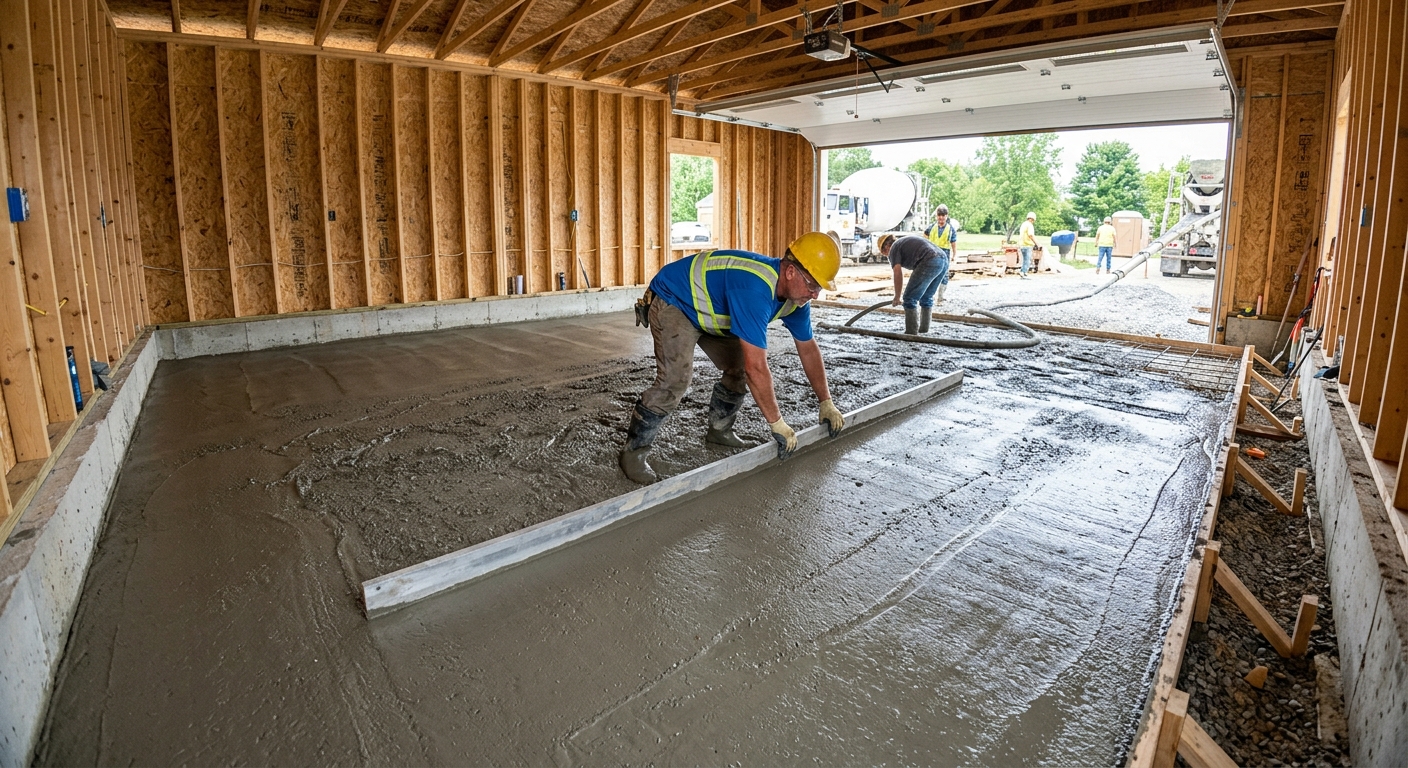
Concrete work options and costs in Highway 11
Concrete work in Highway 11 is typically busiest for driveways, patios and slab-on-grade areas—because most homeowners in the Lower Mainland–Southwest region want durable flatwork that can handle wet winters, coastal humidity and repeated freeze–thaw cycles. In this Highway 11 area, the market is shaped by owner-occupied housing: a large share of homes are single-detached households (Statistics Canada, 2021 Census), which is exactly where concrete flatwork is most common (new driveways, backyard patios, and garage slabs). For context, the local population for the broader profile we use here is 5,500 (Statistics Canada, 2021 Census), and that smaller, clustered market means contractor scheduling can vary during the short, workable weather windows.
Pricing in Lower Mainland–Southwest stays lower than colder parts of BC, but it’s not “cheap concrete.” The reason is that even with a shallow frost line assumption of about 450 mm / 18", specifications still target protection from freeze–thaw movement: footings and thickened edges are placed below frost, soils get proper drainage and compacted granular base, and exterior slabs generally use air-entrained mixes with good jointing. In neighbourhoods where infill and renovations are common—around Abbotsford and the rural outskirts along Highway 11—demand for decorative finishes is also strong, especially for stamped and exposed aggregate driveways.
Below are realistic per-project price ranges for common applications so you can compare like-for-like before you request quotes.
| Application |
Typical Size |
Key Spec |
Finish Option |
Price Range |
| Concrete driveway (standard broom finish) |
400–600 sq ft |
Air-entrained mix; compacted granular base; control joints |
Broom finish |
$7,200–$13,800 |
| Exposed aggregate driveway |
400–600 sq ft |
Air-entrained mix; proper curing schedule; sealing recommended |
Exposed aggregate (retarder wash) |
$9,500–$16,500 |
| Stamped concrete driveway or patio |
350–550 sq ft |
Air-entrained mix; sawcut jointing; release agent system |
Stamped + sealer |
$10,500–$19,800 |
| Plain concrete patio or walkway |
250–450 sq ft |
Compacted base; drainage attention; joint spacing |
Broom or smooth trowel top |
$4,000–$10,200 |
| Garage floor (interior slab) |
400–700 sq ft |
Vapor considerations as applicable; mesh or rebar per design |
Broom finish |
$7,800–$18,200 |
| Foundation footings (structural, below frost) |
Typical home perimeter + interior piers |
Concrete poured below frost; reinforcement per engineer |
Structural formwork + finishing as required |
$14,000–$28,000 |
Prices are estimates only and vary by project scope, site access and material selection.
What affects the price of concrete work in Highway 11
In the Lower Mainland–Southwest, two contractors can quote the “same” concrete driveway and still be 30–50% apart because the real cost drivers are in the specs—not just the square footage. The biggest differences come from excavation depth, base preparation and drainage, reinforcement amount, mix design, finishing method, and how long and how carefully the crew can cure the slab through rain and cool nights. Availability matters too: during busy renovation periods, crews may be scheduled tighter, which can influence mobilization and weather protection costs.
In Highway 11’s climate, frost depth and freeze–thaw cycles dictate every exterior detail. Even though Lower Mainland–Southwest practice often assumes a frost depth around 450 mm / 18", footings, piers and thickened edges are placed below the design frost line to prevent frost heave. Exterior flatwork commonly uses air-entrained concrete so the freeze–thaw cycle doesn’t scale and spall the surface over time. When temperatures dip, colder-weather curing precautions—insulating blankets, curing compounds and sometimes small heaters—add cost and extend timelines, especially when prolonged rain slows the path to proper strength. Finally, de-icing salts accelerate surface deterioration on poorly sealed slabs, so sealing is often recommended on driveways and steps in this part of BC.
Concrete can cost less or more in Highway 11 based on local site conditions. For example, a straightforward 400–600 sq ft broom-finished driveway might align with the $18–$28/sq ft band, but if your soil is saturated and needs deeper granular base plus drainage trenching, your effective cost can move toward the upper end. Similarly, upgrading from a plain patio to stamped work can be justified—if you’re paying for better surface durability and proper jointing—because stamped & decorative concrete commonly lands in the $22–$36/sq ft range. In older housing areas, settlement cracks are also common; addressing base regrading and sub-drainage can add dollars upfront but prevents repeat repairs.
| Price Factor |
Why It Matters |
Cost Impact |
| Frost line depth — determines footing depth and form height |
Footings must extend below the design frost line to reduce frost heave risk |
Higher excavation + formwork; can raise structural concrete scope |
| Site preparation — excavation, grading, compacted granular base |
Wet or weak soils require deeper, better-compacted granular and drainage |
More truckloads and labour; often pushes price upward |
| Reinforcement — rebar or wire mesh requirement |
Reduces cracking and controls shrinkage movement per design |
Material cost + placement time; modest but real increase |
| Mix design — air-entrainment and compressive strength spec |
Exterior air content and strength help resist freeze–thaw scaling |
Better mix costs more but improves long-term durability |
| Finish type — broom vs. stamped vs. exposed aggregate |
Decorative finishes require additional steps and crew time |
Stamped/exposed typically increase unit cost |
| Pour size and concrete truck access to site |
Limited access may require pumping or smaller loads |
Mobilization fees and extra labour can add cost quickly |
| Cold-weather curing precautions — heating and blankets |
Protects strength gain when evenings cool or weather turns damp |
Heating/insulation rental and longer scheduling |
| Control joint pattern and sealing cost |
Joints manage cracking; sealing improves resistance to salts and moisture |
Cut/saw time plus sealer product and application |
Permits & regulations in British Columbia
In British Columbia, structural concrete work typically requires a building permit. That includes footings, foundation walls, grade beams, and any foundation elements that support the building. Municipalities often expect engineered drawings reviewed as part of the permit process. For concrete flatwork—patios, walkways, and driveways—permits are usually not required unless the work affects lot grading, stormwater/impervious surface coverage limits, or ties into a municipal right-of-way or service connection. Because rules can vary depending on where you are along Highway 11 and how your property drains, you should confirm with the municipality before breaking ground.
For contractor compliance, always verify insurance and work coverage. Step-by-step, a homeowner in Highway 11 should: (1) check the contractor’s licence/registration status through the appropriate BC business listings for trades they claim to perform, (2) request a certificate of liability insurance naming you/your property as applicable and confirming active coverage, and (3) confirm workers’ compensation coverage (WSBC/WCB) for the people on your site. Then ask for references on similar jobs in the Lower Mainland–Southwest—especially exterior slabs where freeze–thaw durability matters. You can also ask to see their safety documentation and a sample, itemised scope so you know what’s included (base prep, joints, drainage and sealer) before paying deposits.
If a contractor refuses to provide insurance documentation or can’t describe the footing depth/spec for exterior work below frost, treat that as a red flag and get another quote.
Getting concrete right in Highway 11's freeze-thaw climate
Concrete failures in Highway 11 are usually about water and movement, not “bad concrete.” In the Lower Mainland–Southwest, heavy rainfall followed by cool nights creates wet subgrade and saturated bases; then freeze–thaw cycles do the damage—pushing and pulling the slab slightly until the surface scales or spalls. To spec the job correctly, start with base preparation: compacted granular sub-base to the proper depth for local soils and to support the slab without pumping. Next, mix design: exterior flatwork should use air-entrained concrete (commonly 5–7% air content for many exterior applications) and a minimum compressive strength of 32 MPa, with proper water-cement ratio control at the batch. Control joints are also critical: they limit random cracking by giving concrete a planned place to crack. For curing, plan for at least 7 days of curing under favourable conditions; in cool weather or long-rain periods, curing protection (blankets/insulation or curing compounds) keeps strength gain on track. Finally, sealing matters: apply a penetrating sealer after the slab has cured (often around 28 days post-pour) to help repel de-icing salts and reduce moisture ingress.
To avoid spalling, homeowners should ask direct technical questions: “What air content are you targeting for the mix?”, “How deep and what type of granular base are you compacting?”, and “What is your control joint layout?” A real-world example: a broom-finished driveway may land near $18–$28/sq ft, but adding proper sub-drainage and correct jointing can shift the job toward the upper range. That difference is usually justified because it prevents the early surface breakdown that leads to costly re-pours within a few seasons.
| Spec |
Why It Matters in Highway 11 |
What to Ask For |
Impact if Skipped |
| Compacted granular base (depth?) |
Supports the slab and reduces water pumping that accelerates freeze–thaw damage |
Documented granular depth, material type and compaction method (e.g., plate compaction) |
Settlement, cracking, and premature scaling/spalling risk |
| Air-entrained concrete mix (target air %?) |
Air voids provide space for freezing water, reducing surface scaling |
Target air content (commonly 5–7% for exterior flatwork) and proof of mix design |
Higher likelihood of spalling and scaling in winters |
| Compressive strength (MPa rating) |
Adequate strength helps durability under moisture and temperature swings |
Minimum 32 MPa (or higher if required by spec) for exterior work |
Surface wear, cracking and reduced service life |
| Control joints (spacing per ACI guidelines) |
Controls where cracks form to keep them narrow and manageable |
Specific joint spacing plan and sawcut timing |
Random cracking, water infiltration and faster deterioration |
| Minimum 7-day curing period |
Strength gain depends on protection in cool, damp or rainy conditions |
How curing will be protected when nights are cool or weather is wet |
Lower strength and increased early-age cracking risk |
| Penetrating sealer (when applied after cure) |
Helps repel salts and moisture that trigger freeze–thaw breakdown |
Sealer type and application timing after full cure (often around 28 days) |
Faster moisture penetration, staining and surface deterioration |
How to choose a concrete work contractor in Highway 11
Start by verifying British Columbia compliance. First, ask for the contractor’s business registration/licence information and confirm it matches the concrete work scope they’ll perform. Next, request a certificate of liability insurance; it should be active on your start date and list appropriate coverage for the job duration. Then confirm WSBC/WCB coverage—ask for proof that workers on your site are covered. Don’t accept “we’re insured” without documentation you can review. For extra peace of mind, request references on recent exterior slabs and look for photos of similar driveways or patios that have survived the wet winter conditions along Highway 11.
When you request quotes, insist on 2–3 itemised written estimates. Break them down into labour and materials so you can compare apples to apples: excavation/grading, granular base, reinforcement, concrete mix type, finishing steps, sawcutting and joint sealing, and disposal/cleanup. Carefully review exclusions: is the permit pull included where required, is removal/disposal of old concrete included, and are trucking/pumping charges stated? A good quote also includes a clear schedule—start date, weather contingencies, and completion estimate in writing.
On payment, keep it conservative. Never pay more than 10–15% upfront; use a holdback until the final finishing, joint sealing (where included), and cleanup are complete. Finally, check warranties: workmanship warranty length, product/manufacturer warranty (if applicable), and whether the warranty is transferable to a future owner.
- Ask for their concrete mix specification (air content, strength) for exterior slabs.
- Confirm footing depth/spec when the job touches foundations below frost.
- Require a jointing plan (spacing and sawcut timing) for every slab.
- Verify base prep details: granular type, depth, and compaction proof.
- Check whether drainage/gravel under edge thickening is included.
- Ensure sealing is listed (product and timing) if it’s an exterior driveway/patio.
- Request disposal/loading fees in writing.
- Confirm whether municipal requirements affect lot grading or impervious limits.
- Get proof of liability insurance and WSBC/WCB coverage before work starts.
- Review the scope for reinforcement: mesh vs rebar, placement location and chairing.
- Agree on curing protection method for cool nights or rainy stretches.
- Use a clear contract schedule with weather trigger clauses.
Red flags to watch in Highway 11: (1) no mention of air-entrained mix for exterior slabs, (2) vague answers about joint spacing and sawcut timing, (3) refusal to show insurance/coverage documents, (4) “one-price-fits-all” quotes without site prep details, and (5) demanding large upfront payments (beyond 10–15%) without a holdback.
Frequently asked questions — concrete work in Highway 11
Can concrete be poured in cold weather in Highway 11?
Yes, concrete can often be poured in cold weather in Highway 11, but it depends on temperature, wind, and whether the crew can protect curing. In the Lower Mainland–Southwest, we don’t treat cold like interior BC, but cool nights and frequent rain can still slow strength gain and increase early-age cracking. A reputable contractor will plan cold-weather curing precautions: insulating blankets, curing protection, and sometimes temporary heating so the slab reaches the required strength before exposure. Ask how they manage the first 24–48 hours and what they do if rain starts mid-pour. If your plan is a driveway in the $18–$28/sq ft band, the price may rise within that range if protection equipment and longer curing time are needed to reliably reach design performance.
How do I maintain concrete in Highway 11's freeze-thaw climate?
Maintenance in Highway 11 is mostly about keeping water out and keeping the surface sealed. Start with cleaning: remove debris and don’t allow standing water near slab edges. If you use de-icing salt, that’s another reason sealing is important—salts can accelerate surface deterioration, and freeze–thaw cycles then magnify the damage. For typical exterior patios and walkways (often around the $16–$26/sq ft band), a penetrating sealer after proper cure helps repel moisture. Re-check joints annually: if joint sealant (if included) looks cracked or missing, replace it to stop water infiltration underneath. Finally, address small spalls early: patching before water gets under the slab can be far cheaper than waiting for a larger re-pour.
What causes concrete to spall in Highway 11 winters?
Spalling in Highway 11 winters is usually driven by moisture and freeze–thaw action, most often when the exterior concrete mix isn’t properly air-entrained. If air content is too low, freezing water has nowhere to expand safely inside the cement paste, so the surface loses material (scaling and spalling). Saturated bases and poor drainage worsen the problem because water can get under or within the slab edge region and then freeze. Rain and coastal humidity in the Lower Mainland–Southwest increase the time the surface stays wet, which accelerates deterioration. To reduce risk, ask for an air-entrained exterior mix (commonly 5–7% target air) and proper control joints. If you’re comparing quotes where one is closer to the lower end of exterior pricing (like $18–$28/sq ft for a driveway) and the other is higher, the difference is often the quality of these durability specs and curing protection—not just “brand of concrete.”
What is rebar and when is it required in British Columbia?
Rebar is steel reinforcing bar placed inside concrete to help control cracking and improve structural performance. In British Columbia, when rebar is required depends on the engineered design and the concrete element. For foundations and structural footings below frost, rebar (or equivalent reinforcement) is commonly specified by engineers and the permit drawings—especially because the job must resist loads and movement. For flatwork like patios, driveways and garage slabs, reinforcement might be required based on slab thickness, subgrade conditions, and whether the design calls for it (e.g., heavier vehicle loads). In practice along Highway 11, we often see wire mesh or rebar used for driveways and garage floors when the base prep or thickness requires additional crack control. Ask your contractor what reinforcement they’re providing, placement location (mid-depth), and whether chairs/spacers are used so it sits correctly in the slab.
How long does a concrete project take in Highway 11?
Timelines vary with site access, weather, and what’s being built, but you can expect most exterior flatwork in Highway 11 to follow a predictable sequence. Base excavation and forming can take 1–3 days, depending on soil and disposal needs. Pour day itself is often a half-day to one day for typical residential slabs—then curing and protection matters. Even though the surface may look “set,” concrete needs time to reach strength; many projects require at least 7 days of proper curing for exterior performance. If cold or wet conditions extend curing or require blankets/curing measures, completion can stretch longer. Decorative work like stamped concrete takes extra set-up and finishing time, which can add a day. For most patios and walkways priced in the $16–$26/sq ft band, a realistic window is roughly 1–2 weeks from start to final cure/finish steps, but your contractor should give a weather-aware schedule in writing.
What is a concrete overlay and is it suited to Highway 11?
A concrete overlay is a new layer of concrete poured (or sometimes a resurfacing system applied) over an existing slab to improve surface condition without full removal. It can be suitable in Highway 11 when the existing concrete is structurally sound—meaning it’s not lifting, heavily spalled across large areas, or suffering widespread base failure. Overlays can address surface deterioration and minor unevenness, and they’re often faster than full replacement. However, if the original slab has drainage issues, voids underneath, or repeated freeze–thaw damage, overlaying can trap problems and lead to future failure. If you’re considering a driveway or patio resurfacing, ask for an assessment of base conditions and how they’ll prepare the existing concrete (bonding method, joint treatment, and whether they use a designed overlay thickness). In many cases, the safest route for long-term durability is full replacement where severe freeze–thaw damage exists—even if it’s closer to the upper bands such as $22–$36/sq ft for decorative solutions.