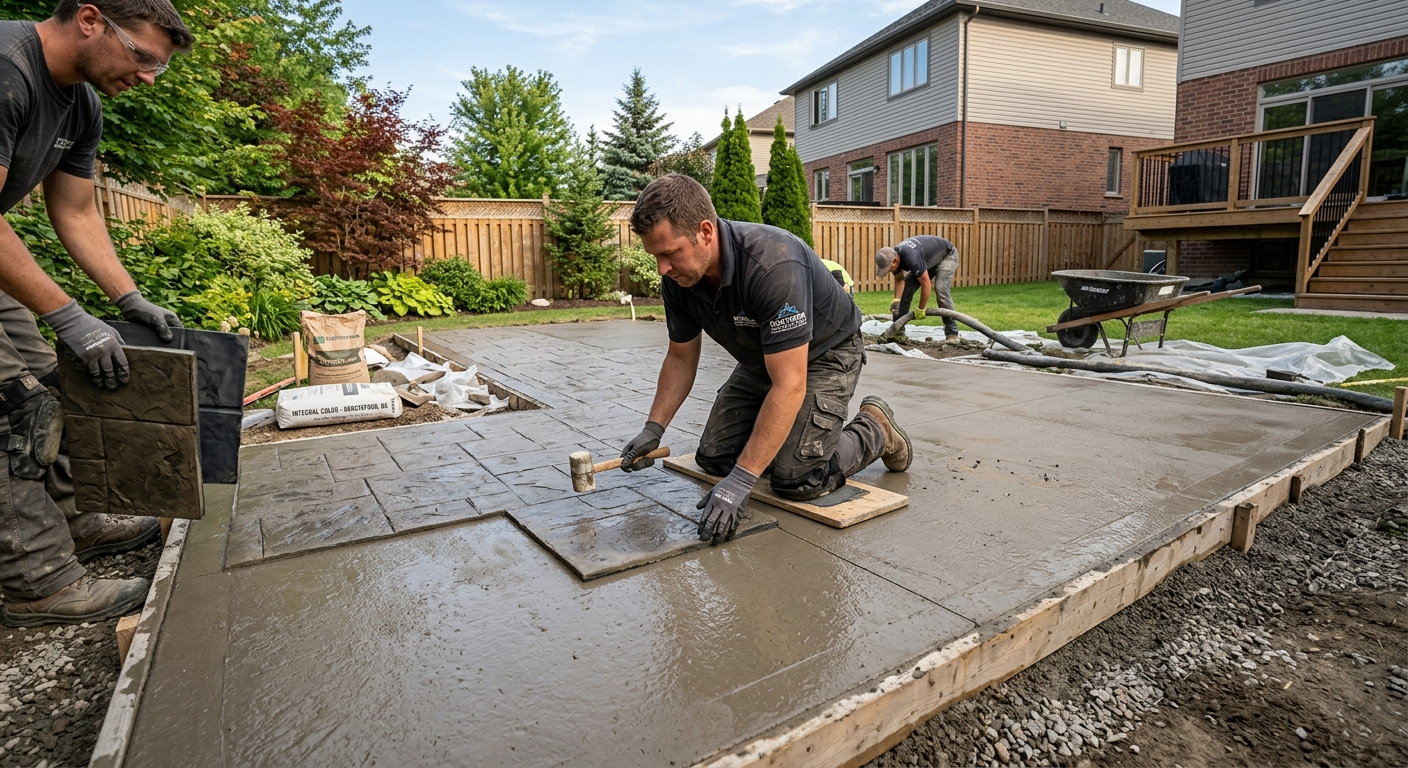
Concrete work options and costs in Little Mountain
Concrete work in Little Mountain is a little different than in the driest parts of Canada. With a population of 1,170 (Statistics Canada, 2021 Census), it’s a smaller market, and when multiple trades are busy in the Lower Mainland–Southwest—especially around busy spring paving windows—scheduling can affect concrete pricing. Also, this area’s housing stock is dominated by single-detached homes, which is exactly where we see the highest demand for driveway slabs, patios, and walkways that must survive wet winters and freeze–thaw cycling. (In the Lower Mainland–Southwest, we plan around a frost depth of about 450 mm / 18".)
Even though our winter weather is milder than interior BC, costs still swing because exterior concrete is exposed to heavy coastal rainfall, saturated soils, and repeated temperature changes. That drives the need for proper sub-base preparation, drainage attention, and air-entrained concrete with control joints. It also means crews often schedule around prolonged rain and cool nights, using curing blankets and sometimes sealers to protect the surface durability of driveways and patios.
In Little Mountain, we commonly see extra demand in the community’s more established residential pockets along the local roads and lane access where vehicle staging is limited—shorter truck access can add labour for moving forms and materials. With all that in mind, here are the typical price bands homeowners use as a starting point, and how the specs change depending on finish and structural requirements. Use the table to compare apples-to-apples, then we’ll break down the biggest cost drivers next.
| Application |
Typical Size |
Key Spec |
Finish Option |
Price Range |
| Concrete driveway (standard broom finish) |
400–600 sq. ft. |
Air-entrained mix, compacted granular base, control joints |
Broom finish |
$12,000–$17,000 |
| Exposed aggregate driveway |
400–600 sq. ft. |
Air-entrained mix, surface retarder or wash method, sealing recommended |
Exposed aggregate |
$14,500–$21,000 |
| Stamped concrete driveway or patio |
300–550 sq. ft. |
Air-entrained mix, proper base, color hardeners/guards |
Stamped + color |
$15,000–$26,000 |
| Plain concrete patio or walkway |
200–400 sq. ft. |
Air-entrained mix, drainage-grade base, joints as needed |
Light broom / smooth-trowel edge |
$4,000–$10,000 |
| Garage floor (interior slab) |
240–500 sq. ft. |
Vapour barrier where required, reinforcing as specified |
Broom finish or smooth power-trowel |
$9,000–$16,000 |
| Foundation footings (structural, below frost) |
Per linear foot equivalent |
Excavation below design frost, engineered steel placement as required |
Structural concrete |
$200–$350 |
Prices are estimates only and vary by project scope, site access and material selection.
What affects the price of concrete work in Little Mountain
Two homeowners can get quotes for the “same” concrete job and see a 30–50% difference, especially across the Lower Mainland–Southwest versus other parts of British Columbia. In the Vancouver–Surrey–Abbotsford corridor, labour demand, short weather windows for outdoor work when it’s raining, and strict durability specs for exterior slabs all push costs up. Meanwhile, colder regions can have deeper frost protection requirements and tighter seasonal schedules, but in our coastal-wet climate the drainage and curing requirements stay high even when temperatures aren’t extreme.
Here’s the reality: frost depth and freeze–thaw cycling dictate the design. In Lower Mainland–Southwest, typical code practice assumes a frost depth around 450 mm / 18", so footings and thickened edges are set below that to limit frost heave. Exterior slabs also require air-entrained concrete to handle freeze–thaw scaling, and proper control joints to manage shrinkage cracking. When the forecast is cool and wet, we add curing blankets and longer cure timelines so the concrete reaches design strength before it’s exposed to saturated conditions and temperature swings. De-icing salt later in winter can accelerate surface spalling if the concrete and finishing weren’t done for durability; that’s why sealing is often part of a good plan.
In Little Mountain, excavation and drainage can be the swing factor. If soils are saturated or the grade needs rebuilding, compacted granular base and sub-drain attention take more labour. If access is tight (common on older residential lanes with limited staging), forms and material handling add time. On the other hand, a straightforward broom-finished driveway might fit closer to the $18–$28 per sq. ft. band, while stamped work can land in the $22–$36 per sq. ft. range because of the added labour for stamping, coloring, and finishing consistency.
| Price Factor |
Why It Matters |
Cost Impact |
| Frost line depth — determines footing depth and form height |
Footings must be below the design frost depth to prevent frost heave |
Higher excavation and more forming, especially where grading is tricky |
| Site preparation — excavation, grading, compacted granular base |
Proper base thickness and compaction control settlement and surface cracking |
Can swing costs by adding truckloads, granular, and compaction time |
| Reinforcement — rebar or wire mesh requirement |
Supports slab performance and reduces cracking in driveways and garage floors |
More steel, tying, and chairing—often a labour-driven increase |
| Mix design — air-entrainment and compressive strength spec |
Air entrainment improves durability during freeze–thaw cycling |
Materials spec changes and quality control may raise concrete unit cost |
| Finish type — broom vs. stamped vs. exposed aggregate |
Finish method affects labour time, artistry, and finishing consistency |
Stamped/exposed typically costs more per sq. ft. than plain broom |
| Pour size and concrete truck access to site |
Short access can require smaller batches or extra handling |
Extra labour and sometimes additional truck trips |
| Cold-weather curing precautions — heating and blankets |
Cool, damp conditions can slow strength gain and increase surface issues |
Blankets, heaters, and longer monitoring add cost |
| Control joint pattern and sealing cost |
Joints control cracking; sealing helps resist salt and moisture |
Small line item that protects the finish and reduces callbacks |
Permits & regulations in British Columbia
In British Columbia, the key permit question is whether your concrete work is structural or whether it’s simply exterior flatwork. Structural concrete work—like footings, foundation walls, and grade beams—usually requires a building permit and often engineered drawings that get reviewed by the municipality or local building authority. Concrete flatwork such as patios, walkways, and typical driveways usually does not require a permit, unless it affects lot grading, stormwater/impervious surface limits, drainage, or the municipal right-of-way.
Before breaking ground in Little Mountain, confirm requirements with the local authority. Also verify the contractor carries liability insurance and Workers’ compensation coverage (WSIB/WCB). The fastest way to protect yourself is to ask for documentation up front and keep it with your quote.
Step-by-step homeowner checks in BC:
- Licensing/registration: find the contractor’s business listing on the applicable provincial online registry and confirm they’re eligible for the type of concrete work you’re hiring.
- Certificate of insurance: request a current certificate of insurance (COI) showing liability coverage and the job address or insured project location.
- Workers’ compensation clearance: ask for proof of WSBC coverage (or the contractor’s current clearance letter/number, depending on how they provide it).
- References: ask for recent projects similar in size and finish (driveway vs. stamped patio) and confirm they completed them on time.
- Ask who coordinates any required engineering/permits: if structural items are included, clarify who submits and who pays associated costs.
Getting concrete right in Little Mountain's freeze-thaw climate
Concrete failures in Little Mountain are usually about moisture and temperature cycling. When water gets into the surface or micro-cracks and then freezes, it expands. Over repeated freeze–thaw cycles, that leads to scaling and spalling—often blamed on “bad concrete,” but it’s typically a specification and execution issue. In the Lower Mainland–Southwest, we manage this by getting the base right, using the correct mix, controlling shrinkage cracking with joints, and curing properly through cool, wet conditions.
(1) Base preparation: we excavate and build a compacted granular sub-base to the correct depth for local soil and the frost-protection intent (with the frost depth expectation around 450 mm / 18" guiding footing/edge design below). (2) Mix design: exterior slabs should use air-entrained concrete—commonly in the 5–7% air range for durable exterior flatwork—so the paste can accommodate freezing water. We also target a minimum 32 MPa compressive strength per design/spec requirements for typical residential exterior work. (3) Control joints: spacing and saw-cut timing limit random cracking, which matters because cracks become pathways for water. (4) Curing: minimum 7-day curing under proper conditions is critical; in cool nights and high humidity, we use curing blankets and monitor conditions. (5) Sealing: applying a penetrating sealer after the cure period (often around 28 days) helps repel de-icing salts and reduces moisture uptake.
Ask your contractor: “What air content are you using, when will you cut the joints, and how will you protect curing if rain moves in?” For a $20–$24 per sq. ft. broom-finished driveway, the biggest “value” is usually not changing the appearance—it’s spending properly on base prep, air-entrained mix, and sealing. Stamped concrete can be worth the higher cost for look, but it should still be built on the same durable foundation approach, otherwise the surface won’t last.
| Spec |
Why It Matters in Little Mountain |
What to Ask For |
Impact if Skipped |
| Compacted granular base (depth?) |
Controls settlement and supports frost-resistance performance through wet soils |
Granular base thickness and compaction method documented on the plan |
Uneven settlement, cracking, and accelerated deterioration |
| Air-entrained concrete mix (target air %?) |
Improves freeze–thaw durability under coastal-wet moisture conditions |
Specified air content typically 5–7% for exterior flatwork |
Higher risk of scaling and spalling in winter |
| Compressive strength (MPa rating) |
Ensures the slab reaches durability and wear performance |
Minimum 32 MPa (or higher if specified by engineer/plan) |
Surface wear, poor strength gain, potential early failure |
| Control joints (spacing per ACI guidelines) |
Limits random cracking so water can’t penetrate as deeply |
Joint spacing, saw-cut timing, and finish treatment at edges |
Wider uncontrolled cracks and more moisture ingress |
| Minimum 7-day curing period |
Builds required strength under cool, damp Lower Mainland conditions |
How they protect curing in cool nights/rain (blankets/sealers timing) |
Weak surface layer and reduced long-term durability |
| Penetrating sealer (when applied after cure) |
Repels salts and reduces water uptake from freeze–thaw exposure |
Penetrating sealer schedule after cure (often around 28 days) |
More staining, moisture absorption, and faster scaling risk |
How to choose a concrete work contractor in Little Mountain
Choosing the right concrete contractor in Little Mountain is mostly about verifying competency and protecting yourself on paperwork. In British Columbia, confirm the contractor can legally perform the scope you’re hiring for by checking their business registration/eligibility on the provincial online registry (where applicable). Next, request a current certificate of insurance showing liability coverage. Finally, ask for proof of WSBC coverage (clearance letter/number or other accepted document) so you’re not exposed if a worker is injured on your property.
When you get quotes, don’t accept “lump sum only” numbers without the breakdown. Ask for 2–3 itemised, written quotes that show labour and materials components: excavation and grading, granular base, reinforcement, concrete supply, forms, finishing (broom/stamped/exposed aggregate), jointing, curing protection, and sealing (if included). Make sure the quote clearly lists what’s excluded—commonly tree cutting, permit/engineering coordination for structural work, disposal, saw-cutting existing slabs, or additional drainage corrections.
Warranty matters. Ask for the workmanship warranty length, what it covers (cracks under what conditions, surface scaling, settlement issues), and whether any product/manufacturer warranty is separate and transferable. Keep your payment schedule safe: never pay more than 10–15% upfront. Use a holdback until the job is complete, cured, and cleaned up as specified.
Also get the timeline in writing: anticipated start date and completion estimate, especially since Lower Mainland concrete often gets delayed by prolonged rain and cool nights. A contractor who won’t commit to a schedule is often guessing.
- Ask for references on similar-scale projects in the Lower Mainland–Southwest corridor.
- Require proof of liability insurance (COI) before work begins.
- Verify WSBC clearance/coverage is active for the project.
- Confirm whether permits are required for any structural items and who handles them.
- Insist on itemised quotes (labour + materials), not only a single total.
- Check if demolition disposal is included in the scope.
- Verify base prep details: granular depth, compaction, and drainage attention.
- Confirm mix spec: air-entrainment for exterior and target compressive strength.
- Ask who supplies and places rebar/wire mesh and chairing supports.
- Clarify jointing: saw-cut timing and spacing approach.
- Ask how curing will be protected if rain/cold weather hits.
- Get sealing included if you’re using de-icing salts; ask for application timing after cure.
Concrete contractor red flags in Little Mountain: quoting “standard mix” without mentioning air entrainment, skipping documented base depth/compaction, offering a lower price by reducing joints or reinforcement, refusing to provide COI/WSBC coverage, and starting without a written scope that clearly covers disposal, curing protection, and sealing responsibilities.
Frequently asked questions — concrete work in Little Mountain
What is air-entrained concrete and why does it matter here?
Air-entrained concrete is a mix designed to include tiny, evenly distributed air bubbles. Those bubbles act like pressure relief points when water inside the concrete freezes, which reduces surface cracking, scaling, and spalling during repeated freeze–thaw cycles. In Little Mountain and the broader Lower Mainland–Southwest, the climate may not be as harsh as inland BC, but the combination of coastal rainfall, saturated soils, and temperature swings still stresses exterior slabs. For that reason, exterior driveways and patios should be specified with air-entrainment (commonly around 5–7% air for exterior flatwork) and paired with proper curing and control joints. If a quote doesn’t clearly state air-entrainment for exterior work, it’s not an apples-to-apples comparison against a contractor priced closer to the $18–$28 per sq. ft. driveway band.
How do I prepare the base for a concrete slab?
Base preparation is where long-term performance is won or lost. A proper base starts with excavation to the correct depth, removing topsoil and soft material, and then building a compacted granular layer designed for support and drainage. In Little Mountain, we also pay close attention to grading so water can shed away from the slab, because saturated subgrade increases risk of freeze–thaw movement. The contractor should specify the granular base thickness, compaction method, and whether they’re allowing drainage or subgrade stabilization where needed. Don’t just ask “is there gravel?”—ask how deep it is and how they verify compaction. When those specs are clear, you’re more likely to get a driveway or patio price in line with the local bands like $16–$26 per sq. ft. for plain patios/walkways.
How do I compare concrete quotes?
To compare quotes in British Columbia fairly, insist they include the same scope details and specifications, not just the final total. Ask for an itemised breakdown covering excavation, granular base, reinforcement, concrete mix requirements (including air-entrainment for exterior), formwork, finish method, jointing plan, curing protection, and sealing (if applicable). Pay attention to what’s excluded: demolition disposal, permit/engineering coordination for structural items, surface grinding, patching existing slabs, and any drainage corrections. Also look at the finish type because it drives labour—stamped work often costs more than a broom finish, commonly aligning with the $22–$36 per sq. ft. stamped/decorative band. If one quote is far lower, it may be cutting corners on base depth, air content, or curing/thermal protection. The safest approach is to compare “spec per spec,” not “price per spec.”
Can concrete be poured in cold weather in Little Mountain?
Yes, concrete can be poured in cold weather in Little Mountain, but the contractor must manage curing and temperature properly. Cool nights and high humidity can slow strength gain, which means the slab needs protection—often curing blankets and sometimes controlled heating—until it reaches safe strength. The bigger risk isn’t that concrete can’t be poured; it’s that it can be poured without maintaining curing conditions, especially when rain moves in. Ask your contractor how they monitor air and slab temperature, whether they use insulation/blankets, and what their minimum curing expectations are. A responsible crew will plan around forecast windows and explain how they’ll protect exterior surfaces. If you’re comparing driveway options priced around $18–$28 per sq. ft., the “cheap” quote might not budget for cold-weather curing precautions that protect durability.
How do I maintain concrete in Little Mountain's freeze-thaw climate?
Maintenance is mostly about controlling moisture and reducing chemical exposure from winter. Start with sealing: a penetrating sealer applied after the cure period (commonly around 28 days) helps repel water and reduces the impact of de-icing salts. Keep gutters and downspouts directing water away from the slab, and avoid piling snow in the same spot repeatedly. If you see small cracks, don’t ignore them—addressing water intrusion early is cheaper than waiting for spalling. Use de-icing products responsibly; harsh salt can increase surface wear if the slab isn’t sealed or if the air-entrainment and curing weren’t done correctly. For patios and walkways, periodic cleaning with the right methods and inspecting joints for gaps helps manage water pathways. In a wet freeze–thaw environment like Little Mountain, good sealing and drainage can extend the life of both plain broom and decorative finishes.
What causes concrete to spall in Little Mountain winters?
Spalling—where small flakes or chips break off the surface—usually comes from water getting into the concrete and freezing repeatedly, expanding and weakening the surface. In Little Mountain, that’s often driven by a combination of saturated conditions, freeze–thaw cycling, and weak surface durability. The most common technical causes are inadequate air-entrainment (too little air means less freeze tolerance), poor curing in cool/wet conditions, insufficient base/drainage leading to water pooling, or control joints being missed so cracks open and let water in. De-icing salts can accelerate the issue by increasing chemical attack on the surface. If you’re shopping for a driveway or patio, tie spalling risk to specs: ask for air-entrained exterior concrete, proper joint spacing, and sealing timing. A contractor who can explain these details—and backs it with a complete scope—should feel confident whether your project lands closer to the broom driveway band ($18–$28) or decorative finishes.