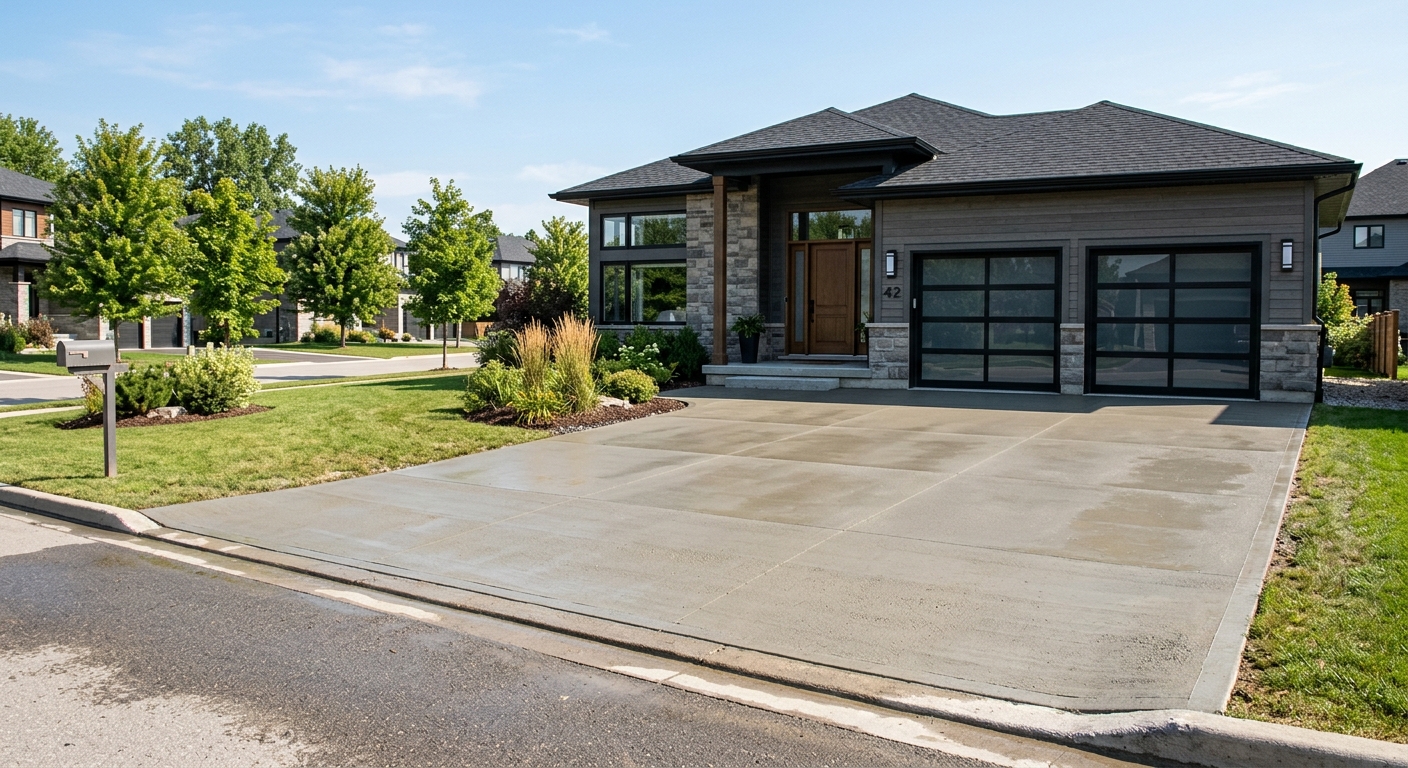
Concrete work options and costs in Arbutus Ridge
Concrete work in Arbutus Ridge, British Columbia is a little different from inland BC because the Lower Mainland–Southwest climate brings frequent freeze–thaw cycles, coastal-wet conditions, and long wet curing periods. That affects everything from base prep to curing blankets, so “the same” driveway can price out quite differently between contractors. In Arbutus Ridge, the primary market for exterior flatwork is typically single-detached and larger lot properties, and the broader Lower Mainland region is supported by a sizable population base (15,295 residents in Arbutus Ridge, per the Statistics Canada, 2021 Census). When demand is steady—especially in neighbourhoods where accessibility and drainage are tight—labour availability and excavation logistics can shift the final cost.
In this area, codes and typical practice assume a frost depth around 450 mm (about 18") for many residential details, but footings and thickened edges are often placed below frost to reduce frost heave risk. Expect crews to design around saturated soils and to use air-entrained mixes and proper control joints for patios, walkways, and driveways. Rain timing also matters: if a pour is scheduled during extended cool, humid stretches, concrete may need additional curing management to achieve durable surface performance.
Below is a practical comparison of common concrete options—use it as a baseline before you request itemised quotes.
| Application |
Typical Size |
Key Spec |
Finish Option |
Price Range |
| Concrete driveway (standard broom finish) |
20 m² (about 215 ft²) |
4" (100 mm) slab, rebar or mesh, air-entrained |
Broom finish + control joints |
$1,200 – $5,600 |
| Exposed aggregate driveway |
20 m² (about 215 ft²) |
5" (125 mm) slab, proper base compaction |
Exposed aggregate (spray/ wash process) |
$3,000 – $7,800 |
| Stamped concrete driveway or patio |
25 m² (about 270 ft²) |
4" (100 mm) slab, air-entrained, release agent system |
Stamped pattern + integral colour |
$4,500 – $10,500 |
| Plain concrete patio or walkway |
15 m² (about 161 ft²) |
4" (100 mm) slab, control joints |
Power trowel light finish or broom edge |
$1,800 – $4,400 |
| Garage floor (interior slab) |
25 m² (about 270 ft²) |
4" (100 mm) slab, vapour strategy as needed |
Smooth trowel or broom finish |
$3,500 – $9,000 |
| Foundation footings (structural, below frost) |
Per project (typ. 1–2 homes) |
Below frost depth, reinforced, engineered as required |
Formed/finished surfaces as specified |
$12,000 – $28,000 |
Prices are estimates only and vary by project scope, site access and material selection.
What affects the price of concrete work in Arbutus Ridge
In Arbutus Ridge and across the Lower Mainland–Southwest, you can see the same driveway or patio priced 30–50% apart because the quote isn’t just “concrete.” The real drivers are excavation depth and drainage details, the engineered base thickness, reinforcement choices, and how a contractor manages cold, wet curing. Even though the Lower Mainland generally has mild winters compared with interior BC, frost protection still matters—footings and thickened edges must be placed below the local design frost depth (practice commonly around 450 mm / 18"). Coastal rainfall also means base prep and drainage work can be more labour-intensive than homeowners expect.
Freeze–thaw cycles dictate every exterior spec. Contractors typically use air-entrained concrete mixes and correct control joint spacing to manage cracking and scaling from repeated moisture movement. If a contractor is short on crew time or schedules in the wrong rain window, they may need additional curing measures—curing blankets, sealers, and longer cure management—which adds cost but improves durability. Also, de-icing salts (even on coastal streets) can accelerate surface spalling if the mix and surface protection aren’t right, so sealing is more than an aesthetic add-on.
Concrete costs can move up or down based on a few Arbutus Ridge realities. A sloped lot may require heavier grading and more granular replacement, and tight access can increase pump or skid-steer time. If you’re comparing a standard broom driveway versus stamped work, the difference is often justified: stamped and decorative systems can land closer to the concrete patio/ walkway band of $16–$26/m² and the decorative/stamped band of $22–$36/m², depending on pattern complexity and finishing labour. If your existing base is already well-compacted and you’re staying with a plain finish, you may stay closer to the lower end of $18–$28/m² for driveways rather than paying for extra excavation and specialised finishing.
| Price Factor |
Why It Matters |
Cost Impact |
| Frost line depth — determines footing depth and form height |
Footings and thickened edges must sit below the frost risk zone to prevent heave |
Can add forming and excavation time; often one of the biggest variability items |
| Site preparation — excavation, grading, compacted granular base |
Saturated or poorly graded soils require removal and engineered base to support the slab |
Higher if access is tight, soil is soft, or drainage upgrades are required |
| Reinforcement — rebar or wire mesh requirement |
Exterior slabs need crack control and structural support under traffic loads |
Cost rises with additional steel and proper tie/spacing labour |
| Mix design — air-entrainment and compressive strength spec |
Air entrainment and strength targets are key for freeze–thaw and durability |
Usually moderate material cost, but can shift labour/cure approach |
| Finish type — broom vs. stamped vs. exposed aggregate |
Decorative work is labour-intensive and requires timing and system materials |
Stamped/exposed typically higher than broom; colour/pattern complexity matters |
| Pour size and concrete truck access to site |
Smaller access-restricted pours may require extra set-up time or pumping |
Delays and logistics can add labour and equipment charges |
| Cold-weather curing precautions — heating and blankets |
Cool, humid weather still needs protected curing for strength and surface quality |
Higher if night temperatures drop or forecasts require blanket scheduling |
| Control joint pattern and sealing cost |
Joints manage shrinkage cracking; sealing helps repel de-icing salts |
Often small line-item but makes a measurable durability difference |
Permits & regulations in British Columbia
In British Columbia, structural concrete work—think footings, foundation walls, grade beams, and other elements that support the structure—typically requires a building permit, and engineered drawings are often reviewed as part of the permit process. For concrete flatwork—driveways, patios, and walkways—a permit is usually not required by default. However, permits can become necessary if the work affects lot grading, changes impervious surface coverage beyond local limits, or impacts municipal right-of-way (for example, tying into a boulevard or altering drainage in a way the municipality regulates). Before you start in Arbutus Ridge, confirm requirements with the local authority.
Also verify your contractor’s credentials. Step one: ask for their certificate of liability insurance and confirm it covers your type of job and work location. Step two: confirm they’re properly registered for the work they perform and that they carry the required coverage for workers; in BC, that typically means ensuring WCB coverage is active for their employees. Step three: request references on similar-scale residential concrete work (driveways, patios, and foundation packages) and ask to see recent results in wet-coastal climates.
To verify, you’ll generally look online for contractor registration/license status where available, then request a current insurance certificate (COI) and any clearance documentation if applicable. If anything can’t be produced quickly, that’s a red flag.
Getting concrete right in Arbutus Ridge's freeze-thaw climate
In Arbutus Ridge, concrete failures usually come from water management problems: poor base prep, insufficient air entrainment, and curing shortcuts that leave concrete vulnerable to freeze–thaw damage and surface scaling. To spec the job correctly, start with base preparation: compacted granular sub-base to the right depth for local soil conditions so the slab doesn’t pump or settle. Next is the mix design—exterior flatwork should use air-entrained concrete (commonly targeting about 5–7% air) and a minimum 32 MPa compressive strength so it can withstand repeated wetting and cooling.
Third, control joints matter. They’re not cosmetic—they’re how you control where cracking happens so it doesn’t become random, stress-driven cracking paths. For curing, plan on at least 7 days under suitable conditions; in coastal BC, cool nights and high humidity can slow strength gain, so contractors often use curing blankets when temperatures dip or when rain threatens the early surface. Finally, sealing helps. For driveways and patios that see de-icing salts and coastal moisture, apply a penetrating sealer after the cure period (often around 28 days) to repel salts and reduce water ingress.
Ask tough questions about spalling prevention. If a contractor can’t explain air entrainment, joint spacing, and curing protection, you’re taking a gamble. For example, spending more on a properly air-entrained broom-finish driveway (often within the $18–$28/m² band) is usually better value than trying to “save” on mix specs and then paying again after surface scaling. Stamped work is higher—often closer to the $22–$36/m² decorative band—but the cost is justified when the contractor follows the full system: base, mix, jointing, and timed finishing.
| Spec |
Why It Matters in Arbutus Ridge |
What to Ask For |
Impact if Skipped |
| Compacted granular base (depth?) |
Prevents pumping, settlement, and water trapping under the slab |
Base thickness and compaction method; drainage plan for wet soils |
Premature cracking, uneven slab, and accelerated freeze–thaw damage |
| Air-entrained concrete mix (target air %?) |
Air voids protect against freeze–thaw scaling and spalling |
Target air content around 5–7% for exterior flatwork |
Higher chance of surface scaling/spalling after winter wetting cycles |
| Compressive strength (MPa rating) |
Ensures the concrete reaches durable strength despite cool, wet curing |
Minimum 32 MPa (typical exterior flatwork spec) |
Reduced durability and strength gain; surface wear and cracking risk |
| Control joints (spacing per ACI guidelines) |
Controls shrinkage cracking locations in a moisture-changing climate |
Joint spacing plan and whether saw-cut or formed joints are used |
Random cracks, water infiltration, and joint-edge deterioration |
| Minimum 7-day curing period |
Cold nights and high humidity slow curing without protection |
Curing method (blankets/sealer timing) and temperature monitoring plan |
Weak surface, poor finish durability, and higher long-term scaling risk |
| Penetrating sealer (when applied after cure) |
Helps repel de-icing salts and reduces water ingress in coastal-wet conditions |
Confirm sealer type and timing (commonly after ~28 days cure) |
More rapid surface deterioration and easier staining/spalling pathways |
How to choose a concrete work contractor in Arbutus Ridge
Choosing the right concrete contractor in Arbutus Ridge starts with verifying credentials and then tightening up your paperwork. In British Columbia, ask for (1) proof of liability insurance—so you’re covered if something is damaged on-site—(2) confirmation of worker coverage (commonly WCB coverage for employees), and (3) a clear explanation of who pulls any required permits for your scope. The practical check is simple: request a current certificate of insurance (COI) and ensure the policy is active and matches the work type and location. For worker coverage, ask for proof of active WCB status; reputable crews provide it without friction.
Next, don’t accept a vague lump sum. Get 2–3 itemised written quotes with separate line items for excavation/grading, granular base, reinforcement, concrete supply (including air-entrained mix details), finishing, and any curing/sealing allowances. Ask what’s excluded: is haul-away/disposal included for excess soil? Is saw-cutting included after curing? Is the sealer included and when will it be applied? Confirm whether permits (if required) are included or billed separately.
For warranty, look for a workmanship warranty length that’s in writing and ask whether it transfers if you sell the home. Payment should be staged: never pay more than 10–15% upfront, and use a holdback until completion and cleanup. Finally, get a start date and completion estimate in writing, not just a “we’ll be around soon” plan.
- Ask for COI showing liability coverage and correct project address
- Confirm WCB coverage status for the contractor’s employees
- Get an itemised quote (labour, materials, equipment, disposal)
- Demand mix details: air entrainment and minimum strength
- Verify base prep: granular thickness, compaction method, drainage notes
- Confirm reinforcement plan (rebar size/spacing or mesh type)
- Check finish spec: broom, stamped system, exposed aggregate process
- Ask about curing method: blankets/sealer timing if cool nights occur
- Confirm control joint spacing and whether joints are cut/saw-cut
- Clarify whether sealing is included and when it’s applied
- Review payment schedule: limit upfront and hold back at practical milestones
- Ask for recent photos or references from Lower Mainland–Southwest wet-coastal sites
Concrete contractor red flags in Arbutus Ridge include: refusing to discuss air-entrained mix targets, quoting without any base thickness or compaction details, no mention of joints and sealing, asking for most payment upfront, and providing only verbal schedules without a written start/completion window.
Frequently asked questions — concrete work in Arbutus Ridge
How long does a concrete driveway last?
A well-built concrete driveway in Arbutus Ridge can last a long time—often 20–30 years or more—when the base is properly compacted, the concrete is air-entrained for freeze–thaw protection, and control joints are done on time. In the Lower Mainland–Southwest, the big enemies are not just cold, but wetting and drying plus winter freeze–thaw cycling. If sealing is neglected and de-icing salts hit unprotected surfaces, you can see scaling and spalling sooner. Quality also depends on drainage at the edges and preventing water from pooling under the slab. For budgeting, homeowners often start with the driveway price band of $18–$28/m², but choosing the “cheapest” mix or skipping curing protection can shorten service life. Always ask what the contractor includes for base prep, air entrainment, joint spacing, and curing.
What is air-entrained concrete and why does it matter here?
Air-entrained concrete is designed to include tiny, evenly distributed air voids that give freezing water a place to expand. In Arbutus Ridge and the broader British Columbia coastal-wet climate, that matters because freeze–thaw cycles repeatedly stress the surface and paste. Without proper air entrainment, water can freeze inside the concrete pores, leading to scaling and spalling—especially when de-icing salts are used and when water is trapped by poor drainage. That’s why exterior slabs typically need air entrainment and control joints, plus correct curing so the concrete develops strength under cool, damp conditions. When you compare quotes, don’t accept “standard concrete” wording—ask for air-entrainment targets (commonly about 5–7% air for exterior flatwork) and whether the contractor will use appropriate mix and curing steps for wet coastal timing. This is one of the most important decisions that protects your investment.
How do I prepare the base for a concrete slab?
Base preparation is the foundation of durability for driveways and patios. In Arbutus Ridge, the contractor should excavate to a consistent depth, remove unsuitable material, and install a compacted granular base that’s thick enough for local soil and frost protection. You also want attention to drainage: saturated subgrade can pump or settle, leading to uneven slabs and cracking. For homeowners, the most practical way to compare contractors is to require the quote to state granular thickness/grade, compaction method, and how they’ll handle wet conditions during excavation and forming. A good contractor will also plan for where water will go after the pour (especially at edges near lawns or downslopes). If you’re seeing quote gaps in the $18–$28/m² driveway band, base prep details are usually a big part of why. Don’t skip discussing drainage, because it’s directly connected to freeze–thaw performance.
How do I compare concrete quotes?
Start by asking for itemised quotes—not just a lump sum. Compare line items for excavation/grading, granular base, reinforcement (rebar size/spacing or mesh type), concrete supply (including air-entrained mix and minimum compressive strength), formwork, finishing, and any curing/blanket or sealing allowances. In the Lower Mainland–Southwest, scheduling around prolonged rain and cool nights affects curing time; you should see what the contractor includes for weather protection. A quote that’s much cheaper than others often omits one of these: proper air entrainment, joint cutting plan, curing management, or a specified base thickness. Also compare access and disposal: is haul-away of excess soil included? Are you paying extra for pumping due to truck access? For price context, stamped/decorative driveways often land above the basic driveway band (while standard driveway pricing is commonly $18–$28/m² in this tier). If one contractor offers a stamped price closer to standard, ask what finish system and curing steps are actually included.
Can concrete be poured in cold weather in Arbutus Ridge?
Yes, concrete can be poured in Arbutus Ridge during colder periods, but it requires the right cold-weather controls. Even in the Lower Mainland–Southwest where winter is milder than interior BC, cool nights and high humidity can slow strength gain and increase early-age risk if concrete is exposed too quickly. That’s why reputable crews plan temperature protection: insulated curing blankets, controlled curing time, and sometimes concrete delivery management (so it doesn’t sit on-site). They should also discuss how they’ll protect the slab edges and ensure curing conditions are maintained long enough to reach strength. The key is that cold-weather procedures cost labour and materials—so quotes may be higher when pouring outside ideal seasonal windows. If a contractor says they’ll pour regardless of forecast without blankets/heating or without specifying curing protection, that’s a concern. Ask how they’ll handle curing through cool nights and what minimum curing period they’ll guarantee before the surface is exposed to rain.
How do I maintain concrete in Arbutus Ridge's freeze-thaw climate?
Maintenance in Arbutus Ridge is mostly about water control and surface protection. After the concrete cures, consider a penetrating sealer (often applied after about 28 days) to reduce water ingress and help protect against de-icing salts. Clean spills quickly and avoid blasting sandblaster-style abrasion that can open the surface. If you use de-icing products, use them appropriately and don’t overuse rock salt—excess salts can speed surface deterioration. Keep drainage pathways clear so water doesn’t pool at slab edges; poor edge drainage is a common trigger for freeze–thaw damage. Also, inspect control joints annually: if joints are filled with debris, water can migrate differently during wet cycles. Minor issues can sometimes be patched early before they become larger spalls. If you want long-term durability, the combination that matters is: correct original air entrainment, proper joints, good curing, and timely sealing. That’s the same approach contractors follow when pricing exterior flatwork in the $16–$26/m² patio/walkway band or $18–$28/m² driveway band, because durability specs are built into those costs.